Published on: 2026-06-30
Updated on: 2026-06-30
EWY and DRAM ETF approach the same 2026 AI memory trade from opposite directions, which is why they have become two of the clearest U.S.-listed ways to express it.
The iShares MSCI South Korea ETF (EWY) now leans heavily on Samsung Electronics and SK Hynix. The Roundhill Memory ETF (DRAM) is built around the memory cycle those two help drive, alongside HBM, DRAM, NAND and SSD names worldwide. The shared pressure point is a single question: how much of the boom is already in the price.
Both funds move on the same memory headlines, yet they are built around different cores. EWY is a Korea fund that happens to be about half memory. DRAM is a memory fund that happens to be about half Korean. The real question is not which ETF is better, but which set of risks an investor takes on around the part the two share.
EWY is a Korea ETF with heavy memory exposure, while DRAM is a memory ETF with only partial Korea exposure.
EWY’s risk begins with Samsung, SK Hynix, the won and foreign flows. DRAM’s risk begins with HBM pricing, memory-cycle earnings and total return swap structure.
Samsung and SK Hynix explain the overlap, but the rest of each portfolio explains the difference.
EWY runs at 57% information technology inside a 100% Korea fund. DRAM is almost entirely memory, yet only about half Korean.
The question is whether an investor wants Korea exposure with chip leadership, or memory exposure with less country concentration.
| Factor | EWY | DRAM ETF |
|---|---|---|
| Fund type | South Korea equity ETF | Global memory and storage ETF |
| Main exposure | Korea large caps | HBM, DRAM, NAND, SSD and storage |
| Expense ratio | 0.59% | 0.65% |
| Shared core | Samsung, SK Hynix | Samsung, SK Hynix |
| Samsung and SK Hynix weight | More than 52% combined: SK Hynix 28.47%, Samsung 23.70% | Part of a top-three weight near three-quarters, with Micron |
| Sector and country profile | 57% information technology, 100% Korea | Mostly memory, roughly half Korea |
| Structure | Standard equity ETF | Active ETF using total return swaps |
| Main upside driver | Korea rally broadens while chips stay strong | Memory pricing and HBM demand stay firm |
| Main risk | Won, foreign flows, Korea concentration | Memory cycle, liquidity, swaps, theme crowding |
EWY's 2026 run is the backdrop. iShares put the fund's NAV total return at 100.57% as of 26 June. For much of that rally, EWY carried a second job. Samsung and SK Hynix trade primarily in Seoul and have historically lacked straightforward U.S.-listed access, so a Korea ETF became the practical proxy for the country's memory leaders.
DRAM ETF, launched on 2 April 2026, gave that trade a dedicated wrapper. The result is not a replacement story. It is a cleaner distinction between country exposure and memory exposure.
EWY remains the broader Korea vehicle, and DRAM is the narrower memory one. Both react to the same Samsung or SK Hynix headline, but investors are not buying the same portfolio.
EWY tracks the MSCI Korea 25/50 Index, held $24.12 billion in net assets as of 29 June, charges 0.59%, and traded with a 30-day median bid-ask spread near 0.04%. That liquidity makes it one of the main U.S.-listed routes into South Korean equities.
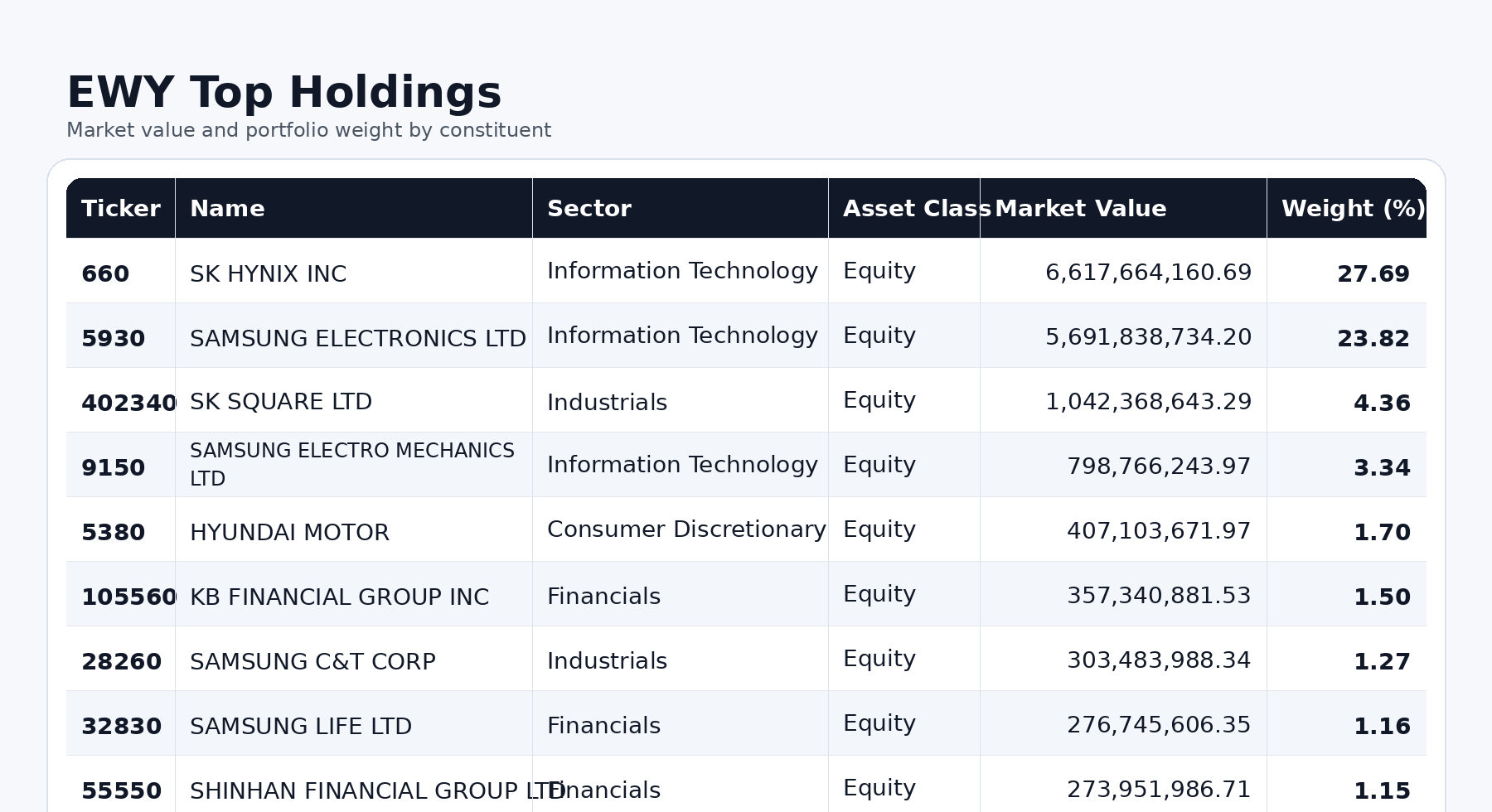
The tilt sits in the holdings. Information technology made up 57.00% of market value as of 26 June, ahead of industrials at 18.72% and financials at 8.61%. Latest holdings data showed SK Hynix at 28.47% and Samsung at 23.70%, putting more than half the fund in two names, with the top 10 positions at 67.54%.
That dual nature cuts both ways. EWY can gain if Korea's rally broadens into financials, industrials, autos or defense, areas that do not move with memory pricing, but it also carries risks unrelated to chips: the won, foreign equity flows, domestic policy and index rebalancing. EWY is not a semiconductor ETF, but its return engine has become chip-heavy.
DRAM is actively managed, charges 0.65%, and ranks among the fastest ETF launches on record, reaching $6.5 billion in about 27 trading days and briefly standing above $20 billion during the late-June surge before the memory pullback cut the reported asset base. Its mandate spans high-bandwidth memory, DRAM, NAND, SSDs, NOR flash, hard disk drives and embedded memory.
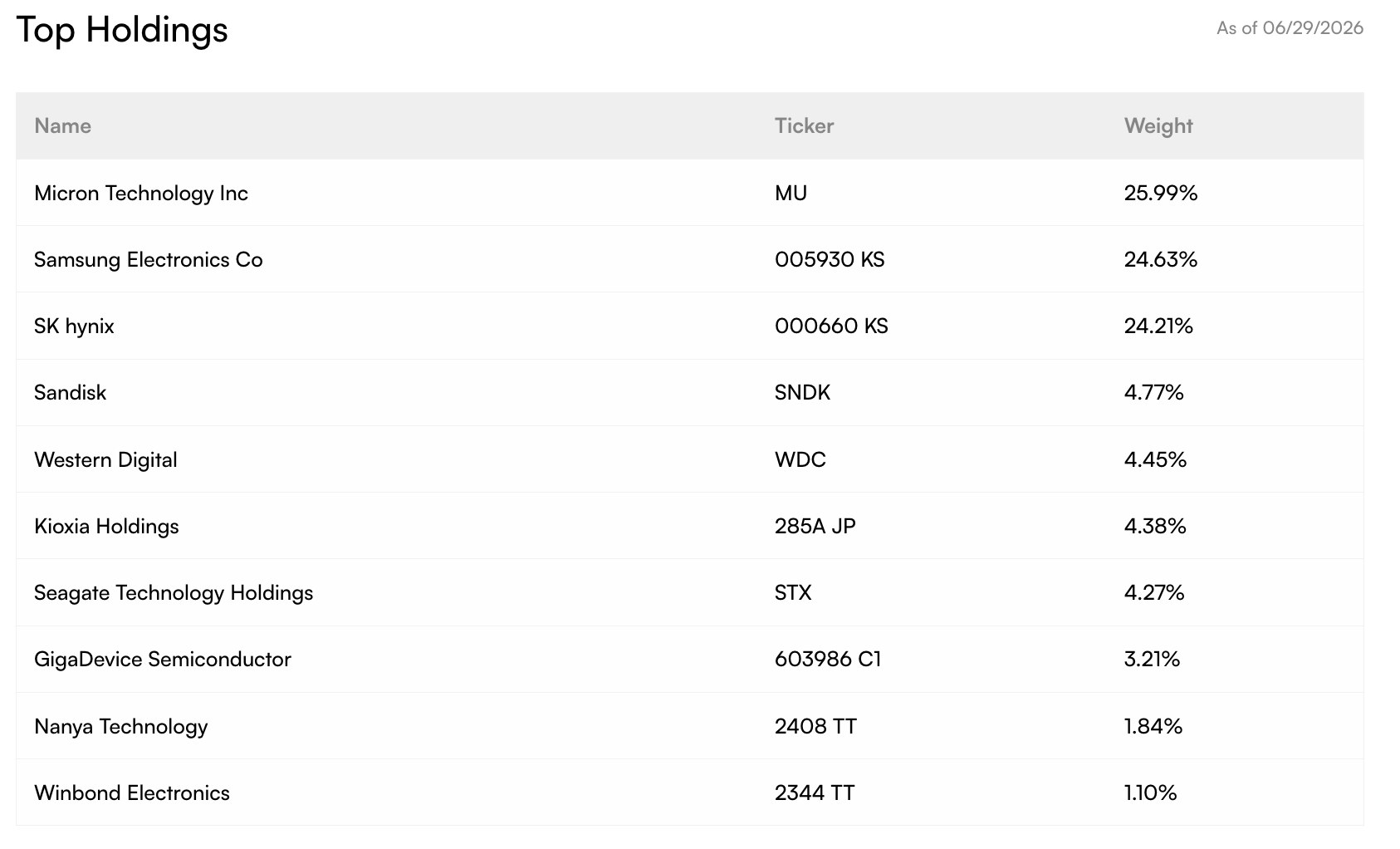
The composition is the most overlooked part. Samsung, SK Hynix and Micron made up about 73% of DRAM at launch and still account for roughly three-quarters of current economic exposure once direct equity and swap positions are combined.
South Korea is about half the fund through Samsung and SK Hynix, while the United States adds a large block through Micron, SanDisk, Western Digital and Seagate, with smaller positions in Taiwan (Nanya, Winbond) and Japan (Kioxia).
Those swap positions, linked to Micron, Samsung and SK Hynix, are how Roundhill stays within regulated investment company diversification limits. DRAM gives cleaner memory exposure than EWY, but that clean exposure strips out most non-memory offsets. It is more direct, not automatically safer.
Samsung and SK Hynix are the reason the comparison exists. EWY owns them because they dominate the Korean index. DRAM owns them because they dominate the memory theme. In EWY they are more than half the fund. In DRAM they anchor the top three alongside Micron, the main U.S. read-through on memory pricing.
SK Hynix has made the overlap more visible. It briefly overtook Samsung as South Korea’s most valuable listed company in June on demand for HBM exposure, and reported first-quarter 2026 revenue of 52.5763 trillion won and operating profit of 37.6103 trillion won, equal to a 72% operating margin.
1) EWY risk. The downside is Korea as much as chips: the won, foreign-flow reversals, domestic policy and KOSPI concentration, with Samsung and SK Hynix able to move the fund on their own. On 23 June the KOSPI fell 9.99% and triggered circuit breakers as both stocks dropped more than 12%, a reminder that country-level shocks land directly here.
2) DRAM risk. The downside is the memory cycle in concentrated form: HBM pricing, AI hardware demand and Micron guidance, with little outside the theme to absorb a turn. The swap structure introduces counterparty exposure, and the narrower holdings leave less liquidity flexibility than a large country fund.
3) Shared risk. Any reversal in AI hardware sentiment can pressure both funds. The same memory strength that lifted them, with TrendForce raising its first-quarter 2026 conventional DRAM contract-price outlook to a 90% to 95% quarter-on-quarter increase and projecting NAND flash up 55% to 60%, has also pushed expectations higher, leaving less room for disappointment.
HBM contract pricing and any shift in the DDR5 trend
Samsung HBM qualification progress
SK Hynix capacity guidance
Micron earnings and margin outlook
USD/KRW
Foreign buying in Korean equities
Whether KOSPI breadth holds beyond chips
SK Hynix’s planned Nasdaq ADR listing on 10 July, which could widen direct access to the stock
DRAM bid-ask spreads and asset stability
DRAM swap exposure
EWY concentration changes after index rebalancing
EWY's next test is whether Korea's rally can broaden beyond Samsung and SK Hynix. The fund has already delivered a NAV total return above 100% in 2026, so additional upside depends on either continued memory strength or stronger participation from financials, industrials, autos and defense.
Without broader market breadth, EWY remains vulnerable to the won, foreign-flow reversals and profit-taking in the two chip leaders.
DRAM's test is narrower. The fund benefits most when HBM demand stays tight, DDR5 and NAND pricing remain firm, and Micron's earnings confirm the same supply shortage visible in Korea. Its weakness is the absence of non-memory offsets.
If contract prices flatten or AI hardware spending slows, the same concentration that gave DRAM cleaner upside can accelerate the downside.
The clean comparison is that EWY needs either Korea breadth or chip leadership, while DRAM needs the memory cycle to stay tight. Samsung and SK Hynix link both funds, but the confirmation signals are different.
EWY and DRAM ETF look like two routes to one trade, and in part they are. Both rise and fall with Samsung, SK Hynix and the memory cycle.
What separates them is the company they keep. EWY surrounds that core with the rest of South Korea, its banks, carmakers, industrials and the won. DRAM surrounds it with the rest of the global memory chain, Micron, the NAND makers and the storage names, plus the swap structure that holds the basket together.
That is why the two are a choice rather than a pair. Owning both does not spread the bet, it deepens it, because the shared core is the heaviest position in each fund. The deciding question is not which one returns more, but which secondary risk an investor would rather hold when memory stops doing the heavy lifting: Korea's currency and foreign flows, or DRAM's concentration and structure.