Published on: 2026-05-12
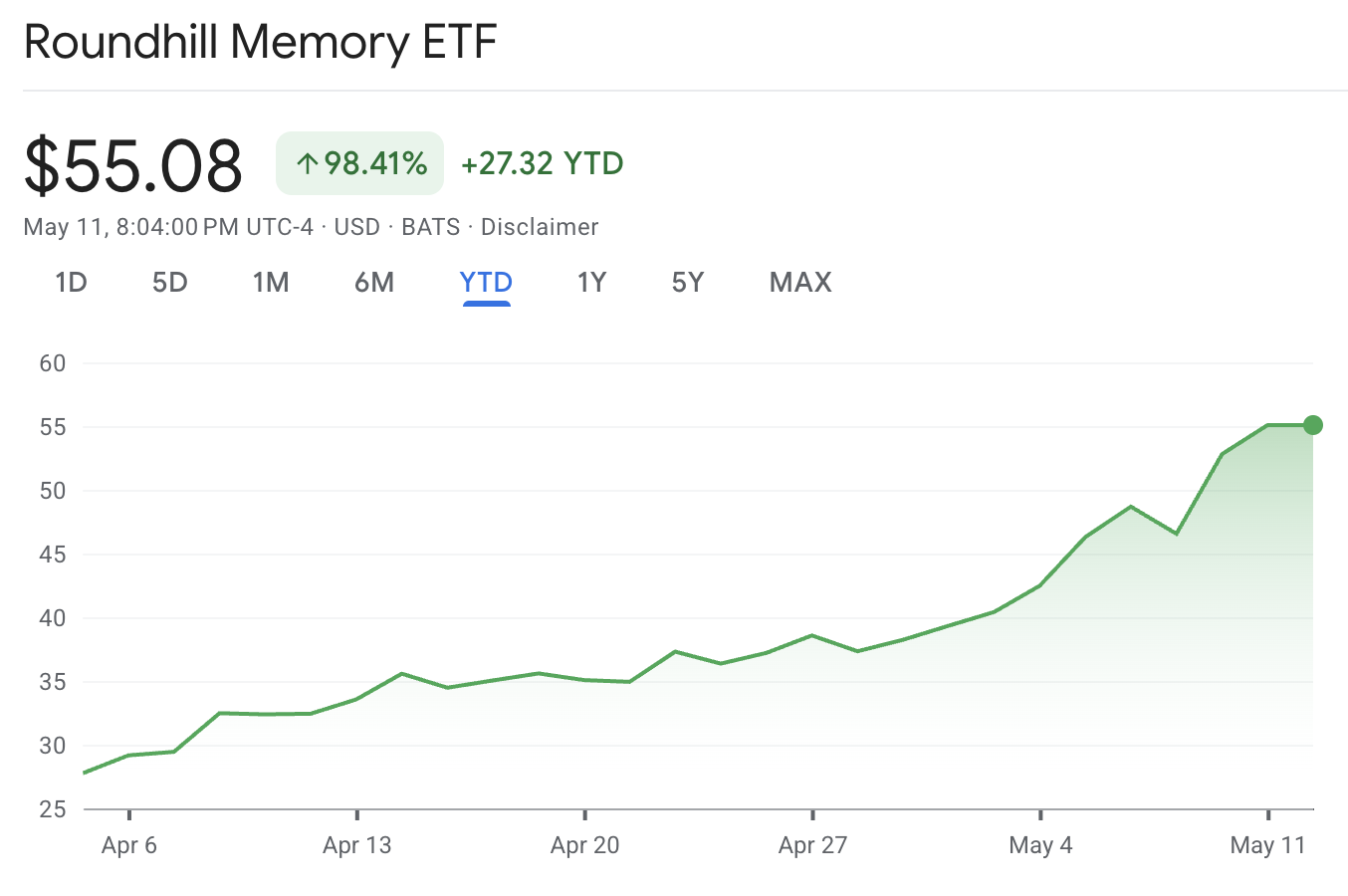
Less than six weeks. That is how long it took the DRAM ETF to nearly double.
Launched on 2 April 2026, the Roundhill Memory ETF, ticker DRAM, became one of the year’s most explosive ETF debuts, crossing $1 billion in assets after 10 trading days and $5 billion after 25. The speed of those inflows revealed more than enthusiasm for semiconductor stocks; it showed investors repricing a less visible constraint in the AI boom.
As the market looks beyond the fastest processors, memory has become the next pressure point. High-bandwidth memory, DRAM, NAND flash and enterprise storage now sit closer to the economics of AI data-center expansion, giving the DRAM ETF a sharper role than a broad semiconductor fund.
A DRAM ETF is best understood as a targeted AI memory stocks fund, not a diversified technology fund.
Its core exposure sits in HBM, DRAM, NAND flash, SSDs and other storage technologies used in AI data centers.
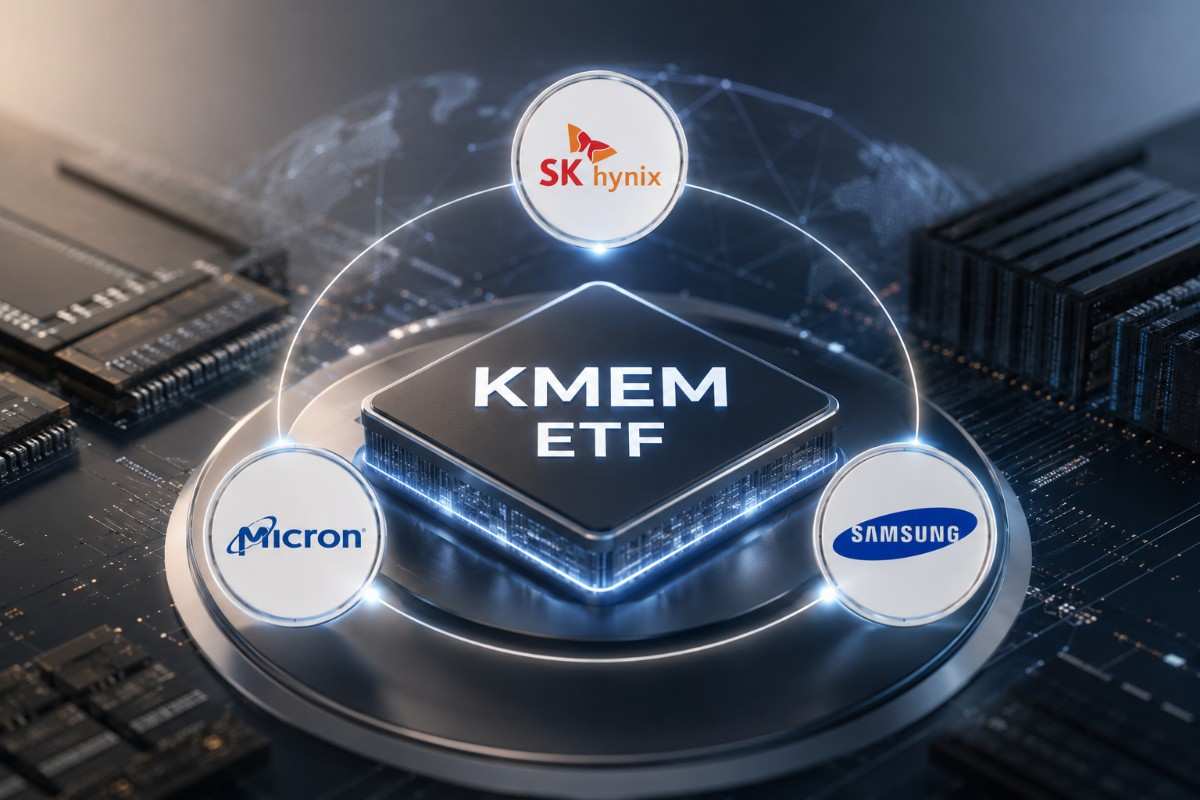
The launch portfolio was highly concentrated, with Samsung, SK Hynix and Micron representing more than 70% of listed holdings.
DRAM’s 0.65% expense ratio is higher than established semiconductor ETFs such as SMH at 0.35% and SOXX at 0.34%.
The opportunity is memory scarcity. The risk is that memory remains cyclical, even when the story is wrapped in AI.
A DRAM ETF is an exchange-traded fund focused on companies in the memory segment of the semiconductor market. Despite the ticker name, it is not limited to traditional DRAM chips.
The current DRAM ETF includes companies tied to high-bandwidth memory, dynamic random-access memory, NAND flash, solid-state storage devices and related memory technologies. Roundhill defines memory companies as firms with at least 50% of revenue or profits linked to semiconductor memory products.
The fund’s appeal comes from a simple market question: if AI models keep getting larger, will memory become more valuable relative to the rest of the chip stack?
AI systems need processors, but processors need constant access to data. When memory bandwidth is limited, even expensive GPUs can sit underused. That is why HBM has become one of the most closely watched parts of the AI supply chain.
The DRAM ETF is highly specific. At launch, the fund was built around a small group of global memory leaders rather than a wide basket of chip companies.
| Company | Launch Weight | Main Relevance |
|---|---|---|
| Samsung Electronics | 24.99% | Global DRAM, NAND and HBM scale |
| SK Hynix | 24.22% | Major HBM supplier and DRAM producer |
| Micron Technology | 23.83% | US memory leader with AI memory exposure |
| Kioxia | 4.87% | NAND flash and storage exposure |
| SanDisk | 4.66% | NAND and storage products |
| Western Digital | 4.64% | Storage and NAND-linked exposure |
| Seagate Technology | 4.49% | Enterprise storage and hard drives |
| Nanya Technology | 3.95% | DRAM exposure |
| Winbond Electronics | 2.35% | Specialty memory exposure |
Holdings are subject to change, but the launch structure shows the main character of the fund: concentrated exposure to the companies most exposed to memory pricing, HBM demand and storage cycles.
That concentration is the point. Investors are not buying a broad technology index. They are buying a narrow thesis that memory demand will remain tight enough to support earnings growth for a small group of producers.
For decades, memory chips were treated as a brutal commodity business. Producers built capacity, prices rose, supply caught up, margins fell and the cycle repeated.
AI has not removed that cycle, but it has changed its shape.
HBM has changed the profit hierarchy inside memory, rewarding producers that can qualify advanced capacity while leaving weaker suppliers tied to lower-margin commodity cycles.
It stacks memory dies vertically and places them close to advanced processors through sophisticated packaging. That gives AI accelerators faster access to data and reduces the performance drag created by slower memory pathways.
The investment consequence is clear. Not every memory company benefits equally from AI. Producers with qualified HBM capacity, strong yields and relationships with leading AI accelerator customers can earn a premium over firms more dependent on conventional DRAM or NAND.
This is where Micron stock, SK Hynix, and Samsung memory exposure become central to the DRAM ETF story. The fund is effectively tracking whether the market is right to treat AI memory as a higher-value business than the old commodity memory cycle.
HBM gets most of the attention, but NAND flash and SSDs give the ETF another layer of exposure.
DRAM helps systems work with active data. NAND stores data when power is off. In AI data centers, NAND-based SSDs support training datasets, model checkpoints, inference logs and cloud applications.
The key difference is cycle timing. DRAM and NAND prices can move in different directions. HBM may be tight while consumer NAND remains soft. Enterprise SSD demand may improve while standard DRAM pricing cools. That mix gives DRAM broader memory exposure, but it does not turn the ETF into a defensive fund.
It remains a semiconductor-cycle product with AI sensitivity.
A broad semiconductor ETF owns more of the chip value chain. That can include Nvidia, TSMC, AMD, Broadcom, Intel, ASML, Applied Materials, Lam Research and Micron, depending on the fund.
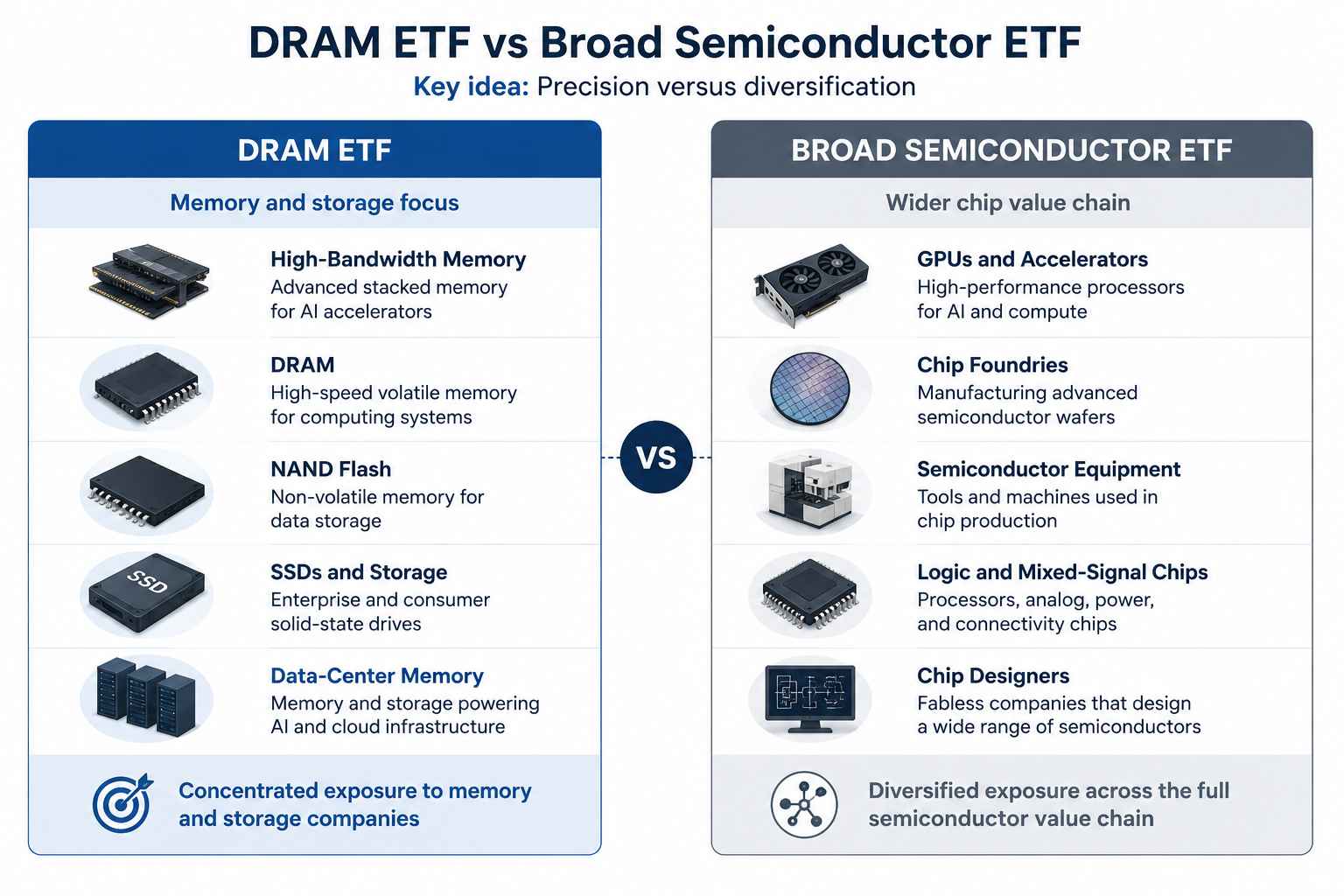
SMH, for example, tracks companies involved in semiconductor production and equipment, while SOXX tracks US-listed semiconductor equities.
| Feature | DRAM ETF | Broad Semiconductor ETF |
|---|---|---|
| Main focus | Memory and storage | Full semiconductor value chain |
| AI exposure | HBM, DRAM, NAND, SSDs | GPUs, foundries, equipment, logic chips, memory |
| Diversification | Low | Higher |
| Top risk | Memory pricing cycle | Broad chip-sector valuation |
| Best suited for | Targeted AI memory exposure | Wider semiconductor exposure |
| Cost example | DRAM: 0.65% | SMH: 0.35%; SOXX: 0.34% |
The choice is not simply about which ETF is “better.” It is about precision versus diversification. DRAM offers cleaner exposure to AI memory stocks. A broad semiconductor ETF offers more balance across the chip industry.
The fund’s launch portfolio was dominated by three companies: Samsung, SK Hynix and Micron. That creates strong exposure to the memory leaders, but also leaves performance tied to a narrow set of earnings reports, technology roadmaps and customer wins.
Memory remains cyclical. If producers add too much supply, prices can fall quickly. If AI demand slows or customers delay orders, the earnings upgrade cycle can reverse.
By May 2026, investors have already rewarded leading memory stocks for AI exposure. The risk is not only weak demand. The risk is that expectations become too aggressive, leaving little room for execution delays, margin pressure or lower contract pricing.
DRAM is a new ETF with limited operating history. Roundhill also notes that the fund uses total return swaps to maintain compliance with regulated investment company diversification rules. Swaps can introduce counterparty and valuation risks.
DRAM ETF is the Roundhill Memory ETF, ticker DRAM, which began trading on Cboe BZX on 2 April 2026. It is the first US-listed ETF designed to offer targeted exposure to global memory and storage companies, including producers of DRAM, HBM, NAND flash, and SSDs.
No. The DRAM ETF covers more than traditional dynamic random-access memory. It also includes HBM, NAND flash, SSDs, HDDs and specialty memory companies.
HBM gives AI accelerators faster access to data. Large AI models require high-speed memory movement as well as compute power, which has made HBM a critical input for advanced data centers.
DRAM focuses on memory and storage companies. SMH and SOXX provide broader semiconductor exposure across chip designers, foundries, equipment makers and memory producers.
It is better viewed as a focused thematic ETF than a conservative core holding. Its narrow exposure can amplify gains during a memory upcycle, but also increase downside when pricing or sentiment turns.
The DRAM ETF is a precise instrument built for a precise thesis: that the memory layer of the AI supply chain will remain undersupplied, highly profitable, and structurally important for years rather than quarters. The inflows suggest investors embraced that thesis rapidly, though price performance alone cannot validate it.
Roundhill CEO Dave Mazza said: “Memory has been identified as the clear AI bottleneck, and there is a shortage of these chips that is going to last not for a quarter but multiple years.” That may be true. It may also already be priced in.
Investors who understand what the fund actually holds, how concentrated it is, and how violently memory cycles can reverse are better positioned to decide whether the DRAM ETF fits their risk tolerance than those drawn in purely by its recent performance.