Published on: 2026-05-12
Updated on: 2026-05-12
The Artificial Intelligence (AI) rally is reaching deeper into Asia’s chip supply chain, where companies producing memory, equipment, and foundry capacity are drawing more market attention. Increasingly, market activity is shifting to Asian companies that supply chips, memory, equipment, and foundry capacity.
South Korea’s recent surpassing of the UK in stock market value has drawn attention. In late April, South Korean-listed companies reached a total market capitalisation of about US$4.04 trillion, compared to the UK’s US$3.99 trillion, according to Bloomberg. South Korea’s market value rose over 45% in 2026, while the UK’s increased by about 3%.
This ranking serves as a signal rather than a definitive measure. Stock market standings can shift quickly due to changes in share prices, exchange rates, valuations, listings, or foreign flows. A correction in Samsung Electronics, currency fluctuations, or a broader decline in chip stocks could quickly close the gap.
More importantly, the ranking highlights that investors are placing greater value on Asian markets linked to AI infrastructure. South Korea represents the memory-chip segment, Japan provides equipment, exporters, and currency exposure, and Taiwan Semiconductor Manufacturing Company (TSMC) anchors the foundry segment. The US continues to drive demand through companies like NVIDIA, Microsoft, Amazon, Alphabet, Meta, and the Nasdaq.
For traders, the chip rally in Asia now offers a way to read how AI demand is moving through memory, equipment, foundry capacity, and currency markets.
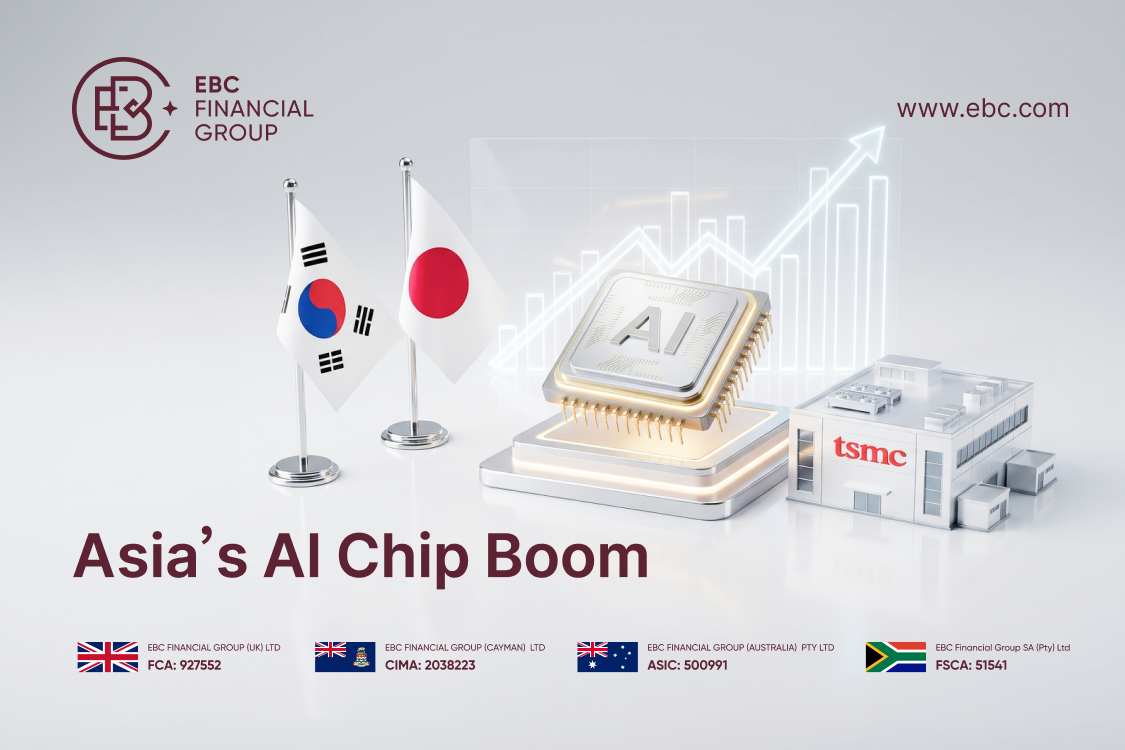
South Korea’s rally has been led by semiconductor giants, particularly Samsung Electronics and SK Hynix.
As of 30 April 2026, Samsung Electronics comprised 32.24% and SK Hynix 21.68% of MSCI’s Korea Index, together accounting for over half of the index.
This makes South Korea a clear equity-market proxy for the memory-chip segment of the AI market. Large AI servers require advanced memory for rapid data processing, and high-bandwidth memory is increasingly important for efficiently handling larger workloads.
South Korea’s trade data also supports the market story. Reuters reported that South Korea’s exports rose 48.0% year on year in April 2026, helped by semiconductor exports, which rose 173%, as AI infrastructure demand continued to support the chip cycle.
The local equity surge has been notable. On 6 May, Reuters reported the KOSPI surpassed 7,000 for the first time, with Samsung Electronics and SK Hynix each rising over 10% to record highs. Samsung’s market value also exceeded US$1 trillion.
This data point does not guarantee the rally’s permanence. A single-session surge may result from short covering, global chip momentum, ETF flows, domestic data, or specific catalysts. In this instance, Reuters attributed the rally to gains in US chip stocks, strong domestic manufacturing and trade data, and foreign investment in local shares.
A simpler interpretation is that South Korea’s market is now highly sensitive to investor expectations about the AI memory cycle. This can drive sharp gains when optimism rises, but also increases vulnerability if memory pricing, earnings guidance, or AI spending expectations decline.
Japan is also a key player in AI hardware, but its market dynamics differ from South Korea’s.
South Korea is closely linked to memory, while Japan is more exposed to semiconductor equipment, precision manufacturing, factory automation, materials, exporters, and currency trends. This makes Japan’s market story more complex.
Investors often watch companies such as Tokyo Electron, Advantest, Disco, Shin-Etsu, Ibiden, and related industrial names as part of Japan’s exposure to AI hardware.
There are company-level signals behind the theme. Reuters reported in July 2025 that Advantest raised its full-year operating profit forecast by 24%, citing strong AI-driven semiconductor demand. Reuters also reported in February 2026 that Tokyo Electron raised its annual net profit forecast by 12.7% to 550 billion Yen for the year ending March 2026.
The Yen is another important factor. A weaker Yen benefits Japanese exporters by increasing the value of overseas earnings and attracting foreign investors. Conversely, a sharp Yen rebound can pressure exporter sentiment and lead to profit-taking.
This dynamic keeps Japan in focus for investors. In April, J.P. Morgan raised its year-end Nikkei 225 target to 70,000 from 61,000, citing the AI boom and a weaker Yen. However, this is one sell-side perspective and not a guarantee that Japanese equities will continue to rise.
The key difference is that Korea’s market moves mainly with memory-chip expectations, while Japan’s is influenced by a broader set of factors, including chip-equipment demand, exporter earnings, Yen movements, corporate reform, and global risk appetite.
The foundry segment is essential to understanding the AI chip boom.
TSMC is central, as many leading AI chips rely on advanced foundry capacity. For traders, the foundry perspective links the supply chain: strong AI demand benefits memory suppliers in South Korea, equipment and materials suppliers in Japan, and sustains foundry demand at TSMC. If order flow slows, weakness can spread throughout the chain.
The TSMC link also overlaps with Japan. Reuters reported in February 2026 that TSMC planned advanced 3-nanometre chip production in Japan, with reported investment of US$17 billion, as demand for AI chips remained strong.
Monitoring the AI hardware cycle across memory, equipment, and foundry capacity provides a more comprehensive view than focusing on a single market.
Traders can follow the theme through several market instruments. The Japan Nikkei 225 Index (225JPY) tracks Japan’s broader equity rally, while the iShares MSCI South Korea ETF (EWY.P) reflects South Korean equity exposure. The iShares MSCI Taiwan ETF (EWT.P) offers access to the foundry-linked part of the supply chain, while the iShares MSCI All Country Asia ETF (AAXJ.OQ) gives a broader Asia view. For semiconductors, the VanEck Semiconductor ETF (SMH.OQ) and iShares Semiconductor ETF (SOXX.OQ) track the wider chip sector. The US NASDAQ-100 Index (NASUSD) and Invesco QQQ Trust Series 1 (QQQ.OQ) remain useful for US technology sentiment, while US Dollar vs Japanese Yen (USDJPY) reflects the currency side of Japan’s equity story. Major US technology stocks, including NVIDIA Corp (NVDA.OQ), Microsoft Corp (MSFT.OQ), Amazon.com Inc (AMZN.OQ), Alphabet Inc Class A (GOOGL.OQ), Meta Platforms Inc (META.OQ), and Apple Inc (AAPL.OQ), also help traders monitor end demand.
These instruments should not be treated as interchangeable.
EWY.P reflects South Korean equity exposure, where Samsung Electronics and SK Hynix carry large index weight, and memory-chip expectations matter.
225JPY tracks Japan’s Nikkei 225, where the AI link runs through equipment, exporters, industrial technology, and Yen sensitivity.
EWT.P adds the foundry layer through Taiwan-linked exposure.
SMH.OQ and SOXX.OQ offer a broader semiconductor basket for traders who want to watch the global chip cycle rather than one market.
NASUSD and QQQ.OQ remain important because US technology earnings still influence AI spending expectations.
USDJPY helps show whether the Yen is supporting or weighing on Japanese exporters.
Each instrument captures a different part of the chain. Korea, Japan, semiconductors, the Nasdaq, and the Yen may react to the same AI news, but their underlying drivers differ.
A key risk is assuming that ongoing AI spending will automatically lead to continued gains for Asian chip stocks.
Memory chips are cyclical: prices rise quickly when demand tightens and fall when supply increases. Equipment demand can surge if companies accelerate capacity expansion. Shares may rally ahead of earnings, then correct once positive news is priced in.
US technology spending is not unlimited. If hyperscalers reduce capital expenditure, delay data centre expansion, or face pressure to justify AI investments, the impact can quickly spread through the Asian supply chain. A weaker forecast from a major US chip or cloud company can first affect Nasdaq sentiment, then influence Korean memory stocks, Japanese equipment makers, and semiconductor ETFs.
This does not undermine the AI hardware thesis, but it makes timing critical. The strongest rallies often occur when earnings expectations are being revised upward. Risks increase when investors assume these revisions will continue without pause.
Semiconductors are now part of industrial policy, export control regimes, and supply chain security planning. That can affect companies even when end-demand remains strong.
In January 2026, the US Bureau of Industry and Security revised its licensing policy for certain advanced semiconductors exported to China and Macau, moving from a presumption of denial to a case-by-case review framework. Reuters also reported that the US ordered several chip-equipment companies to halt some shipments to Hua Hong, China’s second-largest chipmaker, as part of wider restrictions on advanced semiconductor production.
These rules matter because Asian chip firms operate across borders. Samsung and SK Hynix have operations linked to China. Japanese equipment makers can be affected by restrictions on where tools can be sold, serviced, or installed. TSMC’s foundry ecosystem is tied to global customers, US technology, and export-control compliance.
Reuters separately reported that Samsung and SK Hynix received US annual approvals for shipments of chipmaking tools to China in 2026, offering temporary relief under a system that still requires closer review.
For traders, the focus should not be on predicting policy, but on recognising that export licences, tariffs, shipment restrictions, and supply chain rules can alter earnings outlooks even if AI demand stays strong.
For Asian traders, the main shift is in timing.
A US chip-stock rally can influence Seoul and Tokyo the next morning. A Samsung or SK Hynix earnings update can affect Korean equities and semiconductor exchange-traded funds. A sharp move in USDJPY can change how traders read Japanese exporters. A TSMC update can shift the foundry and equipment parts of the chain.
This provides regional traders with more factors to monitor, but also increases the risk of oversimplifying the theme.
A stronger Nasdaq does not guarantee gains in Japanese equities. A rally in Samsung and SK Hynix does not mean the entire Korean market is strong. While a weaker Yen may support Japanese exporters, it can also increase import costs and complicate the Bank of Japan’s policy decisions.
The key is understanding which part of the value chain is driving movement.
The next phase depends on whether earnings can meet expectations.
For South Korea, the key signals are memory-chip prices, semiconductor exports, foreign equity flows, and earnings guidance from Samsung Electronics and SK Hynix.
For Japan, traders should watch the Nikkei 225, USDJPY, exporter guidance, chip-equipment orders, and updates from companies such as Tokyo Electron, Advantest, Disco, Shin-Etsu, and Ibiden.
For TSMC and the foundry layer, the focus is on order flow, foundry utilisation, advanced-node demand, and whether AI chip production continues to absorb new capacity.
For the US, the most important signals remain NVIDIA guidance, hyperscaler capital expenditure, Nasdaq risk appetite, and whether major technology companies can show that AI investment is turning into revenue.
Trade policy should sit beside those market signals. Export licences, tariff changes, equipment restrictions, and supply chain rules can all affect how quickly AI demand turns into sales and earnings.
While South Korea surpassing the UK is a notable headline, the more important takeaway is that Asia is now an active part of the AI equity cycle. Korea reflects memory demand, Japan represents equipment, exporters, and currency conditions, and TSMC embodies foundry capacity. The US continues to set much of the tone for demand.
The next test is whether the upcoming guidance supports this value chain. NVIDIA will set the tone for AI demand, Samsung and SK Hynix will indicate if memory pricing remains strong, and the Bank of Japan will influence the level of support the Yen provides to Japanese exporters.