Published on: 2026-06-24
A portfolio is a collection of financial assets or trading positions owned by a trader or investor.
It can include stocks, ETFs, bonds, commodities, forex positions, funds, cash, and other financial instruments. Some portfolios are simple, while others include many different markets and asset types.
For beginner traders, the easiest way to understand a portfolio is this: it is the full basket of everything you hold, not just one trade or one investment.
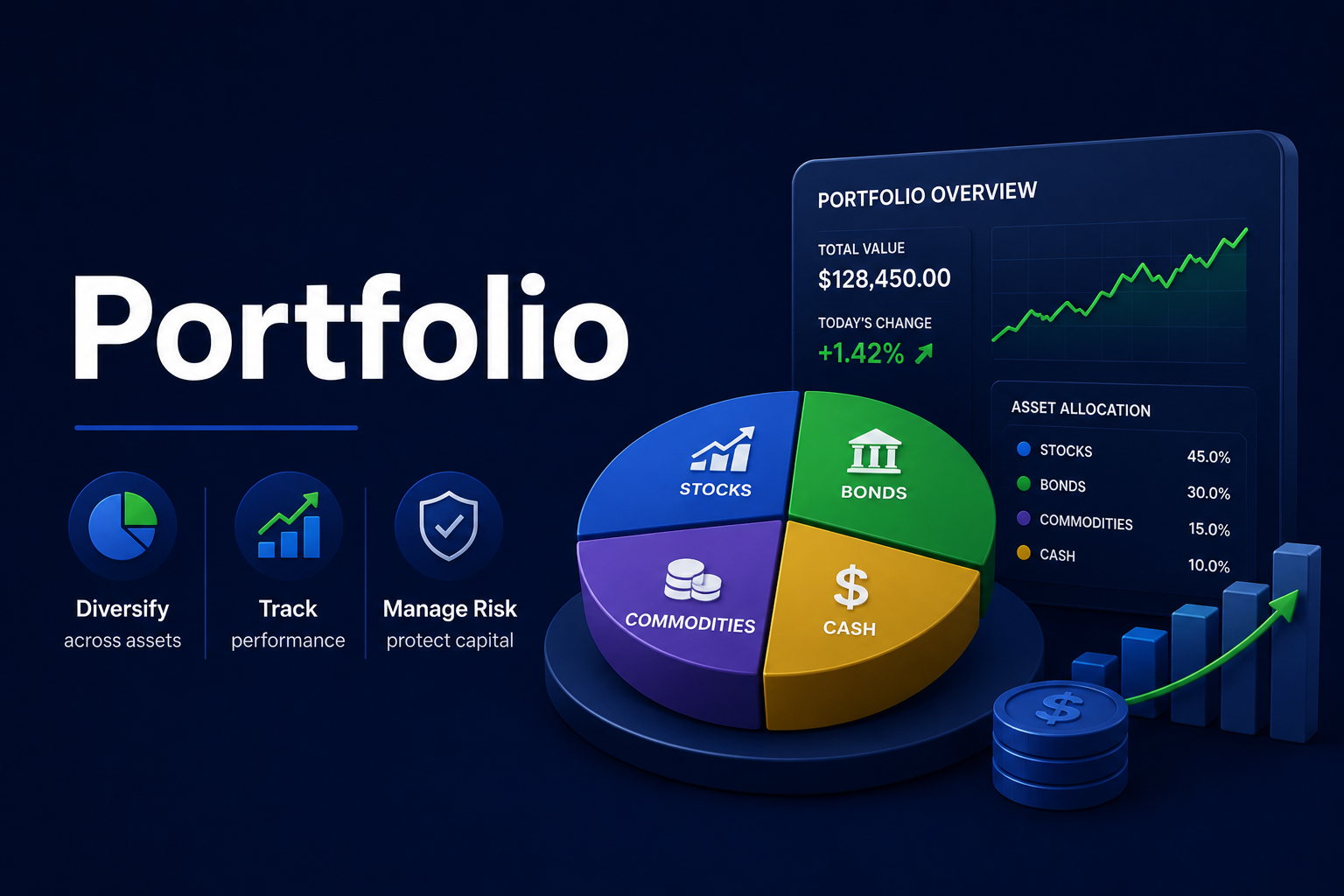
A portfolio shows how a trader or investor spreads money across different assets. For example, a simple investment portfolio may include:
50% stocks
30% ETFs
10% gold
10% cash
An active trader’s portfolio may look different. It may include a forex position, an index position, a commodity position, and available cash for margin or risk control.
The important point is that a portfolio is not only about what assets are included. It is also about how much money is placed in each asset and how those assets move together.
A portfolio matters because traders and investors should not judge each position in isolation.
One trade may look small on its own, but several positions may carry the same risk. For example, a trader may hold a technology stock, a Nasdaq index position, and a semiconductor ETF. These may look like different positions, but they can all be affected by the same technology-sector weakness.
This is why portfolio thinking is important. It helps traders ask whether they are truly diversified or whether they are taking the same risk in different forms.
A single trade is one position. A portfolio is the full group of positions. A trader may have one profitable trade, but the overall portfolio can still lose money if other positions fall more. This is why experienced traders look at total exposure, not only individual trade ideas.
For example, a trader may make money on one stock but lose more from several other positions linked to the same market trend. The portfolio result matters more than one winning trade.
Diversification means spreading money across different assets, sectors, markets, or strategies.
The goal is to avoid depending too much on one asset or one market theme. A portfolio that holds only one stock is highly concentrated. A portfolio that includes different asset classes may be more balanced.
However, diversification does not mean buying random assets. Good diversification means the assets do not all react the same way to the same market event.
For example, holding five technology-related assets may still leave a portfolio exposed to one sector. If the technology sector falls, all five positions may fall together.
Portfolio allocation means how much of the portfolio is placed in each asset.
For example:
60% stocks
20% bonds
10% commodities
10% cash
Allocation matters because it shows where the portfolio’s risk and return may come from. A risky asset with a small allocation may not damage the portfolio too much. A risky asset with a large allocation can dominate the whole result.
This is why traders should not only ask, “What should I buy?” They should also ask, “How much of my portfolio should this position represent?”
Portfolio risk is the total risk across all holdings. It can include market risk, sector risk, currency risk, liquidity risk, leverage risk, and concentration risk.
For beginners, concentration risk is one of the most important. This happens when too much of the portfolio depends on one asset, one sector, or one market view.
For example, if 80% of a portfolio is placed in one stock, the portfolio is highly concentrated. Even if the company is strong, one bad earnings report or market shock can create a large loss.
A common mistake is thinking that more positions automatically mean a safer portfolio. If all positions move in the same direction, the portfolio may still be risky.
Another mistake is ignoring position size. A small risky trade may be manageable, but a large risky trade can damage the whole portfolio.
Beginners may also focus too much on profit potential and not enough on risk. A portfolio should be built around both opportunity and protection.
Another mistake is not reviewing the portfolio. As prices change, the weight of each asset can change too. A portfolio that was balanced before may become concentrated later.
Diversification: Spreading money across different assets or markets to reduce dependence on one position.
Asset Allocation: Deciding how much of a portfolio should be placed in different asset classes.
Risk Management: The process of controlling possible losses before and during trading.
Position Sizing: Choosing how much money or volume to place in a trade.
ETF: A fund traded on an exchange that usually tracks a group of assets or an index.
Drawdown: A decline in account or portfolio value from a previous high.
A portfolio is the full collection of assets or positions held by a trader or investor. It can include stocks, ETFs, forex positions, commodities, cash, and other financial instruments.
A portfolio is important because it shows total exposure. Even if one trade looks safe, the whole portfolio may be risky if several positions depend on the same market direction or sector.
Portfolio diversification means spreading money across different assets, sectors, or markets. The goal is to reduce dependence on one position, but diversification only helps if the assets do not all move the same way.
Portfolio allocation means deciding how much money goes into each asset or asset class. It helps traders understand where their risk and potential return are coming from.
A portfolio is the full basket of investments or trading positions held by a trader or investor. It shows not only what someone owns, but also how much risk is spread across different assets.
For beginner traders, a portfolio is useful because it shifts attention from one trade to the bigger picture. A strong portfolio is not just about holding more assets. It is about balance, diversification, allocation, and risk control.