Published on: 2026-06-26
Updated on: 2026-06-26
RSP vs SPY is the defining S&P 500 ETF question for 2026, and it comes down to one choice: stick with the mega-cap leaders that dominate the index, or position for a broader recovery in the average stock.
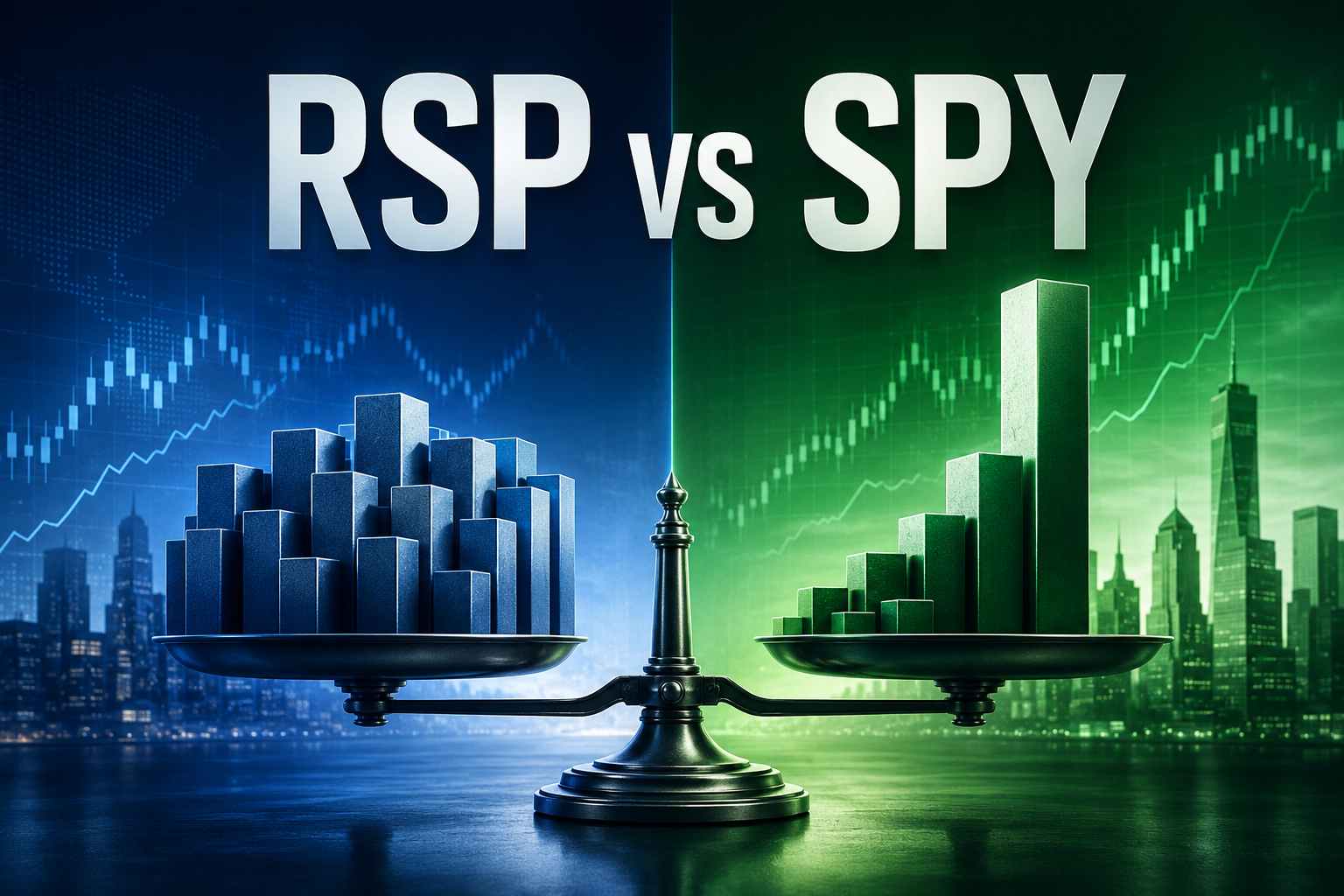
Here is the direct verdict up front: SPY remains the default core holding for broad, market-cap-weighted S&P 500 exposure, while RSP, the equal-weight S&P 500 ETF, works as a deliberate breadth tilt for investors who expect 2026 leadership to widen beyond mega-cap AI names. Neither is the outright winner.
Whether you choose SPY or RSP, they are bets on different market regimes, and the rest of this guide explains exactly when each one pays off.
SPY is the default market-cap-weighted S&P 500 ETF: $771.35B in AUM, 0.0945% expense ratio, as of late June 2026 [1].
RSP is the equal-weight alternative, resetting constituents to roughly 0.2% at each quarterly rebalance [3][4].
SPY’s top 10 holdings are 36.46% of assets versus under 3% for RSP, making this a concentration-versus-breadth decision [1][2].
SPY leads over longer timeframes; RSP gains relevance when breadth improves and leadership rotates beyond mega-cap AI.
Both funds track the same S&P 500 constituent universe. The only meaningful difference is weighting, and that single rule is the whole story.
SPY, the SPDR S&P 500 ETF, is float-adjusted market-cap weighted [1], so the biggest companies get the biggest slice and every new dollar flows toward whatever has grown largest.
RSP, the Invesco S&P 500 Equal Weight ETF, resets every holding to roughly 0.2% at each quarterly rebalance [3][4], trimming winners and topping up laggards. The choice is concentration versus breadth, not good fund versus bad fund. (For fund mechanics, see our RSP ETF breakdown and SPY ETF basics pages.)
| Metric | SPY | RSP | Why It Matters in 2026 |
|---|---|---|---|
| Weighting method | Float-adjusted market-cap weighted [1] | Equal weighted | SPY follows the largest stocks; RSP tests whether the average S&P 500 stock can catch up. |
| Rebalance discipline | Market weights drift naturally | Quarterly equal-weight reset [3][4] | RSP trims stocks that have grown above equal weight and adds to those below it. |
| Assets under management | $771.35B [1] | About $90B to $92B [2] | SPY is the deeper core vehicle; RSP remains large enough for scalable breadth exposure. |
| Expense ratio | 0.0945% [1] | 0.20% [2] | RSP needs breadth improvement to justify its higher fee. |
| Holdings exposure | 504 fund holdings [1] | S&P 500 equal-weight exposure | Both access the same universe, but implementation details can differ. |
| Top-10 holdings weight | 36.46% [1] | Under 3% [2] | The clearest numerical expression of concentration versus breadth. |
SPY data from State Street, holdings and sector data as of Jun. 24, 2026 [1]. Equal-weight methodology and quarterly rebalance from S&P Dow Jones Indices [3][4]. RSP fee, AUM, top-10 weight, sector weights, and performance from Invesco [2]; confirm against the Invesco RSP profile before publication, as live figures update daily.
SPY is a momentum vehicle by construction. Cap weighting hands the biggest winners an ever-larger share, so the fund is implicitly long whatever is working, which through 2026 has meant a heavy tilt toward AI infrastructure and mega-cap technology.
As of Jun. 24, 2026, SPY’s top 10 holdings accounted for 36.46% of the fund, led by Nvidia at 7.62% and Apple at 6.80%, and information technology alone made up 37.58% of sector exposure [1]. In RSP, those same mega-caps receive only a small equal-weight allocation after rebalance, with their combined weight typically a fraction of their SPY exposure and subject to drift between quarterly resets [3][4].
When leadership stays narrow, that concentration is exactly what you want. SPY has returned roughly 15.5% annualized over the past decade on official month-end NAV data, while RSP sits closer to 11% over the comparable 10-year period [1][2].
If you expect the largest US companies to keep getting larger, SPY is the cleaner, cheaper way to own that view, at about 0.09% versus RSP’s 0.20% [1][2]. RSP’s quarterly rebalancing also creates more turnover, which may matter for taxable investors.
RSP makes the opposite bet. Equal weighting builds in a structural mid-cap tilt and a value lean, roughly doubling its exposure to industrials, financials, and materials relative to SPY. Its sector map looks nothing like SPY’s.
| Sector | SPY Weight [1] | RSP Weight [2] | RSP Tilt |
|---|---|---|---|
| Information Technology | 37.58% | 13.78% | -23.80 pp |
| Industrials | 8.85% | 15.77% | +6.92 pp |
| Financials | 12.00% | 14.84% | +2.84 pp |
| Health Care | 8.75% | 11.49% | +2.74 pp |
| Consumer Discretionary | 9.26% | 10.68% | +1.42 pp |
| Materials | 1.87% | 5.04% | +3.17 pp |
| Real Estate | 1.89% | 5.78% | +3.89 pp |
| Communication Services | 9.72% | 3.98% | -5.74 pp |
This table proves the thesis. RSP is not simply “less tech.” It reallocates meaningful weight toward industrials, financials, healthcare, materials, and real estate, the sectors that matter if 2026 leadership broadens beyond mega-cap AI. SPY weights: State Street, Jun. 24, 2026 [1]; RSP weights: Invesco [2], confirm before publication.
To outperform, RSP needs improving breadth, a value or cyclical rotation, or a mega-cap stumble, as it got in stretches of 2026 when the biggest names paused. The trade-off is real: RSP swaps single-stock concentration risk for sector and mid-cap risk, a different risk profile rather than a safer one.
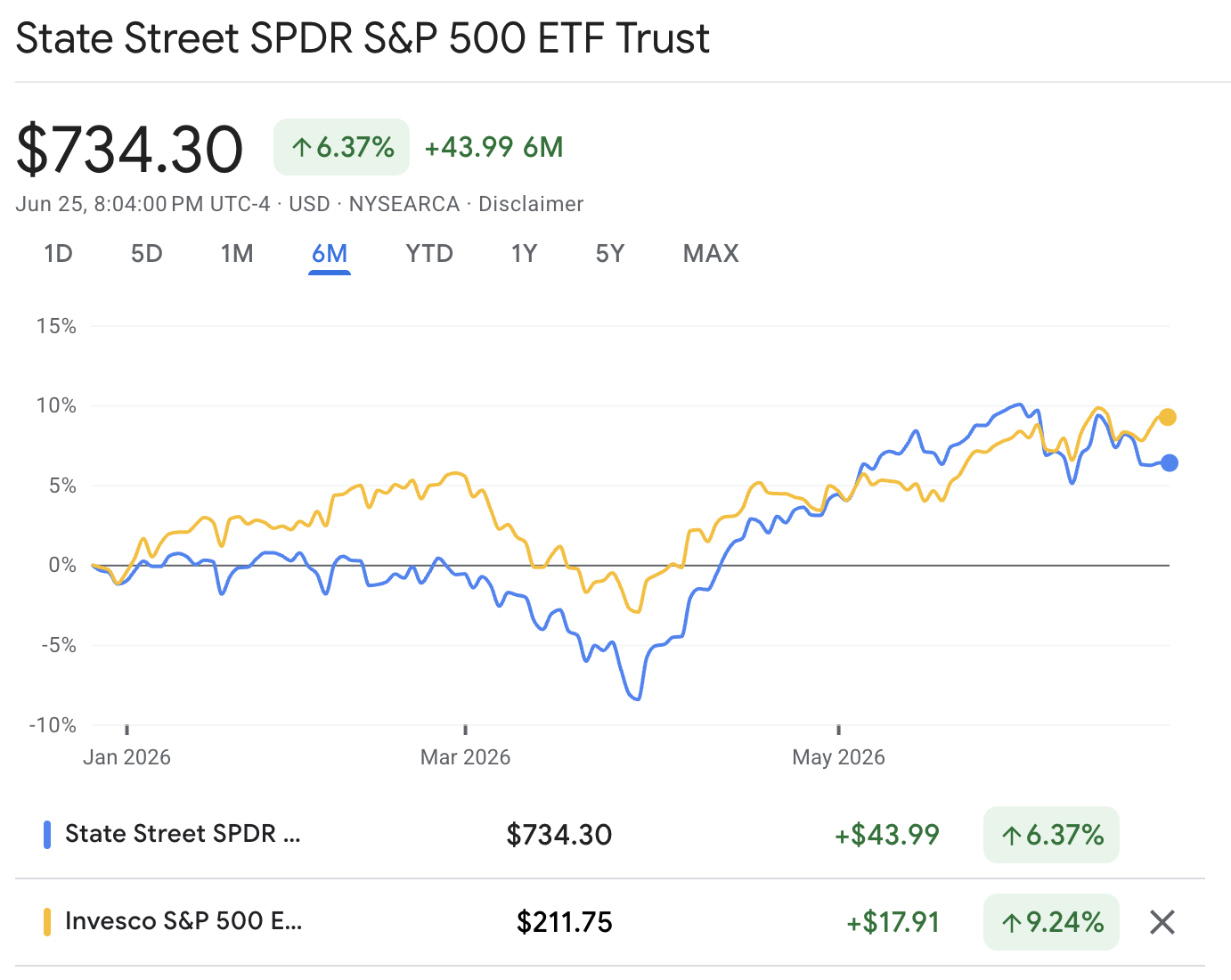
The evidence in 2026 is genuinely mixed. On the broadening side, strategists have flagged a rotation under way since late 2025, with cyclicals, financials, materials, and smaller constituents participating more, and the valuation gap favours the breadth case: SPY trades at a higher P/E and P/B than RSP [1][2], reflecting the premium investors still pay for mega-cap growth.
| Valuation Metric | SPY [1] | RSP | Interpretation |
|---|---|---|---|
| Price/Earnings | 26.86 | Lower than SPY | SPY carries the richer mega-cap growth multiple. |
| Forward P/E | 22.17 | Lower than SPY | Cap-weighted exposure still prices in stronger mega-cap earnings power. |
| Price/Book | 5.32 | Lower than SPY | RSP is a lower-multiple route into the same universe, with more cyclical and mid-cap sensitivity. |
On the top-heavy side, concentration remains near record levels and headline returns are still driven by a handful of AI-related mega-caps, with leadership narrowing and broadening in waves. Same-vendor data show RSP ahead year to date in 2026, but SPY still leads over one-, three-, five-, and 10-year periods [1][2].
The honest read: 2026 is a market trying to broaden, with frequent relapses into mega-cap dominance, which is when investors ask this question most.
Neither universally. SPY wins when mega-cap leaders drive the index; RSP wins when returns broaden across the average S&P 500 stock.
SPY for simple, low-cost core exposure; add RSP if you already hold heavy mega-cap tech or expect 2026 leadership to widen beyond AI names.
Sometimes. Cap weighting has won over the past decade, but equal weight tends to lead in broad, value-led markets.
Mega-cap concentration powered the cap-weighted index through the AI run, while RSP’s equal weighting kept those winners small.
When breadth improves, value and cyclicals rotate higher, or mega-cap leaders stumble.
Potentially, if the market broadens, but the setup is mixed, so RSP works best as a sized tilt rather than a wholesale SPY replacement.
Start with what you already own. If a cap-weighted S&P 500 fund is your only equity holding and you want simple, low-cost exposure, SPY is the sensible default.
If you already hold heavy mega-cap tech, more SPY only doubles down on names you already own; RSP gives better diversification inside the same index, with lower single-stock risk and a value lean, and it is one of the most practical equal-weight options given its scale, 0.20% expense ratio, and track record dating back to its Apr. 24, 2003 inception [2]. (Comparing VOO or IVV? See our best S&P 500 ETFs comparison.)
The cleanest approach is to treat SPY as the core and RSP as a satellite breadth tilt sized to conviction: lean to SPY if you expect mega-cap AI leadership to continue, increase the RSP tilt if you expect 2026’s rotation into the average stock to keep building. RSP is not a better SPY. It is a different bet on the same index, and 2026 is the kind of year that finally tests which bet is right.
Traders looking for diversified S&P 500 ETF exposure rather than individual stock selection can find the SPY ETF or RSP ETF listed as a CFD on EBC's ETF platform. An ETF CFD gives proportional exposure to all of the ETF's constituents in a single position, spreading single-stock earnings risk while maintaining full sector directionality. Both long and short positions are available.