Published on: 2026-07-10
Updated on: 2026-07-10
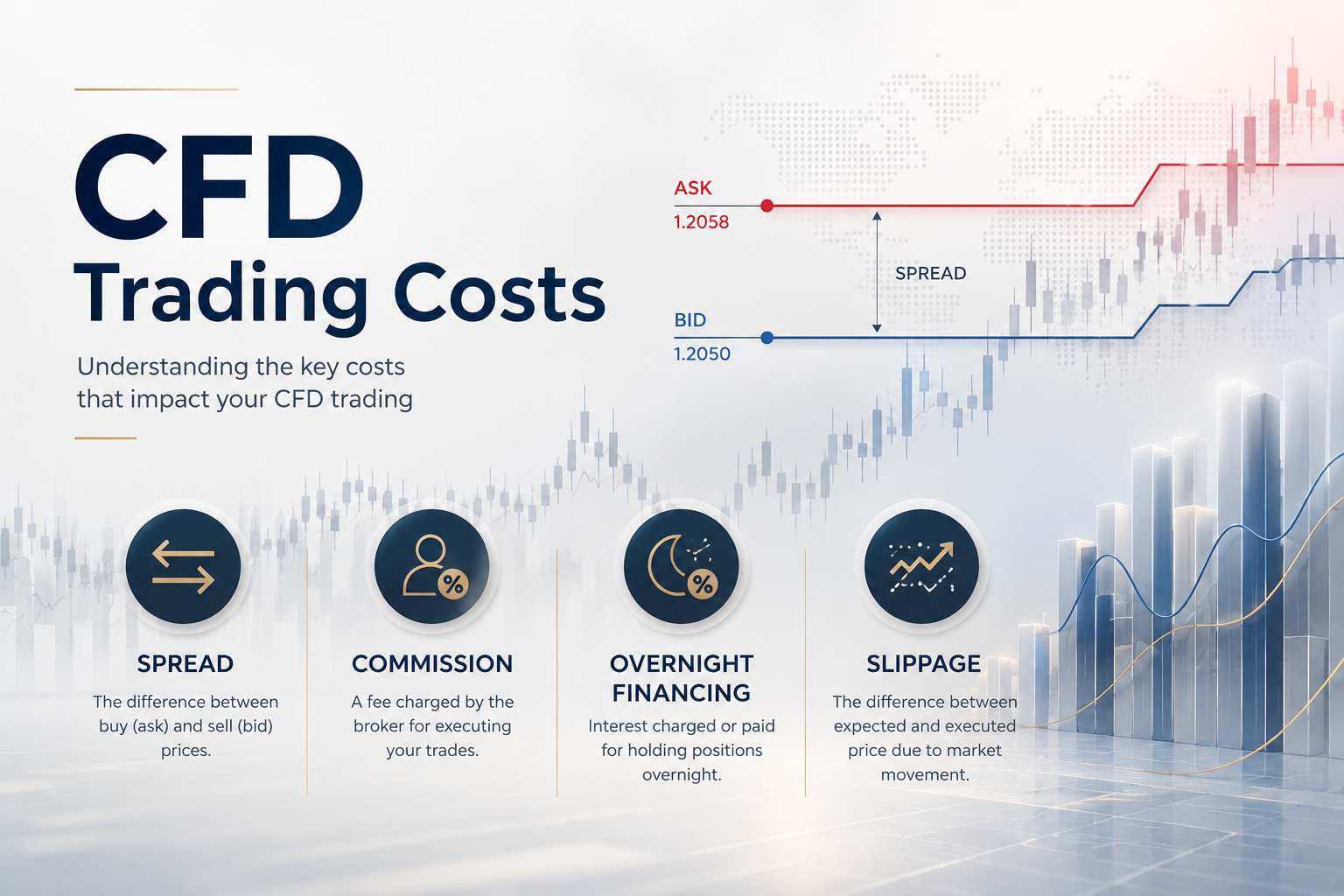
Overnight funding is the charge or credit applied when a leveraged trading position remains open beyond a broker’s daily rollover time. It is common in cash CFDs and forex, where a trader deposits margin to control a larger market position.
The amount depends mainly on the position’s value, the trade direction, the annual funding rate, and the number of funding days. A broker may post one day of financing at each rollover, or combine several days into a single adjustment for weekends and market holidays. This article also shows how overnight funding affects positions held for 5, 10, and 30 days.

Overnight funding applies when an open position crosses the broker’s rollover cutoff. The relevant time is set by the broker and may not align with midnight in the trader’s local time zone.
A position opened and closed before that cutoff will generally avoid overnight funding. A position opened shortly before the cutoff may incur a full daily adjustment even if it remains open for only a brief period. Traders should therefore check the rollover time shown for the specific account and instrument.
Funding continues to accrue for days when the position remains economically open, including weekends. The broker may collect those days separately or together.
In forex, overnight funding is often referred to as the swap or rollover rate. It reflects the interest-rate difference between the two currencies, the trade direction, tom-next pricing and the broker’s adjustment.
Benchmark rates directly affect financing costs. On a $100,000 position, a 1-percentage-point increase in the annual funding rate adds approximately $2.74 per day using a 365-day basis: $100,000 × 1.0% ÷ 365 = $2.74
Rate cuts generally reduce long-position funding costs, all else equal. For short positions, lower benchmark rates can reduce or eliminate a potential credit.
Funding can continue to accrue over weekends even when the underlying market is closed. Brokers may post several calendar days of financing in one adjustment.
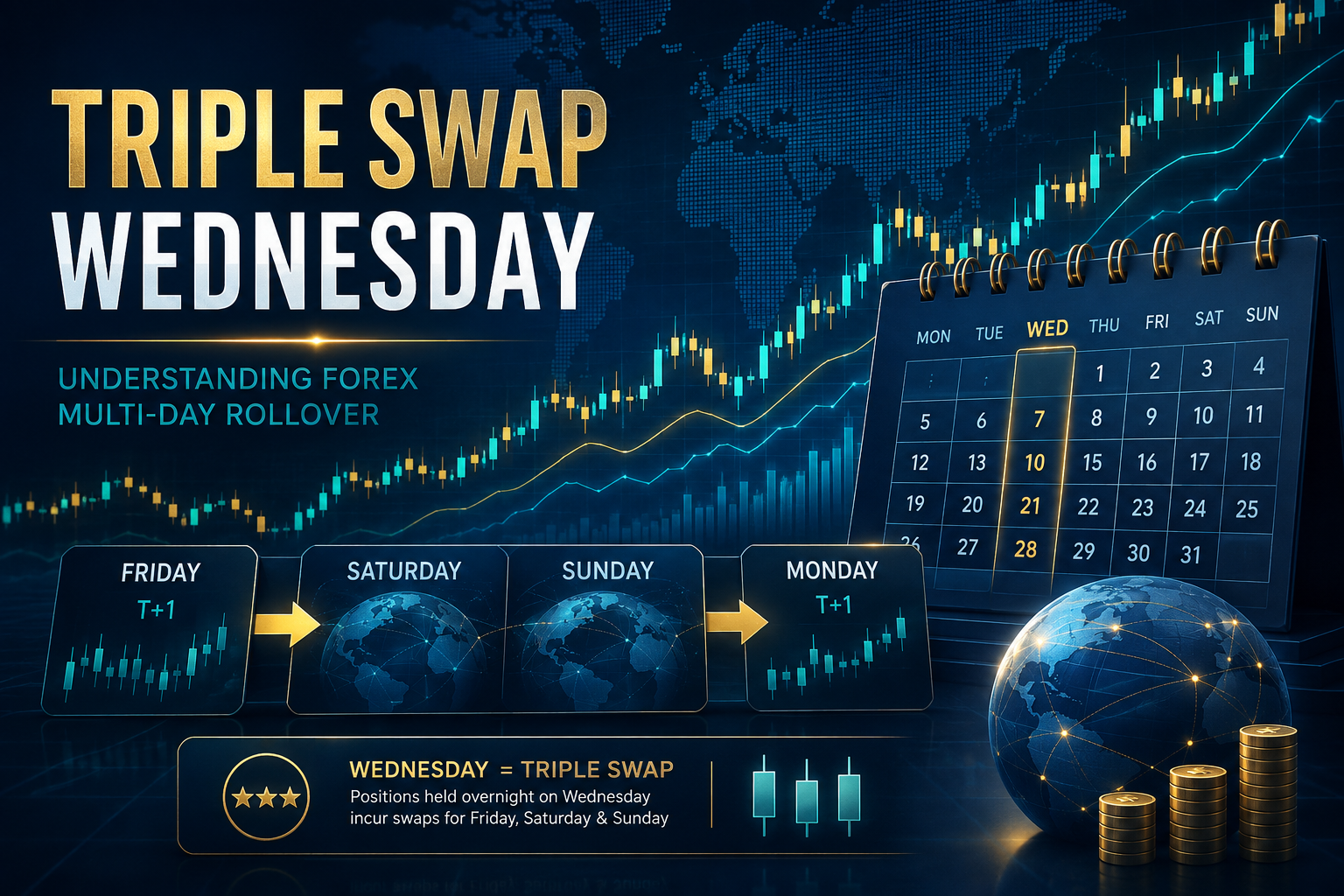
Forex commonly uses a three-day rollover around Wednesday because spot currency trades usually settle two business days after the trade date. Rolling a Wednesday position forward moves settlement across the weekend.
Other instruments may apply weekend funding on Friday or another scheduled day. Public holidays can also change the number of days included. Traders should check the schedule for each instrument rather than assume every CFD has a Wednesday triple charge.
A common simplified formula is: Daily overnight funding = Position value × Annual funding rate ÷ Day-count basis
Where:
Notional position value = units × closing price × contract multiplier
Annual funding rate = benchmark rate plus or minus the broker adjustment
Day-count basis is usually 360 or 365, depending on the instrument and currency.
The position value is the full market exposure used in the broker’s calculation. The annual funding rate usually combines a benchmark interest rate with the broker’s financing adjustment. The day-count basis is commonly 360 or 365 days, depending on the market and provider.
| Market | Typical Funding Basis | Important Consideration |
|---|---|---|
| Share and Index CFDs | Currency benchmark rate ± broker adjustment | Calculated on the full market exposure |
| Forex CFDs | Tom-next pricing or interest-rate differential + markup | Long and short swap rates can differ significantly |
| Spot Metals | Tom-next pricing or instrument-specific swap | Rates may change daily |
| Cash Commodities | Financing rate plus possible futures-curve adjustment | Contango and backwardation can affect funding adjustments |
Consider a $100,000 long CFD with a 5.0% benchmark rate and a 2.5% broker adjustment.
| Calculation Component | Illustrative Amount |
|---|---|
| Position Value | $100,000 |
| Benchmark Rate | 5.0% |
| Broker Adjustment | 2.5% |
| Total Annual Funding Rate | 7.5% |
| Day-Count Basis | 365 |
| Daily Funding Charge | $20.55 |
The calculation is: $100,000 × 7.5% ÷ 365 = $20.55
A trader who deposited $5,000 of margin would still pay $20.55 in this example because the calculation uses the $100,000 position value. The broker’s platform may display the result directly as a cash amount, a points adjustment, or a percentage rate.
Long positions commonly use a rate based on the benchmark interest rate plus the broker’s adjustment. When benchmark rates rise, the cost of holding a long leveraged position generally rises as well.
Short positions may use a different calculation. Depending on the benchmark rate, broker adjustment and instrument, a short position may receive a credit, incur a smaller charge or pay a full debit. Short share CFDs can also attract stock-borrow costs when the underlying shares are scarce or expensive to borrow.
The displayed long and short rates should always be checked separately. The fact that one side receives a credit does not mean the opposite side will pay an equal amount.
In forex, overnight funding is often referred to as the swap or rollover rate. It reflects the interest-rate relationship between the two currencies, the direction of trade, and the broker’s adjustment. Many providers derive the rate from tom-next pricing, which represents the cost of moving settlement forward by one day.
Cash CFDs provide margin-based market exposure, straightforward long and short positioning, no fixed expiry and no need to roll a dated contract during a brief trade.
Cash-market pricing can be competitive for short holding periods, particularly when the position does not cross multiple rollover points.
Financing is charged at each rollover and calculated against the position’s notional exposure.
Accumulated funding can eventually outweigh the initial spread advantage when a position remains open for longer.
Futures usually have no separate daily financing debit because their cost of carry is reflected in the contract price or spread.
The more efficient instrument depends partly on the expected holding period and total trading costs.
Benchmark rates directly influence many overnight funding calculations. A 1-percentage-point increase in the annual rate adds about $2.74 per day to the cost of a $100,000 position using a 365-day basis: $100,000 × 1.0% ÷ 365 = $2.74
Central bank decisions and money market conditions can therefore change the amount charged or credited while a position remains open. The rate shown when the trade is opened should not be treated as fixed for the entire holding period.
Using the same $100,000 long position and 7.5% annual funding rate, the daily charge is $20.55. The following table shows how the cost builds over time.
| Holding Period | Cumulative Funding Cost | Cost as % of Position Value | Cost as % of $5,000 Margin |
|---|---|---|---|
| 5 funding days | $102.74 | 0.103% | 2.05% |
| 10 funding days | $205.48 | 0.205% | 4.11% |
| 30 funding days | $616.44 | 0.616% | 12.33% |
After five funding days, the position must make more than $102.74 to cover financing alone. After 30 funding days, that hurdle rises to $616.44. Spreads, commissions, currency conversion costs, and other adjustments would increase the total break-even amount.
The percentage looks modest relative to the $100,000 position, but it is more significant relative to the $5,000 margin committed. This difference explains why traders should judge funding against both market exposure and account capital.
Weekend funding may appear as a larger single debit, but the cumulative cost still reflects the number of days covered. A Wednesday forex adjustment representing three days would increase the account charge immediately even though two of those days fall over the weekend.
For comparison, suppose a $100,000 short position carries an annual funding credit of 1.0%. The position would receive about $2.74 per funding day, or $82.19 over 30 funding days. If the displayed short rate is a debit instead, the same formula produces a charge.
This recurring cost is why cash CFDs are often more efficient for short tactical trades than for long holding periods. Entry and exit costs are paid at the transaction, while overnight funding is repeated at every rollover. Futures may not show a separate daily charge because financing is incorporated into the contract price, although spreads, basis and contract-roll costs still apply.
Central-bank interest-rate decisions
Changes in benchmark market rates
Broker financing adjustments
Currency interest-rate differentials
Stock-borrow availability
Futures-market contango or backwardation
Unusual liquidity or market conditions
The funding rate shown when a trade opens may change during the holding period.
Traders can manage funding costs by checking long and short rates before opening a position and including expected financing in the trade’s break-even level.
For longer holding periods, cash CFD pricing should be compared with futures pricing and other available instruments. Traders should also review the rollover time, weekend schedule and any multi-day adjustments.
Closing and reopening a position solely to avoid funding may create another spread, commission, slippage or market-gap risk. Funding assumptions should also be reviewed after major interest-rate changes.
Contract for Difference: A CFD is a leveraged derivative that tracks an asset’s price movement without transferring ownership of the underlying asset.
Leverage: Leverage allows a trader to control a larger market position with a smaller amount of deposited capital.
Margin: Margin is the capital required to open and maintain a leveraged position.
Swap Rate: A swap rate is the debit or credit applied when certain leveraged positions roll into the next trading day.
Rollover: The process of carrying an open position from one trading day to the next.
Overnight funding is charged when an open position crosses the broker’s rollover cutoff. That time may differ from midnight and the trader’s timezone, so the instrument’s published schedule should be checked.
Forex brokers commonly apply a three-day rollover on Wednesday because spot trades settle on a two-business-day cycle. Rolling Wednesday’s settlement forward crosses the weekend and covers three calendar days.
Futures generally do not show a separate daily overnight funding fee because financing and carrying costs are incorporated into the contract price. Traders may still pay spreads, commissions and rollover costs.
Yes. Repeated financing raises the trade’s break-even level. A small favourable price move may no longer cover accumulated funding, spreads and commissions, especially when a leveraged position remains open for many days.
Overnight funding is the daily charge or credit applied when a leveraged position remains open beyond the broker’s rollover time. Its impact depends on the position's value, the trade direction, benchmark rates, and the number of funding days. A single adjustment may be small, but repeated charges can steadily raise the trade’s break-even level, particularly when the position remains open across weekends or for several weeks.