Published on: 2026-06-22
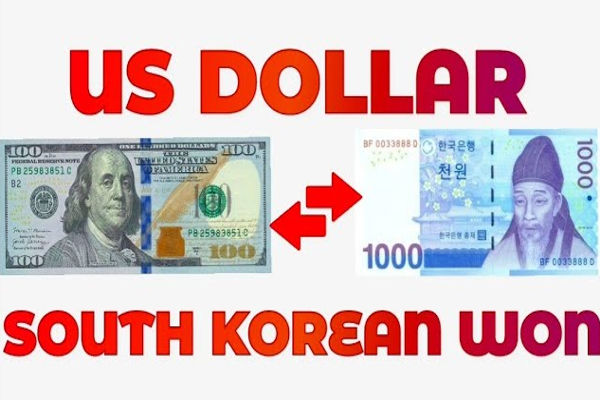
USD/KRW is pressing the upper boundary of its yearly range, and the level it is testing is one the Korean won has rarely visited in over fifteen years.
USD/KRW is trading near 1,539, just below its 52-week high of 1,559 and within reach of the 1,550 to 1,560 band, the won’s weakest territory since the aftermath of the 2009 global financial crisis.
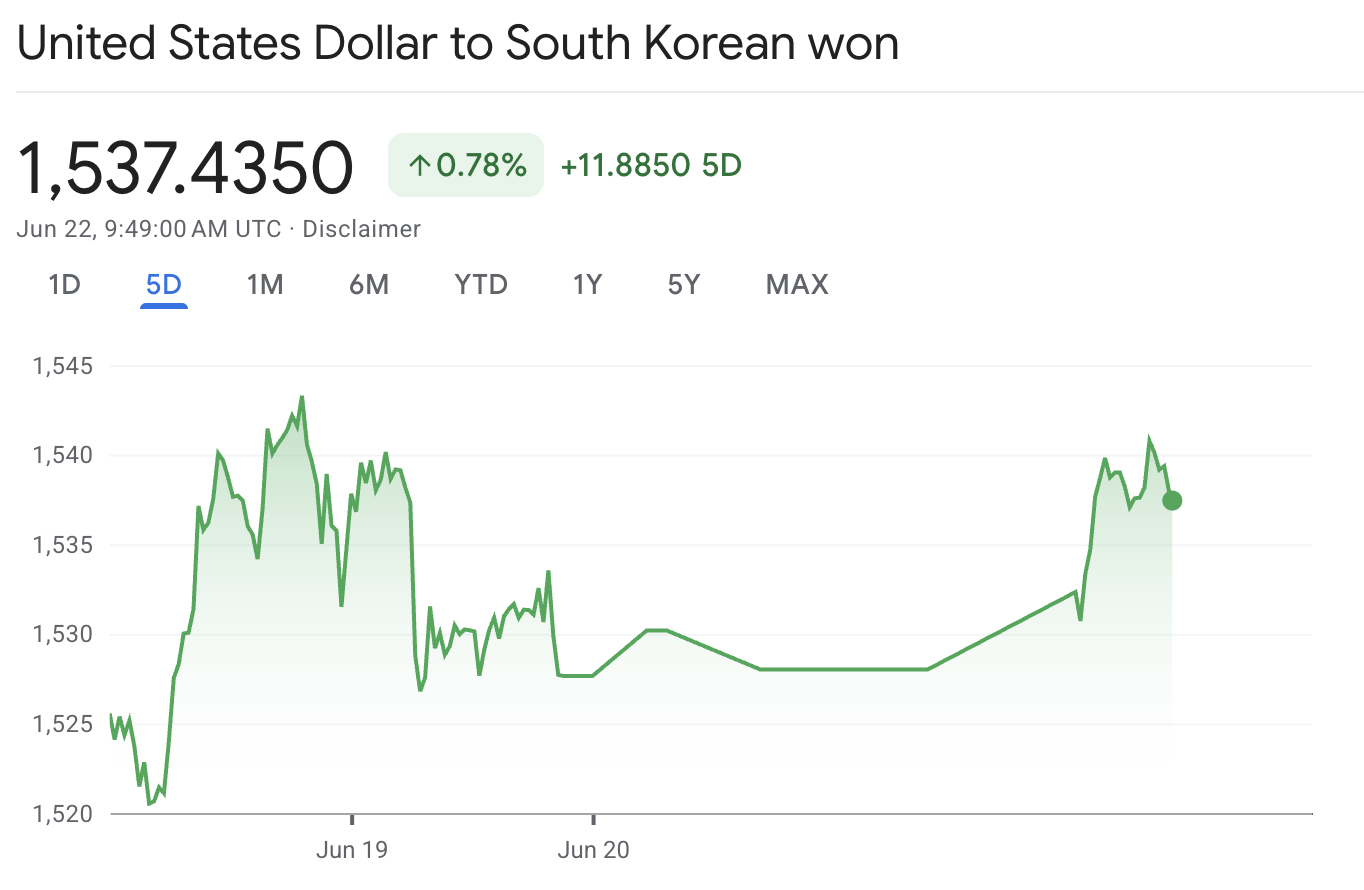
The setup is more than a simple breakout test. Price sits above every major moving average and momentum is positive, but the resistance directly overhead is also the zone where Korean and US authorities have leaned against won weakness this year. The market is now testing whether the dollar can clear a level that is technical, psychological, and politically sensitive at the same time.
| Category | Level / Indicator | Reading | Signal |
|---|---|---|---|
| Price | Spot price | 1,539.35 | Near 52-week resistance |
| Momentum | RSI (14) | 56.31 | Positive, not overbought |
| Momentum | StochRSI (14) | 61.12 | Momentum intact |
| Momentum | MACD (12,26) | 1.37 | Upside bias confirmed |
| Trend Strength | ADX (14) | 26.87 | Moderate trend strength |
| Volatility | ATR (14) | 3.15 | Volatility contained |
| Moving Average | EMA 20 | 1,536.27 | Near-term support |
| Moving Average | EMA 50 | 1,532.35 | Trend support |
| Moving Average | EMA 200 | 1,524.91 | Long-term trend floor |
| Resistance | Major resistance | 1,559 | 52-week high and intervention-watch zone |
| Resistance | Key resistance | 1,550 | Upper band of the breakout test |
| Resistance | Near-term resistance | 1,542 | Top of the current intraday pocket |
| Support | Immediate support | 1,536 | First intraday pullback level |
| Support | Key support | 1,532 | 50-period EMA shelf |
| Support | Structural support | 1,525 | 200-period EMA and invalidation floor |
The moving-average structure is the most reliable part of the setup. USD/KRW trades above the 20-, 50-, and 200-period lines, which keeps trend alignment intact. The 20-period EMA near 1,536 and the 50-period EMA near 1,532 form the first shelf of support, with the 200-period EMA near 1,525 marking the deeper trend floor.
While those levels hold, pullbacks read as retracements rather than reversals.
The short end is less uniform. The fastest averages, the 5-period in particular, have rolled into sell signals while the 10-period and longer lines stay supportive. That split is the honest version of a buy label: the broader trend is still higher, but the immediate momentum behind it has stopped accelerating.
RSI at 56.31 sits comfortably above neutral and short of overbought, MACD at 1.37 keeps the upside bias in place, and StochRSI at 61.12 points to continued buying interest. ADX at 26.87 is the telling reading: it describes a trend that is established but not forceful, which fits a pair pressing resistance on measured rather than expanding range.
The contained ATR cuts both ways. Breakouts from low volatility can run hard, but only with a genuine daily close beyond resistance to trigger them.
The near-term pivot is 1,539, with intraday resistance at 1,540, 1,541, and 1,542. Those levels matter for execution but not for the trend. The level that counts is the 1,550 to 1,559 band. It is the top of the 52-week range, and it sits close to the weakest the won has traded since 2009, which is exactly why it carries weight beyond the chart.
Korean authorities have been active here. A joint statement from the Ministry of Economy and Finance and the Bank of Korea in late 2025 described the won’s weakness as excessive and pulled the pair sharply lower, from around 1,480 toward 1,460.
US officials have since added rare public pressure of their own, calling the won weaker than fundamentals justify. A technical break above 1,559 would be a real signal, but traders should expect it to be contested by more than chart-based sellers.
On the downside, 1,536 is the first support, then 1,532, then the 1,525 trend floor. A move into that band would not end the uptrend on its own. The bullish case weakens only on a daily close beneath the 200-period EMA, which would turn the recent advance into a failed test of resistance rather than a base for higher levels.
The pair has shown how fast that can happen: in June the won swung from near 1,560 back toward 1,508 in a handful of sessions on a single shift in risk sentiment, before reversing again after the Federal Reserve signalled a higher-for-longer policy path.
The policy gap remains the structural support for USD/KRW. The Bank of Korea has held its base rate at 2.50%, while the Federal Reserve has signalled a higher-for-longer stance, keeping US yields elevated.
In calm conditions that gap may not drive a sharp selloff, but during risk-off episodes it becomes more powerful, since investors are paid more to hold dollar assets while the won stays exposed to external shocks.
Oil is the most direct external pressure on the won. Renewed Middle East tension and concern over supply through the Strait of Hormuz have pushed crude higher, and South Korea relies heavily on imported energy.
Higher oil prices raise the country’s dollar-denominated import bill, increase dollar demand from energy importers, and feed inflation through fuel and transport costs. Strong semiconductor exports support the external position but do not fully offset that pressure.
The older framework, in which strong exports generated dollar inflows that supported the won, has weakened. Korean exports surged more than 60% year-on-year in the first 20 days of June on robust semiconductor demand, yet the won remained under pressure.
The reason is portfolio behaviour: Korean households, pension funds, and institutions have steadily increased overseas investment, especially into US assets, creating persistent dollar demand even when the current account is in surplus.
That structural outflow is why USD/KRW can stay elevated despite Korea’s strength in semiconductors and AI supply chains, and why authorities have turned to pension-fund hedging and dollar sales to slow the move.
The technical bias is higher, but the decisive variable is no longer on the chart. The band that would complete the breakout is the same one where Korean and US authorities are most likely to step in, which makes the setup asymmetric near the highs.
A daily close above 1,559 would expose 1,562 and then 1,570; a close below 1,532 would favour consolidation toward the 1,525 floor. Until one of those resolves, USD/KRW is best read as bullish in structure and tense at the top of its range.