Published on: 2026-08-14
Updated on: 2026-08-14
Credit card balances rose $21 billion in the second quarter to $1.26 trillion, near the $1.28 trillion record set in late 2025.
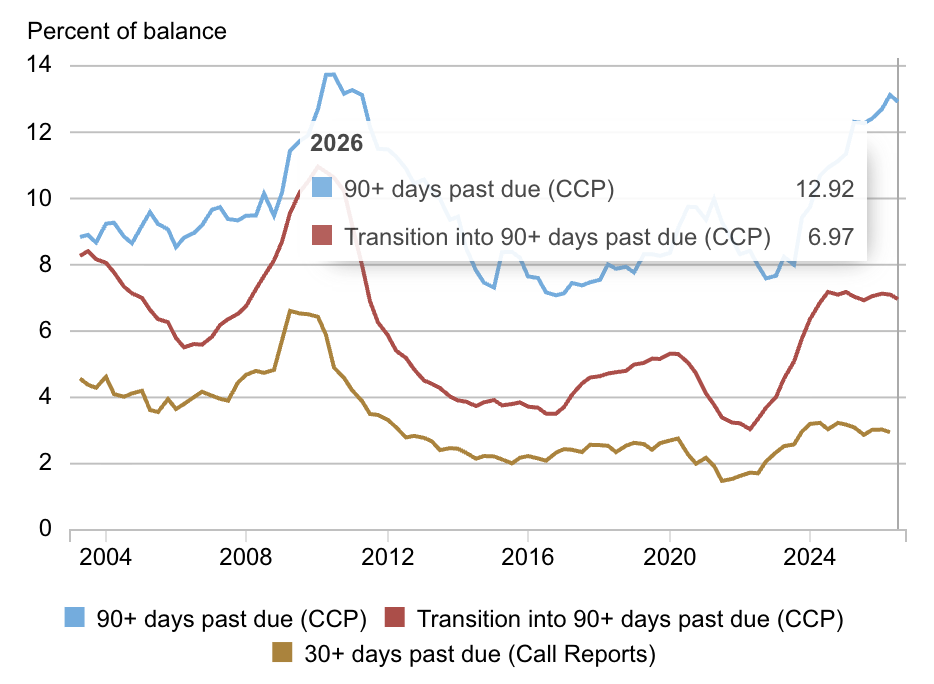
On consumer credit reports, the share of card balances 90 days or more past due climbed from 7.6% in Q3 2022 to 12.8% in Q1 2026.
New York Fed researchers attribute that rise mainly to charged-off debt lenders now report for longer, rather than to a fresh wave of missed payments.
Newly delinquent balances have been broadly stable since 2024, although the Fed still describes the pace as elevated.
July payrolls fell 23,000 and the prior two months were revised down by a combined 103,000.
Two figures from the same New York Fed release point in different directions. On consumer credit reports, the share of credit card balances 90 days or more past due has reached 12.8%, a level associated with the aftermath of the financial crisis, while the rate at which borrowers newly fall behind has barely moved in two years.

The Quarterly Report on Household Debt and Credit showed total household debt slipping $13 billion in the second quarter to $18.8 trillion, with 4.7% of balances in some stage of delinquency. Credit cards ran the other way, rising $21 billion, or 1.7%, to $1.26 trillion after a $25 billion seasonal decline in the first quarter.
About 175 million Americans hold a card and roughly 60% carry a balance rather than clearing it each month, at an average rate of 22.15% on balances accruing interest.
Against that, the delinquency figure looked severe. Between the third quarter of 2022 and the first quarter of 2026, the share of card balances reported on consumer credit files as 90 days or more past due rose from 7.6% to 12.8%, prompting concern that Americans were falling behind at rates not seen since the Great Recession.
The 12.8% is a stock measure, counting every delinquent balance currently on credit reports whenever it arrived. The flow measure counts only what newly turns 90 days late. A stock can keep climbing long after the flow into it levels off.
| Measure | What it counts | Latest reading |
|---|---|---|
| Stock delinquency, NY Fed | 90+ days past due on credit reports, including charged-off debt | 12.8%, Q1 2026 |
| Flow into serious delinquency, NY Fed | Balances newly turning 90+ days past due | 6.97% over the past year |
| Bank delinquency, Board of Governors | 30+ days past due on lenders’ books, with charge-offs removed | 2.92%, Q1 2026 |
New delinquencies accelerated after the pandemic and lifted both series together, then stabilised in early 2024. The flow flattened. The stock did not, and almost the entire increase since has come from severely derogatory balances, meaning accounts lenders have already charged off.
A charge-off leaves the lender’s books once and drops out of bank statistics, yet the borrower still owes it and the bureaus keep recording it. That is why the credit-report measure sits above the bank measure despite covering a later stage of distress.
Between 2004 and 2012, about 40% of charged-off debts were still reported a year later. By 2024 that had doubled to 80%, with no matching shift in the recovery rates published by the Consumer Financial Protection Bureau, which points to reporting practice rather than debt performance.
Strip those balances out and the credit-report series falls back into line with both the flow rate and the bank data.
None of this is an all-clear, and the New York Fed did not present it as one. About 6.97% of card balances moved into serious delinquency over the past year, against 6.93% a year earlier, a pace the Bank calls elevated and continues to monitor. More than 23 million Americans still carry charged-off card balances on their credit reports, which affects their borrowing costs regardless of how the aggregate is calculated.
Joelle Scally, an economic policy advisor at the New York Fed, said delinquency rates across most products have held steady over the past two years, while new delinquencies on credit cards and auto loans remain at elevated levels.
The sequence runs like this. Card distress genuinely worsened between 2022 and 2024. Since then it has been elevated but broadly flat, while the headline measure kept climbing because earlier bad debt never left the dataset. Researchers also noted that many households operate with little financial cushion between pay periods.
Repayment stress is manageable while income holds, and that is where the data has softened.
US payrolls fell 23,000 in July against expectations of a gain above 80,000, and against an average monthly gain of 34,000 over the prior year.
May and June were revised down by 66,000 and 37,000, leaving those two months 103,000 lower than first reported and the three-month average near 20,000. Unemployment eased to 4.1% from 4.2%, though the decline reflected a smaller labour force rather than stronger hiring. Participation fell to 61.4% and annual wage growth slowed to 3.2%.
Spending has held. Real consumer spending rose 0.4% in June, while the personal saving rate slipped to 2.7% from 3.0% in May.
The Fed’s framing points toward a different set of readings for tracking conditions from here.
Flow delinquency turning up. A climb from the current plateau would weaken the case that stress has stabilised.
Bank charge-offs accelerating. The commercial-bank rate was 4.01% in the first quarter, and increases there reflect fresh losses rather than accumulated ones.
Unemployment rising materially. Job losses are the most direct route from elevated stress to accelerating stress.
Real spending turning negative. Consumption has absorbed the strain so far.
Lending standards tightening. Lower limits and approval rates would reinforce a slowdown rather than cushion it.
Analysts generally trace the sequence in that order. Weaker employment reduces income, income weakness lifts new delinquencies, and softer discretionary spending tends to appear in the results of card issuers, consumer lenders and consumer-facing retailers before it reaches the wider economy.
On New York Fed consumer credit reports, 12.8% of outstanding credit card balances were reported as 90 or more days past due in Q1 2026, up from 7.6% in Q3 2022. Bank Call Report data cover a different population and remove charged-off loans.
Charged-off debt leaves lenders’ books and disappears from bank statistics, but stays on credit reports while the borrower still owes it. The two series capture different stages.
The New York Fed describes the pace as elevated but broadly stable since 2024, with about 6.97% of balances newly turning delinquent over the past year.
Balances stood at $1.26 trillion at the end of June 2026, up $21 billion in the quarter.
The 12.8% figure is not wrong. It is the wrong measure for one particular question. As a gauge of how much distressed debt Americans are carrying, the New York Fed still considers it useful, and it stays directly relevant to the more than 23 million people whose credit reports hold a charged-off card balance.
For the separate question of whether repayment stress is accelerating right now, the Fed points to the flow rate as the more accurate view of current behaviour. That series and the bank data currently say the same thing: stress is elevated and has stopped worsening. Whether that holds is likely to appear first in payroll and flow readings rather than in another increase in the delinquency stock.