Published on: 2025-12-31
Updated on: 2025-12-31
The stock market is heading into 2026 with two facts that sit side by side. First, U.S. equities are ending 2025 near record highs after another strong year. Second, valuations are already pricing in a lot of good news, which means 2026 will likely reward discipline more than excitement.
As of the U.S. close on December 30, 2025, the S&P 500 closed at 6,896.24, the Dow closed at 48,367.06, the Nasdaq Composite closed at 23,419.08, and the Russell 2000 closed at 2,500.59.
Based on these figures, below is a clear scenario map for the stock market forecast for 2026.
| Index | Bear case target (2026) | Base case target (2026) | Bull case target (2026) |
|---|---|---|---|
| S&P 500 | 5,300 to 5,900 | 6,700 to 7,500 | 7,600 to 8,250 |
| Nasdaq Composite | 18,000 to 20,500 | 23,000 to 26,000 | 26,500 to 29,700 |
| Dow Jones Industrial Average | 41,000 to 44,200 | 47,000 to 52,200 | 52,200 to 56,500 |
| Russell 2000 | 2,060 to 2,270 | 2,390 to 2,830 | 2,830 to 3,130 |
| Index | Dec 30, 2025 close | 52-week low | 52-week high |
|---|---|---|---|
| S&P 500 | 6,896.24 | 4,835.04 | 6,945.77 |
| Nasdaq Composite | 23,419.08 | 14,784.03 | 24,019.99 |
| Dow Jones Industrial Average | 48,367.06 | 36,611.78 | 48,886.86 |
| Russell 2000 | 2,500.59 | 1,732.99 | 2,595.98 |
2025 wasn't a quiet year, but it finished on a strong note.
The S&P 500 gained about 17.3% in 2025.
The Dow gained about 13.7% in 2025.
The Nasdaq gained about 21.3% in 2025.
The Russell 2000 gained about 12.1% in 2025.
That top end of the range matters because it tells you something simple: the market is not "cheap" in the way it would be after a major washout. It is expensive enough that 2026 needs either steady earnings growth, easier rates, or both.
Most yearly index moves come down to one equation: Index level = Earnings × Valuation multiple
Right now, earnings expectations are positive, but the valuation multiple is already elevated.
Late-December work shows two key points:
Analysts expect S&P 500 earnings growth of about 15% in calendar year 2026.
The S&P 500 forward 12-month P/E is at 22.5, which is above the 5-year average (20.0) and the 10-year average (18.7).
Analysts are also projecting S&P 500 EPS of $304.88 for CY 2026 (with $268.30 for CY 2025 at the time of the note).
Thus, much of the 2026 profit positivity is already reflected in the price.
When the market is priced this way, upside usually needs either (1) earnings to beat expectations, or (2) the P/E multiple to rise further, which typically requires rates to fall or risk appetite to surge.

Inflation (CPI) was up 2.7% over the past 12 months in November 2025.
In December, the Fed lowered its policy rate to a target range of 3.50 to 3.75.
The Fed's median estimate for the policy rate by the end of 2026 is approximately $3.4.
This tells the market something important: the "easy money" era isn't back. The base case remains a market that must contend with actual yields.
The unemployment rate was 4.6% in November 2025.
Real GDP growth was documented at 4.3% (annual rate) in the third quarter of 2025.
If unemployment continues to rise in 2026, the market will quickly begin to value lower profits.
The market is not cheap. According to the data above, the large-cap benchmark forward P/E is roughly in the low-20s (around 22.5 to 23.3 lately).
At a 22.5 forward P/E, the earnings yield is about 4.44% (100/22.5).
The yield on the 10-year Treasury was approximately 4.12% as of December 29, 2025.
So the "earnings yield minus 10-year yield" spread is only about +0.32%. That's not a big cushion if growth disappoints.
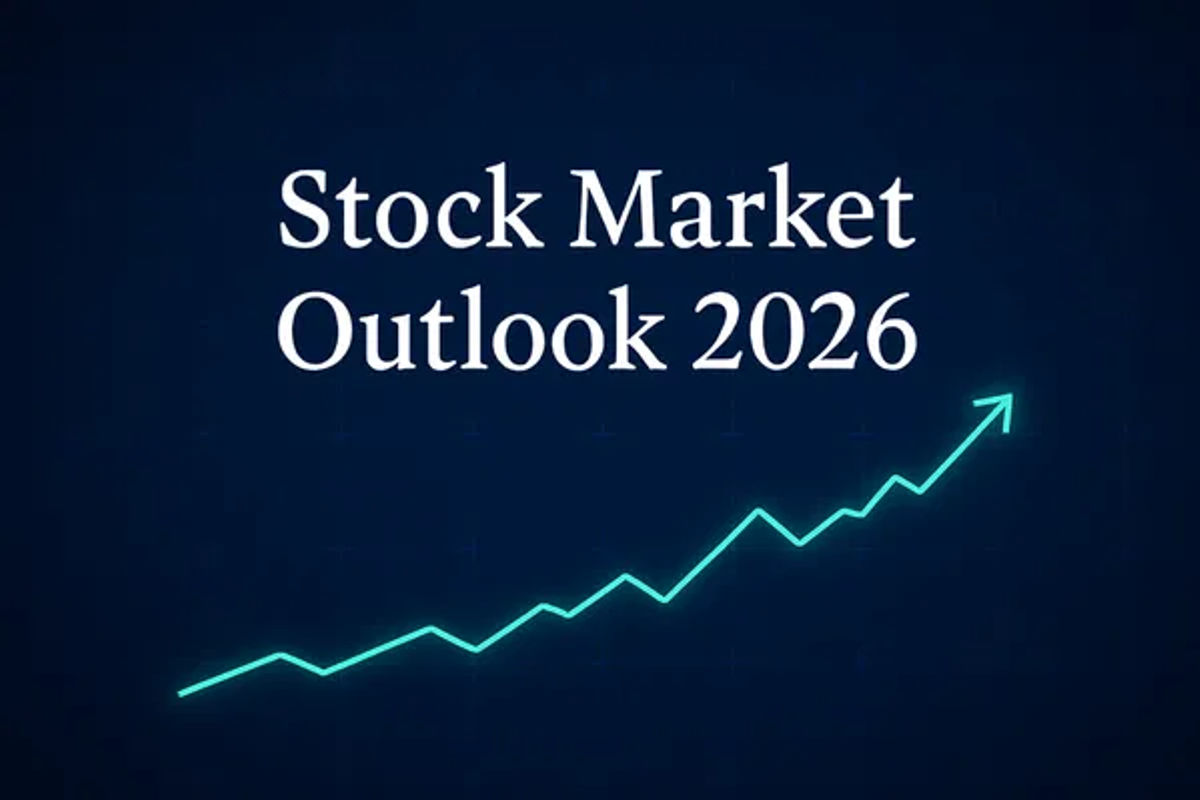 Base Case: What Has to Happen?
Inflation continues to decline, allowing the market to appraise earnings at a greater multiple without appearing reckless.
Earnings growth holds up close to expectations, and the growth spreads beyond a small group of mega-cap leaders.
Rate pressure stays contained, and the "high-yield alternative" does not pull capital away from equities.
A useful bull case trigger is the bond market. For example, a 10-year yield above roughly 4.6% iss a level where equities can start to struggle. If yields do not break higher, the bull case becomes easier.
Bull Case Targets
In the bull case, price typically clears the prior highs and holds above them, then transitions into a sustained trend, rather than briefly popping to new highs and quickly fading back below the breakout level.
S&P 500: 7,600 to 8,250
Nasdaq Composite: 26,500 to 29,700
Dow: 52,200 to 56,500
Russell 2000: 2,830 to 3,130
Those upper bands line up with common extension zones based on the 2025 range.
Bear markets usually begin with one of two problems: earnings fall, or rates rise, or both.
Inflation picks up again, and interest rates remain elevated for an extended period, more than what the markets desire.
Earnings disappoint because margins tighten, wage costs rise, or demand slows.
Market leadership narrows even further, so the index looks "fine" until it suddenly is not.
Bear Case Targets
In the bear case, the first serious test is usually a retracement toward the middle of the prior year's range.
S&P 500: 5,300 to 5,900
Nasdaq Composite: 18,000 to 20,500
Dow: 41,000 to 44,200
Russell 2000: 2,060 to 2,270
These bands sit near widely watched retracement zones based on the 2025 move.
A base case does not mean "boring." It often means a year with sharp swings, but limited net progress.
Earnings grow, but not enough to justify pushing valuations much higher from already elevated levels.
Rates drift lower in a slow, uneven way, which supports dips but does not fuel a straight-line rally.
The market rotates between sectors, creating opportunities for active traders even if the index is range-bound.
Base Case Targets
S&P 500: 6,700 to 7,500
Nasdaq Composite: 23,000 to 26,000
Dow: 47,000 to 52,200
Russell 2000: 2,390 to 2,830
The cleanest way for us to plan targets is to map where pullbacks tend to pause (support) and where rallies often stall (resistance).
| Index | First support zone (23.6% retracement) | Mid support (50% retracement) | Deep support (61.8% retracement) | First upside target (127.2% extension) |
|---|---|---|---|---|
| S&P 500 | ~6,448 | ~5,890 | ~5,641 | ~7,520 |
| Nasdaq Composite | ~21,840 | ~19,402 | ~18,312 | ~26,532 |
| Dow | ~45,990 | ~42,749 | ~41,301 | ~52,226 |
| Russell 2000 | ~2,392 | ~2,164 | ~2,063 | ~2,831 |
These levels are calculated directly from their 52-week low and high.
Simply put, if 2026 starts with a correction, the market will often try to stabilise near the first support zone, and then it will "decide' whether the move is a normal reset or the start of something worse.
It can be, but valuations are already high. Thus, 2026 needs solid earnings and a friendly rate backdrop to deliver strong upside.
The biggest risk is a valuation reset driven by rates. If inflation stays sticky and yields rise, equities can fall even if the economy does not crash.
A reasonable base case range is 6,700 to 7,500, with a bull case that pushes into the mid-7,000s to low-8,000s if earnings and rates align. The bear case risk sits in the mid-5,000s if the market de-rates.
In conclusion, the 2026 stock market outlook ultimately hinges on a tight trade-off: whether earnings can deliver, and how much investors are willing to pay for those earnings.
For traders, the practical edge in 2026 is not guessing headlines. It is staying level-driven. Use the prior year's highs as the breakout test, use the retracement zones as realistic support areas, and let the bond market confirm whether risk appetite is expanding or tightening.
Disclaimer: This material is for general information purposes only and is not intended as (and should not be considered to be) financial, investment or other advice on which reliance should be placed. No opinion given in the material constitutes a recommendation by EBC or the author that any particular investment, security, transaction or investment strategy is suitable for any specific person.