Published on: 2025-12-29
Updated on: 2025-12-31
DJT stock price prediction 2026 starts with a simple point: this is a headline-driven momentum stock, not a slow-and-steady mover.
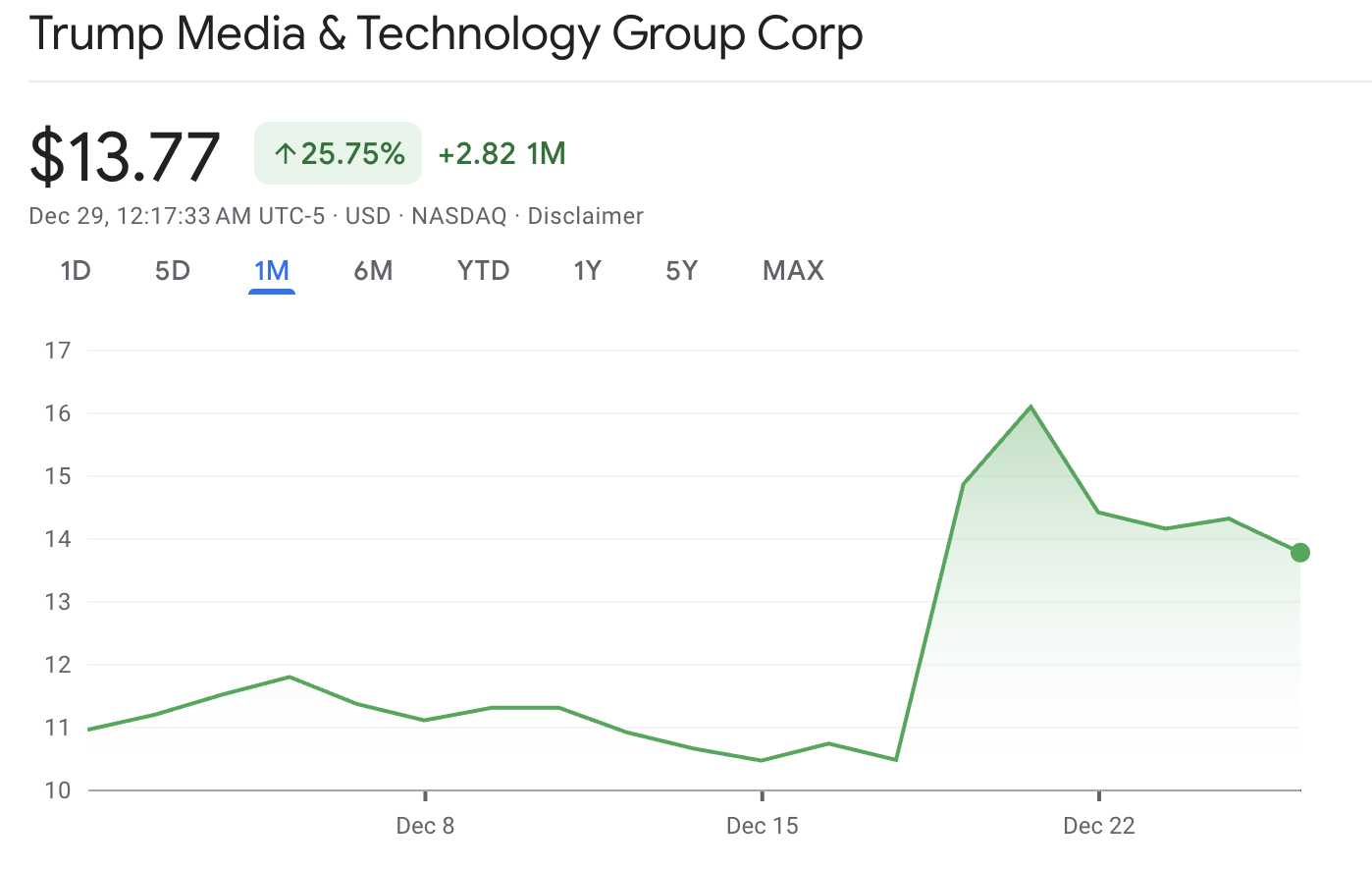
For example, after the mid-December surge tied to an announced $6 billion all-stock merger expected to close in mid-2026, the price snapped back into a choppy pullback and then settled into a tight, two-sided range.
Thus, according to the current framework, our bearish scenario for 2026 ranges from $8 to $12, the neutral scenario ranges from $10 to $23, and the optimistic scenario ranges from $23 to $36.
These represent trading areas, not guarantees, and DJT can shift between them rapidly as attention and liquidity fluctuate.
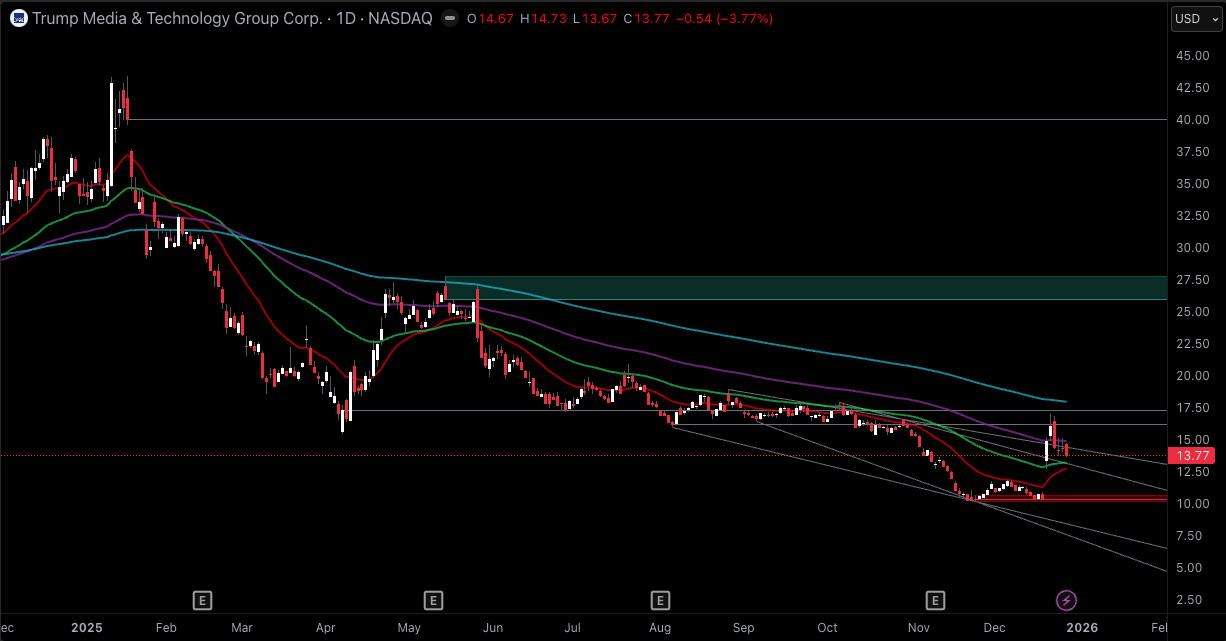
Last price (latest session): ~$13.77
52-week range: $10.18 to $43.46
Shares outstanding (as of November 5, 2025): 279,997,636
As of the latest session available (U.S. market close on December 26, 2025), DJT traded around $13.77, after printing an intraday high near $14.80 and a low near $13.68. Volume came in around 9.18 million shares, suggesting interest is still present, but uneven from day to day.
Using that share count and the latest price, DJT's market value is roughly $3.9 billion (simple price × shares). That gap between a multi-billion market cap and today's revenue base is a key clue to how the stock trades: sentiment and positioning can matter as much as fundamentals.
The company's most recent quarterly filing (quarter ended September 30, 2025) lays out three points traders should not ignore:
For the three months ended September 30, 2025, the filing shows net sales of $972.9 thousand (about $0.97 million).
In that same quarter, the filing indicates a net loss of approximately $54.8 million.
The balance sheet and management discussion feature significant financial assets and digital assets. As of September 30, 2025, the filing lists (in thousands):
Cash and cash equivalents: 166,072.7
Restricted cash: 335,838.8
Short-term investments: 550,421.7
Trading securities: 587,505.1
Digital assets: 1,466,689.0
Total assets: 3,265,266.5
The company also states it ended the quarter with $3,106,527.3 thousand of cash, equivalents, restricted cash, short-term investments, trading securities, and digital assets, alongside $950,769.1 thousand of debt (excluding lease liabilities).
It matters for 2026 because DJT is not just "a platform story." It also has meaningful exposure to digital-asset price swings and financing structure, and it openly flags risks tied to that strategy.
| Indicator (Daily) | Latest / Reference Value | What it suggests |
|---|---|---|
| Last price | $13.77 | Current reference price |
| Day high / low | $14.80 / $13.68 | Wide intraday range |
| Volume (latest session) | 9,176,454 | Active, but not "peak mania" |
| 20-day moving average | 12.14 | Short-term support zone |
| 50-day moving average | 12.98 | Near-term trend line |
| 200-day moving average | 17.92 | Major overhead resistance |
| RSI (14) | 56.69 | Neutral to mildly bullish |
| Stochastic %K / %D (14) | 56.02 / 57.44 | Mid-range, not stretched |
| ATR (14) | 1.05 | Big daily movement potential |
| Historical volatility (14) | 161.12% | Extreme volatility stock |
| 52-week high / low | 43.46 / 10.18 | Defines long-range map |
DJT is currently in an awkward spot:
Price is above the 50-day average (~$12.98), which supports short-term bounces.
The price is still well below the 200-day moving average (around $17.92), a classic technical sign that the longer-term trend remains under pressure.
That combination often produces sharp rallies that stall into overhead resistance.
On common daily settings:
14-day RSI: ~56.69 (neutral, slightly positive)
MACD (daily): around -0.05 on some feeds, which is close to flat and fits the "choppy momentum" feel.
If you trade DJT like a normal large-cap stock, it will punish you. The ranges are big:
14-day ATR: ~$1.05
ATR as % of price: ~7.63%
14-day historical volatility: ~161%
A simple way to read that: a normal daily move can easily be 7% to 8%, even when nothing "big" is happening.
Bigger swings usually need participation. Recent averages show that volume can surge and fade quickly:
20-day average volume: ~14.68M
50-day average volume: ~9.41M
When DJT rallies on weak volume, it is more likely to retrace.
These are calculated levels traders often use as quick decision zones.
Using High 14.80, Low 13.68, Close 13.77:
| Level | Price |
|---|---|
| Pivot | 14.08 |
| Resistance 1 (R1) | 14.49 |
| Resistance 2 (R2) | 15.20 |
| Resistance 3 (R3) | 15.61 |
| Support 1 (S1) | 13.37 |
| Support 2 (S2) | 12.96 |
| Support 3 (S3) | 12.25 |

2026 Target Zone: $8 to $12
What gets you there:
Price loses the $12.25 to $12.96 support pocket (pivot supports), then the market starts leaning on the $10.18 52-week low.
Any renewed dilution fear matters here. The filing describes an equity incentive plan that can increase the share pool each year starting in 2026, tied to a percentage of shares outstanding.
If digital-asset prices fall hard, DJT's balance sheet exposure can become a headline risk on its own.
2026 Target Zone: $10 to $23
What gets you there:
The price remains above the 52-week low, yet it has struggled to regain and maintain a position above the 200-day average (approximately $17.92), placing ongoing strain on the longer-term trend.
The tape maintains a recognisable pattern: sudden spikes, rapid fades, a consolidation phase, followed by another breakout effort.
Key levels inside this base range:
Support: $12.14 (20-day), then $10.18 (major low)
Resistance: $17.30 to $17.92 (Fib + 200-day), then $22.89 (Fib 61.8%)
2026 Target Zone: $23 to $36
Stretch Target (High Volatility Path): Retest $43+
What gets you there:
DJT reclaims the 200-day moving average (~$17.92) and holds it as support, not just a one-day poke.
Price clears $22.89, then pushes into $26.82 and $30.75.
Volume expands, and the daily ranges stay large (ATR stays elevated), which is how DJT tends to trend when it really moves.
For this to be a "clean" bull case, traders usually want at least one of these to improve:
clearer monetisation progress (revenue traction)
lower financing fear
fewer shocks tied to the digital-asset strategy
With 14-day historical volatility near 161% and an ATR of around $1.05, overly tight stop losses are prone to being triggered repeatedly.
Share-based compensation and plan expansions can change the supply picture over time. The document describes a yearly escalation process commencing in 2026.
Quarterly net sales below $1M compared to quarterly losses exceeding $50M represents a disconnect that can dampen sentiment when excitement wanes.
The narrative now revolves around significant digital-asset holdings and associated disclosures. The filing also warns that bitcoin's price can be highly volatile, and that those swings could materially affect results, and, by extension, the stock price.
The company discloses significant debt and restricted cash used as collateral, which can limit flexibility depending on market conditions.
$8 to $12 (bear), $10 to $23 (base range), $23 to $36 (bull), with an outside chance of a $43+ retest if a full trend reversal takes hold.
The key support levels traders watch are $13.37 (pivot support), $12.96, $12.14 (20-day average), and the major long-range level at $10.18 (52-week low).
The most important one is the 200-day moving average near $17.92, because it often decides whether rallies turn into trends or fail.
DJT stock has very high realised volatility, and its trading interest tends to surge in bursts rather than stay steady.
In conclusion, DJT's 2026 outlook is less about one perfect price target and more about how price behaves around a few high levels. Currently, the chart is signalling that a short-term bounce is plausible, but the bigger-picture trend remains a headwind as long as the price stays below the 200-day moving average.
At the same time, the filings suggest a company generating moderate revenue but still posting significant losses, with financial statements showing substantial involvement in digital assets.
If you trade DJT, treat it like what it is: a high-volatility vehicle. Use position sizing that can survive wide swings, and let the levels do the talking.
Disclaimer: This material is for general information purposes only and is not intended as (and should not be considered to be) financial, investment or other advice on which reliance should be placed. No opinion given in the material constitutes a recommendation by EBC or the author that any particular investment, security, transaction or investment strategy is suitable for any specific person.