Published on: 2025-12-30
Updated on: 2025-12-30
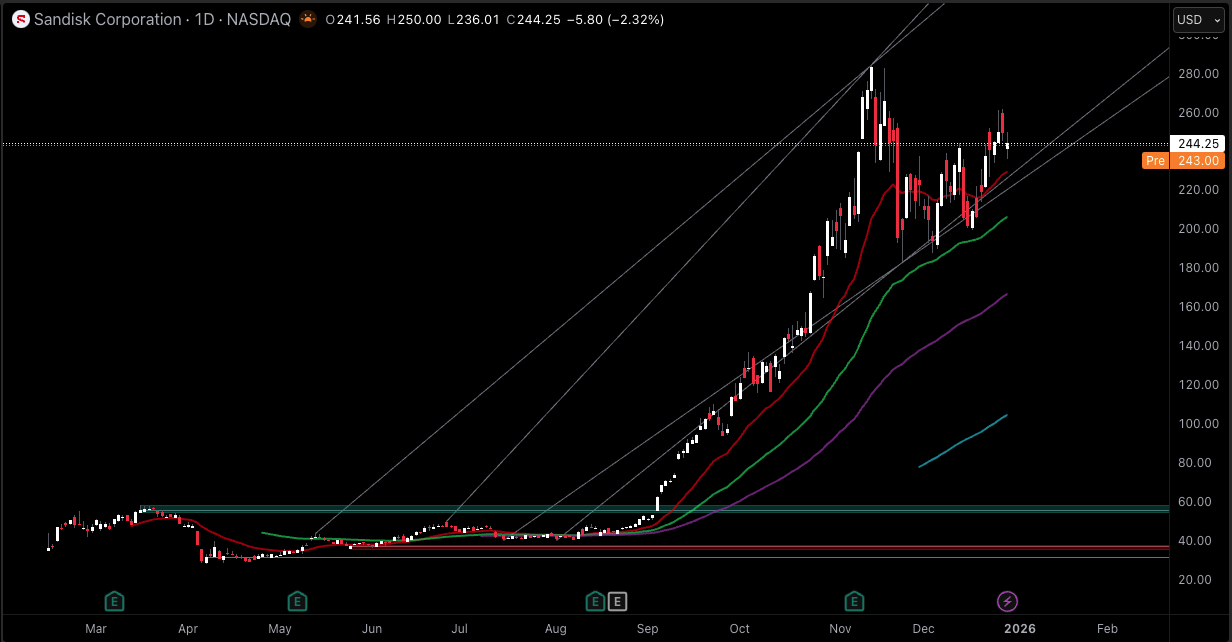
SanDisk stock (SNDK) last closed at $244.25, implying an equity value of roughly $36 bn using the company’s most recently reported share count. One widely used way to measure the move is from the first when-issued close of $36.00 to the latest close, which equals a +578% price gain.
That run began after Western Digital’s flash business was separated into a standalone company. A when-issued market started on February 13, 2025, and regular-way trading began on February 24, 2025, under SNDK.
By year-end, screens tracking S&P 500 constituents commonly ranked SNDK as the top-performing member on a year-to-date price basis, and it also entered the S&P 500 effective November 28, 2025.
The most direct AI link for SanDisk stock is not consumer gadgets. It is datacenter storage that feeds training data, checkpoints, vector databases, and inference logs. In fiscal Q1 2026, SanDisk reported $269m of datacenter revenue, +26% sequentially, and described active work across five major hyperscale customers (including multiple qualification tracks). [1]
The critical point is a mix. Datacenter-class SSD demand tends to be higher value per bit than commodity client devices, and mix shifts can move margins even when unit growth is ordinary.
SanDisk’s Q1 end-market split showed datacenter and edge both rising +26% sequentially, while consumer grew +11%, a pattern consistent with a cycle that is broadening beyond retail.
SanDisk’s fiscal 2025 results show how fast profitability moves when the NAND supply-demand balance tightens. Net revenue rose to $7.355 bn, and gross margin expanded to 30.1% from 16.1% in the prior year.
Management attributed the fiscal 2025 revenue increase to +6% exabytes sold and +4% ASP per gigabyte, which is the textbook recipe for a cyclical upswing: more bits sold and better pricing at the same time. [2]
Cost absorption matters as much as pricing. In fiscal 2024, SanDisk recorded $252m of reduced capacity utilization charges, versus $75m in fiscal 2025, which directly supported margin recovery.
This is why investors treat memory as a macro-like cycle: small changes in utilization can create large changes in earnings power.
Technology transitions decide which part of the cycle a supplier captures. In fiscal Q1 2026, SanDisk said BiCS8 represented 15% of total bits shipped and is expected to become the majority of bit production exiting fiscal 2026.
Faster ramps typically lower cost per bit, support higher-performance products, and reduce the risk that pricing gains are “given back” through higher manufacturing cost.
Guidance reinforced that point. For fiscal Q2 2026, SanDisk guided to $2.55 bn–$2.65 bn revenue and 41.0%–43.0% non-GAAP gross margin, a dramatic step-up from 29.9% in Q1 on the same non-GAAP basis. [1] That kind of margin inflection is a key reason SNDK stock rerated so quickly.
SanDisk’s filings and recent quarterly releases show a business that is recovering margins while still carrying the balance-sheet structure of a separation.
| Metric | FY 2025 | Q4 FY 2025 | Q1 FY 2026 |
|---|---|---|---|
| Revenue | $7,355m | $1,901m | $2,308m |
| GAAP Gross Margin | 30.1% | 26.2% | 29.8% |
| GAAP Net Income (Loss) | $(1,641)m | $(23)m | $112m |
| Non-GAAP EPS | n/a | $0.29 | $1.22 |
Two details keep the FY 2025 bottom line from being a clean read-through on operating momentum. First, FY 2025 included a $1.83 bn goodwill impairment, a large non-cash charge that makes GAAP net income look far worse than gross profit trends imply. Second, the cycle was still normalizing, with utilization charges and prior-year inventory actions distorting year-over-year comparisons.
At fiscal year-end, SanDisk reported $1.481 bn in cash and cash equivalents and $1.829 bn in long-term debt (plus $20m in the current portion). The core borrowing is a $2.0 bn term loan due in 2032, with an annualized interest rate of 7% as of fiscal year-end; the company reported $100m of scheduled and voluntary payments during FY 2025.
The separation structure also matters for supply and stock dynamics. Western Digital retained 19.9% of SanDisk’s shares and disclosed an intent to dispose of that stake within 12 months via exchanges or distributions, which can be a real technical overhang when blocks come to market.
Memory economics punish undisciplined capacity adds. SanDisk stated it maintained a conservative capital expenditure strategy in FY 2025 and FY 2024, but expects higher capital investments in FY 2026 as it transitions to newer nodes. Investors tracking SNDK stock should treat this as a gating factor: higher capex can raise near-term depreciation and cash needs, but it can also protect cost leadership if executed well.
SanDisk’s FY 2025 margin expansion was not only price-driven. The company highlighted improved pricing and mix, as well as a sharp drop in underutilization charges and the absence of a prior-year flash inventory write-down.
For analysts, the practical takeaway is that “spot NAND price” alone is not a full earnings model. The absorption of fixed costs often determines whether incremental revenue reaches the bottom line.
FY 2025 revenue by end market was Cloud $960m, Client $4,127m, and Consumer $2,268m, with cloud up sharply versus the prior year. In Q1 FY 2026, SanDisk reported stronger sequential growth in datacenter and edge than in consumer, and explicitly tied momentum to strengthening demand and its positioning within that demand.
This mix shift is the most important “economist’s angle” for SanDisk stock. When datacenter investment accelerates, it pulls forward demand for performance and endurance. That increases the value of leadership nodes and raises the payoff to a successful BiCS8 ramp.
Using the latest close near $244 and the company’s reported share count of 145,805,548, the implied equity value is about $36 bn. Against FY 2025 revenue of $7.355 bn, that is roughly 4.8x price-to-sales, which is a high multiple for a cyclical memory business unless the market believes margins will hold at a mid-cycle or late-cycle level for longer than usual.
SanDisk’s Q2 FY 2026 outlook included 41.0%-43.0% non-GAAP gross margin and $3.00–$3.40 non-GAAP EPS on about 155m diluted shares. That implies roughly $465m–$527m of quarterly non-GAAP net income. If pricing and utilization remain favorable, the earnings power embedded in the current stock price becomes easier to justify.
For SNDK stock, the next phase is not about proving that NAND is cyclical. The next phase is proving that AI-driven storage demand and product mix can extend the upcycle and reduce the depth of the next downturn. The proof points are concrete: sustained datacenter qualification wins, BiCS8 moving toward majority production, and gross margin holding closer to the 40% range than the 20% range.
SNDK’s price structure is consistent with a strong uptrend: it has traded from an all-time low of $27.89 to an all-time high of $284.76 since it returned to public markets. At the latest close near $244, the stock sits about 14% below that high, which is a relatively shallow drawdown for a name that has risen several-fold.
Technicians typically watch round-number zones and prior extremes when a stock is in price discovery. For SNDK stock, the obvious reference points are $285 (prior peak), the $250 area (recent trading congestion), and the low-to-mid $200s,where the stock has repeatedly found buyers during pullbacks. Day-level data also shows wide intraday ranges, such as a recent session with $236.01 low and $250.00 high, which signals elevated volatility and the need for disciplined position sizing.

The near-term setup is dominated by execution against guidance and the sustainability of margin expansion. A few items are especially high impact.
Margin delivery: Q2 guidance calls for a step change in gross margin to the low 40% range.
Datacenter traction: sequential datacenter growth and hyperscaler qualification updates matter more than consumer sell-through in an AI-led cycle.
BiCS8 scaling: moving from 15% of bits shipped toward majority production is a measurable cost and product competitiveness catalyst.
Capital intensity: higher FY 2026 capex can either strengthen the moat or compress free cash flow if pricing turns.
Share overhang mechanics: disposal of the retained 19.9% stake can add supply at times when momentum cools.
Risks remain cyclical and structural. The most important are NAND price reversals, aggressive industry capacity adds, execution risk on node transitions, customer concentration dynamics, and the fact that most revenue is generated outside the U.S., which adds FX and geopolitical sensitivity.
Using the first when-issued close of $36.00 and the latest close of $244.25, SanDisk stock is up about +578% on a price basis. The result changes if a different start date is used, but the year’s gain is still several-fold.
AI infrastructure increases storage demand because training and inference workflows generate large, rapidly growing datasets. SanDisk reported datacenter revenue up 26% sequentially in fiscal Q1 2026 and described active engagement across major hyperscale customers, making AI-linked storage a central driver.
NAND flash is cyclical because price and utilization swing with the supply-demand balance. SanDisk’s fiscal 2025 gross margin rose to 30.1% as pricing improved and utilization charges fell versus the prior year. Small changes in utilization can lead to large changes in profit.
BiCS8 is SanDisk’s current-generation flash technology ramp. Management said BiCS8 was 15% of bits shipped in fiscal Q1 2026 and should become the majority of bit production exiting fiscal 2026. Scaling advanced nodes typically reduces cost per bit and supports higher-value SSD products.
S&P 500 inclusion can increase passive fund ownership and daily liquidity because index funds must hold the stock. S&P Dow Jones Indices announced SNDK’s addition effective prior to the open on November 28, 2025, which can create one-time demand around the effective date.
The main risks are a NAND pricing downturn, higher-than-expected FY 2026 capex, and execution risk in the BiCS8 transition. Investors should also track the potential supply impact from the disposal of the retained 19.9% stake and the company’s floating-rate term loan cost.
SanDisk stock surged because two forces aligned: an improving memory pricing cycle and a structural demand tailwind from AI-linked storage. Financial results clearly show operating leverage, with FY 2025 gross margin expanding to 30.1% and Q2 FY 2026 guidance pointing to margins in the low 40% range on a non-GAAP basis.
What comes next is a test of durability. If datacenter traction and BiCS8 scaling keep mix and cost moving in the right direction, the market’s high multiple can remain defensible. If pricing softens while capex rises, the same leverage that lifted SNDK stock can work in reverse.
Disclaimer: This material is for general information purposes only and is not intended as (and should not be considered to be) financial, investment, or other advice on which reliance should be placed. No opinion given in the material constitutes a recommendation by EBC or the author that any particular investment, security, transaction, or investment strategy is suitable for any specific person.
[2]https://www.sec.gov/Archives/edgar/data/2023554/000202355425000034/sndk-20250627.htm