Published on: 2026-07-22
Updated on: 2026-07-23
Between 22 June and 17 July 2026, the price action in semiconductor ETFs looked like capitulation.
The Roundhill Memory ETF (DRAM) fell almost 40% from its peak, the iShares Semiconductor ETF (SOXX) shed 24%, the VanEck Semiconductor ETF (SMH) lost 20%, and the leveraged Direxion Daily Semiconductor Bull 3X Shares (SOXL) collapsed 61%. What followed was not the exodus that usually accompanies drops of that size.

Investors poured roughly $24.7 billion into the four funds in under a month, and the buying stayed heavy even as the selloff deepened. Then, on 21 July, chip stocks ripped higher. The question that buying implicitly asked is now being tested in real time: did $25 billion of dip-buying call the bottom, or merely interrupt a deeper reset?
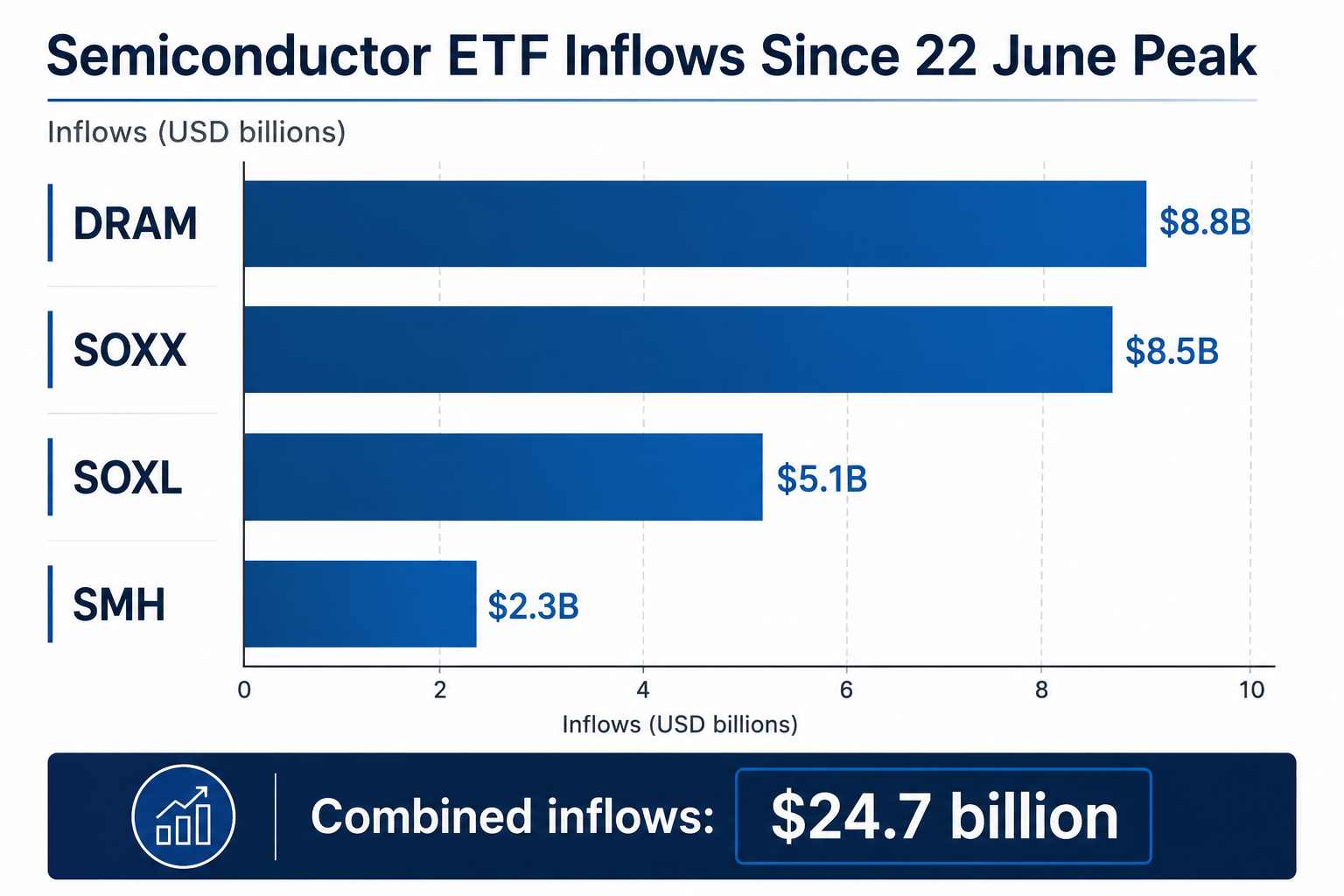
Roughly $24.7 billion flowed into DRAM, SOXX, SOXL and SMH in under a month, even as those funds fell 40%, 24%, 61% and 20% from their 22 June peaks.
The buying stayed heavy as prices fell, offsetting nearly all of DRAM’s losses in assets terms rather than turning to redemptions.
The bull case rests on tight memory supply through 2028 and hyperscaler AI-era capital spending estimated in the hundreds of billions of dollars for 2026; the bear case is that crowded positioning and leveraged products leave the sector exposed to a violent unwind.
Chip stocks rebounded hard on 21 July, with the PHLX Semiconductor Index up 5.21% and Micron back above a $1 trillion valuation, but the index stayed below its June peak and key technical levels.
Strategists have framed the selloff as a technical positioning washout rather than a broken thesis, so upcoming AI-spender and chipmaker earnings, not the single-day bounce, will decide whether the dip-buyers called it right.
The scale of the inflows is striking. According to an ETF flow data, DRAM took in $8.8 billion, SOXX $8.5 billion, SOXL $5.1 billion and SMH $2.3 billion over the stretch from the 22 June peak, a combined $24.7 billion. The memory fund is the clearest illustration of the dynamic.
DRAM lost close to 40% of its value, yet its assets under management sat at about $23.4 billion afterward, only a shade below the late-June peak of $25.9 billion. Inflows had almost entirely offset the market losses. Money was arriving fast enough to fill the hole that falling prices were digging.
The buying did not slow as the selloff deepened. In the week ending 17 July, with prices still sliding, SOXX and DRAM added another $2.4 billion and $1.7 billion respectively, according to weekly ETF flow data.
By 20 July, SOXX’s month-to-date intake of about $6.13 billion was its largest in records going back to 2018, and it came in a month the fund was down roughly 18.6%, on pace for its worst since November 2008.
Bank of America’s semiconductor analyst Vivek Arya characterised the decline as a summer reset rather than a fundamental reversal, and the reporting around his note captured the mood plainly: prices cratered and money rushed in, with investors leaning into the AI trade’s most crowded corner rather than fleeing it.
That is not how capitulation usually looks. It is how conviction, or stubbornness, looks.
The buyers were betting on supply, not the chart, on the view that the memory cycle has further to run and capacity is genuinely tight.
JPMorgan’s Mislav Matejka judged the sector to be approaching oversold territory and saw no meaningful new supply before 2028, and reports citing Goldman Sachs went further, describing the shortage building through 2026 as potentially the sharpest in roughly fifteen years.
Micron had contracted its entire high-bandwidth memory supply for calendar 2026 before the year began and has since raised its fiscal-2026 capital-spending forecast to around $27 billion to chase it, yet capacity cannot answer a price spike quickly: Micron did not expect first wafer output from its new Idaho fab until mid-2027, with further US supply later still.
From that vantage point, a 40% drawdown in a fund tracking the memory names is not a warning; it is a discount on an ongoing structural build-out.
The valuations give that argument teeth. Around the mid-July lows, one contemporaneous reading put Micron at roughly six times forward earnings and SanDisk near eight, both a fraction of the broad market’s 19-to-21-times forward multiple.
Behind those numbers, Micron’s fiscal third-quarter revenue reached $41.5 billion, up from $9.3 billion a year earlier, with a GAAP gross margin above 80%. That is not the profile of a company whose earnings are collapsing.
The demand side has been telegraphed loudly. Analyst estimates of combined 2026 capital spending for the largest hyperscalers, generally Alphabet, Amazon, Microsoft and Meta, run toward $700 billion or more, with a large share earmarked for AI infrastructure and data-centre capacity.
For an investor who believes that spending is real and durable, the summer selloff reads as an entry point in a story that has not changed, more a positioning washout after a huge year-to-date run than a break in the underlying setup.
The counterargument reads that same cheap multiple the other way. Memory is the most cyclical corner of semiconductors, and a collapsing forward multiple there has historically been a warning rather than a discount, because it falls when the market senses the earnings underneath it are about to shrink.
Micron has walked this path before, looking cheapest in its most profitable years just before the cycle rolled over. A single-digit multiple can mean the shares are cheap, or that the market does not believe the current earnings will last.
The way investors bought this dip compounds the risk. Capital crowded in so quickly that any wobble in AI spending could trigger a disorderly unwind, and the leveraged corner amplifies the danger: SOXL, built to deliver three times the daily move of its benchmark, fell 61% over the drawdown, a reminder that daily-exposure products inflict lasting damage when held through a slide.
Concentration is the quieter risk, and it sits where the money went. The memory ETF that drew the most cash carries the least diversification, with roughly 70% of its company exposure in three names, Micron, SK Hynix and Samsung, at nearly double the fee of a broad chip fund; when those three move together, as they did on the way down, there is nowhere in the portfolio to hide.
History offers a sobering reference point. In the 2022 drawdown, SOXX fell roughly 46% peak to trough, and Arya counted nine declines of more than 10% in the chip index since ChatGPT launched in late 2022, averaging about 14% over roughly a month each. Dip-buying has often been rewarded in this cycle, but a single bounce proves little about whether the low is in.
On 21 July, the PHLX Semiconductor Index rose 5.21%, led by memory and storage shares. Micron jumped about 12% and returned to a $1 trillion market capitalisation, while SanDisk and Western Digital posted strong gains.
The rally built on a Monday recovery from oversold conditions and coincided with a strong opening to earnings season, with the large majority of the S&P 500 companies that had reported by that point beating profit expectations. On the surface, it looked like vindication for the buyers.
The detail that complicates that reading is where the index actually sits. Even after the bounce, the SOX remained well below its June peak and beneath its 50-day moving average, having fallen more than 20% from its June high into what qualifies as a bear market before recovering.
Strategists have been careful to frame the pullback as technical rather than fundamental, a positioning flush rather than a change in the thesis, and reporting pointed to hedge funds having cut their semiconductor and AI-related exposure sharply during the decline.
A rebound from oversold conditions after a forced-selling episode is a familiar pattern, and it is not the same thing as a confirmed bottom.
The rebound alone does not resolve the question; the coming weeks will. Earnings from the major AI spenders and chipmakers are the real test of whether the crowded-trade flush has cleared or merely paused.
If hyperscaler capital-expenditure guidance holds and memory pricing stays firm, the $25 billion of dip-buying will look prescient and those cheap multiples should re-rate higher. If spending softens or price increases slow, as one of Morgan Stanley’s July memory notes cautioned when it flagged a peaking rate of change, the inflows will look like an early call in a reset that had further to run.
For now, the two facts sit uneasily together. Investors committed roughly $25 billion on the way down, and the market has bounced but not healed. Whether that was conviction rewarded or conviction tested will be decided by fundamentals, not by a single strong session. The buyers have placed their bet, and the market has not yet paid it out.