Published on: 2026-03-18
Updated on: 2026-03-18
AI infrastructure and the energy supercycle have converged into a unified investment theme by 2026. The market has shifted beyond the traditional view of AI as primarily a software or chip-driven narrative.
What matters now is whether companies can secure enough power, cooling, and physical capacity to turn AI demand into durable revenue.
The St. Louis Fed found that AI-related investment categories accounted for 39% of total US GDP growth in the first three quarters of 2025, while a separate Federal Reserve note showed AI-related trade topped $272 billion in the first half of 2025, up 65% from a year earlier.
AI infrastructure spending has become one of the primary drivers of US economic growth in 2026
Power availability has overtaken chip supply as the dominant constraint on AI expansion
The energy sector is repricing to reflect its role as essential AI infrastructure, not just utilities
Investors who understand the chip-to-grid value chain are best positioned for what comes next
Although the scale of AI capital expenditure may seem abstract, its practical implications remain highly significant for investors.
The Big Four hyperscalers, Meta, Alphabet, Amazon, and Microsoft, are projected to spend over $650 billion on capital expenditures in 2026, and the spending is not limited to chips. It extends to power grids and cooling systems required to sustain them.
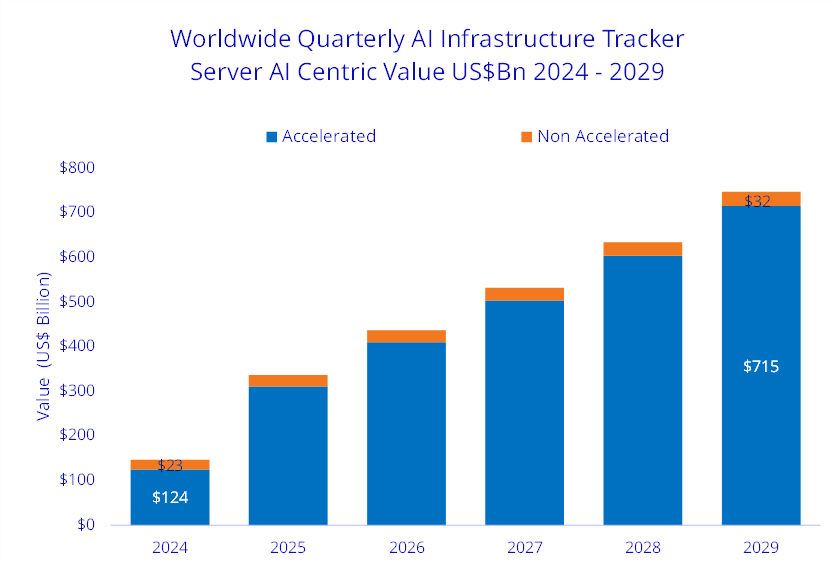
The global data center sector is expected to expand at a 14% compound annual growth rate through 2030, with roughly 100 gigawatts of new capacity projected to come online between 2026 and 2030, effectively doubling the world’s installed base.
This forecast is based on signed contracts, committed capital expenditures, and lease agreements, all supported by historically robust corporate balance sheets rather than speculative projections.
Analysts characterize the industry as entering the initial phase of a potential $3 trillion global infrastructure supercycle from 2026 to 2030, with approximately $1.2 trillion in real estate asset value creation alone.
Power availability has become the main constraint on AI expansion. As workloads move from pilot programmes to large-scale training and inference, electricity demand is rising faster than much of the ageing US grid can absorb.
The issue is no longer limited to chips. Data centre growth now depends on grid access, substations, cooling, backup systems, and the ability to deliver reliable power to increasingly dense computing clusters.
That is why the market has started to shift its attention from semiconductor supply alone to the wider energy and infrastructure chain. In 2026, compute is only as valuable as the power that keeps it running.
One of the biggest mistakes in this theme is reducing it to nuclear alone. Nuclear has strategic importance because it offers firm, low-carbon baseload generation, and hyperscalers clearly understand that.
Microsoft’s long-term agreement with Constellation helped advance the restart of Three Mile Island Unit 1, now called the Crane Clean Energy Center, showing that tech companies are moving upstream into power procurement rather than waiting for the grid to catch up.
But the broader winners are more diverse. AI infrastructure also rewards companies exposed to switchgear, backup power, liquid cooling, power conversion, and high-density rack architecture.
Eaton says it is working with Nvidia on design best practices, reference architectures, and power management solutions to support high-density GPU deployments and the move toward high-voltage direct current systems for AI factories.
This represents a fundamental market shift. While NVIDIA remains central, the focus has expanded beyond silicon leadership to include the ability to accelerate power delivery, deployment, and monetization.
Understanding the thesis is one thing. Knowing where it is showing up in markets is another. The AI infrastructure and energy supercycle is increasingly visible across three key industry groups.
This remains the core layer of the AI trade, as demand for advanced chips and server capacity continues to drive investment. But the story is now bigger than compute alone.
Electricity supply has become a strategic bottleneck for AI expansion. That is pushing energy producers, grid operators, and power-related infrastructure closer to the centre of the investment theme.
Power distribution, thermal management, and data centre hardware are becoming essential parts of the buildout. These industries sit directly at the point where AI demand must be turned into operating capacity.
The chip-to-grid opportunity encompasses more than these industries. Investors seeking exposure to the AI infrastructure and energy supercycle should understand each segment of the value chain:
| Layer | What It Covers | Key Names |
|---|---|---|
| Compute | GPUs, custom silicon, HBM memory | Nvidia, AMD, SK Hynix |
| Power Management | Grid-to-chip distribution, UPS, cooling | Eaton, Vertiv, Schneider Electric |
| Energy Generation | Always-on, carbon-free baseload power | Constellation Energy, Talen Energy |
| Data Center REITs | Physical infrastructure, colocation | Equinix, Digital Realty |
| Copper and Materials | Cabling, power distribution infrastructure | Freeport-McMoRan, Southern Copper |
The materials layer is the least-discussed angle of this trade and arguably the most supply-constrained.
Data center copper demand alone could reach 572,000 tonnes annually by 2028, roughly equivalent to adding a new top-tier mining nation to global supply in under four years.
Meanwhile, two major industrial suppliers committed a combined two billion dollars to US power equipment manufacturing in early 2026, specifically citing AI-driven demand signals as the basis for those decisions.
The AI trade is entering a more disciplined phase in 2026. The Federal Reserve says AI has become a key driver of the global economic outlook, supported by an exceptional wave of infrastructure commitments, which means the market is no longer trading a narrow software theme but a broader industrial buildout.
The Department of Energy says data centers used 176 terawatt-hours of US electricity in 2023 and could reach 325 to 580 terawatt-hours by 2028, while its policy hub frames rising load from data centers and AI as a central part of the new electricity-demand cycle.
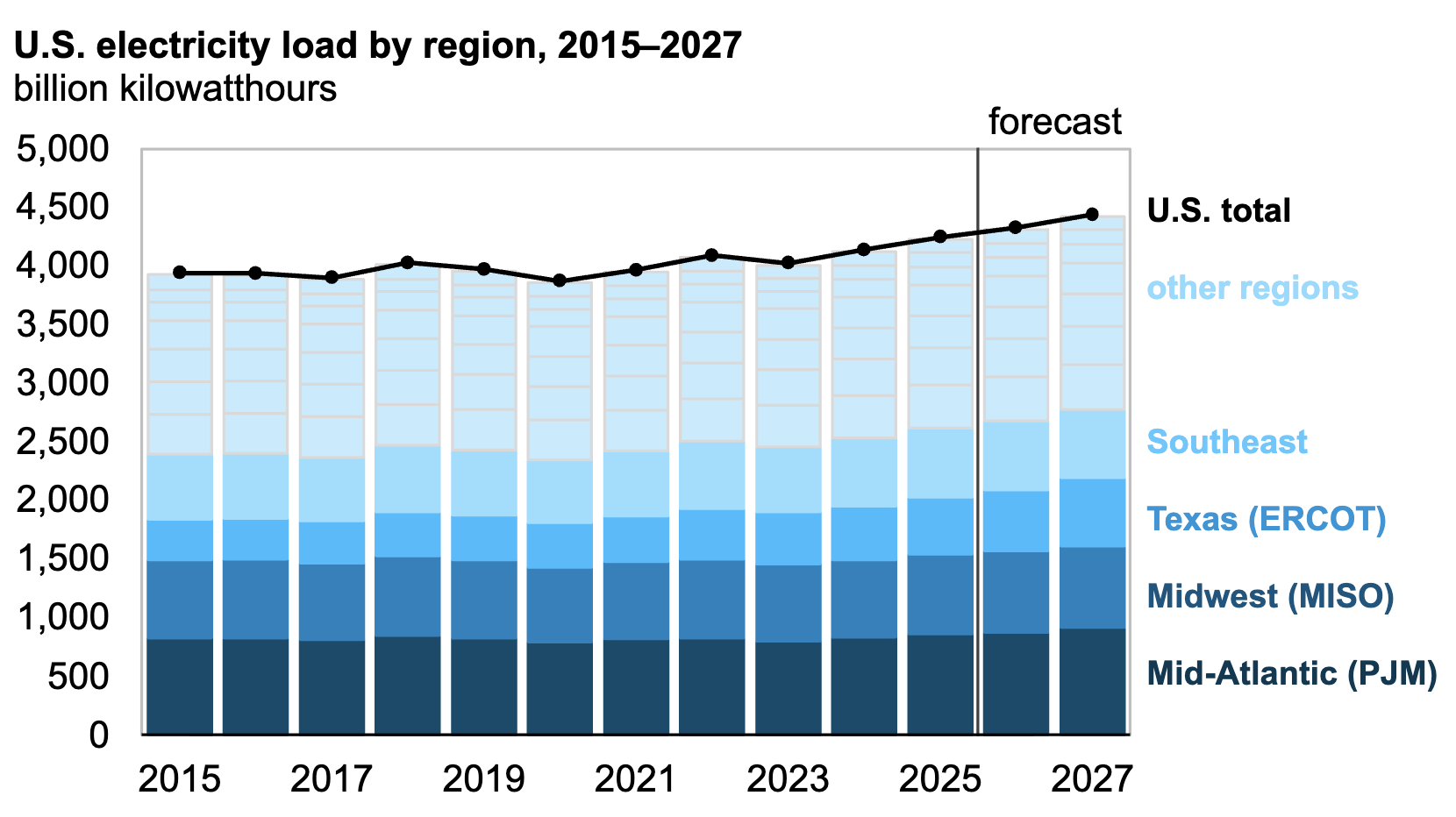
DOE’s AI infrastructure recommendations note that hyperscale facilities are already seeking roughly 300 to 1,000 megawatts with lead times of one to three years, which is stretching local grids and pushing investors to pay closer attention to generation, transmission, substations, cooling, and interconnection rather than chips alone.
A comprehensive market outlook must address potential risks to maintain analytical rigor.
Return-on-investment scrutiny: The market is transitioning into a show-me phase. Companies must translate record capex into tangible earnings growth or face multiple compressions.
Grid constraints: Approximately 70% of the US grid is approaching the end of life, and the gap between AI power demand and grid delivery capacity is the most tangible near-term constraint on the supercycle.
Geopolitical and tariff risk: US export controls on advanced AI chips to China remain a significant revenue risk for semiconductor names, while evolving tariff policy represents a broader black swan for the entire infrastructure supply chain.
Inference shift: A significant workload shift is anticipated in 2027, when inference could overtake training as the dominant AI requirement, redistributing demand from centralised clusters to distributed regional hubs and potentially reshuffling which infrastructure assets matter most.
It refers to the multi-year, multi-trillion-dollar buildout of data centers, power generation, and supporting hardware required to run large-scale AI workloads.
AI is the convergence point of productivity competition, the energy endgame, and geopolitical rivalry. Compute equals power, and power availability now determines where and how fast AI infrastructure can be deployed. Without reliable energy, the chips sit idle.
Utility companies with behind-the-meter nuclear deals and power companies have become unlikely darlings of tech investors.
Unlike the dot-com era, where companies spent on unproven business models, the 2026 spending is backed by the strongest balance sheets in corporate history and verified enterprise demand.
Power availability, rather than land or capital, has emerged as the dominant limiting factor shaping where, when, and how data centers can be developed. Competitive advantage is increasingly accruing to operators who can secure energy early and navigate utility timelines.
The revised investment case is straightforward. AI infrastructure is no longer a narrow semiconductor theme, and the energy supercycle is no longer a side story for utilities specialists. They now describe the same capital cycle.
Hyperscalers are investing at unprecedented levels, data centre demand is increasing faster than power systems can accommodate, and the market is broadening from compute to the entire physical stack required for large-scale AI deployment.
Disclaimer: This material is for general information purposes only and is not intended as (and should not be considered to be) financial, investment, or other advice on which reliance should be placed. No opinion given in the material constitutes a recommendation by EBC or the author that any particular investment, security, transaction, or investment strategy is suitable for any specific person.
https://www.stlouisfed.org/on-the-economy/2026/jan/tracking-ai-contribution-gdp-growth
https://earth.org/energy-transition-where-are-we-headed-in-2026/