Published on: 2026-06-24
Chip ETFs fell nearly 8%. NVIDIA dropped more than 4%. QQQ lost more than 3%. Yet long-term Treasury bond ETF TLT barely moved higher, gold fell by less than 2%, small caps slipped by about 1%, and the broader S&P 500 ETF declined by around 1.4%.
If rates were the whole problem, why did the damage look so uneven?
The Fed gave markets a reason to reduce risk, but the selling did not hit every asset equally. SOXX’s 7.9% drop, TLT’s 0.15% rise, and semiconductors’ crowded-trade signal show why headlines rarely explain the whole move.
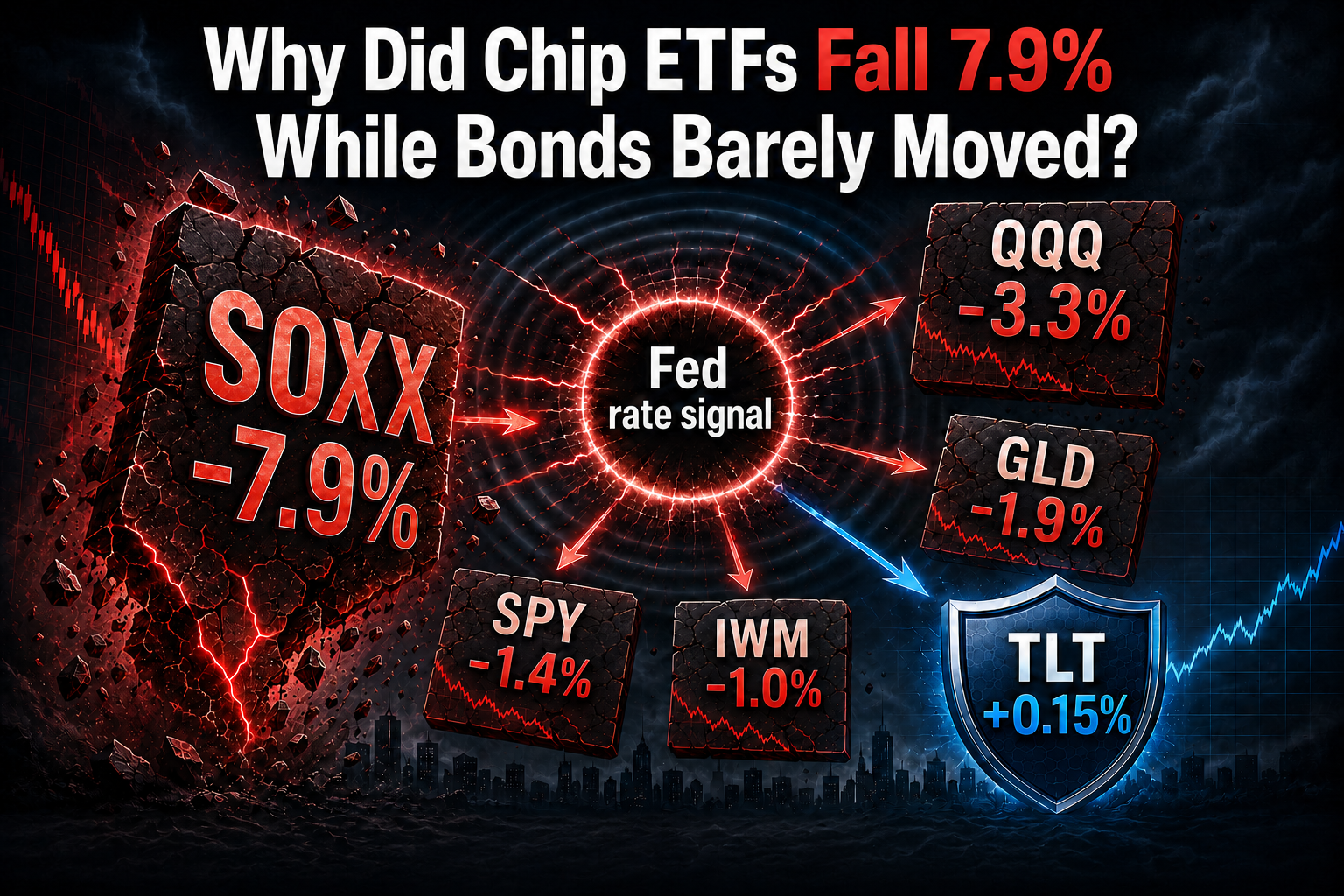
SOXX fell 7.9% while TLT rose 0.15%, showing the selloff was concentrated rather than market-wide.
SOXX remained up 100.4% year-to-date even after the drop, suggesting expectations were already extremely high.
A Bank of America survey showed 80% of fund managers viewed semiconductors as the market’s most crowded long trade.
TLT’s stability suggests investors were not simply dumping every rate-sensitive asset.
The Fed explains the trigger, but SOXX’s 100.4% YTD gain and crowded-trade signal help explain why the damage landed hardest in chips.
The Federal Reserve kept its target range for the federal funds rate at 3.50% to 3.75% at its June meeting, while saying inflation remained above its 2% goal. That gave markets a rate-related reason to reduce risk. Higher-rate fear can make investors less willing to hold assets that depend heavily on future growth, easy financing, or very optimistic earnings expectations.
But a Fed headline cannot fully explain why SOXX fell much harder than SPY, IWM, GLD, or TLT. The Fed gave investors a reason to sell. It did not tell them what to sell. The market decided that part on its own.
The table below shows that the sell-off was concentrated in chips and growth-heavy tech, not evenly spread across all rate-sensitive assets.
| Asset | What It Represents | Move |
|---|---|---|
| SOXX | Semiconductor ETF / chip stocks | -7.9% |
| NVDA | AI chip leader | -4.1% |
| QQQ | Growth-heavy Nasdaq stocks | -3.3% |
| GLD | Gold ETF | -1.9% |
| SPY | Broad U.S. stock market | -1.4% |
| IWM | Small-cap stocks | -1.0% |
| TLT | Long-term Treasury bonds | +0.15% |
SOXX fell almost six times as much as SPY. QQQ fell more than twice as much as SPY. TLT did not fall at all. GLD was pressured, but nowhere near the scale of the chip-stock move. That spread shows the market was not selling every asset with the same force.
SOXX was the clearest pressure point because it sits directly inside one of the market’s strongest trades: semiconductors and AI infrastructure. MarketWatch reported that SOXX fell 7.9% during the selloff and that all 30 components of the ETF declined. Even after that drop, SOXX was still up 100.4% year-to-date, compared with a 16.6% gain for the S&P 500 information technology sector.
That is the strongest number in the story. It shows how much optimism investors had already priced into semiconductors before the Fed shock arrived. When an asset has already risen that much, investors may have less patience for bad news. A rate signal can become the excuse to take profit, cut exposure, or question whether expectations moved too far too quickly.
There was also broader evidence of heavy enthusiasm around the chip trade. Bank of America’s fund-manager survey found that a record 80% of respondents viewed semiconductors as the most crowded long trade, while ETF.com reported that the VanEck Semiconductor ETF, SMH, nearly broke $7 billion in single-day net flows during the same stretch of semiconductor enthusiasm.
That evidence strengthens the argument that semiconductor stocks entered the selloff with unusually high investor enthusiasm. It does not prove that crowding was the only reason SOXX fell. A clearer explanation is that investors had already piled heavily into the AI and semiconductor trade, making it more vulnerable when sentiment shifted.
For traders comparing concentrated chip exposure with broader ETF exposure, SOXX.OQ and SMH.OQ is listed among EBC’s ETF CFD instruments, which allows users to track semiconductor themes through a basket rather than selecting individual chip stocks.
TLT barely moving was the first clue that the selloff was not a pure rate panic. Long-term Treasury bond ETFs can fall when investors expect higher rates, yet TLT edged up 0.15% while SOXX dropped 7.9%. That gap suggests investors were not simply dumping every asset tied to interest-rate expectations.
Gold, small caps, and the broader market confirmed the same message. GLD fell about 1.9%, IWM slipped around 1.0%, and SPY declined roughly 1.4%. Those moves showed pressure, but not the kind of indiscriminate liquidation that would explain an almost 8% collapse in chip ETFs.
The pattern separates the trigger from the target. The Fed gave investors a reason to reduce risk, but the heaviest selling landed where expectations were already most stretched. Bonds were stable, gold and small caps were only moderately weaker, and the broad market held up far better than semiconductors.
If rates were the whole story, the damage would have looked broader. Instead, the tape pointed to a crowded-chip reset.
A beginner may look at the selloff and say, “The Fed caused it.” That is not wrong, but it is incomplete. A better market reader asks why one asset fell much more than another.
Markets react to news through the expectations investors already had before the headline arrived. If an asset has surged, attracted heavy inflows, and become a favourite trade, it can fall harder when the mood changes. If another asset still has defensive demand, like long-term Treasury bonds, it may hold up even when the headline sounds rate-negative.
The contrast between SOXX and TLT is the point. SOXX showed that optimism had been high, and selling pressure had become severe. TLT showed that the market was not in a pure rate panic.
The news starts the move. Expectations decide where the damage lands.
Higher rates can make borrowing more expensive and reduce how much investors are willing to pay for future earnings. Growth stocks can be more sensitive because much of their value often depends on expected future earnings.
Bond ETFs can react to both rate expectations and safety demand. Higher-rate fear can pressure long-term bonds, but stock-market weakness can also create demand for Treasuries. TLT’s stability suggested the selloff was not a pure rate panic.
Chip stocks had already rallied strongly and were closely tied to expectations for AI infrastructure. SOXX was still up more than 100% for the year after the drop, while fund-manager survey data showed semiconductors had become a crowded long trade. That made the group more vulnerable when sentiment changed.
Yes. Chip ETFs can fall because of rate pressure, profit-taking, weaker earnings expectations, geopolitical risk, or broad tech selling. Crowding is not the only explanation. It is one useful clue because SOXX had already risen sharply, and semiconductors were identified as a crowded long trade.
The next test comes at the July 28–29 FOMC meeting, when traders will again have to decide whether a rate signal deserves broad selling or only a reset in the market’s most crowded trades.
If SOXX falls harder than SPY, GLD, IWM, and TLT again, the message will be hard to ignore: the headline may come from the Fed, but the damage lands where optimism was already stretched.
Federal Reserve June 17, 2026 FOMC statement: rates held at 3.50%–3.75%; inflation remained elevated relative to the 2% goal. (federalreserve.gov)
MarketWatch: SOXX fell 7.9%, all 30 components declined, and SOXX was still up 100.4% year-to-date after the drop. (marketwatch.com)
MarketWatch on Bank of America fund-manager survey: 80% of respondents viewed semiconductors as the most crowded long trade; SOXX was up 99% for the year at that point. (marketwatch.com)
ETF.com: SMH nearly broke $7 billion in single-day net flows amid semiconductor enthusiasm. (etf.com)