Published on: 2026-06-23
Updated on: 2026-06-23
SMH vs SOXX is really a choice between two ways to own the same trade. Both semiconductor ETFs hold the companies behind chip design, foundry production, memory, AI infrastructure, and the equipment that builds it all. What separates them is construction.
The VanEck Semiconductor ETF (SMH) concentrates capital in the largest AI-linked chip leaders. The iShares Semiconductor ETF (SOXX) spreads the same theme across a wider basket.
In 2026, that distinction carries more weight than it used to. The chip cycle has widened beyond GPUs into high-bandwidth memory, foundry capacity, networking silicon, advanced packaging, and wafer-fabrication equipment. With both funds charging near-identical fees, the decision turns on exposure, concentration, valuation, and how much these holdings already overlap with what you own.
SMH is the larger, more concentrated fund, with roughly $78.4 billion in net assets, 26 holdings, and NVIDIA near 18.3% of the portfolio.
SOXX is the broader option, with about $47.0 billion in net assets, 30 holdings, and meaningful weight in semiconductor equipment.
Fees barely differ: 0.35% for SMH and 0.34% for SOXX, which makes fund structure the real decision, not cost.
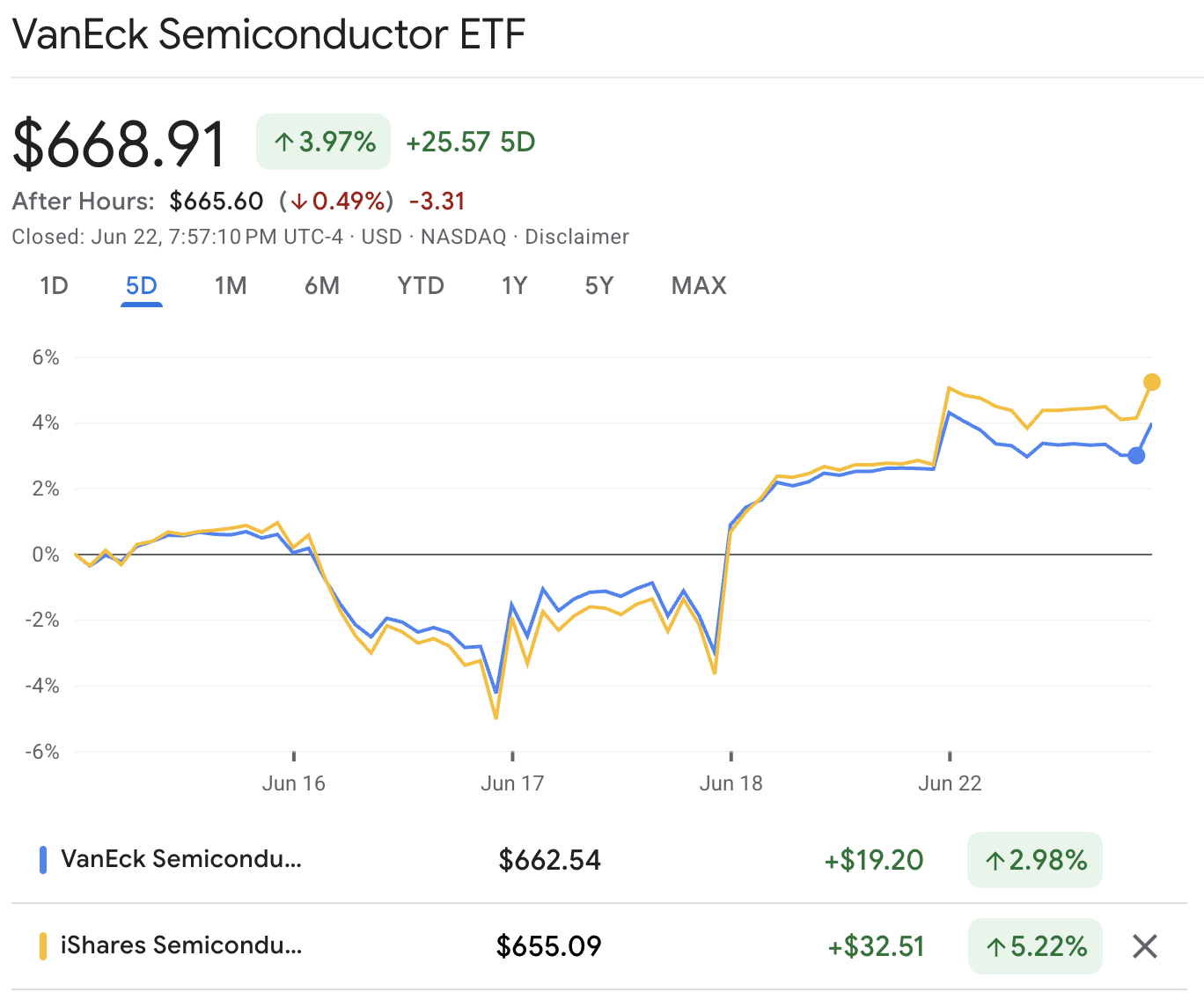
SOXX has led on 2026 momentum, with reported year-to-date NAV gains above 110% against roughly 86% for SMH over a comparable June window.
The core difference is concentration, not sector access. SMH leans into AI mega-cap leadership; SOXX captures a wider slice of the production chain.
The two funds share most of their largest names, so the difference shows up in weighting rather than membership.
SMH is the concentrated expression of the trade. NVIDIA sits near 18.3% of assets, and together with TSMC, Broadcom, Micron, and AMD, the top five reach roughly 43.7% of the fund. That tilts SMH toward AI accelerators, advanced-node manufacturing, AI networking, and high-bandwidth memory, with the largest equipment names included but not driving the portfolio.
SOXX takes a broader approach. It holds about 30 stocks against 26 for SMH and allocates close to 21% to semiconductor equipment, giving it more direct exposure to wafer tools, lithography, inspection, and the fab build-out itself. No single position dominates the way NVIDIA dominates SMH.
| Metric | SMH | SOXX |
|---|---|---|
| Net assets | About $78.4B | About $47.0B |
| Expense ratio | 0.35% | 0.34% |
| Holdings | 26 | 30 |
| Largest position | NVIDIA, about 18.3% | Lower single-stock concentration |
| Key tilt | AI mega-cap leadership | Broader cycle and equipment |
| Main sensitivity | NVIDIA, TSMC, Broadcom, AI capex | Memory, equipment orders, sector breadth |
Holdings, weights, and assets change at each rebalance and with market movement. Verify against current fund documentation before trading.
The one-basis-point fee gap is not a deciding factor. The split that matters is how much capital each index pushes toward the dominant AI names versus the rest of the value chain.
SMH works as a focused bet on semiconductor leadership. Its largest holdings sit at the center of the current cycle: NVIDIA in accelerators, TSMC in advanced-node manufacturing, Broadcom in AI networking and custom silicon, and Micron in high-bandwidth memory, with ASML, Applied Materials, Lam Research, and KLA tying the fund to equipment demand.
That roster gives investors the most direct route into the companies setting the pace of AI infrastructure. When capital keeps flowing toward the biggest chip names, SMH’s weighting lets those winners run rather than capping them.
The same structure defines its risk. With NVIDIA alone near a fifth of the fund, SMH has limited ability to cushion a single-name shock through its smaller positions. A cooling in AI capital expenditure, tighter export rules, or compression in large-cap chip valuations would land harder here than in a flatter portfolio. SMH is best read as a concentrated leadership vehicle, not a broad proxy for the chip market.
SOXX owns many of the same leaders but routes more capital into the rest of the industry. Its roughly 21% equipment weighting is the defining feature, connecting the fund to fab expansion, wafer processing, inspection, and advanced packaging rather than to a handful of design names.
AI demand is forcing capacity investment across the sector, and accelerators are only the visible layer. The foundries that build them, the memory that feeds them, and the tools that equip the fabs all sit downstream of the same spending wave, and SOXX captures more of that breadth.
Liquidity is not a constraint either, with about $47 billion in assets and a reported bid-ask spread near 0.03%. The real consideration is valuation. A reported price-to-earnings ratio above 75, a beta above 2, and a three-year standard deviation near 35% are a reminder that broader is not safer.
SOXX remains a high-beta fund priced for sustained growth, with returns that depend on whether participation keeps widening across memory, equipment, foundries, and analog recovery rather than on one stock.
With both funds' construction now on the table, the practical question turns to access. Investors who want the concentrated, leadership-led version of the trade tend to look at SMH, while those who prefer the broader basket lean toward SOXX, and both ETFs are available on EBC Financial Group.
Two forces are shaping the sector this year, and they map directly onto the two funds.
AI infrastructure remains the headline. Cloud providers and large platforms keep committing to accelerators, custom silicon, networking, and server hardware, which supports the leaders that anchor SMH.
Capacity investment is the second force, and it is where SOXX’s tilt earns its keep. SEMI’s April 2026 300mm Fab Outlook projects worldwide 300mm fab equipment spending rising about 18% to $133 billion in 2026 and a further 14% to $151 billion in 2027, the first year the figure would clear $150 billion.
That points to a multi-year manufacturing build-out across logic, memory, and advanced process technology, the layer of the chain SOXX is most exposed to.
The open question is not whether semiconductors stay a growth theme. It is where the returns concentrate.
If leadership stays with the largest AI chipmakers, SMH’s structure carries more upside. If participation broadens into memory, equipment, and cyclical names, SOXX is positioned to capture more of the spread.
Both ETFs already reflect heavy optimism. SMH’s reported year-to-date gain near 86% and SOXX’s above 110% show that semiconductor exposure has moved from an early-cycle opportunity to crowded growth leadership.
Momentum still helps, but valuation discipline matters more after a move of that size. Chip stocks routinely trade ahead of earnings inflections, which rewards investors during an upgrade cycle and exposes them when expectations outrun confirmed revenue and margins.
The signal is sharpest in SOXX, where the reported P/E above 75 leaves returns dependent on earnings acceleration and durable demand. That figure does not prove overvaluation on its own, since index-level earnings can be distorted at a cycle turn, but it raises the bar for what the fund has to deliver.
SMH carries the mirror image of that risk through concentration: its outcome is tied to whether NVIDIA, TSMC, Broadcom, and AMD keep compounding. Strong execution rewards the structure; a reset in expectations amplifies the downside.
Several variables could move the comparison through the rest of the year:
AI capital expenditure: Sustained data-center spending underpins demand across the sector. A slower capex cycle would pressure both funds, with the AI-heavy SMH likely more sensitive.
Memory pricing: High-bandwidth memory remains central to AI servers, and a durable memory upcycle would lift both ETFs, with broader exposure capturing more of it.
Equipment orders: Rising fab spending flows to wafer, lithography, inspection, and packaging suppliers, where SOXX holds more weight.
Export policy: New restrictions on advanced chips, tools, or China-linked sales would cloud revenue visibility across the sector, and concentrated AI holdings could react more sharply.
Valuation compression: High-multiple chip funds can fall even with healthy long-term demand if expectations run too far ahead or rates pressure growth stocks.
The right choice depends on what you already hold and how much single-name risk you want.
SMH suits a concentrated AI semiconductor allocation and a direct view on the largest chip leaders, accepting more exposure to NVIDIA and a handful of peers in exchange. SOXX suits broader chip-cycle exposure, spreading risk across more names and giving equipment suppliers a larger role.
Portfolio overlap is the practical tiebreaker. An investor already holding NVIDIA, Broadcom, AMD, or TSMC directly gains less diversification from SMH than from SOXX, while an investor with little AI-chip exposure gets a more direct entry through SMH.
Neither fund is an income holding, since yields are minimal and the case rests on capital appreciation, and neither is low volatility. Both stay tied to earnings revisions, AI capex, export policy, and risk appetite.
SMH and SOXX are semiconductor ETFs that package the same theme in different proportions. SMH concentrates in AI-linked leaders such as NVIDIA, TSMC, Broadcom, Micron, and AMD, while SOXX balances those names against a deeper bench of chipmakers and equipment suppliers.
For 2026, the comparison comes down to allocation style rather than sector access. SMH is the case for concentrated AI leadership. SOXX is the case for broader semiconductor-cycle exposure. Where you land depends on whether you expect returns to stay with the largest chip names or to keep widening across the production chain.
Whether your thesis favours concentration or breadth, the prudent final step is to verify each fund's current holdings and weightings, both of which reset at every rebalance. SMH and SOXX are both available through EBC's ETF offering. Reviewing each fund's composition and exposure side by side is the kind of due diligence worth completing before sizing a position in either.