Published on: 2026-09-04
USD/JPY traded as low as 155.25 on 4 September, just above the 155.20 level the yen reached after July’s intervention.
No official operation has been identified. BOJ account data showed no Ministry of Finance yen buying behind Wednesday’s jump.
Headline September BOJ hike odds are near 75%, below the 87% priced on 27 August. The bigger repricing is in the path beyond September.
Hajime Takata’s 2 September call for nimbler, meeting-by-meeting hikes turned attention to the pace of BOJ tightening.
Waller’s remarks cut September Fed hike odds to roughly 50%, removing support from the dollar leg of the pair.
USD/JPY traded as low as 155.25 in Asian hours on Friday, 4 September, within a fraction of the 155.20 to 155.21 level the yen reached after July’s US-Japan intervention. No official operation has been identified behind the move.
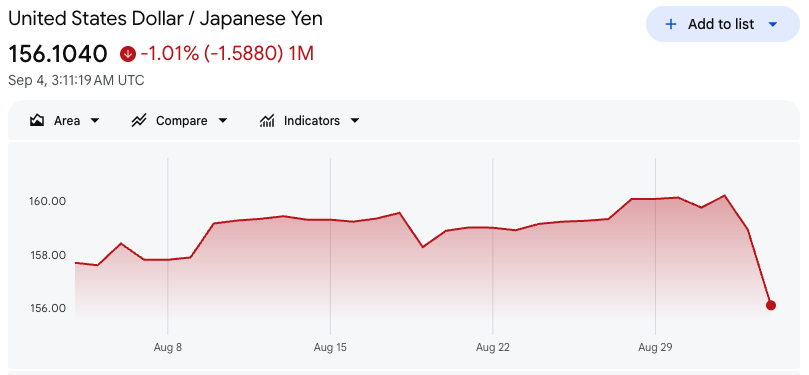
Eight days earlier, on 27 August, the pair traded around 159.2 with money markets pricing an 87% chance of a September Bank of Japan hike. Headline odds on that single meeting are now lower, near 75%. The yen is still on course for a weekly gain of roughly 2.5%.
 The question has changed. It is no longer whether the BOJ moves this month, but whether traders are finally pricing a faster Japanese tightening cycle at the same moment US rate expectations turn the other way.
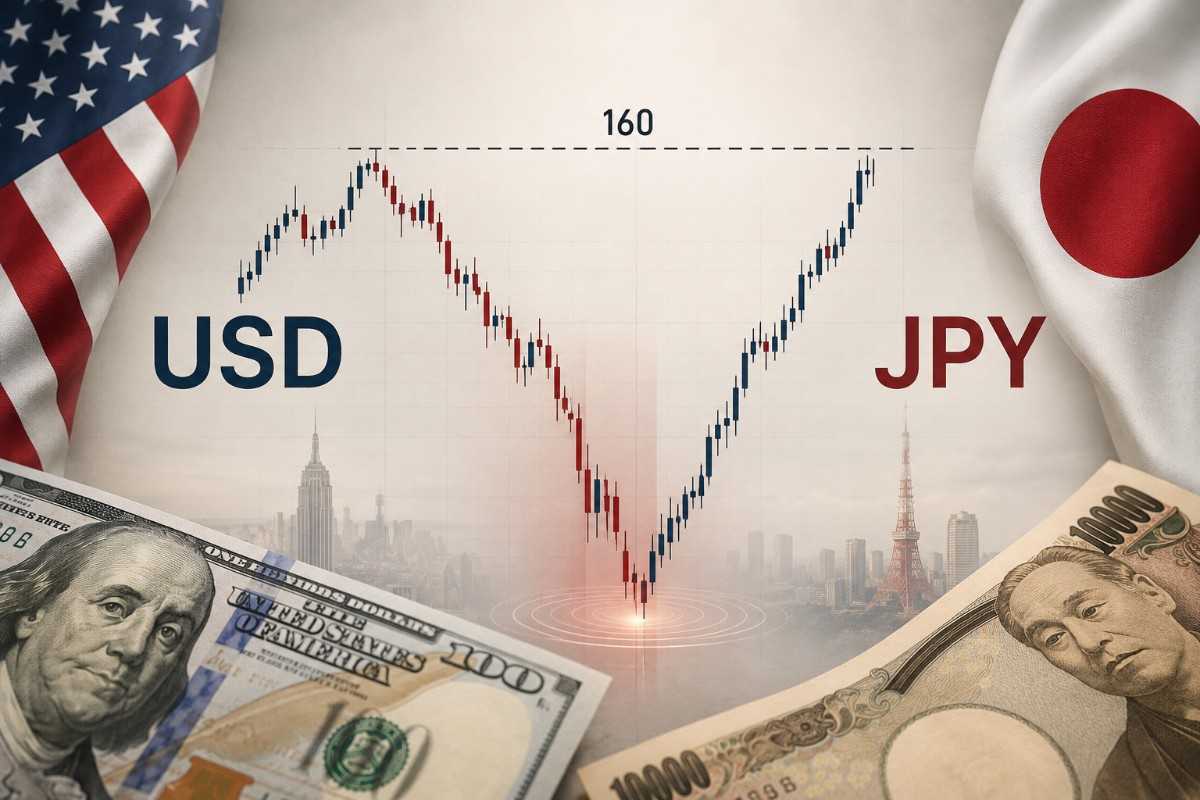
The yen reached a 40-year low of 163.98 per dollar before Japan and the United States acted jointly on 31 July. It then strengthened to as far as 155.21 before the move faded.
By 27 August the pair had climbed back to 159.2, and it pushed above 160 into the end of the month. Wednesday, 2 September brought a sudden 0.94% yen gain to 158.67. Thursday added more than 2%, taking the pair to 155.47 in New York after touching 156.15 earlier in the session, the strongest for the yen since 3 August. Friday’s low of 155.25 followed, with spot easing back to about 155.7 later in Asian trading.
Three sessions have therefore unwound almost the entire rebound that took four weeks to build. Clearing 155.21 would put the yen at its firmest since 6 May.
The July appreciation was an engineered one. This one carries no such fingerprint.
BOJ daily account data covering Wednesday showed no dollar selling or yen buying by the Ministry of Finance, according to Jeremy Stretch, chief international strategist at CIBC Capital Markets, who added that market participants reported no rate checks either.
Goldman Sachs analysts noted that Thursday’s yen strength built gradually rather than in a burst, with far more muted spillover into other dollar pairs than in previous intervention episodes.
That is evidence of absence rather than proof, and Japanese officials have kept the option visible. Vice Finance Minister for International Affairs Atsushi Mimura said on Thursday he was “neither satisfied nor reassured” by recent moves and that authorities remained on heightened alert.
On Friday he said Tokyo was in constant contact with US counterparts; the dollar slipped to 155.305 shortly afterwards.
Speaking in Sapporo on Wednesday, 2 September, board member Hajime Takata argued the BOJ should raise rates nimbly to counter intensifying inflation pressure rather than hold to the fixed semiannual pace markets had assumed. He called 2026 a turning point requiring flexibility on both pace and magnitude, and left the appropriate speed to each individual meeting.
He was the sole dissenter in July, voting for 1.25% against the board’s hold at 1.0%. Reuters has separately reported that the BOJ is prepared to move as soon as the 17 to 18 September meeting and is weighing a faster sequence thereafter than its recent cadence of roughly two increases a year.
Markets now price about 75% odds of a 25 basis point move this month. Some traders are discussing a larger increment rather than treating it as the base case, and an October follow-up is seen as possible but unlikely. The repricing shows up in the bond market too: the two-year JGB yield reached 1.83%, its highest since 1995, while the 10-year touched 3%.
Fed Governor Christopher Waller said on Thursday he would be inclined to argue for holding the federal funds target at 3.50% to 3.75% this month if incoming data confirm that inflation pressure is cooling.
Odds of a September increase fell to 48% from 59% immediately after, and sat near 50% on Friday. In late August, before Chair Kevin Warsh’s hawkish Jackson Hole address, that figure was closer to 40%. The dollar index dropped 0.69% to 98.91 on Thursday and was flat at 99.01 on Friday, heading for a 0.7% weekly decline.
USD/JPY discounts the expected path of both policy rates rather than today’s gap, which remains wide at roughly 2.5 to 2.75 percentage points and won't close with a single move on either side. What changed this week is that the expected direction of travel on each leg began pointing the same way for the yen.
On 27 August, Deputy Governor Ryozo Himino endorsed further increases and said policymakers must heed upside price risks more than before. The pair moved less than 0.1%. With 87% already priced, a hawkish official was confirming a conclusion traders had reached weeks earlier.
Takata addressed a variable that was still open: what happens after the next meeting. Waller then moved a second that had worked against the yen since Jackson Hole. Neither was the September probability.
The yen never needed higher odds on one meeting. It needed the market to reconsider how quickly Japan moves beyond the next hike, while the US side stopped firming. That combination arrived this week.
The 155.20 to 155.25 band is a recent reference point rather than structural support. It marks the best the yen achieved with official backing in July and the level it retested on Friday without any.
A sustained close below it would signal the market can carry the yen further than intervention did. Softer payrolls, further trimming of Fed hike pricing, harder evidence of faster BOJ normalisation and a retreat in the 10-year Treasury yield from around 4.77% would each support that outcome.
Failure to hold leaves the pair exposed to a retracement into the 156 to 158.7 range traded earlier this week. Stretch has already called current pricing too hawkish, while cautioning that continued speculation over a faster hiking sequence could squeeze dollar longs first.
The August employment report had not been released at the time of writing. Consensus looks for roughly 55,000 to 58,000 jobs after July’s 23,000 decline, with unemployment steady at 4.1%. ADP’s private-sector count of 38,000 undershot expectations.
The reaction function is inverted from recent years. A strong print is the hawkish outcome that revives September Fed pricing and lifts the dollar; a weak one trims that risk and puts 155 back in play. Consumer and producer price data follow next week, then the FOMC on 15 and 16 September and the BOJ two days after it.
In late August the puzzle was why a heavily discounted BOJ hike left the yen stranded near 160. That question has been answered by a repricing of everything beyond the next meeting.
Whether the yen holds this ground now rests on data rather than on the Ministry of Finance. The level reached with intervention in July has been matched without it. Staying below it requires the US and Japanese rate paths to keep converging in expectation, and payrolls get the first vote.