Published on: 2026-07-27
Updated on: 2026-07-27
New ETF launches in 2026 reached 1,084 by mid-July, equal to 93% of the 1,161 products that launched in all of 2025.
The wrapper is plainly in demand, and it has also become cheap to manufacture: of the 474 ETFs launched in 2021, 37% had closed by March 2026 and only 29% had reached $100 million in assets.
Repeat that record and about 400 of this year’s funds could disappear by 2031, which makes the headline launch count less useful than a harder question: which of these funds were built to last.

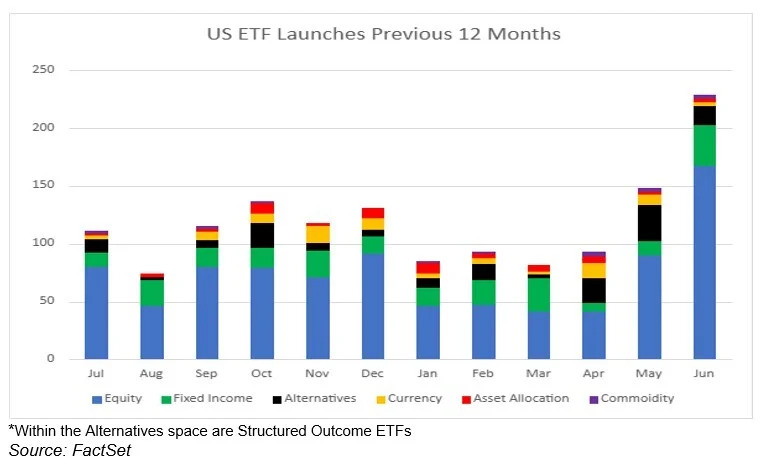
The U.S. recorded 1,084 new ETF launches by mid-July 2026, and June alone brought a record 228.
On the 2021 cohort’s five-year record, about 683 of the 2026 funds would still be open by 2031, roughly 314 of them holding at least $100 million.
Morningstar estimates a typical active ETF with $250,000 in annual fixed costs needs about $33 million in assets to break even.
Almost a quarter of 2026 launches were leveraged single-stock funds, which carry daily-reset, concentration and closure risks.
The U.S. market recorded 1,084 new ETF launches by mid-July 2026, against 1,161 for the whole of 2025.
| Metric | Figure | As of |
|---|---|---|
| New U.S. ETFs launched | 1,084 | Mid-July 2026 |
| New U.S. ETFs launched in 2025 | 1,161 | 31 December 2025 |
| Total U.S. ETFs listed | 5,072 | 31 March 2026 |
| U.S.-listed ETF assets | $15.7 trillion | 30 June 2026 |
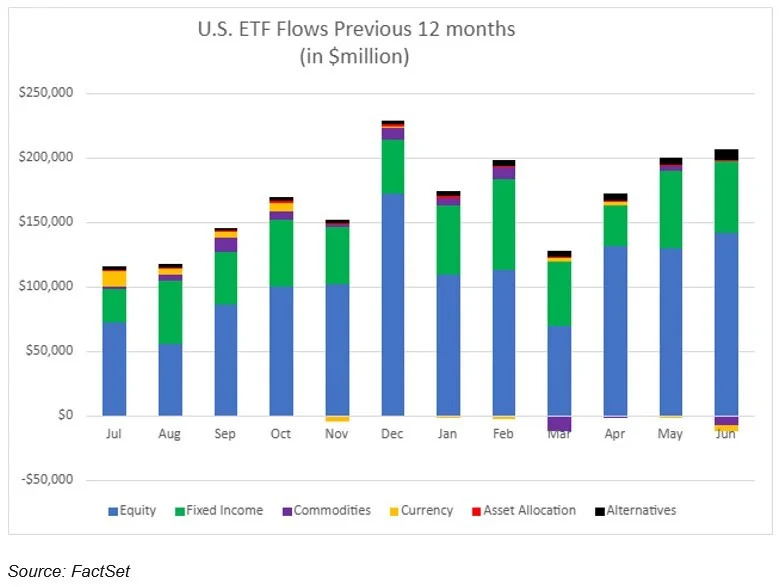
| First-half 2026 net inflows | More than $1 trillion | 30 June 2026 |
Launch totals are from Morningstar data reported by the Financial Times. Listings, assets and first-half flows are from FactSet.
Assets stay concentrated in established funds. FactSet counted 228 launches in June, 81 of them from Corgi Insurance Services.
By late July, Corgi had brought 188 funds to market and filed for another 360 while managing less than $1 billion; one of its portfolio managers said the firm expected roughly 20% of its products to gather 80% of its assets. That is the launch model in a sentence: flood the shelf, then let flows decide.
Active management, not indexing, produced most of the recent growth: Cerulli Associates counted 953 active ETF launches in 2025, 84% of all launches under its methodology. The change in the rules made that possible.
Since December 2019, Rule 6c-11 has let qualifying ETFs launch without a separate exemptive order from the SEC. Cutting that step lowered the time and legal cost of reaching the market, so an issuer can test a niche idea cheaply and wind it down just as cheaply when the assets never arrive.
That freedom stretched the wrapper far beyond index tracking. Options-income strategies, buffer funds, mutual-fund conversions, crypto exposure and single-stock products now trade inside it.
Large issuers spread governance, legal and administration costs across dozens of funds, so weak products can be merged or liquidated without much pain. Morningstar recorded about 150 active ETF closures and mergers in 2025, running quietly alongside the record launch activity.
FactSet tracked the 474 ETFs launched in 2021 through 31 March 2026. Applying that five-year record to the first 1,084 launches of 2026 gives a base case.
| Five-year outcome | 2021 cohort | Implied 2026 result |
|---|---|---|
| Closed | 37% | About 401 |
| Open with $100M+ | 29% | About 314 |
| Open below $100M | About 34% | About 369 |
The base case leaves 683 funds open by 2031. Some of the 369 smaller survivors may still be growing; others may remain open only because their issuers are willing to subsidise them.
Closures have lagged the launch surge so far. FactSet estimates that ETFs launched from 2021 to 2023 are 271 closures behind historical pace, and its discretionary closure rate fell from 5.5% during the 2010s to 5.1% between 2021 and 2025 even as launches accelerated. A backlog delayed is not a backlog cancelled.
Product mix may raise the risk. Almost one-quarter of 2026 launches through mid-July were leveraged single-stock funds, up from 20% in 2025 and 4% in 2024, and Schwab identifies leveraged and inverse ETFs as especially prone to closure.
About 400 closures is therefore a defensible central estimate, not a firm forecast. Future markets, issuer subsidies, mergers and investor appetite for specialised products could move the outcome in either direction.
Morningstar estimates that an active ETF with about $250,000 in annual fixed costs needs roughly $33 million in assets to break even at a typical active-fund fee. The reason the hurdle moves is simple arithmetic: a fund’s fee revenue is its assets multiplied by its fee rate, so a lower fee needs proportionally more assets to cover the same fixed cost.
A 0.75% annual fee requires about $33 million.
A 0.35% fee requires about $71 million.
A 0.20% fee requires about $125 million.
These are illustrations, because costs and net issuer revenue vary. FactSet found that 1,950 U.S. ETFs, or 38.4% of the market, held less than $50 million at the end of March, while 1,850 generated implied annual revenue of $250,000 or less. Flow direction can be more useful than one AUM reading: a small fund gathering assets is a different case from a small fund bleeding them.
Morningstar counted about 150 active ETF closures and mergers in 2025. Only six had more than $50 million at the start of the year, and the typical closed product had lasted about 1.75 years.
An ETF closure does not erase the securities the fund holds. The issuer normally announces the decision several weeks in advance, sets a final trading date and then liquidates the portfolio.
Shareholders can sell before trading ends or wait for the final distribution. Schwab says the payment is ordinarily close to NAV, and most final distributions arrive within three to five business days after delisting.
Selling early allows faster reinvestment but exposes the shareholder to the bid-ask spread. Waiting avoids a secondary-market sale but leaves the investor in cash once the fund liquidates. Either route can trigger an unplanned capital gain or loss in a taxable account.
New products earn their place when they cut costs, improve tax efficiency or add genuinely different exposure. Many do not. Thematic funds built on artificial intelligence, cloud, semiconductor and digital-transformation labels can own many of the same large technology companies, so several tickers may still leave a portfolio concentrated in one valuation cycle.
A niche fund that pairs a high expense ratio with a wide bid-ask spread has to clear both hurdles before it earns anything for the holder. SEC ETF rules require disclosures covering bid-ask spreads and premiums or discounts to NAV, which is where an investor can check those costs before buying.
A single-stock ETF provides exposure to one company, so it does not offer the diversification of a conventional equity ETF. Leveraged and inverse versions commonly target a multiple of the stock’s return for a single trading day, and that daily reset changes longer-term results:
The stock and a two-times daily ETF both begin at $100.
The stock rises 10% to $110; the ETF rises 20% to $120.
The stock then falls 9.09% back to $100.
The ETF falls 18.18% to $98.18, leaving it down 1.82% before fees and financing costs.
The reason is compounding, not a pricing error. Because the fund rebuilds its leverage every session, each day’s return builds on a new base, so a choppy run of gains and losses can leave the holder behind the stated multiple even when the share ends where it started. In calm, trending markets the same maths can help; in volatile ones it usually hurts.
FINRA says daily-reset leveraged and inverse ETFs are typically unsuitable for retail investors planning to hold them for longer than one trading session, particularly in volatile markets.
The SEC also warns that leveraged or inverse single-stock ETFs remove diversification and can diverge significantly from the longer-term return of the underlying share. These products can serve closely monitored short-term trading or hedging, but they need a different review from a broad-market ETF.
Purpose and overlap: Check the holdings, weighting method and derivatives exposure, then compare them with funds you already own.
Commercial viability: Review AUM, recent net flows, fund age, expense ratio, issuer support and close substitutes.
Tradability: Examine the median bid-ask spread, any premium or discount to NAV, and how easily the fund trades at its largest positions.
Reset terms: For leveraged, inverse and options-based funds, confirm the target period and the behaviour in volatile markets.
FactSet’s closure-risk methodology works the same way, weighing AUM, competition, flow direction and legal structure rather than fund size alone. The ticker and theme are only the starting point; the prospectus objective and portfolio structure decide what the fund is actually built to deliver.
FactSet says discretionary closures averaged 5.1% of the prior year-end ETF count from 2021 to 2025. Morningstar counted about 150 active ETF closures and mergers in 2025.
Closure does not automatically destroy the fund’s value. Shareholders can sell before delisting or receive cash after liquidation, though spreads, taxes and time out of the market can affect the result.
There is no universal threshold. Morningstar estimates about $33 million for a typical active ETF with $250,000 in annual fixed costs, while lower-fee products may need substantially more.
FINRA generally considers daily-reset leveraged and inverse ETFs unsuitable beyond one session for retail investors, especially in volatile markets, because compounding can move returns far from the underlying stock.
Rule 6c-11 streamlined launches, active strategies widened the product set, and platform economics let issuers release many funds at once and wait to see which attract assets.
The real test is economic, and it lands over the next 12 to 24 months, once issuers can see which 2026 funds are pulling in sustained inflows and which still run on seed capital.
Morningstar found the active ETFs that closed in 2025 had lasted only about 1.75 years, so weak products may not get a long runway, and on the 2021 cohort’s record that points to about 400 of this year’s new ETF launches closing by 2031. A fund that lasts has to solve a continuing portfolio problem, gather enough assets to cover its costs and trade cleanly.
The closure itself is usually manageable; the larger danger is buying a complex or overlapping fund without checking that its structure and economics fit how long you mean to hold it.
U.S. Securities and Exchange Commission, Exchange-Traded Funds and Rule 6c-11: https://www.sec.gov/rules-regulations/2019/09/exchange-traded-funds
U.S. Securities and Exchange Commission, Statement on Single-Stock Leveraged and Inverse ETFs: https://www.sec.gov/newsroom/speeches-statements/schock-statement-single-stock-levered-or-inverse-etfs-071122
FINRA, Regulatory Notice 09-31: Leveraged and Inverse ETFs: https://www.finra.org/rules-guidance/notices/09-31