Published on: 2026-08-28
Updated on: 2026-08-28
Zinc is expensive in London because of where the metal is, not because the world has run out of it. Global refined supply and demand are close to balance in 2026. Immediately deliverable metal in the London warehouse system is not.
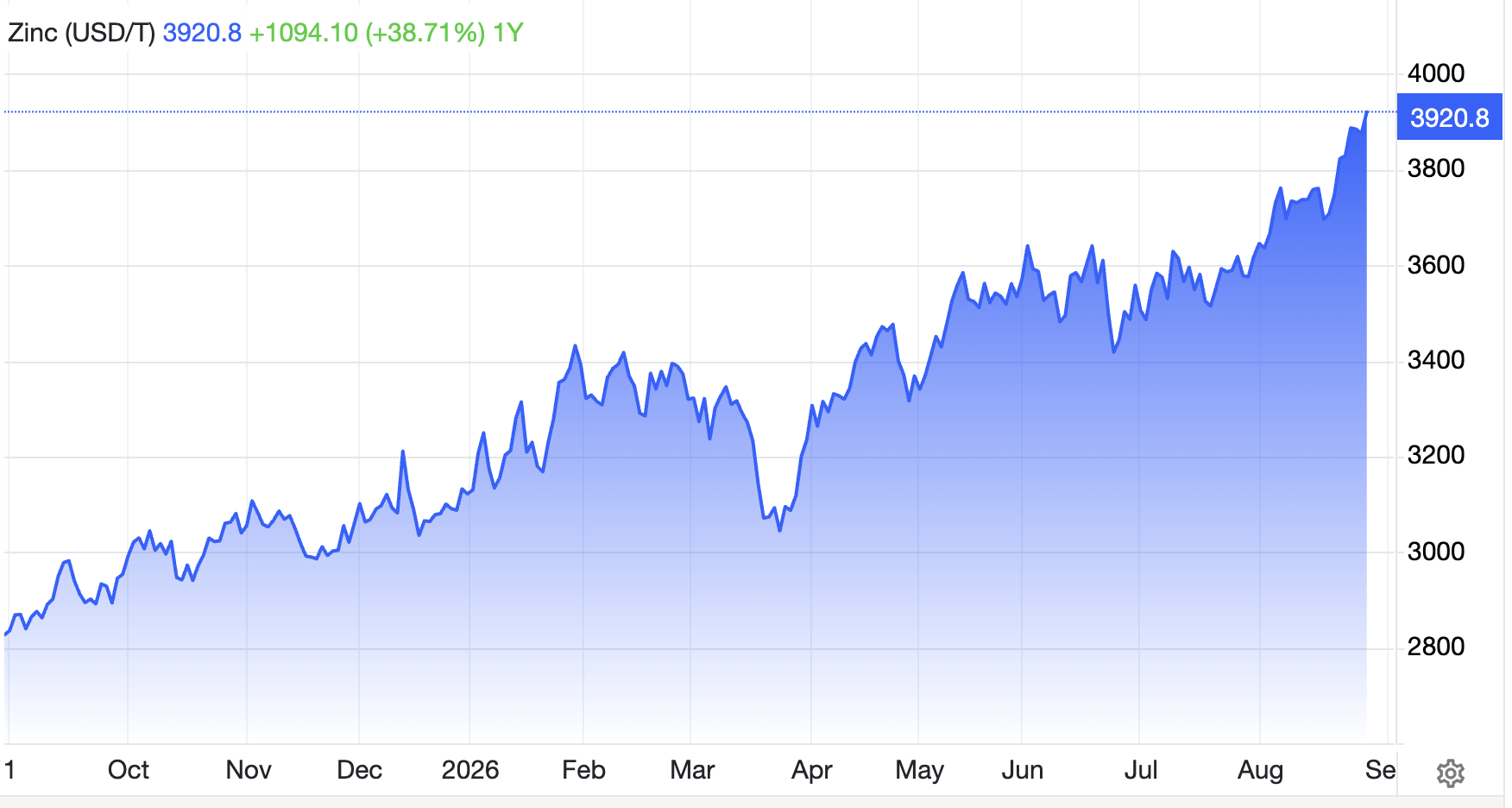
Three-month LME zinc reached $3,949.50 a tonne on 26 August, the highest since June 2022. By the following day, buyers were paying $231.75 more for cash metal than for delivery three months out.
The International Lead and Zinc Study Group expects a 2026 refined deficit of just 19,000 tonnes in a 14-million-tonne market, and its own half-year data show a surplus. The answer lies further up the supply chain.
LME three-month zinc hit $3,949.50 a tonne on 26 August 2026, the strongest level since June 2022, with the cash-to-three-month backwardation reaching $231.75 the next day.
ILZSG forecasts a 19,000-tonne refined deficit for 2026 against demand of 14.00 million tonnes, equal to roughly 0.14% of annual consumption, or about half a day of global use.
Preliminary ILZSG figures show a 120,000-tonne refined surplus in the first half of 2026, with Chinese output up 5.9% while production outside China fell 3.4%.
Spot treatment charges for imported concentrate in China reached a record low near minus $117.50 a dry tonne in August, against an $85 annual benchmark.
| Metric | Latest figure | Reading |
|---|---|---|
| LME three-month zinc | $3,949.50/t peak, 26 Aug 2026 | Highest since June 2022 |
| Cash to three-month spread | $231.75/t backwardation, 27 Aug | Prompt metal at a premium |
| LME warehouse stocks | 97,875 t, 27 Aug 2026 | Lowest since Dec 2025 in mid-August |
| End-2024 LME stocks | 234,100 t | Current level is 58% lower |
| 2026 refined demand (ILZSG) | 14.00 Mt | Size of the global market |
| 2026 refined production (ILZSG) | 13.99 Mt | Near balance |
| Forecast 2026 deficit | 19,000 t | About 0.14% of annual demand |
| H1 2026 actual balance | 120,000 t surplus | Surplus already booked |
| Imported concentrate spot TC | Record low near -$117.50/dmt | Concentrate scarcity |
Two of these lines sit in tension. The annual balance describes a market with almost no shortfall. The spread, the stock level and the concentrate charge describe a market where prompt units are hard to source. Both readings are accurate, because they measure different things.
The headline numbers do not support a dramatic shortage. In its 23 April 2026 forecast, the International Lead and Zinc Study Group put global refined zinc demand at 14.00 million tonnes for the year, up 1.3%, against refined output of 13.99 million tonnes, up 1.4%. The residual is a deficit of 19,000 tonnes.
Set against annual consumption, that gap works out at roughly 0.14%, or about half a day of global usage. It falls comfortably inside the margin of error of any supply-demand model, and a single month of better-than-expected smelter runs would erase it.
The group’s more recent preliminary data point the other way. Its 26 August release showed the refined zinc market in surplus by 120,000 tonnes over the first six months of 2026, with total reported inventories rising by 92,000 tonnes.
A market carrying a booked half-year surplus does not usually trade at a four-year high with the widest cash premium since December. The annual balance is simply the wrong instrument for the question. It measures production against usage over twelve months. Price is set by the far smaller pool of metal that can be delivered, where the contract requires it, on the day it falls due.
Zinc reaches a buyer through several distinct stages: ore is mined, milled into concentrate, shipped to a smelter and refined into metal. Most of that metal then moves directly from producer to merchant to galvaniser, never touching an exchange warehouse.
Warranting is optional, which is why exchange stock behaves as a separate market with its own balance, much like the gap that opens between paper and physical crude when prompt barrels turn scarce.
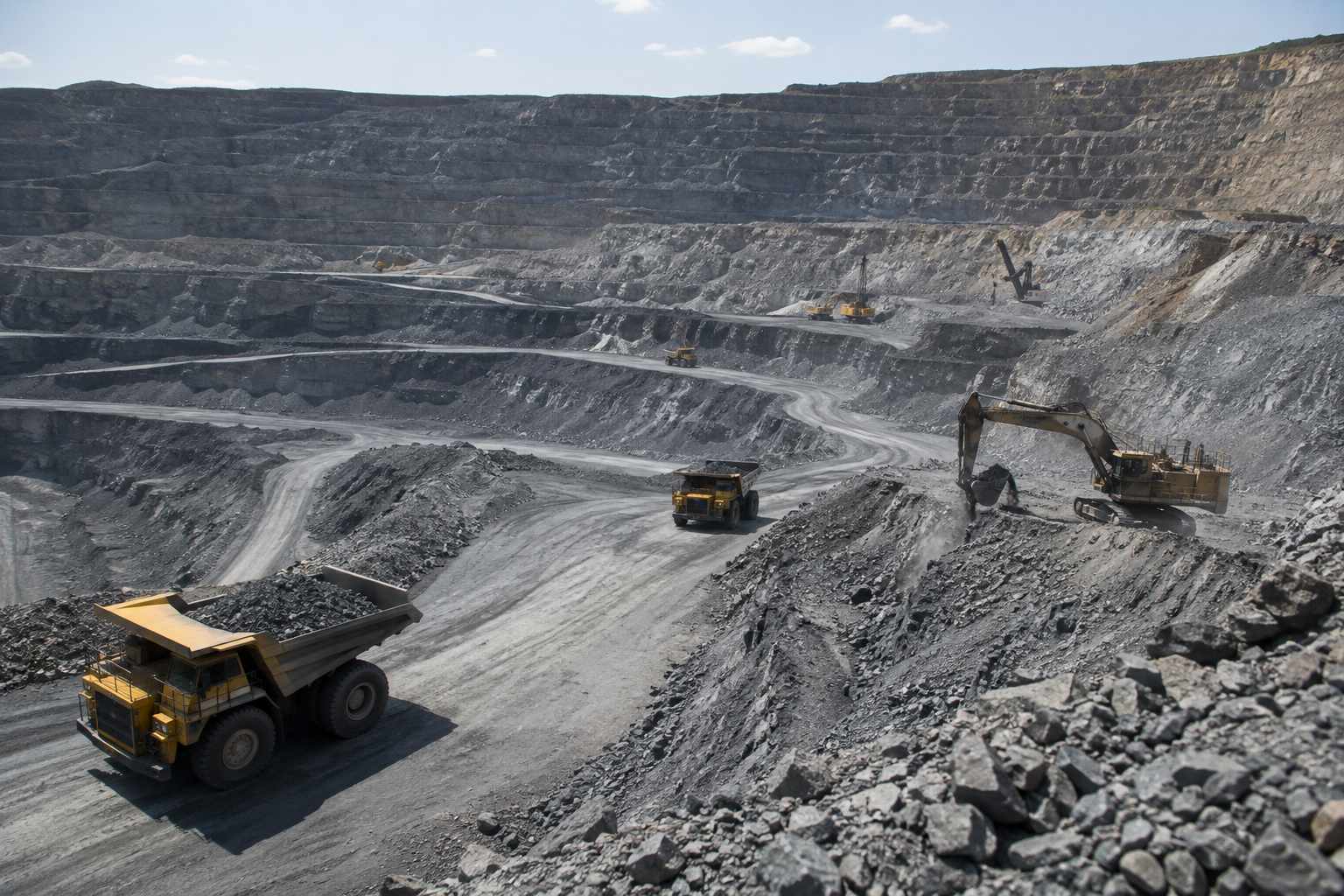
The 2026 constraint began at the top. ILZSG preliminary data published on 26 August show world zinc mine production fell 2.6% in the first half, a sharp reversal from the 1.1% growth its monthly series had recorded through May.
The largest reductions came at Antamina in Peru, Garpenberg in Sweden and Red Dog in the United States, with the closure of Australia’s Lady Loretta at the end of 2025 removing further tonnage. Higher volumes from Kipushi in the Democratic Republic of Congo and the restart of zinc recovery at Aljustrel in Portugal offset only part of the loss.
Refined output still grew, by 1.3% globally, but the split beneath that figure is where the two markets diverge. Chinese refined production rose 5.9% in the half, while output in the rest of the world contracted 3.4%, held back by reductions in Europe, Japan, Kazakhstan, Mexico and Peru.
The phrase “zinc supply” therefore hides three separate problems. Ore is scarcer, refined metal is more plentiful, and almost all the growth is concentrated in one region.
A treatment charge is the fee a smelter deducts for converting concentrate into refined metal. In a normal market the miner pays it, and the level tracks raw-material availability: plentiful concentrate lifts the charge, scarce concentrate cuts it as smelters compete for feed.
That fee has now inverted. Shanghai Metals Market’s index for imported zinc concentrate reached a record low near minus $117.50 a dry tonne in August 2026, having fallen through zero in late March and slid steadily since. Offers for high-grade South American material were heard between minus $120 and minus $150.
Domestic Chinese charges have followed, with the Zn50 weekly average at minus 1,550 yuan a tonne of contained metal. The 2026 annual benchmark, settled at $85 a tonne, now reads like a relic of a calmer market.
A negative charge means the smelter pays a premium for the right to process the ore. Margins then rest on by-products such as sulphuric acid, silver and lead rather than on the processing fee itself. Smelters without captive mines or recycled feed respond by trimming run rates, which is why refined output outside China fell even though zinc was never geologically scarce.
Refined zinc is not fungible across geography in the way a global balance sheet implies. A tonne that sits in a Shanghai warehouse and a tonne in Rotterdam are the same metal, but only one of them can settle an LME contract this week. The copper market has repriced around the same distinction, attaching a scarcity premium to deliverable units rather than to global tonnage.
The regional split has been wide. Stocks in facilities linked to the Shanghai Futures Exchange more than doubled over the year to 155,954 tonnes by 21 August. LME inventories moved the other way, falling around a quarter in two months to 88,000 tonnes in mid-August, the lowest since December, before recovering to 97,875 tonnes on 27 August. End-2024 LME stock was 234,100 tonnes.
Metal crosses between the two systems only when the economics work. An exporter has to clear a 13% value-added tax, freight and insurance, and a mismatch between the forward pricing Asian buyers use and the cash reference an exporter needs to lock a margin. Warehouse eligibility and financing costs add friction, and a cargo takes weeks to arrive on warrant.
That gap is narrowing. Chinese net refined imports fell to 39,000 tonnes in the first half, 141,000 tonnes lower than a year earlier, and the country turned a net exporter in July on shipments of 9,200 tonnes. Roughly two-thirds of recent LME deliveries have landed in Hong Kong, approved for good delivery only last year and already functioning as an arbitrage conduit.
An outright price tells you zinc is expensive. The shape of the forward curve tells you when it is expensive.
In a well-supplied market, forward prices exceed cash to cover storage, insurance and financing, a structure known as contango. Zinc has moved the other way, and steadily rather than suddenly. The LME cash-to-three-month spread ran at roughly $52 in the week to 7 August, $106 to 14 August, $132 on 21 August, $199 on 26 August and $231.75 on 27 August. Three months earlier, cash traded at a $25 discount.
Anyone carrying leveraged commodity exposure rather than physical metal meets the same curve through roll and financing costs. Reuters reported in early August that three entities together held a large share of available warrants and cash positions, further concentrating the pressure.
The spread can stay wide even when forecasters expect the market to loosen, since a fourth-quarter forecast does not settle a contract due next week. It remains the cleanest read on prompt scarcity, and the first indicator that would ease once metal starts arriving in volume.
Physical tightness and price amplification are not the same thing, and 2026 has produced both.
Positioning is unusually one-sided. Investment funds held more than 110,000 tonnes of long zinc exposure in late August, the largest collective bullish position since the LME began publishing position reports in 2018. Option activity points the same way, with roughly 1,500 lots of December $4,000 calls open and a further 757 lots struck at $4,500.
Zinc is not alone in drawing that crowd: tin's record run this year paired a real deficit with heavy speculative interest.
Expiry pressure added to it. One participant held a short equal to 20% to 29% of open interest on the August LME contract, which expired on 19 August. With prompt stock thin and rolls expensive, closing that exposure was costly regardless of the fundamental view behind it.
None of this means the tightness is manufactured. The concentrate charges and the decline in refined output outside China are measurable. It does mean part of the price is paying for positioning rather than for zinc, and that portion can unwind faster than the physical constraint does.
Tightness in one location corrects itself once the cost of moving metal there falls below the reward. Several channels are already open.
The most direct is delivery. LME stocks rose to 97,875 tonnes on 27 August, a three-week high, after 1,100 tonnes arrived in Singapore and Hong Kong warehouses, and further inflows would erode the cash premium. A sustained export arbitrage would accelerate that, since Chinese smelters hold capacity that domestic demand is not absorbing.
Further up the chain, treatment charges would need to recover before smelters outside China can lift run rates without leaning on by-product revenue. That depends on concentrate availability, which in turn depends on whether disrupted operations return and whether new capacity in the Democratic Republic of Congo, Portugal and China arrives on schedule.
Demand can also do the work. Galvanising absorbs close to 60% of refined zinc, so slower construction or manufacturing activity would cut offtake in the regions where availability is thinnest, loosening spreads without a single extra tonne being produced. Supply shocks bite hardest when inventories are low, and the reverse holds as they rebuild.
Arbitrage runs through all of it. Every dollar the London price gains makes shipping metal there more attractive, which is why squeezes like this usually end through logistics rather than forecasts.
| Indicator | Tightening signal | Easing signal |
|---|---|---|
| LME inventories | Falling | Rising |
| Cash to three-month spread | Wider backwardation | Narrower premium |
| Treatment charges | More negative | Recovering |
| Chinese refined exports | Limited | Increasing |
| Smelter output outside China | Falling | Recovering |
| Galvanised steel demand | Strengthening | Weakening |
The 2026 zinc market is not defined by a global shortage. It is defined by where concentrate is available, how smelters respond when the processing fee turns negative, and how much refined metal can be delivered into the exchange that sets the marginal price.
Three readings will show whether the squeeze is holding or fading. LME inventories, and particularly the on-warrant share, indicate how much metal is actually available. The cash-to-three-month spread prices the urgency. Treatment charges show whether the constraint is easing at its source.
If stocks build while the spread narrows and charges recover, the dislocation is closing. If concentrate stays scarce and warrants keep leaving, the gap between the global balance and the London price will persist.