Published on: 2026-04-20
Updated on: 2026-04-20
Most commodity coverage in 2026 has chased oil shocks, gold records, and copper supply politics. Silver has quietly been building one of the most structurally compelling stories in the entire commodities market, and very few investors are paying close enough attention.
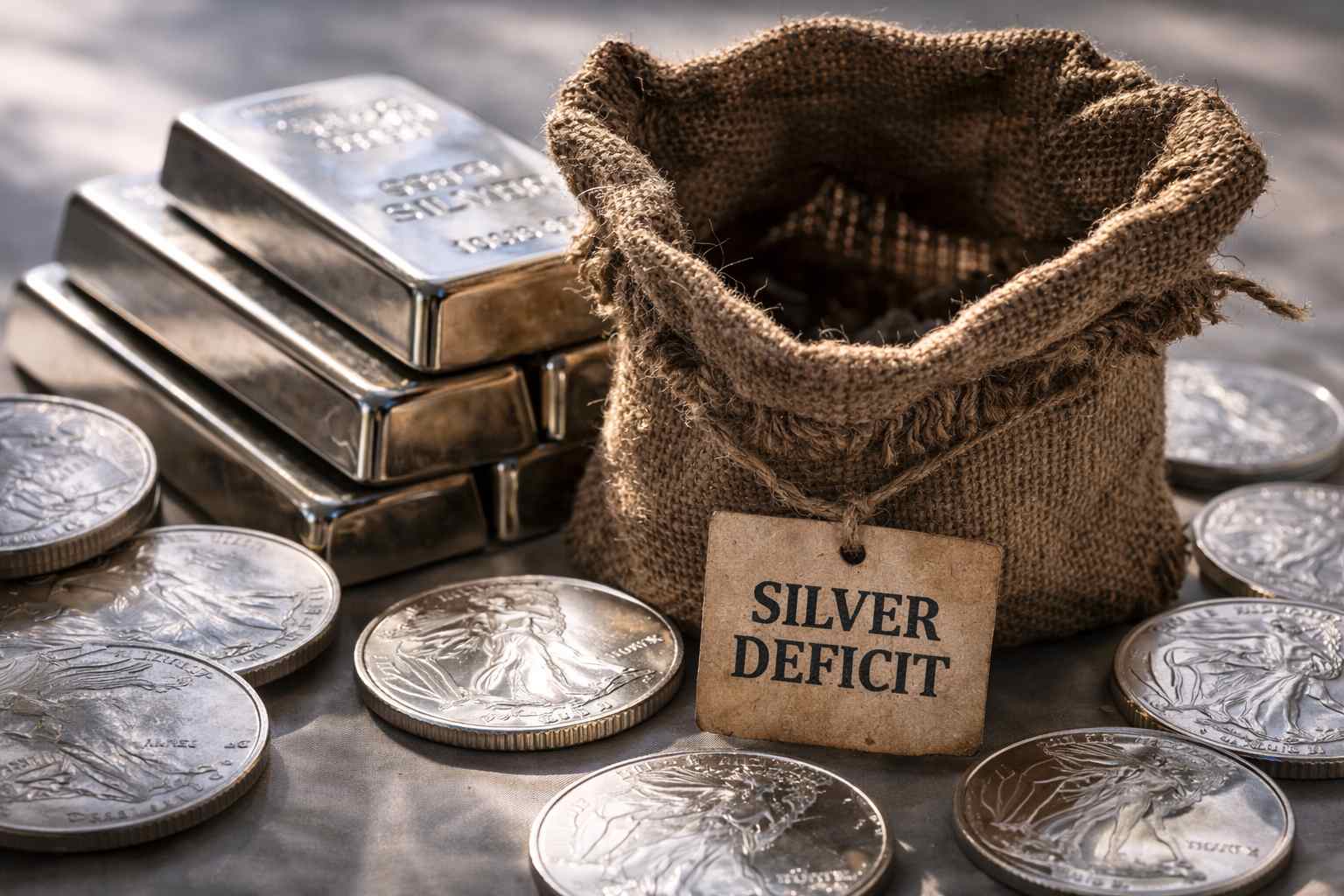
The Silver Institute and consultancy Metals Focus published their annual outlook on April 15, warning that the silver market is heading for a sixth consecutive year of structural deficit. Since 2021, 762 million troy ounces have been drawn from global stocks to cover the gap between supply and demand.
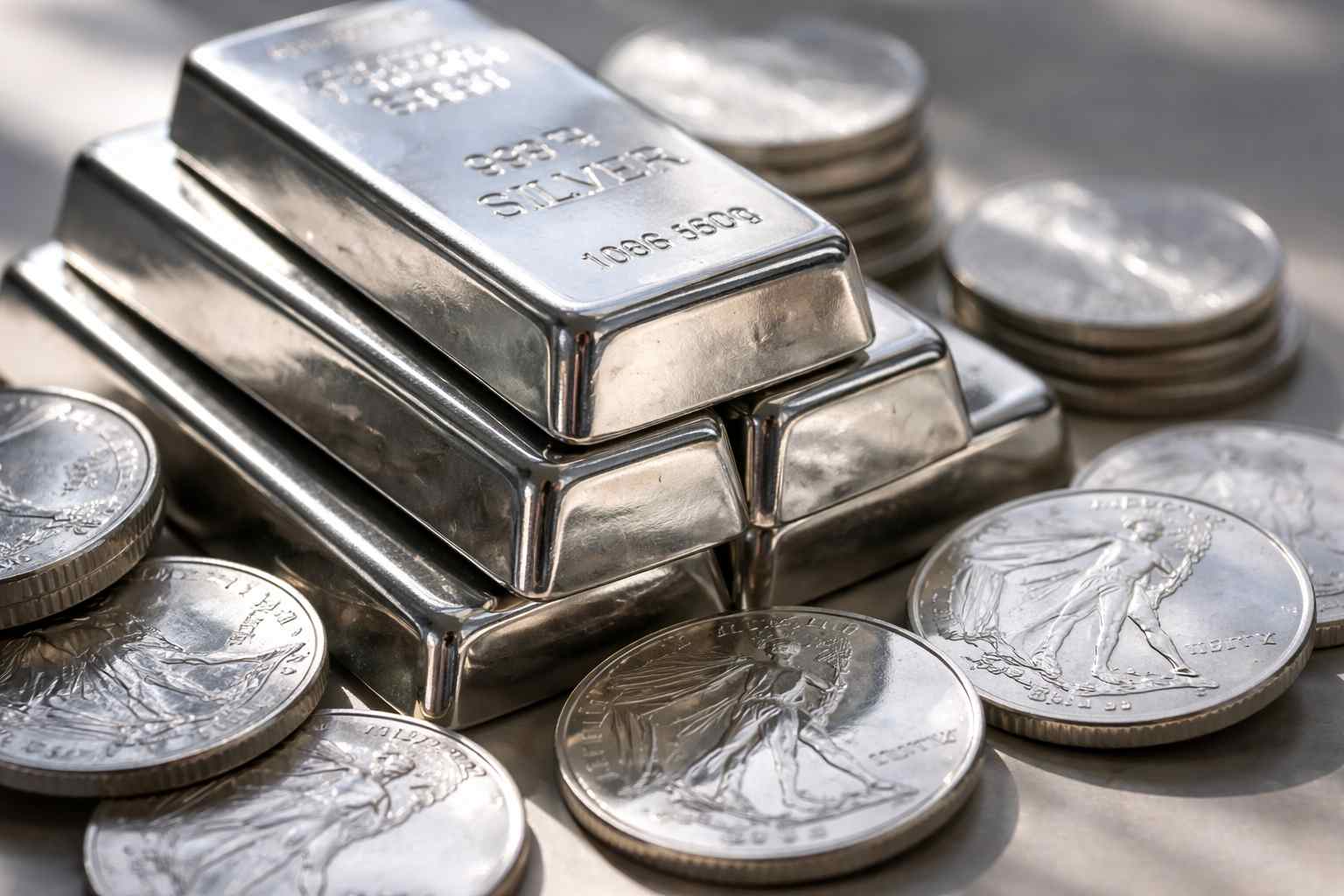
That number needs context. Seven hundred and sixty-two million troy ounces is roughly equivalent to an entire year of global mine output. The market has been drawing down above-ground stocks for a half decade to bridge the gap between supply and demand. The 2026 silver market deficit is projected to widen to 46.3 million ounces, up from 40.3 million ounces in 2025, a 15% increase in the shortfall.
A structural deficit is not a temporary shortage caused by a factory fire or a shipping delay. It is a condition in which the global market, taken as a whole, consistently produces less of a commodity than it consumes, year after year, and has to draw down existing reserves to make up the difference.
Silver is a hybrid asset. It is part monetary metal, part industrial necessity, and part speculative pressure point. It is used in electronics, solar applications, electric vehicles, jewelry, and investment products, which means it is pulled by both manufacturing demand and financial fear at the same time.
It is trading on a market structure that has now been in structural deficit for six consecutive years.
The October 2025 liquidity squeeze in the benchmark London market was a direct result of that process, triggered by months of inflows into U.S. inventories and silver-backed exchange-traded products alongside a spike in physical demand. The squeeze drove prices to their record high of $121.6 per ounce in January 2026, following a 147% surge in 2025.
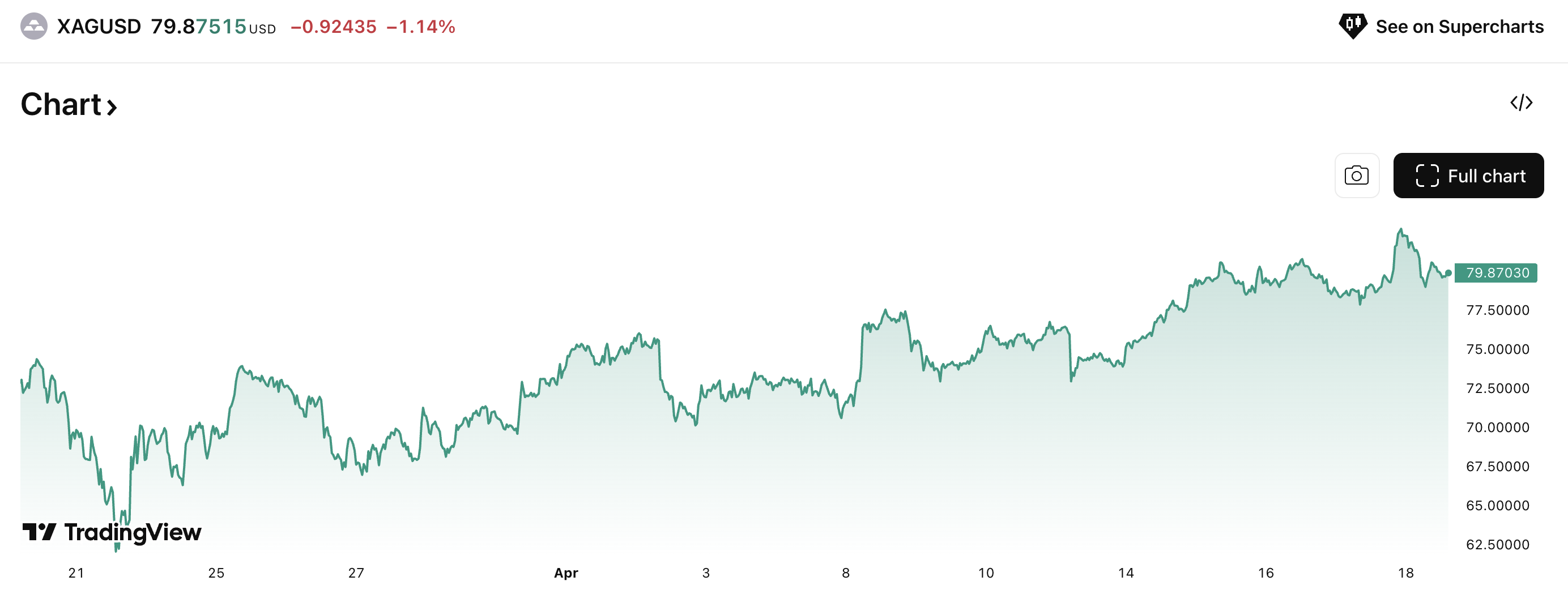
The important thing to understand about that episode is that it was not caused by a supply disruption or a geopolitical event. It was caused by the ordinary mechanics of a market that had been running a deficit for four straight years. The reserve simply ran low enough that a surge in buying created a genuine delivery problem.
The most intuitive response to a supply deficit is to ask: why don’t miners just produce more silver? The answer reveals why this particular market behaves differently from most commodities.
Roughly 70 to 80% of the world’s silver supply is produced as a byproduct of mining for copper, lead, and zinc. Dedicated silver mines are rare. As a result, production cannot quickly increase when demand rises or prices spike. New mines take time; it often requires 7 to 15 years to move from discovery to meaningful output.
When copper demand is strong, copper miners produce more copper, and silver output rises as a byproduct. When copper demand is weak, the reverse happens regardless of what the silver price is doing. Silver producers are, in most cases, making decisions based on other metals entirely.
Silver mine production is expected to increase by 1% to 820 million ounces in 2026, driven by stronger output from existing operations and recently commissioned projects. In Mexico, the most growth will come from primary silver mines.
That 1% increase in output against a widening deficit makes clear that supply is not the solution in 2026. The market remains dependent on continued drawdowns of above-ground stock.
The reason the deficit persists even as overall demand softens is that the industrial categories driving silver consumption are not price-sensitive in the way that, say, jewellery or silverware markets are. Industries building solar panels, electric vehicles, and AI data centers need silver to function. They do not cut back because the price has risen.
Solar photovoltaic technology is among the most significant and fastest-growing applications of silver demand. In 2014, only 11% of silver industrial demand came from this sector, compared to 29% in 2024. That is nearly a three-fold increase in relative share in a decade, driven by the global expansion of renewable energy capacity.
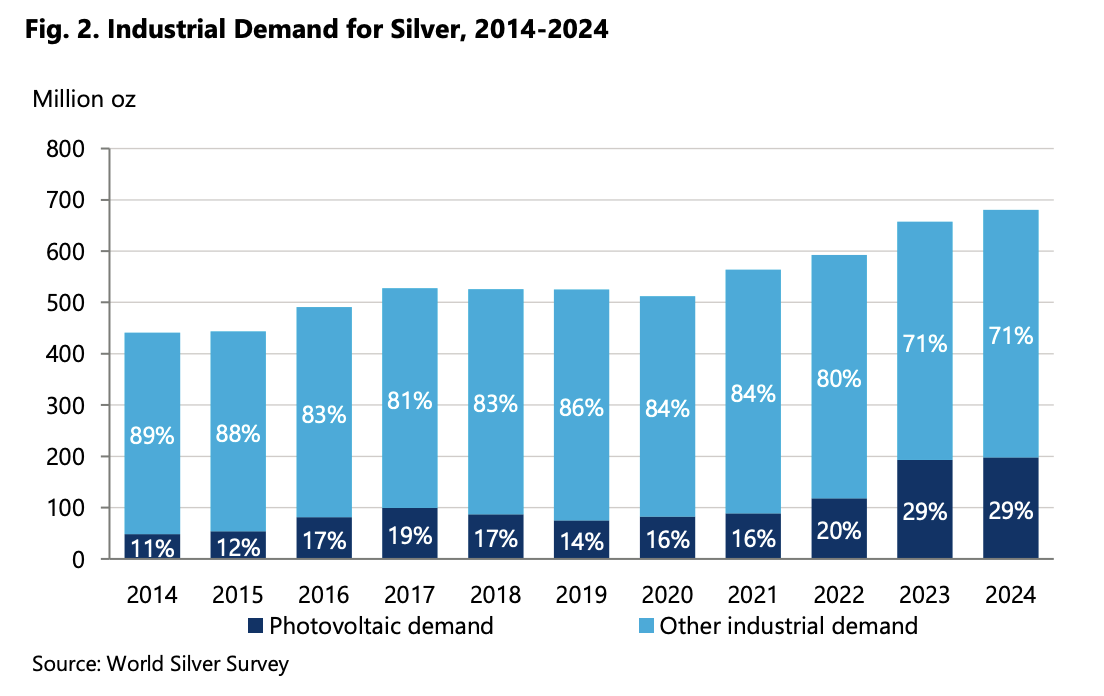
The electric vehicle revolution is also driving substantial increases in silver demand. The Silver Institute’s report by Oxford Economics forecasts global automotive silver demand to increase at a compound annual growth rate of 3.4% between 2025 and 2031.
EV vehicles are expected to overtake internal combustion engine vehicles as the primary source of automotive silver demand by 2027.
The AI data center angle is newer but increasingly significant. As digitalization and AI adoption accelerate, demand for critical minerals including silver used in data center applications is growing alongside a total global IT power capacity that has increased approximately 53 times since 2000.
This is the structural demand floor. Industrial users of silver are not speculating. They are building physical infrastructure that requires the metal. As long as the green energy transition and digital build-out continue, that floor does not lower.
Alongside the industrial story, a separate and equally significant driver is now reasserting itself: physical investment demand. Physical investment in silver bars and coins is forecast to rise by 18% to a three-year high of 227 million ounces. After three consecutive years of decline, Western physical investment is expected to recover in 2026 as silver’s exceptional price performance and ongoing macroeconomic uncertainty rekindle investor interest.
The World Silver Association expects demand for silver bars and coins to jump 18% in 2026. Against the background of an unstable global economy and geopolitical risks, silver is again being perceived as a safe haven and the main instrument of capital preservation.
This matters for a specific reason. Investment demand and industrial demand are additive. Industrial demand provides the structural floor. Investment demand is the accelerant. When both are rising simultaneously and supply is constrained, the conditions for a price squeeze are more easily met.
J.P. Morgan Global Research forecasts an $81 per ounce average for 2026, more than double the 2025 average, citing the same structural shortfall. Simply put, silver no longer has the same buffer of above-ground metal to absorb shocks.
Gold receives most of the media coverage whenever macroeconomic anxiety rises, and for good reason. It has deeper liquidity, a longer monetary history, and wider institutional adoption. But the investment thesis for silver in 2026 rests on something gold does not have in the same measure: a genuine industrial demand foundation that is disconnected from financial sentiment.
Gold’s price is overwhelmingly driven by monetary factors, real interest rates, and safe-haven positioning. Silver shares those characteristics but layers on top of them a demand structure tied to the energy transition and technology build-out that is compulsory rather than discretionary.
That dual nature is both the source of silver’s volatility and the reason the current deficit cycle has persisted even through periods of weak investor sentiment.
Silver sits at the intersection of several highly favorable market conditions: it is in a supply deficit, with soaring demand, fragile supply chains, and impacted by the debasement trade.
Silver often behaves like gold with a louder amplifier, reacting to monetary stress, inflation anxiety, and distrust in paper systems while also carrying an industrial growth narrative tied to electrification and technology.
This is one of the clearest stress gauges in the market. If a smaller share of London vault silver is freely available, the market becomes more vulnerable to abrupt squeezes. Reuters said available metal improved from last year’s extreme lows, but squeeze risk remains if volatility rises and investor flows return.
Retail investment is back in the story. Reuters said coin-and-bar demand is expected to rise 18% in 2026, supported by recovering U.S. buying. The Silver Institute’s February outlook also projected physical investment to jump, with Western interest recovering and India building on strong momentum.
Silver’s long-term case still depends partly on industrial use. The Silver Institute said solar demand is facing thrifting pressure, but AI infrastructure, data centers, and autos remain supportive demand channels. Investors should care less about one headline application and more about whether total industrial demand stays resilient despite substitution.
A market can be structurally tight and still trade down hard in the short run. That is why the silver supply deficit theme works best as a medium-term framework, not as a daily trading slogan. Physical tightness raises the odds of violent moves. It does not eliminate two-way risk. This conclusion is an inference from the recent price swing and the market-balance data.
Reuters reported on April 15 that the global silver market is expected to post a 46.3 million ounce deficit in 2026, following a 40.3 million ounce deficit in 2025.
No. It means annual demand is running above annual supply, so the market must draw from existing inventories to make up the difference.
Because above-ground stocks still exist, high prices can reduce some demand, and silver is heavily influenced by macro factors such as the dollar, real yields, and investor positioning.
Because physical investment demand can tighten the market quickly when available inventories are already limited. Coin-and-bar demand is expected to rise 18% in 2026.
Silver shares gold’s monetary-metal appeal, but it also has a much larger industrial-demand component. That makes it more sensitive to the economic cycle and more volatile than gold.
The silver supply deficit is one of the most important commodity stories of 2026 because it explains why silver keeps behaving like a market with hidden tension under the surface. Demand is still outrunning supply. Inventories have already been drawn down for years. The physical market is more sensitive than it looks.
That does not guarantee an immediate squeeze or a straight climb in prices. It does mean silver now deserves to be read as a structurally tight market where the next surge in investment demand could matter a lot more than it did when inventories were easier to access. For investors, that is the real lesson behind the silver supply deficit story.