Published on: 2026-05-07
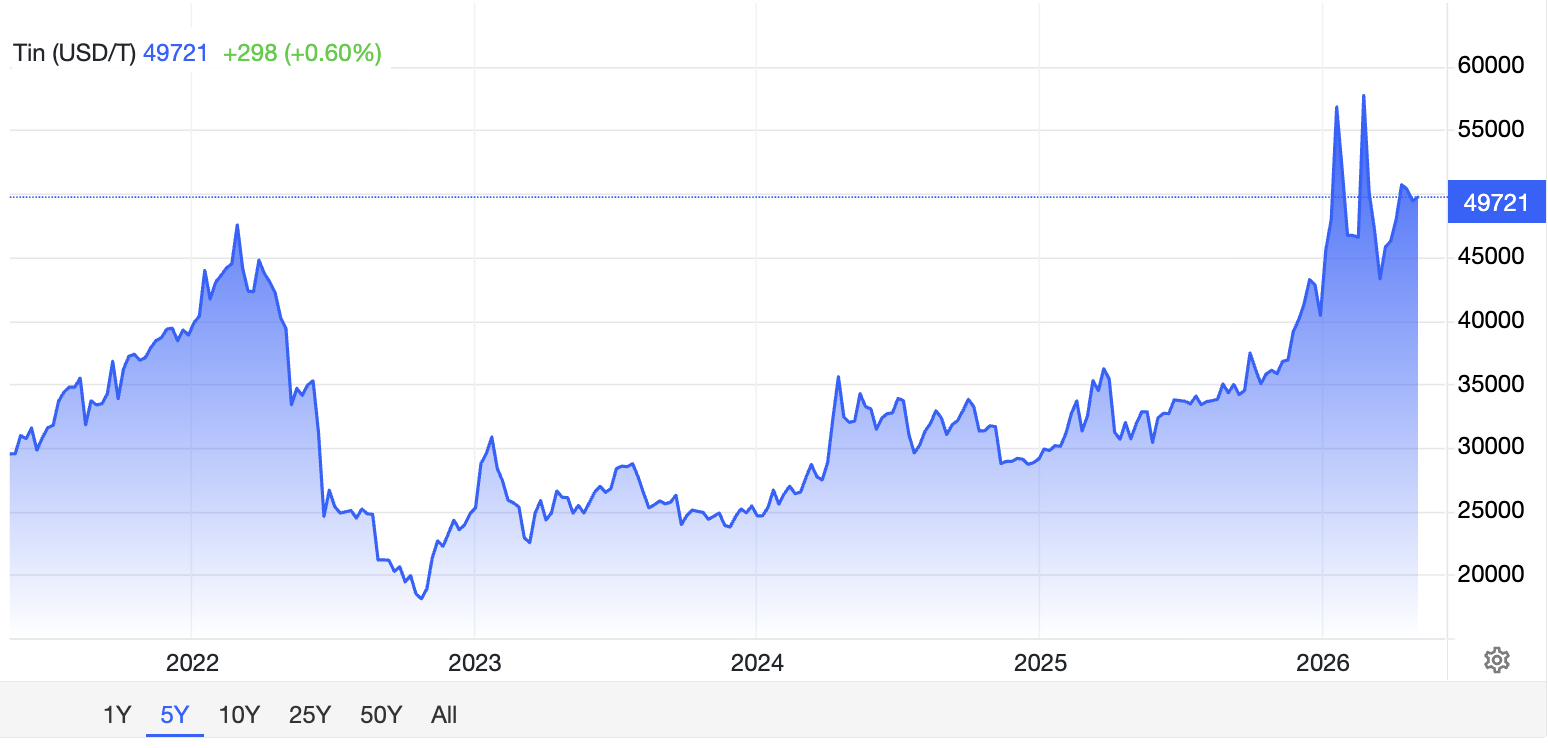
The tin price has delivered one of the least expected commodity moves of the year: a nominal record high on the London Metal Exchange. In mid-January, the LME three-month tin contract closed at $53,462 per tonne, which the International Tin Association described as a nominal all-time high. The rally later extended above $58,000 per tonne before profit-taking cooled momentum.
Copper took most of the attention. Tin delivered the sharper repricing. The tin market now sits at the intersection of two powerful forces: a structural supply deficit and a demand cycle tied to the most capital-intensive technology buildout in modern markets.
To understand where the tin price goes next, you need to understand why a small solder metal has become a critical AI supply-chain input.
Tin has traded close to the $50,000 per tonne zone after setting a nominal LME record earlier this year.
Solder accounts for about 50% of global tin demand, linking the metal directly to electronics, semiconductors, servers, solar equipment, and electric vehicles.
Refined tin production is expected to rise by about 3% this year, while demand is expected to grow by 3.5%, leaving the market vulnerable to deficit conditions.
Myanmar, Indonesia, and the Democratic Republic of Congo remain the three main supply pressure points.
Tin is not the new copper by scale, but it is becoming a copper-like bottleneck in digital infrastructure.
The strongest price signals to watch are Myanmar export recovery, Indonesia quota execution, LME and SHFE inventories, semiconductor demand, and speculative positioning.
The most important fact in the tin price story is also the least discussed: solder accounts for about half of global tin demand. Semiconductor packages, printed circuit boards, server assemblies, data-centre power systems, and advanced electronics all rely on tin-based solder connections.
AI infrastructure spending therefore creates indirect tin demand. Hyperscalers are not only buying graphics processing units. They are buying servers, storage systems, networking equipment, power modules, cooling controls, and circuit boards. Each layer requires soldered connections before it can function inside a data centre.
This makes tin one of the least visible AI metals. Copper carries power across grids and data-centre campuses. Tin connects the electronic components inside the machines. Copper captures the scale of electrification. Tin captures the precision of digital infrastructure.
The semiconductor cycle strengthens the link. The global chip market is projected to grow from about $627 billion in 2024 to more than $1 trillion by 2030, while silicon wafer shipments are expected to rise 5.2% this year. Most chips eventually enter packages, boards, and systems that depend on solder.
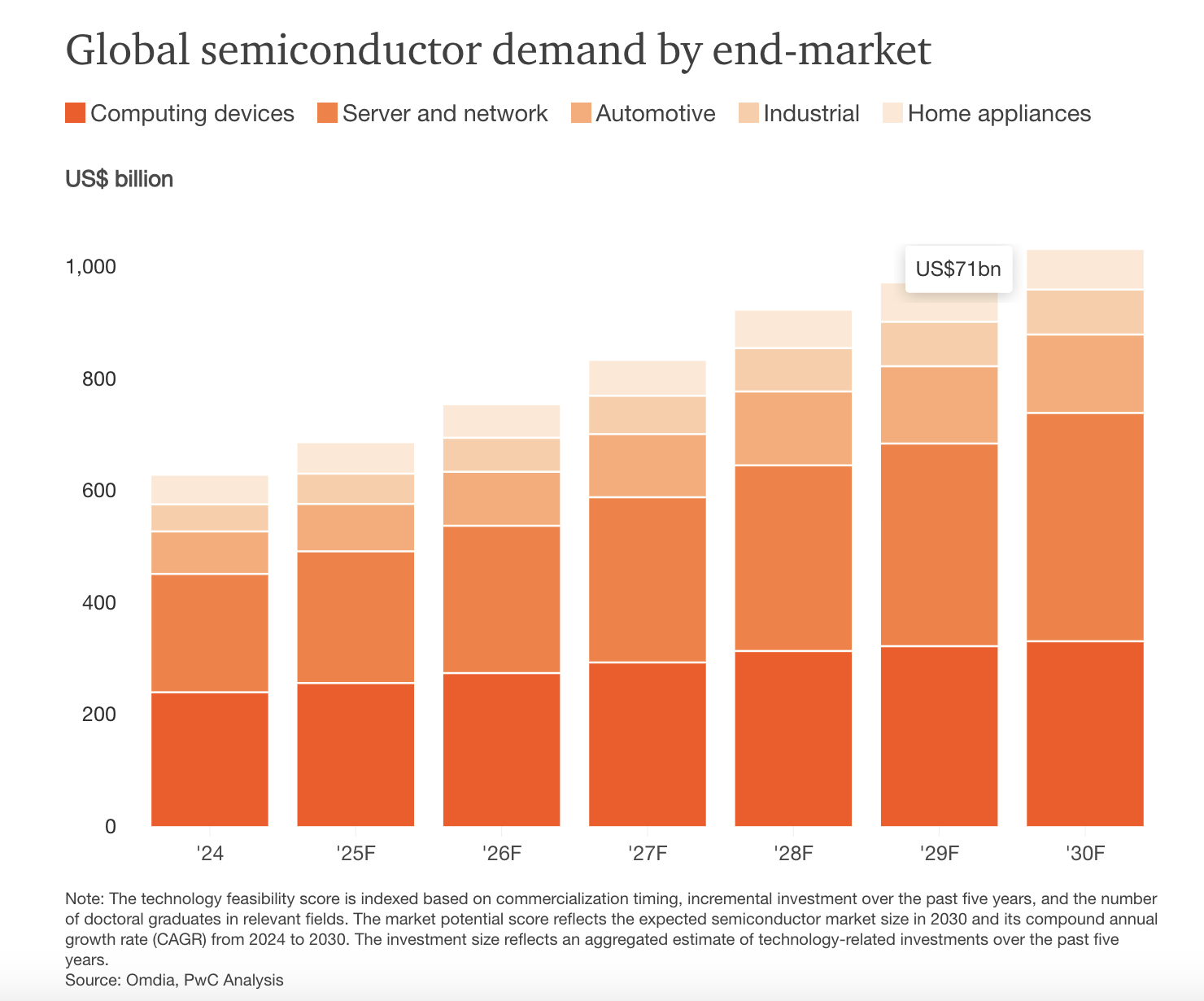
AI does not consume tin directly. It consumes electronics, and modern electronics consume tin.
Tin is not a single-application commodity. Its demand base has widened across several industrial and technology segments:
Solar panels: Tin is used in solder ribbon, solder paste, and metallisation processes that connect photovoltaic cells.
Electric vehicles: A modern EV contains more control units, sensors, battery-management electronics, and power modules than a combustion-engine vehicle.
Tinplate packaging: Food and beverage packaging remains a steady base-load demand segment.
Specialty alloys and chemicals: Tin compounds are used in coatings, stabilisers, glass applications, and selected industrial processes.
Lead-acid batteries and emerging battery chemistries: Tin continues to appear in established battery applications and research into next-generation systems.
This demand profile gives tin a wider base than its reputation suggests. The old image was food cans and plating. The modern reality is solder, circuit boards, renewable energy hardware, automotive electronics, and data infrastructure.
If demand gives tin its growth story, supply gives the tin price its volatility. The market is expected to move into deficit this year, the first such deficit since 2021. Coface estimates refined tin production growth at about 3%, short of expected demand growth of 3.5%.
That gap looks small on paper. In a physically tight and relatively illiquid market, it can become significant. Tin is far smaller than copper, aluminium, or nickel. Thin inventory cover and concentrated mine supply mean small disruptions can produce large price moves.
| Indicator | Latest Signal | Market Interpretation |
|---|---|---|
| LME three-month tin record | $53,462 per tonne | Nominal all-time high confirmed in mid-January |
| Tin CFD price | $49,721 per tonne | Price remained near the $50,000 zone in early May |
| One-month move | +8.19% | Momentum stayed positive despite pullbacks |
| Year-on-year move | +55.42% | Tin outperformed many broader base-metal narratives |
| Solder share of demand | About 50% | Electronics remain the core structural demand channel |
| Expected refined output growth | +3% | Supply growth remains limited |
| Expected demand growth | +3.5% | Demand growth is expected to exceed refined supply growth |
The snapshot explains why tin can feel unstable even when the underlying thesis is strong. Prices are elevated, supply recovery is uneven, and demand is tied to high-growth technology sectors. This creates a market where corrections can be sharp without destroying the structural case.
Tin’s supply risk is concentrated in three markets where disruption has already affected physical flows. In Myanmar, the Man Maw mine in Wa State was historically one of the world’s most important tin sources and accounted for roughly 70% of Myanmar’s output before its suspension.
The August 2023 mining ban removed a key cassiterite stream for Chinese smelters, and the restart has been slow despite new three-year permits. With Myanmar holding about 700,000 tonnes of tin reserves, any meaningful recovery would ease pressure on the market. A delayed recovery keeps the deficit intact.
Indonesia remains the most visible near-term supply variable. The country is the world’s largest refined tin exporter, but shipments fell 33% to about 46,000 tonnes in 2024 after tighter quotas, permit delays, and regulatory scrutiny disrupted output.
The official quota is expected to rise from about 53,000 tonnes to 60,000 tonnes, but actual exports will depend on smooth permit execution and enforcement consistency.
The DRC adds a geopolitical risk premium. The Bisie mine accounts for around 6% of global tin supply and sits in North Kivu, where conflict between M23 rebels and the Congolese army has repeatedly threatened operations. In a market with limited spare supply, disruption at a single major mine can quickly become a price catalyst.
The comparison is imperfect, but useful. Copper is the infrastructure metal of electrification, tied to grids, construction, power cables, and industrial activity. Tin is narrower, but its role is harder to ignore as electronics, semiconductors, solar equipment, EVs, and data centres expand.
The difference is function. Copper carries electricity. Tin connects the components that make electronic systems work. Its largest demand source is solder, and there is no broad, low-cost substitute for tin-based solder across mainstream electronics manufacturing at industrial scale.
Tin also shares one important feature with copper: supply cannot respond quickly. New mines can take five to ten years to move from discovery to production, while the project pipeline remains thin. Copper is already central to institutional commodity allocation. Tin is still being discovered by a smaller pool of capital, which gives the tin price story more room to develop.
The tin price will depend on whether supply recovery can catch up with demand from electronics and AI infrastructure. Six signals matter most:
Myanmar exports: A clear recovery in Man Maw shipments would ease supply pressure. A slow restart keeps the deficit risk intact.
Indonesia quotas: Higher quotas only help if they translate into steady refined-tin exports.
LME and SHFE inventories: Rising stocks would suggest easing tightness. Falling stocks would confirm continued physical stress.
AI infrastructure spending: Stronger data-centre investment supports tin demand through servers, storage systems, power modules, and networking equipment.
Semiconductor activity: Wafer shipments, chip packaging, and PCB production remain direct indicators for solder demand.
Macro risk appetite: Risk-off conditions can pull speculative capital out of base metals, creating short-term price drops even when physical supply remains tight.
Tin price is rising because supply remains tight while demand from electronics, semiconductors, solar equipment, EVs, and AI data centres is growing. Low inventories and supply disruption in Myanmar, Indonesia, and the DRC have added further pressure.
Tin is not the new copper by scale. Copper powers grids and electrification. Tin plays a smaller but critical role in solder, which connects electronic components. Its importance comes from supply-chain bottleneck risk rather than volume.
AI increases tin demand indirectly through servers, chips, circuit boards, storage systems, power modules, and networking equipment. These components rely on tin-based solder. As data-centre investment rises, demand for electronics assembly also increases.
The tin market is a case study in how a small, essential metal can reprice when technology demand collides with a constrained supply chain. Tin is physically embedded in the electronics the global economy is racing to build, yet the market remains exposed to geography, geopolitics, thin inventories, and years of underinvestment in new mine development.
Copper went through its own recognition cycle as electrification became the dominant commodity theme. Tin appears to be entering a similar phase, but through a different channel. It is not the metal that powers the AI boom. It is the metal that helps connect it.