Published on: 2026-02-26
Updated on: 2026-02-26
Silver entered a new pricing regime in early 2026, trading near $90 per ounce after reaching record highs in late January. The focus for the next five years is on the sustainability of these levels, rather than a potential breakout.
The market’s core support is structural: the Silver Institute expects a sixth straight deficit in 2026 (67 Moz), with the balance still relying on above-ground inventory drawdowns.
Solar demand is transitioning from volume growth to efficiency-driven reductions. However, demand from power, electronics, automotive, and AI infrastructure is providing new support. As a result, downside risks are now more influenced by macroeconomic factors than by industrial decline.
2026 is expected to see unusually wide trading ranges, with LBMA forecasts spanning approximately $42 to $165. These ranges are more significant than any single price target.
| Metric | Latest Read | Unit | Date / Period |
|---|---|---|---|
| Spot Silver (Bid) | 89.49 | USD/oz | Feb 26, 2026 |
| Spot Silver Day’s Range | 87.27 to 90.48 | USD/oz | Feb 26, 2026 |
| 2026 Silver Market Balance (Forecast) | -67 | Million Oz | 2026E |
| 2026 Total Silver Supply (Forecast) | 1.05 | Billion Oz | 2026E |
| 2026 Silver Mine Production (Forecast) | 820 | Million Oz | 2026E |
| 2026 Recycling (Forecast) | 200+ | Million Oz | 2026E |
| 2026 LBMA Analyst Average Forecast | 79.57 | USD/oz (avg) | 2026 |
| 2024 Market Balance | -148.9 | Million Oz | 2024 |
| 2024 PV Demand (Within E&E) | 197.6 | Million Oz | 2024 |
| World Mine Production | 26,000 | Metric Tons | 2025E |
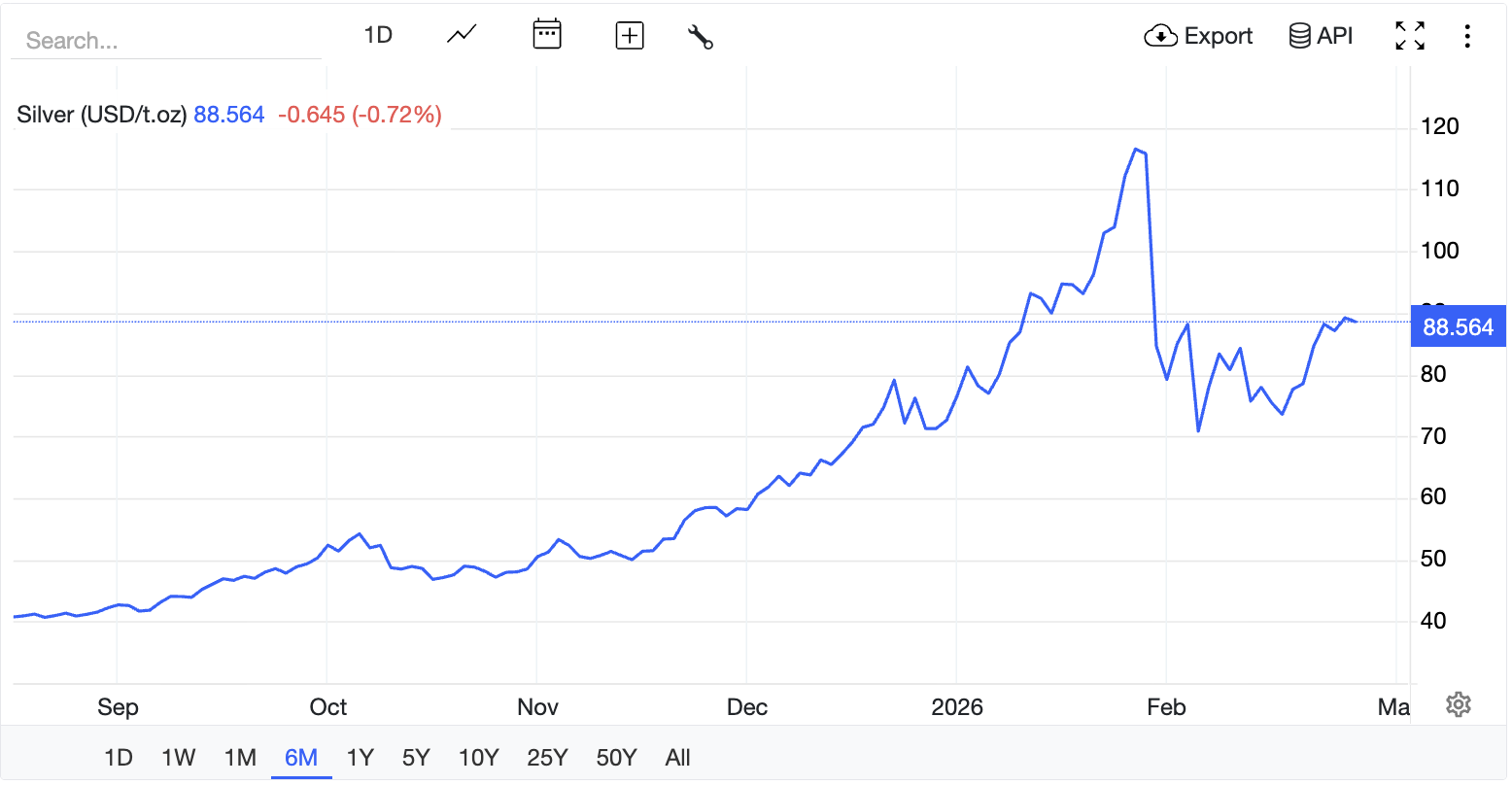
Silver is entering 2026 from a position of validated scarcity, not undervaluation. The Silver Institute reports that silver exceeded $100 per ounce in January before declining below $80 and then stabilizing. This pattern reflects a market adjusting to a higher clearing price as liquidity and positioning evolve.
Price movements support this narrative. Widely followed daily data show silver rising above $110 per ounce in late January before retreating to the $70s and $80s in early February. This highlights how leverage and margin dynamics can quickly outweigh fundamentals in the short term.
The critical implication for a 2026-2031 outlook is this: the floor is increasingly set by physical tightness and deficit math, while macro liquidity, real rates, and investor behavior set the ceiling. That combination tends to produce wide ranges and fast reversals.
Most silver is produced as a byproduct of lead-zinc, copper, and gold mining, not as a primary metal. That limits the industry’s ability to respond quickly to higher prices by increasing “silver-only” supply.
For 2026 specifically, the Silver Institute forecasts total supply up 1.5% to 1.05 billion oz, with mine output up about 1% to 820 Moz and recycling up 7% to above 200 Moz. Even after that supply response, the market still posts a 67 Moz deficit, implying continued reliance on inventory releases.
World Silver Survey 2025 data shows the market already ran deep deficits in 2024: total demand 1,164.1 Moz vs total supply 1,015.1 Moz (a -148.9 Moz balance), with industrial demand at 680.5 Moz and PV demand near 197.6 Moz.
For 2026, the Silver Institute expects industrial fabrication to decrease by about 2% to approximately 650 million ounces, primarily due to PV efficiency improvements and some substitution. This decline is partially offset by increased demand from data centers, AI technologies, and automotive electronics.
A central question for 2028-2031 is whether PV demand will accelerate despite efficiency gains. Industry research indicates that, under aggressive deployment scenarios, PV could represent a larger share of silver demand by 2030. This would be structurally positive for prices if supply does not keep pace.
Silver remains sensitive to macroeconomic factors such as real interest rates, the dollar, and gold price trends. The World Bank’s commodity outlook identifies silver as both a safe-haven asset and a key input for the energy transition, while also noting that weaker industrial activity poses a downside risk.
In practice, the 2026-2031 outlook depends on whether the coming years are characterized by ongoing policy uncertainty and lower real rates, which would be bullish, or by tighter financial conditions and weaker manufacturing, which would be bearish.
| Year | Base Case Average | Bull Case Average | Bear Case Average | What Drives The Outcome |
|---|---|---|---|---|
| 2026 | 80 to 95 | 100 to 125 | 60 to 75 | Deficit persists (67 Moz), investment stays firm, volatility remains elevated |
| 2027 | 75 to 95 | 105 to 135 | 55 to 70 | Macro normalization vs continued inventory drawdown; PV thrifting vs AI and grid demand |
| 2028 | 80 to 105 | 115 to 150 | 60 to 80 | Supply response lags due to byproduct nature; recycling rises with price, but not enough |
| 2029 | 85 to 115 | 125 to 165 | 65 to 85 | Industrial electrification and compute buildout expand, financial conditions decide the multiple |
| 2030 | 90 to 125 | 140 to 185 | 70 to 90 | PV deployment tail risk returns; tightness worsens if thrifting plateaus |
| 2031 | 95 to 135 | 150 to 200 | 75 to 95 | Structural scarcity stays priced if deficits persist through the cycle |
These are annual average ranges rather than single price points. In a tight physical market, silver can trade 30% to 50% above or below the annual mean, making ranges more realistic than specific targets. The LBMA’s 2026 survey reflects this, with forecasts ranging from approximately $42 to $165.
Reconciling with 2026 consensus forecasts: The LBMA’s average 2026 forecast is $79.57 per ounce, while the Silver Institute reports the year began with record highs and ongoing tightness, with spot prices near $90. This highlights that surveys often lag significant market shifts.
The Silver Institute notes that silver is forming technical price support following the post-January decline. In markets that are both tight and actively traded, support and liquidity levels are important as they affect hedging, margin requirements, and ETF activity.
$80 per ounce has become a key psychological support level, while $100 per ounce is a likely target during renewed momentum. The late-January surge above $110 demonstrates how quickly prices can overshoot when market positioning becomes imbalanced.
A sustained decline typically requires both a macroeconomic headwind, such as rising real rates or a stronger dollar, and evidence that deficits are narrowing faster than anticipated, due to increased recycling and weaker industrial demand.
Since the 2026 outlook already factors in higher recycling, any additional bearish surprise would likely be driven by weaker demand.
On the upside, key catalysts for renewed price acceleration include a resurgence in PV demand if efficiency gains stall, ongoing policy uncertainty that supports safe-haven demand, and continued inventory drawdowns that drive higher prices for immediate delivery.
The Silver Institute’s 2026 outlook is the cleanest current read on the physical market because it publishes explicit supply, demand, and deficit expectations, and it ties the balance to inventories. For price expectations, the LBMA’s annual survey is useful for showing dispersion and volatility.
Because silver is still a macro asset, when liquidity tightens or leveraged positions unwind, the price can drop faster than the physical market can respond. The Silver Institute highlights this dynamic directly in 2026’s whipsaw, with record highs in January followed by a sharp break before support formed.
Solar remains a major pillar, but the story is evolving. 2024 PV demand was roughly 198 Moz in the World Silver Survey 2025 data, yet 2026 expectations include PV thrifting and substitution. The swing factor is whether PV deployment and technology choices overwhelm thrift gains by 2029-2031.
Watch three indicators: the annual deficit size (and whether it keeps forcing inventory drawdowns), recycling’s responsiveness to high prices, and whether industrial demand outside PV (autos, power, data centers) keeps compounding. The Silver Institute’s 2026 framework emphasizes all three as the core drivers of the current regime.
The 2026-2031 outlook for silver is characterized by higher average prices and ongoing volatility. The Silver Institute projects a 67 million ounce deficit in 2026, even with increased recycling and record-high total supply, meaning the market will continue to rely on inventory drawdowns rather than new production.
The base case supports average prices between $80 and $135 per ounce through 2031, while the bull case envisions prices exceeding $150 during peak periods.
Disclaimer: This material is for general information purposes only and is not intended as (and should not be considered to be) financial, investment or other advice on which reliance should be placed. No opinion given in the material constitutes a recommendation by EBC or the author that any particular investment, security, transaction or investment strategy is suitable for any specific person.