Published on: 2026-08-28
Updated on: 2026-08-28
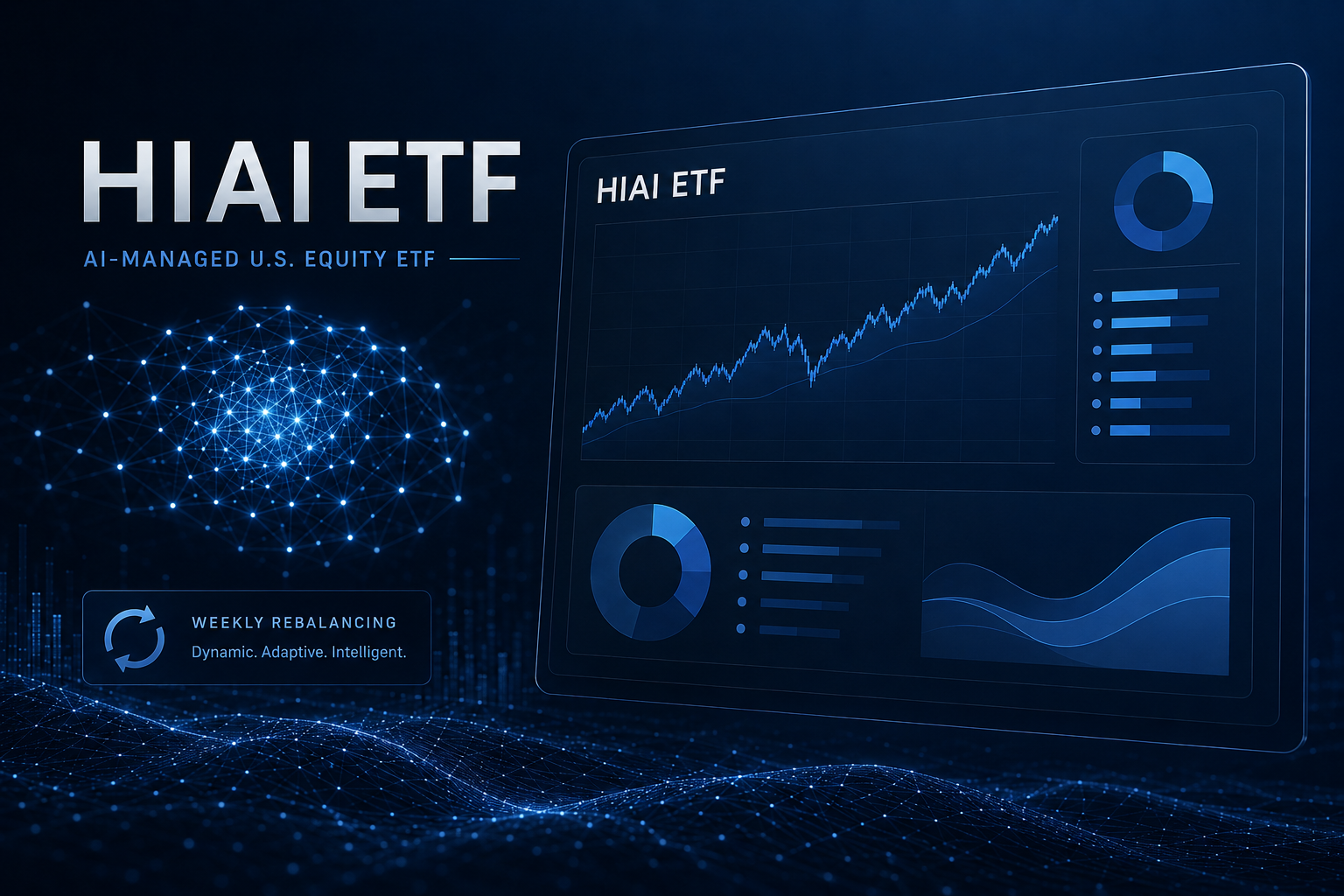
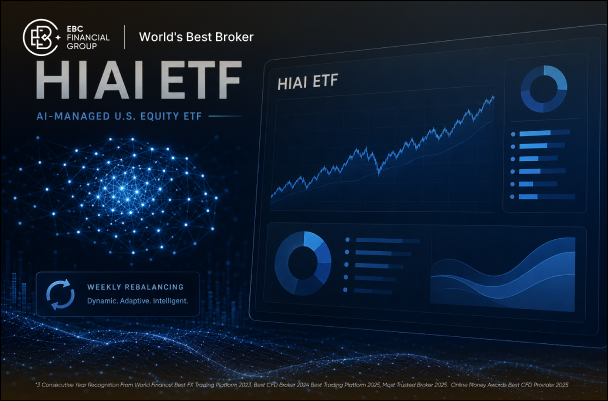
The HIAI ETF began trading on August 21, 2026 with an unusual proposition: instead of using artificial intelligence as an investment theme, it uses AI to decide which stocks the fund should own. Its proprietary BAILA model selects securities, sizes positions and can adjust how much overall equity risk the portfolio carries.
That puts HIAI in a different category from the growing list of ETFs built around Nvidia, semiconductors, AI software and data centres. The key question is how BAILA turns market data into actual stock selections, position sizes and portfolio-level risk decisions.
The Ai Funds High Conviction US Equity AI-Managed ETF (HIAI) launched on August 21, 2026 and trades on the Cboe BZX Exchange.
BAILA selects roughly 40 to 60 stocks from the 1,000 most liquid U.S. equities, while also determining position sizes and overall market exposure.
The model analyses more than 30 years of market history, using Bayesian probability, machine learning and portfolio optimisation to compare current conditions with previous market environments.
HIAI reviews its portfolio weekly and can reduce equity exposure or move toward cash when its risk signals deteriorate.
HIAI itself has almost no operating history, so whether AI management improves returns or reduces losses remains unproven.
| HIAI ETF Snapshot | Details |
| Full name | Ai Funds High Conviction US Equity AI-Managed ETF |
| Ticker | HIAI |
| Exchange | Cboe BZX |
| Launch date | August 21, 2026 |
| Stock universe | 1,000 most liquid U.S. equities |
| Typical portfolio | Approximately 40–60 stocks |
|
Portfolio review
(Management fee)
|
Weekly |
Investment model (Management style) |
BAILA |
| Objective | Long-term capital appreciation, with an aim to outperform the S&P 500 over a full market cycle |
The easiest mistake is to read “AI-managed ETF” and assume HIAI is another fund designed to capture the artificial-intelligence boom.
Most AI-themed ETFs work differently. They typically own companies positioned somewhere in the AI value chain, including semiconductor manufacturers, cloud providers, software developers and infrastructure businesses. Their exposure is defined by the companies they own.
HIAI’s use of AI concerns how those ownership decisions are made.
Ai Funds describes its proprietary BAILA model as the fund’s investment strategist. Instead of following a fixed index or relying primarily on a human portfolio manager to choose securities, BAILA constructs the portfolio through a systematic process and adjusts risk as conditions change.
That means HIAI does not need a company to be an “AI stock” before considering it. Its starting universe is roughly 1,000 liquid U.S. equities across the market. From there, the model decides which securities deserve a place in a much smaller high-conviction portfolio.
The product therefore sits closer to quantitative active management than to a conventional thematic AI ETF.
BAILA’s exact scoring rules, signal weights and security-level decision thresholds are proprietary. The disclosures explain the architecture of the process, but not the formula needed to reproduce individual stock selections.
The first step is the investment universe. HIAI starts with the 1,000 most liquid U.S. equities, providing a large pool of stocks while avoiding much of the liquidity risk associated with thinly traded companies.
BAILA then assesses the market environment itself. The model analyses more than 30 years of historical data spanning multiple market cycles and looks for past environments that resemble current conditions.
An earlier prospectus description characterised this process partly through risk-on and risk-off regimes. Rather than considering a stock entirely in isolation, BAILA therefore appears to evaluate securities within the market environment in which they are trading.
The model then applies Bayesian probability.
Bayesian analysis updates probabilities as new evidence arrives. In BAILA’s case, that allows the model to revise its assessment of securities and market conditions continuously rather than rely on a fixed forecast.
Those probability estimates feed into portfolio construction. AI Funds says BAILA determines which stocks to hold, how large each position should be and how much overall equity exposure the fund should carry.
Earlier filing material described a smaller 20-to-40-stock portfolio, while the August launch disclosure states approximately 40 to 60 holdings. The newer launch disclosure is therefore the better guide to HIAI’s current portfolio construction.
The important feature is that stock selection and risk management happen within the same process. BAILA therefore combines security selection, position sizing and portfolio-level risk allocation within the same process.
Earlier filing material allowed equity exposure to range from 0% to 100%, illustrating how much flexibility the strategy was designed to have. Current exposure should still be checked against the latest fund disclosures rather than inferred solely from the earlier filing.
HIAI therefore has to get two decisions broadly right: which stocks deserve capital and how much market exposure the portfolio should carry.
HIAI’s branding places considerable emphasis on the machine making investment decisions, although that does not mean humans disappear from the fund.
Ai Funds says BAILA serves as the investment strategist and delivers fully constructed portfolios. The model was launched in 2019 and was used in adviser-distributed strategies before HIAI’s ETF launch.
At the same time, Ai Funds explicitly says those portfolios operate with oversight from its investment team. Milliman Financial Risk Management also serves as HIAI’s sub-adviser. Milliman had $273.2 billion in global assets under management and advisement as of June 30, 2026.
The term ‘AI’ also needs clarification. Nothing in the disclosed material suggests BAILA operates like a generative chatbot or large language model.
It is described as a system built around Bayesian statistics, machine learning, historical market analysis and portfolio optimisation. Quantitative investment funds have used algorithms and statistical models for decades.
What differentiates HIAI is that BAILA is used to generate the portfolio itself rather than merely producing research signals for a discretionary manager.
That creates a different source of active risk. HIAI can rotate across sectors as BAILA’s probabilities change and can also vary overall equity exposure rather than remaining continuously invested.
HIAI becomes easier to understand when placed beside the two ETF structures investors already know.
A traditional S&P 500 index ETF follows an established benchmark. Its portfolio is largely determined by index membership and weighting rules, with no attempt to predict which individual constituent will outperform next week.
An AI-themed ETF takes a different route. It intentionally owns companies expected to benefit from artificial intelligence, such as semiconductor businesses, hyperscalers, software developers or data-centre infrastructure providers. AI is the investment exposure.
With HIAI, AI is the decision-making process.
That creates a very different return profile. HIAI could theoretically own technology companies when BAILA finds them attractive, then rotate into companies from completely different industries as its probabilities change. It can also vary its overall market exposure rather than remaining continuously invested.
Its stated aim is to outperform the S&P 500 over a full market cycle. That sets a demanding benchmark because the model’s stock selection, position sizing and exposure decisions all need to add value consistently over time.
The ‘30+ years’ claim refers to the historical dataset analysed by BAILA, not a three-decade live investment record. BAILA launched in 2019, while HIAI began trading only on August 21, 2026. The historical data broaden the model’s reference set across different market regimes, but they provide a broader statistical reference set, not proof that future market behaviour will repeat.
A larger historical sample can still help the model compare current conditions with different rate, volatility and recession environments. The limitation is that historical relationships can weaken or disappear when market structure or policy regimes change.
There is also regime risk. Relationships learned from earlier market environments may stop working during unusual monetary, geopolitical or structural shifts.
The limitation is that financial markets do not have to repeat previous relationships. A model may identify today’s conditions as resembling an earlier regime, only for policy, market structure or investor behaviour to produce a different outcome.
Thirty years of inputs consequently provide BAILA with a larger statistical reference set. They provide a broader statistical reference set, not proof that future market behaviour will repeat.
The most relevant risks for HIAI differ from the usual concerns surrounding AI-themed funds.
The first is model risk. BAILA applies its process systematically, but a systematic decision can still be wrong.
The second is data risk. Earlier filings warn that results depend on the quality, reliability and timeliness of the information supplied to the model. Missing, stale or inaccurate inputs can therefore affect portfolio decisions.
There is also regime risk. Historical relationships can break down, particularly during unusual monetary, geopolitical or technological shifts.
HIAI’s ability to change exposure introduces timing and whipsaw risk. The model could reduce stocks after a decline and miss the recovery, or increase exposure shortly before another selloff.
Its approximately 40-to-60-stock portfolio also creates greater concentration risk than an index containing hundreds of securities. Strong stock selection can help performance, while poor selections can have a correspondingly larger impact.
Finally, there is the most basic problem: HIAI is new.
HIAI also charges a 0.85% annual management fee, so the strategy ultimately needs to add enough value to overcome its higher cost relative to many passive index ETFs.
HIAI is a useful test of how far AI-led systematic portfolio management can move from institutional strategies into the mainstream ETF market.
The sophistication of the model will not settle the question on its own.
The evidence will come from how BAILA performs when markets stop behaving favourably. Its stock selections need to outperform often enough, its position sizing needs to control unintended concentration, and its risk signals need to reduce exposure at useful moments rather than repeatedly entering and exiting at the wrong time.
Performance also needs to be judged over the period HIAI itself identifies: a full market cycle. A strong year during a bull market would reveal little about whether its defensive process works, just as one successful move to cash would not establish that the model can repeatedly identify regime changes.
For now, HIAI is genuinely different from the typical ETF carrying an AI label. It places a Bayesian machine-learning model at the centre of stock selection, position sizing and market-exposure decisions rather than simply investing in companies associated with artificial intelligence.
Whether AI-managed ETFs develop into a meaningful alternative to index and traditional active strategies will depend on live results rather than the sophistication of the model itself. For now, HIAI’s process is differentiated; its performance remains unproven.