Published on: 2026-06-29
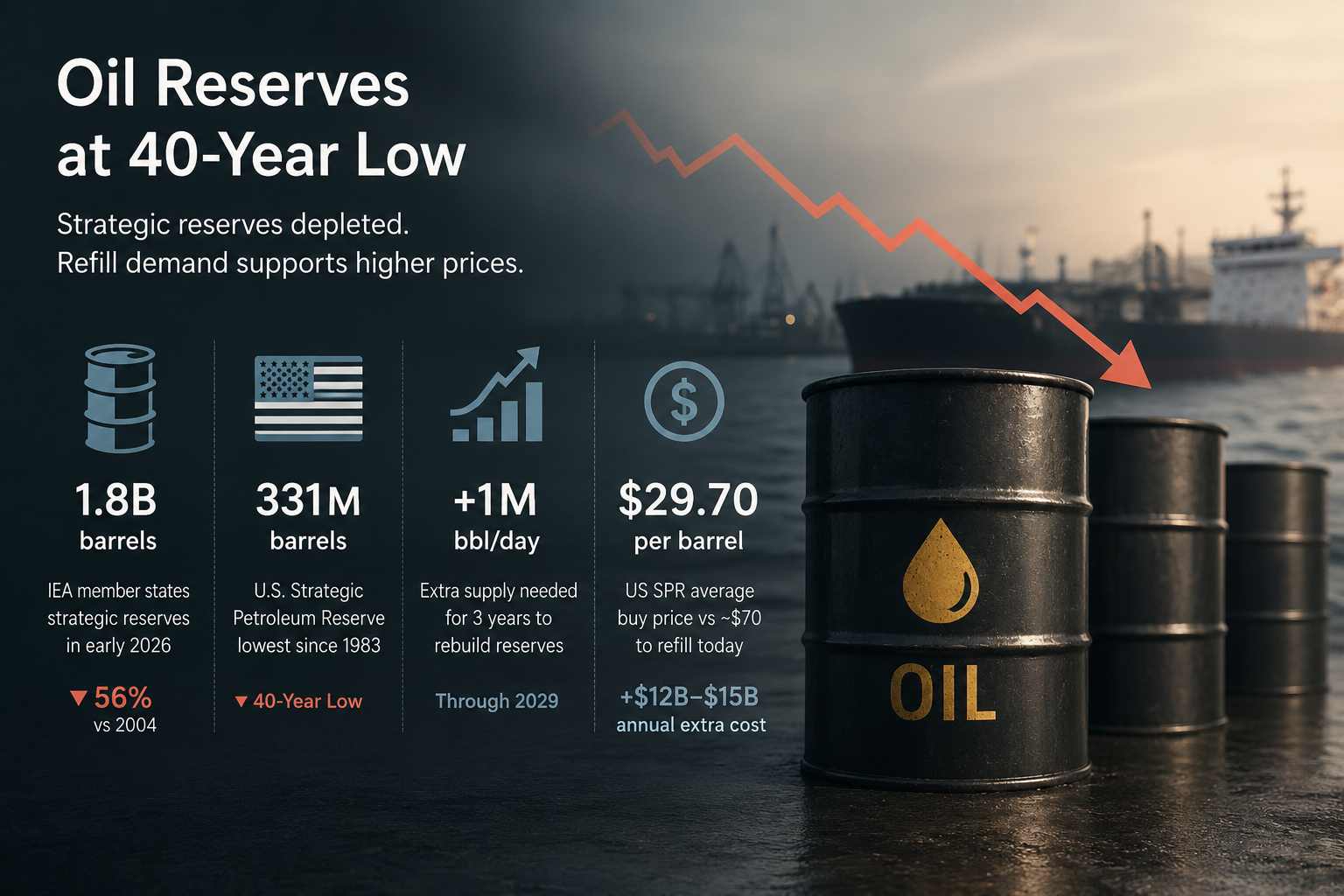
In early 2026, IEA member states maintained approximately 1.8 billion barrels in strategic reserves, a significant decrease from around 4.1 billion in 2004. The largest supply disruption in oil-market history was met with a government and industry buffer less than half as deep as that of two decades earlier.
The US Strategic Petroleum Reserve has fallen to approximately 331 million barrels, its lowest level since 1983, while total US crude inventories, including the reserve, have reached their lowest point since 1984. Given the slow pace of reserve replenishment, these multi-decade lows are expected to influence the market for several months.
According to IEA estimates, restoring depleted stocks would necessitate an additional 1 million barrels per day of supply for three years, beyond normal demand growth, extending through 2029. This sustained refill demand supports prices, even as a surplus is projected for 2027, thereby limiting the coexistence of low oil prices and active reserve replenishment.
Oil withdrawn from these reserves was originally acquired at low prices but must now be replaced at significantly higher costs. The US reserve has an average acquisition price of $29.70 per barrel, compared to a current refill cost of approximately $70 per barrel. Additionally, a permanent Gulf freight and insurance premium of about $2 per barrel adds an estimated $12 billion to $15 billion annually to global trade expenses.
Brent crude prices have returned to the low $70s, similar to pre-war levels, and the US benchmark crude fell below $70 for the first time since February 27, the day before the conflict began. Prices have declined by approximately 40% from a wartime peak above $120. Gulf exports have recovered to about 75% to 85% of pre-war volumes as tanker traffic resumes through the Strait of Hormuz. Based solely on price, the market shock appears to have subsided.
The US Strategic Petroleum Reserve is currently at approximately 331 million barrels, the lowest level since 1983, following a drawdown of approximately 75 million barrels in the spring. Total US crude inventories, including the reserve, have reached their lowest point since 1984, and stocks at the Cushing delivery hub have declined to a 12-year low. Replenishing a strategic reserve is a multi-year process; therefore, these inventory levels will continue to influence the market through at least 2027.
The risk premium persisted in the market despite declining prices, shifting from price indicators to inventory levels. Each barrel purchased by governments for reserve replenishment now represents a sustained source of demand. This aspect of the situation has not yet been fully reflected in market pricing, and the reopening that facilitated lower prices remains provisional rather than definitive.
The June ceasefire initiated a 60-day negotiation period extending through the summer, but the terms for long-term transit through the Strait remain unresolved. Tanker traffic has increased from a wartime low of approximately 9.6 million barrels per day to around 12 million, although shipowners remain cautious and sporadic attacks on vessels have persisted despite the truce. The waterway is currently accessible due to temporary circumstances rather than a stable agreement.
The US Energy Information Administration projects that traffic through the Strait will not return to pre-conflict levels until early 2027. Demining primary shipping lanes, repairing damaged Gulf refining capacity, and reestablishing insurance and charter arrangements require significant time beyond what a ceasefire announcement provides. Saudi Arabia and the UAE have diverted some volumes through pipelines to the Red Sea and Fujairah; however, these alternative routes accommodate only a small portion of the 17 million barrels per day that typically transit Hormuz.
In a market with such limited buffering, price volatility is highly sensitive to news events. The supply, which declined by approximately 40% from its peak, could rebound rapidly in response to renewed tensions, as the inventories that would typically absorb shocks have already been depleted. Any future disruption would encounter storage levels lower than at any point in the past forty years.
IEA member states held about 1.8 billion barrels of strategic reserves in early 2026, against roughly 4.1 billion in 2004. The world walked into the worst oil-supply disruption on record, carrying a buffer less than half the depth it held two decades earlier. The erosion was gradual, which is why it drew little notice until the tanks were needed.
The coordinated response drained that thinner buffer at speed. All 32 IEA members agreed to release 400 million barrels, the sixth coordinated action in the agency’s history and more than double the 183 million released after Russia’s invasion of Ukraine in 2022. Observed global inventories, including oil on water, fell by about 250 million barrels across March and April alone, close to 4 million barrels a day.
Reported reserves overstate usable reserves, which makes the real cushion thinner than the headline. A strategic stock carries an operational minimum below which oil cannot physically flow, and the US reserve must stay at least 20% full to function, so the line that matters is crossed long before a tank reaches zero. Commercial inventories have been depleting at a pace the IEA measures in weeks rather than months.
The oil that left these reserves was acquired over decades at prices far below today’s. The US Department of Energy puts the average price paid for all oil in its reserve at $29.70 per barrel, a figure based mostly on purchases in the late 1970s and early 1980s. Even the most recent top-up, 59 million barrels bought between 2023 and early 2025, averaged under $76 a barrel.
Refilling the 400 million barrels released through the IEA mechanism would cost about $28 billion at $70 per barrel for crude alone. Set that refill against a blended historical acquisition cost near $45 across the OECD, and roughly $10 billion of the bill is pure price gap, money lost because the cheap oil is gone. The IMF’s working assumption of about $82 per barrel for 2026 would widen that gap to about $14 billion.
The US recovers part of its volume through the release structure, which is an exchange rather than a sale, so borrowers return more barrels than they took. That mechanism helps at the margin. It does not solve the core problem, since physical damage to the salt caverns has already slowed refill work, and buying at scale still competes with the open market.
War-risk insurance for a Hormuz transit ran about 0.125% of a vessel’s value before the war, reached 2.5% to 5% at the peak, eased toward 1% by April, and now looks set to settle in a 1% to 2% range. The Strait has been shown to be a chokepoint that can close for weeks, and insurers price that demonstrated risk into every future transit.
A conservative premium of about $2 a barrel on the 17 million barrels a day that normally move through Hormuz adds an estimated $12 billion to $15 billion a year to the cost of global energy trade. That recurring figure outweighs the one-time refill premium, and it raises the delivered price of every Gulf barrel that goes into a refill cargo. It is the cost the world keeps paying long after the reserves are restored.
The US bought back only 59 million barrels between 2023 and early 2025, at a pace of nearly 30 million barrels a year, and paused even that when prices rose. At that rate, restoring the roughly 84 million barrels lost since February would take close to three years, and refilling toward the 714-million-barrel capacity would run into the next decade. Releasing a reserve takes weeks, while rebuilding one takes years.
The mechanics work against speed. Physical damage to the salt caverns that hold the oil has already slowed refill work, and large-scale buying needs fresh congressional appropriations rather than spare cash. The administration has asked Congress for $87.6 billion in supplemental funding, most of it to replenish resources that the war has depleted.
Timing decides the cost. Buying back into a tight market lifts the price of the very barrels being purchased, so the cheapest window is a genuine surplus rather than a recovery rally. A reserve rebuilt in a hurry, against a market also trying to refill commercial tanks, pays a premium that patient buyers avoid.
The IEA estimates that rebuilding drawn-down stocks, including strategic reserves, would require roughly an additional 1 million barrels per day of supply over the next three years on top of underlying demand growth. The cumulative oil-liquids deficit reaches about 900 million barrels by late 2026, according to the agency’s tracking. Refilling that hole is not a single-quarter event; it is a standing bid that runs toward 2029.
A million barrels a day of added demand is close to the entire import appetite of a mid-size consuming economy, layered onto the market for three years. That bid arrives precisely as supply swings back toward surplus, which sets the defining tension of the next phase. A surplus would normally pull prices lower, while the refill bid pulls in the opposite direction, and the two land in the same window.
Cheap oil and an active refill bid cannot share the market for long. Every government and refiner that rushes to rebuild stocks at the same time lifts the price of the barrels they are buying, which raises the cost of the refill itself. The floor under oil for the rest of this decade is being set in storage tanks, not on a trading screen.
The drawdown separated economies that were prepared from those that were not. China entered the war with the world's largest emergency reserve, estimated at nearly 1.3 billion barrels, built steadily over the past decade. That depth let Beijing cut crude purchases by roughly a third and draw on domestic stocks rather than buy in the spot market, where prices were spiking, a choice that helped steady global prices through the peak of the disruption.
The rest of the import map looks very different, as set out in the table below.
| Holder | Reserve position | Action during the war | Refill or build task |
|---|---|---|---|
| China | About 1.3 billion barrels, the world’s largest | Cut purchases roughly a third, drew on domestic stock | Refilling from a position of strength |
| Japan | State and private stocks near 470 million barrels, about 224 days of cover | Inventories down about 50% to a ten-year seasonal low | Large multi-year rebuild |
| United States | About 415 million barrels before the war, near half of 714 millioncapacity | Released into a 172-million-barrelpledge; reserve now at a 1983 low | About 84 million barrels to reach pre-war level; 383 million to fill capacity |
| Europe (EU) | A standing 90-day stockholding obligation | Germany re-offered crude and jet fuel; gas storage near 30% after a hard winter | Replenishment competing with refiners |
| India | Reserve covers only about 8 daysof imports, near 37 million barrels | Inventories down about 10% | Over 400 million barrels and about $28 billion to reach a 90-day standard |
| Pakistan | Roughly 20 days of refined product cover | Drew on thin commercial stock | About 35 million barrels of new storage to build a 90-day buffer |
India carries the heaviest catch-up burden. An eight-day buffer against an IEA benchmark of 90 days leaves almost no margin, and closing that gap would cost about $28 billion at $70 a barrel before any new storage is built. The economies that skipped the cost of a deep reserve in calm years now face that cost in a market that has learned what a closed Strait does to price.
The war split the world into winners and payers along a clear line. Energy exporters saw revenue gains, with the United States up about $50 billion and Russia more than $15 billion, as Gulf rivals lost ground. Importers absorbed the shock, and the refill bill now lands on the same importers who already paid the price spike.
Europe took a second blow through gas. QatarEnergy declared force majeure on exports in early March; a strike at the Ras Laffan complex cut Qatari LNG capacity by about 17%, with repairs estimated at three to five years; and Dutch TTF gas nearly doubled to over €60 per megawatt hour. The European Central Bank postponed planned rate cuts in March and raised its inflation forecast, while UK inflation is expected to breach 5% in 2026, and some airports imposed jet fuel rationing.
The IMF measured the macro cost in its April outlook, titled Global Economy in the Shadow of War. It cut 2026 global growth to 3.1% from a pre-conflict 3.4% path and lifted headline inflation to 4.4%, with an adverse scenario of 2.5% growth and 5.4% inflation and a severe scenario of near 2% growth and inflation above 6%. The same chokepoint carries roughly 30% of global nitrogen fertilizer exports, which links this energy shock directly to food costs through the gas-to-fertilizer chain.
The IEA projects global oil supply to rebound by about 8 million barrels per day to 110.3 million barrels per day in 2027, after falling to 102.4 million barrels per day in 2026. A surplus is forming for next year, which under normal conditions would drag prices lower and make refilling cheap. The refill bid is what stands between that surplus and a soft market.
The supply behind that rebound is thinner than a normal cycle would deliver. Oil investment is set to fall below $500 billion in 2026, a third consecutive annual decline, even as the world tries to rebuild reserves and meet recovering demand. A market refilling 900 million barrels of deficit on a shrinking investment base has little spare capacity to absorb a fresh shock.
Three forward signals will tell traders how this resolves. The pace of the refill bid will show how firm the price floor becomes; US distillate stocks sit about 13% below their five-year average, with jet fuel cover near the IEA comfort line; and full Strait normalization, which the EIA does not expect before early 2027, remains hostage to the unresolved transit terms.
Refilling strategic reserves to pre-war levels runs near $28 billion at today’s price; the price gap against cheaply acquired oil locks in $10 billion to $14 billion that no policy can recover; and a permanent Gulf freight premium adds $12 billion to $15 billion a year on top. The refill bill is the part of this war that compounds quietly, long after the price screen has calmed.
The refill bid, not the spot price, is the trade that shapes the next three years, because a million extra barrels a day of demand cannot quietly vanish into a market the IEA expects to be in surplus. The 2027 surplus is the window to refill cheaply, and the governments that buy into it will pay far less than those that wait for the next disruption to remind them why the reserves existed.
The gap between 4.1 billion barrels in 2004 and 1.8 billion today is the real story behind cheap oil. The world let its margin of safety erode for twenty years, learned its value in a single quarter, and now has to rebuild it at a price the calm years never charged.