Published on: 2026-03-12
Updated on: 2026-03-12
The International Energy Agency (IEA) has authorized the largest emergency oil reserve release in its history, an action that would typically be viewed favorably by oil traders.
Yet crude still rallied, which tells you the market’s real concern is not only the size of the response, but whether it can keep barrels moving through the world’s most sensitive energy chokepoint.
The IEA said member countries will make 400 million barrels available from emergency reserves, more than double the 2022 coordinated release.

The decision came after the conflict-linked disruption to shipping through the Strait of Hormuz and a steep deterioration in oil market conditions flagged by IEA Executive Director Fatih Birol.
The IEA has approved a record emergency oil stock release.
Oil prices continued to rally amid intense supply fears.
Traders are focused on shipping risk and lost flows, not just reserve volumes.
While the intervention may reduce market volatility, it does not address the fundamental supply disruption.
The IEA move is a coordinated emergency stock release by its member countries, aimed at cushioning the market after a sharp supply shock. AP reported that the group agreed to make 400 million barrels available, while the IEA had said just a day earlier that all options, including releasing emergency stocks, were under discussion as market conditions worsened.
This is a historically large intervention. According to analysts, it is more than double the 182.7 million barrels released in response to Russia’s full-scale invasion of Ukraine in 2022.
The release is possible because IEA countries hold more than 1.2 billion barrels of public emergency stocks, plus roughly 600 million barrels held by industry under government obligation. That reserve framework sits at the core of the IEA’s energy security mission.
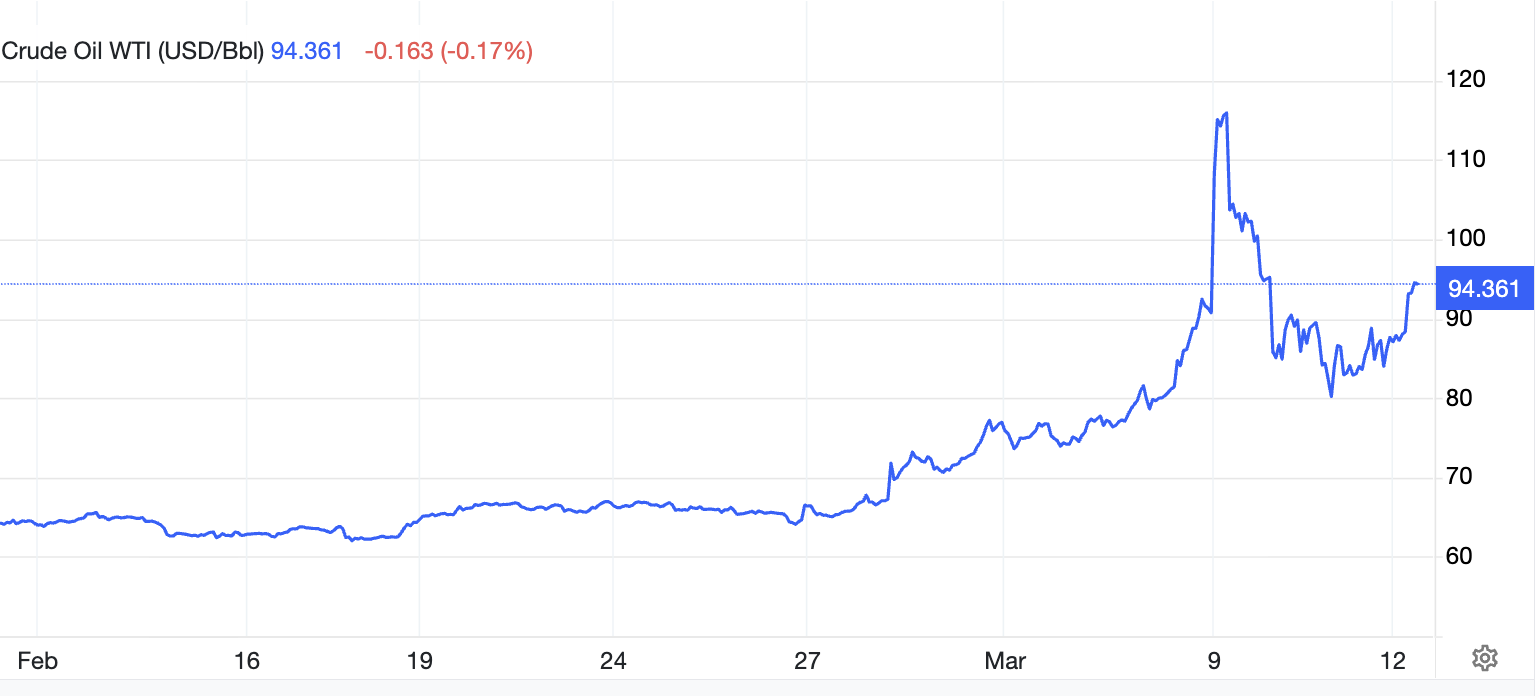
As of 9:30 p.m. Eastern on March 11, 2026, Brent crude traded at $97.67 per barrel and West Texas Intermediate (WTI) at $92.56 per barrel. Earlier in the session, Brent settled at $91.98 and WTI at $87.25, highlighting the rapid oil price escalation following the IEA reserve release announcement.
| Benchmark | Most Recent Quoted Price | Session Move | Earlier Settlement |
|---|---|---|---|
| Brent Crude | $97.67 per barrel | +6.3% | $91.98 |
| WTI Crude | $92.56 per barrel | +6.0% | $87.25 |
Oil is still trading with a heavy geopolitical risk premium. The reserve release helped steady sentiment briefly, but the market is still focused on shipping disruption and supply risk around the Strait of Hormuz, which is why prices remained elevated.
The market reaction shows that traders see the reserve release as helpful, but not decisive. Brent had already surged as the Middle East conflict disrupted shipping and raised the risk premium across energy markets, and recent reporting showed prices remained volatile even after the IEA move came into view.
The core issue is the Strait of Hormuz. AP reported that the waterway is effectively closed and that roughly a fifth of all oil shipped from the Persian Gulf normally passes through it, while the IEA warned in official statements that transit challenges and curtailed production were creating “significant and growing risks” for the market.
That is why prices rallied on a headline that, on paper, should have capped them. Traders are treating reserve oil as a bridge, not a cure, because emergency barrels cannot fully replace disrupted flows if the shipping route stays constrained.
The biggest doubt is logistical, not political. Reserve releases can add supply to the market, but they do not reopen sea lanes, restore damaged infrastructure, or instantly move crude through refineries, pipelines, and terminals.
Analysts described the release as having a short-term stabilising effect, but not as a “silver bullet.”

There is also a timing issue. The United States, which accounts for 172 million barrels of the release, said deliveries would begin next week and take about 120 days. Germany said its first quantities would take a couple of days to start flowing.
This is important because oil markets respond strongly to immediate scarcity. Although a reserve draw can mitigate some effects, it does not change the IEA's report that export volumes of crude and refined products are currently less than 10% of prewar levels.
| Metric | Latest Figure |
|---|---|
| U.S. SPR crude oil stocks | 415.442 million barrels |
| Current authorized SPR capacity | 714 million barrels |
| SPR fill level | 58.2% |
| U.S. commercial crude oil stocks | 443.103 million barrels |
| Total U.S. crude oil stocks, including SPR | 858.545 million barrels |
These figures are from the EIA Weekly Petroleum Status Report for the week ended March 6, 2026, released March 11, 2026, plus DOE’s current SPR capacity figure.
In the near term, market activity continues to reflect the ongoing disruption. The U.S. Energy Information Administration stated that short-term flow disruptions and a sustained risk premium are expected to keep Brent prices elevated in the second quarter, although inventories are projected to increase once flows through the Strait of Hormuz resume.
| What Supports Prices | What Could Calm Prices |
|---|---|
| Disrupted shipping through the Strait of Hormuz | Emergency oil release from IEA members |
| Curtailed production and lower export flows | Slower demand growth if prices stay high |
| Persistent geopolitical risk premium | Reopening of transit routes |
| Delays between reserve release and physical delivery | Rising inventories once flows normalise |
As a result, the market faces two opposing influences. While emergency stocks can alleviate panic and reduce volatility, prolonged impairment of the Strait of Hormuz diminishes the effectiveness of reserve releases in stabilizing prices.
Official updates on shipping access through the Strait of Hormuz, because that remains the market’s main pressure point.
The pace and timing of the IEA release, not just the headline volume, are important because delivery lags can keep spot crude tight.
Insurance costs and tanker traffic, since high premiums can delay any real normalisation in oil flows.
Signs of restored exports or inventory builds, because the EIA still sees downside for oil later in 2026 if supply normalises.
The IEA, or International Energy Agency, is an energy watchdog created to support energy security and coordinate emergency responses to supply shocks.
The IEA said member countries will make 400 million barrels available, the largest emergency oil reserve release in its history.
Prices are still reacting to shipping disruption and lost flows through the Strait of Hormuz. Traders see the reserve release as support, but not a full solution.
It is a critical shipping route for Persian Gulf oil and gas. About one-fifth of the region’s oil shipments normally pass through it.
It may help stabilise fuel markets, but the effect depends on how long the disruption lasts and how quickly released barrels reach refiners and consumers.
Yes. AP reported that the new release is more than double the 182.7 million barrels coordinated in 2022.
The IEA has delivered the strongest emergency response available to it, a record oil stock release intended to stabilize a market affected by severe disruption. This measure is significant and is expected to help mitigate the risk of a widespread supply panic.
But the market’s scepticism is rational. Until transit through the Strait of Hormuz improves and lost flows start to return, reserve barrels are more likely to buy time than settle the crisis. That is why prices rallied even as the IEA moved.
Disclaimer: This material is for general information purposes only and is not intended as (and should not be considered to be) financial, investment or other advice on which reliance should be placed. No opinion given in the material constitutes a recommendation by EBC or the author that any particular investment, security, transaction or investment strategy is suitable for any specific person.