Published on: 2026-03-04
Updated on: 2026-03-04
Crude oil in 2026 is being pulled in two directions at once. One force is oversupply, which tends to push prices lower over the course of months.
The U.S. Energy Information Administration (EIA) expects global oil production to exceed global demand, with inventories rising into 2027, which is why it forecasts Brent to average $58 a barrel in 2026.
The other force is geopolitical risk, which can push prices sharply higher in a matter of days. Amid the recent escalation regarding Iran and shipping risks, Brent crude oil increased by approximately 6% to around $83 per barrel on March 3, 2026.
| Scenario | What has to happen | Likely WTI range | Likely Brent range |
|---|---|---|---|
| Base case (most likely) | Inventories build and supply stays ample | $48 to $62 | $52 to $66 |
| Bull case (risk premium holds) | Sustained disruption risk or tighter OPEC+ | $65 to $85 | $72 to $95 |
| Bear case (surplus dominates) | Demand disappoints or supply rises faster | $40 to $52 | $45 to $58 |
These are practical trading ranges, not promises. They show where price could spend time if conditions match each scenario. The EIA's annual averages sit inside the base-case band.
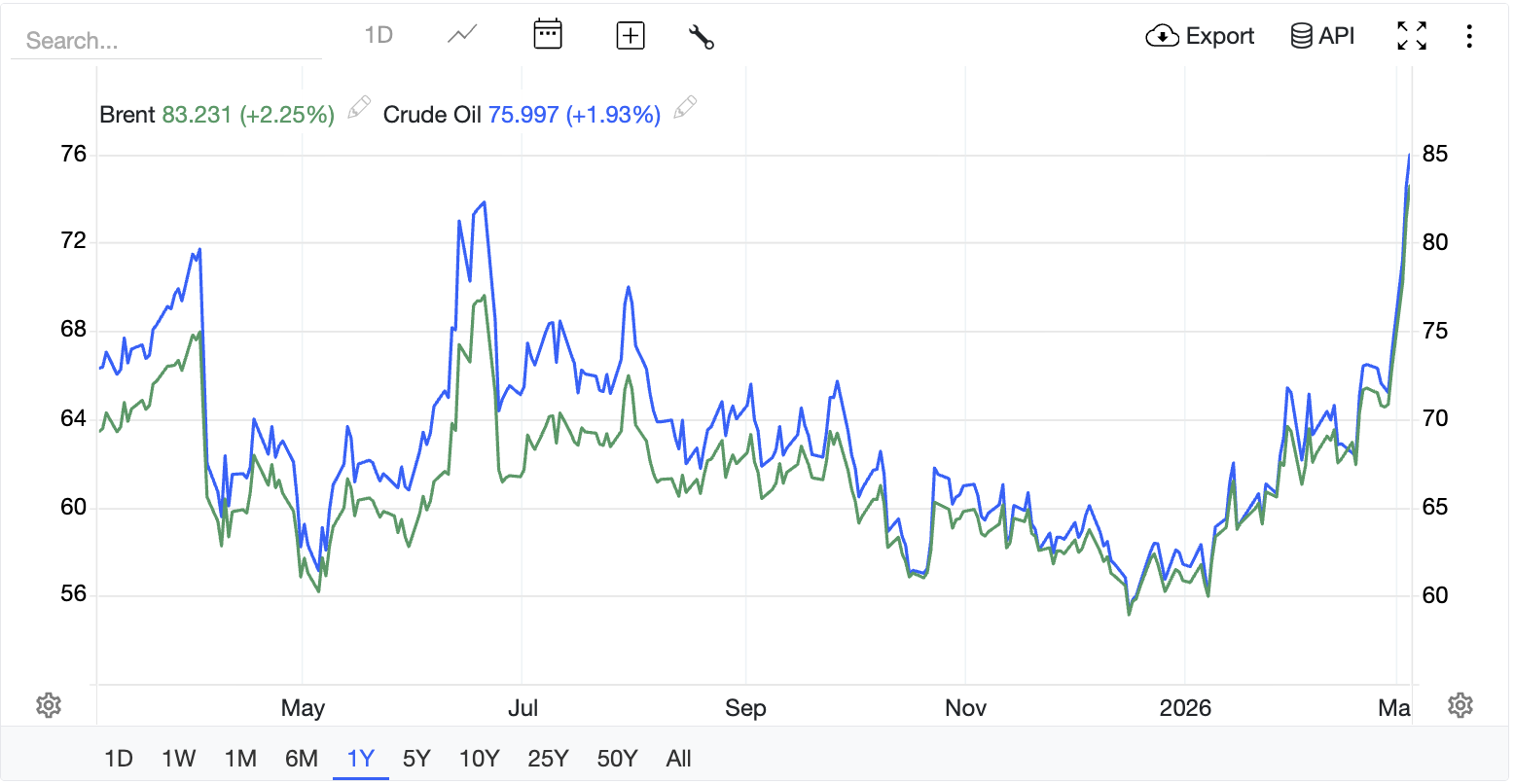
Crude entered March with strong momentum. Brent traded around $82 per barrel during this week's surge, and U.S. crude moved above $75 at points, according to market coverage of the latest conflict headlines.
Brent is around $82.21 on March 4, 2026, which fits the same broad picture of a sharp jump from late February levels.
This matters because many "2026 forecasts" are annual averages. A high price today does not guarantee a high average next year, particularly if the market later reverts to a cost- or inventory-driven baseline.

The best way to answer that question is to separate the baseline from the tail risks. Oil is not like most assets.
It is a physical market first, and a financial market second. The price is set by a daily tug of war between supply, demand, and inventories.
The IEA expects global oil demand growth of about 930,000 barrels per day in 2026, with non-OECD countries driving the growth.
OPEC's most recent outlook maintains a positive view on demand growth, projecting an increase of approximately 1.4 million barrels per day by 2026.
When demand growth is modest, and supply remains robust, inventory levels typically increase. An increase in inventories often leads to a decline in prices, unless producers reduce output.
OPEC+ is still the swing factor. The EIA notes that OPEC+ policy can limit declines even in a surplus environment.
If the group keeps supply tight, it can stabilise the market. If it relaxes too early into a surplus, prices can drop quickly.
Oil can be calm for months, and then move violently in days. This week's price spike shows the point. News flows around conflict, and the risk to flows through key routes has been enough to lift prices sharply.
This signifies the "fat tail" risk for 2026, potentially disturbing usual supply-demand dynamics temporarily.
Thus, the practical answer is: the average price is more likely to fall than rise, but the path can still include sharp rallies.
The EIA's Short-Term Energy Outlook from February 2026 serves as a valuable benchmark for establishing a 2026 baseline.
| Benchmark | 2026 average forecast | What EIA says is driving it |
|---|---|---|
| Brent | $57.69/bbl | Production exceeds demand and inventories build |
| WTI | $53.42/bbl | Same surplus logic, with inventory builds staying large |
The EIA also describes a world where inventory builds remain heavy, and where OPEC+ policy and China's strategic buying can soften the downside, but not fully reverse it.
Main Takeaway:
EIA's base case is not "oil collapses." It is "oil cools." That is a different trade setup. It often creates a choppy market with sharp spikes on risk headlines, followed by slow fades when the physical balance looks comfortable again.
The IEA anticipates that demand growth will average 930 kb/d in 2026, driven by more stable economic conditions and lower oil prices compared to the year before, with non-OECD countries again playing a significant role.
OPEC's latest outlook maintains global demand growth at 1.4 mb/d in 2026, with most of the growth expected outside the OECD.
If OPEC is right, the market can tighten faster than many expect, and dips can be bought with more confidence.
If the IEA is right, the market is more likely to spend 2026 in "range mode," where rallies are sold unless supply risk increases again.
Oil demand is closely linked to economic growth, trade, and industrial activity. It also ties into inflation, which then feeds into interest rate expectations.
The IMF's January 2026 World Economic Outlook update projects global growth of 3.3% for 2026. That is a steady, supportive backdrop for demand. It is not a recession call.
However, energy spikes can still hit inflation. European Central Bank chief economist Philip Lane cautioned that a prolonged conflict disrupting oil and gas supply could drive inflation higher and negatively impact output, underscoring that sharp fluctuations in oil prices can influence central bank decisions.
Consistent inventory builds, which both the IEA and EIA highlight as the signature of a surplus market.
Weak Chinese demand signals, which the World Bank flags as part of the downtrend case.
OPEC+ supply increases that arrive faster than demand growth, which widens the buffer.
A sustained tightening of prompt spreads signals physical tightness rather than paper fear.
Evidence of disrupted shipping flows, especially around Hormuz, where volumes are too large to replace quickly.
Stronger non-OECD demand, closer to OPEC's pace, which shifts the balance.
Most major forecasters expect an oversupplied market, keeping Brent around $58–$60 on average, which is not a classic bullish setup.
Geopolitics can quickly remove barrels from the market, and traders add a risk premium when shipping routes or production sites are threatened. This week's sharp move tied to Middle East risk is a clear example.
Yes, steady growth usually supports demand. The IMF projects global growth of 3.3% in 2026, which is not a recession baseline.
They use different assumptions on growth, policy, and how demand responds to prices. The IEA predicts demand growth of about 930 kb/d in 2026, while OPEC is more optimistic, forecasting around 1.4 mb/d.
In conclusion, the most defensible 2026 crude forecast is not a straight line up or down. It is a lower-than-average price environment characterized by surplus supply and rising inventories, with occasional spikes when geopolitical issues threaten key routes.
If you want one clean baseline, many institutional views cluster around $58–$60 Brent for 2026.
If you want one clean upside risk, watch Hormuz, because the volumes are so large that even a partial disruption can quickly reprice the entire market.
Disclaimer: This material is for general information purposes only and is not intended as (and should not be considered to be) financial, investment or other advice on which reliance should be placed. No opinion given in the material constitutes a recommendation by EBC or the author that any particular investment, security, transaction or investment strategy is suitable for any specific person.