Published on: 2026-06-29
The G7’s rare earth exposure does not end at the mine. Alternative suppliers hold about 40% of magnet rare earth mining, yet only about 6% of permanent magnet production, creating an 85% supply-chain drop before rare earths become magnets.
The pressure now sits in separation, refining, alloying and magnet-making, where the G7’s 2030 dependency target will either gain industrial weight or remain a mining-side ambition.
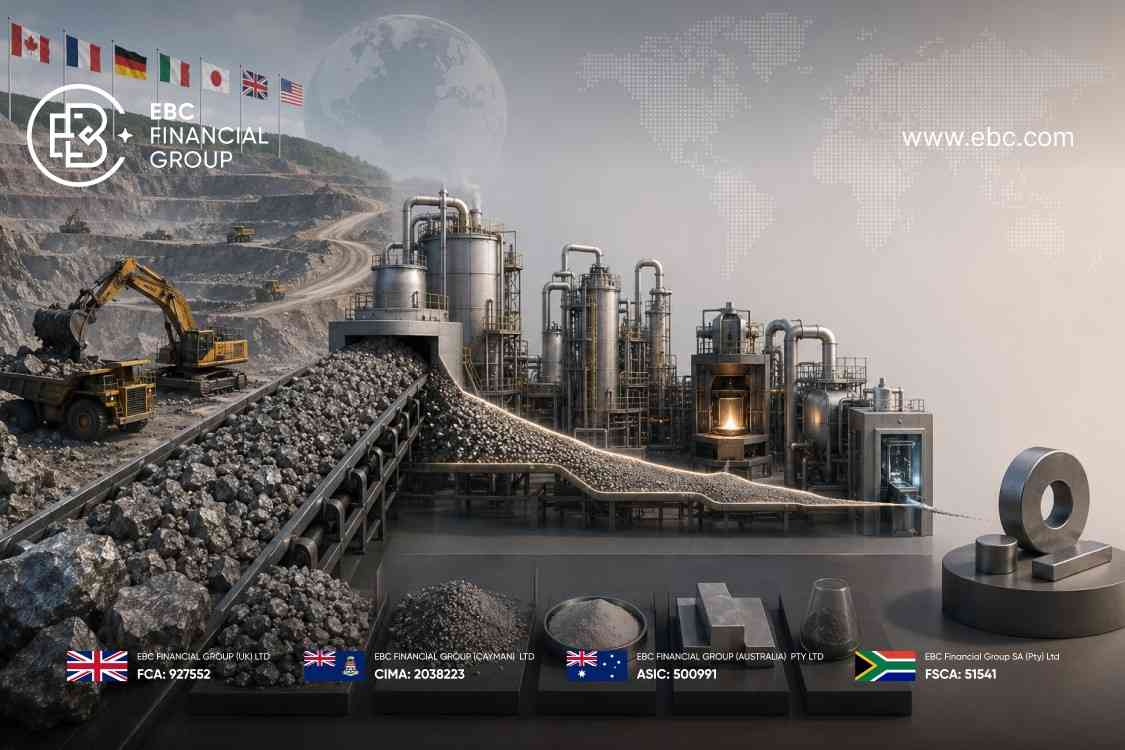
Alternative suppliers hold about 40% of magnet rare earth mining but only 6% of permanent magnet production, implying an 85% supply-chain drop.
China’s share is 60% in mined magnet rare earths, 91% in refining and 94% in permanent magnet output.
The G7’s 17 June 2026 target aims to cut single-supplier dependency below 60% by 2030.
Reaching that target would require alternative magnet capacity to scale far beyond today’s 6% share.
The decisive signal is shifting from mine approvals to separation, refining, alloying and magnet-making capacity.
Rare earth policy often begins with mines because mines are visible: locations, reserves, permits and investment headlines. The sharper number appears later in the chain, where alternative supply falls from about 40% of mining to about 6% of permanent magnet production.
IEA data show China holds around 60% of magnet rare earth mining, 91% of separation and refining, and 94% of rare-earth permanent magnet production. That leaves alternative suppliers with roughly 40% of mining, 9% of refining and only 6% of permanent magnets.
| Stage | Alternative share | What it shows |
|---|---|---|
| Mining | About 40% | Supply exists early |
| Refining | About 9% | The chain narrows |
| Magnets | About 6% | The bottleneck peaks |
The 85% figure comes from the drop from 40% to 6%. The decline is 34 percentage points, equal to 85% of the original alternative mining share.
The 6% is small, but it is not empty. It includes established Japanese producers such as Shin-Etsu Chemical, TDK, and Proterial; European capacity through VAC; and emerging U.S. capacity from MP Materials and eVAC.
Shin-Etsu, TDK and Proterial all produce neodymium or rare earth magnet products. VAC describes itself as a Western rare-earth permanent magnet producer with operational facilities in Germany, Slovakia and Finland, while MP Materials has selected Northlake, Texas, for its planned 10X rare earth magnet manufacturing campus.
The issue is not the absence of alternative magnet maker, as the alternative base remains too small, fragmented and early-stage to offset the concentration visible at the final component.
The 85% drop is a share-based measure rather than a claim of physical material loss. The missing piece is the ability to carry mined material through the industrial stages that create the final component.
Rare earths do not power electric vehicles, wind turbines, robotics, industrial motors, defence systems or data-centre hardware as raw mineral concentrates. They gain strategic value after processing, alloying and magnet manufacturing.
Permanent magnets are small components with large consequences. They allow motors to become lighter, stronger and more efficient. The IEA identifies permanent magnets as the fastest-growing and most strategically important rare earth application, accounting for around 95% of total rare earth consumption by value.
Demand is moving in the same direction. Magnet rare earth demand has doubled since 2015 and is set to rise by another third by 2030 under current policy settings. Electrification drives the first layer. Automation, robotics, and digital infrastructure add another layer.
A mine does not move an electric vehicle. A magnet does.
USGS data show the same mismatch in the United States. Mine production reached 51,000 tons of rare-earth-oxide equivalent in mineral concentrates in 2025, while apparent consumption of rare-earth compounds and metals stood at 27,000 tons.
Even with mine output almost 1.9 times apparent consumption, the country still recorded 67% net import reliance on rare-earth compounds and metals. The gap is not in the ground. It is in the stages after the ground.
China’s rare earth position reflects industrial depth rather than geology alone. Mining share begins the story, while processing scale, metallurgical capability, magnet equipment, skilled labour, customer qualification, and domestic demand complete it.
China did not merely secure rare earths. It industrialised them.
The IEA describes the rare earth value chain as a sequence running from extraction and beneficiation to chemical upgrading, oxide separation, metal refining, alloying and magnet manufacturing. Separation converts mixed rare earth feeds into individual oxides. Refined oxides become metals. Metals become alloy powders. Alloy powders become magnets.
The G7 is trying to replicate that continuity without decades of accumulated scale. Building parallel capacity means more than opening mines. It means replicating the industrial links that keep material moving from oxide to metal, alloy and magnet without losing scale.

The G7’s June 2026 declaration gives the supply-chain gap a deadline. Leaders said they aim to reduce dependency on a single supplier outside the G7 and partner countries for rare earths and permanent magnets to under 60% by 2030, with an ambition to reach 50% later.
The target cannot be reached at the mine alone. If alternative suppliers currently account for only about 6% of permanent magnet production, moving toward a world in which no single supplier controls more than 60% requires a much larger non-dominant magnet base.
Using global magnet shares as a proxy, alternative magnet capacity would need to move toward at least 40% of the global supply. That implies a roughly 6.7-fold scale-up from today’s 6% share.
The number is not an official G7 metric. It measures the distance between today’s magnet-production structure and the 2030 diversification goal. Mine announcements alone cannot carry that target.
Even the 60% threshold should not be mistaken for a competitive market structure. A single supplier at 59% of permanent magnet output would still shape pricing, qualification timelines and industrial availability. The target is best read as a first resilience line, not the end state of diversification.
The G7 is no longer treating critical minerals as a narrow extraction issue. Its June 2026 declaration cited 195 projects announced since the beginning of 2026, reaching €64 billion of investment across critical-minerals value chains, including equity participation and offtake agreements. The declaration also referred to a joint plan to develop industrial capacity for rare earths and permanent magnets.
Capital is moving beyond the mine and toward processing, recycling, stockpiling, traceability, offtake structures and industrial capacity. Those pieces make the rare earth supply resilient rather than merely available.
A mine can be announced before the downstream chain exists around it. A refinery, metal plant, alloy facility, or magnet factory needs technical expertise, reliable feedstock, environmental approvals, customer qualification, and competitive operating costs. The calendar is harder than the press release.
That timing gap makes 2030 difficult. The G7 has a policy framework and rising capital commitments, while supply-chain losses still occur in the middle and final stages. Those stages require operating capacity, not project pipelines alone.
The weakest outcome would be a larger upstream base feeding the same narrow downstream channel. In that version, the G7 would own more material at the start of the chain but not gain enough leverage at the end.
Mine count is no longer the strongest measure of rare earth security. The stronger measure is how much material survives the journey from concentrate to separated oxide, refined metal, alloy and permanent magnet.
The 85% supply-chain drop shows why the G7’s challenge is not discovery alone. Alternative supply exists at the start of the chain, then loses most of its presence before the component that carries industrial value.
Rare earth security does not begin underground. It begins when the material reaches the magnet stage.