Published on: 2026-06-23
US rare earth stocks in 2026 are repricing around China’s control of the processing and magnet chain the West still cannot quickly replace. The six U.S.-listed names that stand out are MP Materials, USA Rare Earth, Energy Fuels, NioCorp Developments, American Resources and Ramaco Resources.
MP, USAR and UUUU sit closest to the bottleneck, while NB, AREC and METC offer higher-risk ways to trade the same supply squeeze.
The danger is not missing the rare earth trade entirely, but buying the wrong part of it after the easy hype has already arrived.
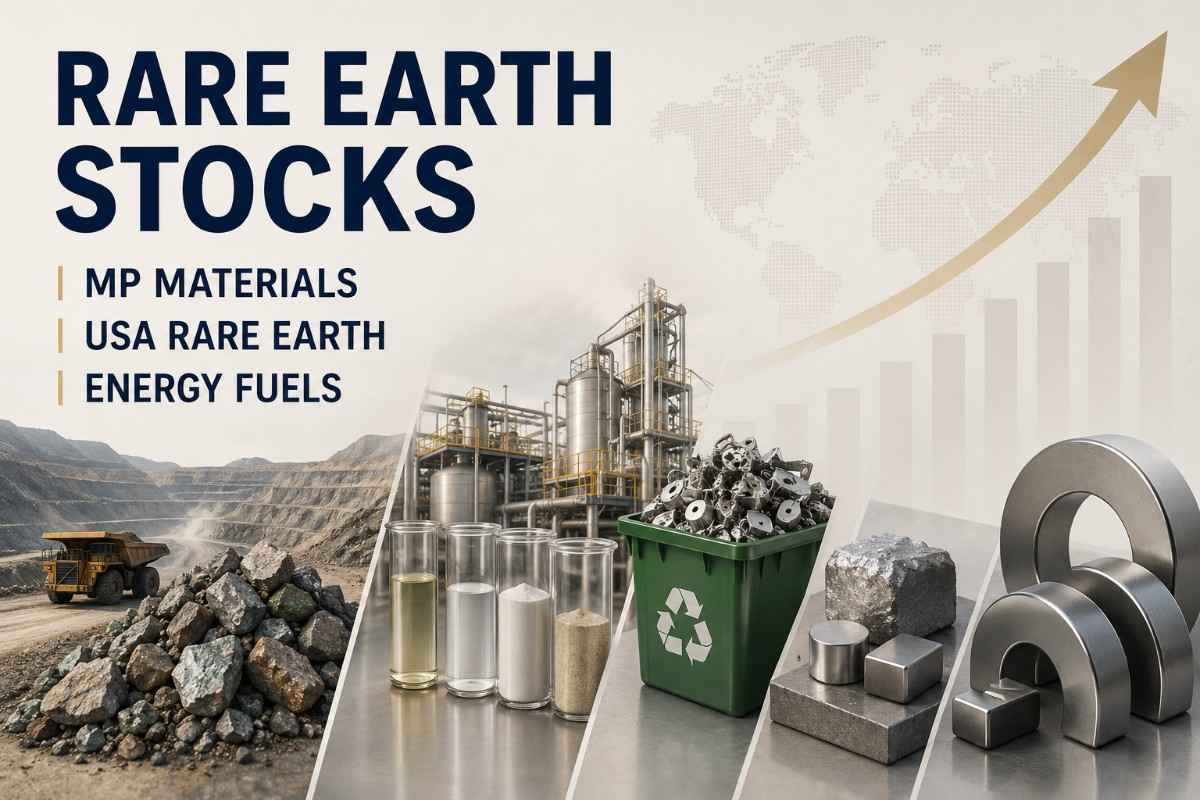
MP, USAR and UUUU form the first tier because they sit closest to mine-to-magnet capacity, federal funding and heavy rare earth processing.
NB, AREC and METC belong in the optionality tier, with upside tied to project financing, recycling, feedstock or early-stage resource work.
China controls more than 90% of rare earth refining and almost 95% of permanent magnet production, pushing the sector premium toward processing, alloys and magnets.
U.S. rare earth oxide equivalent output in mineral concentrates reached 51,000 tons in 2025, yet reliance on imports of rare earth compounds and metals remained at 67%.
MP’s magnet ramp, USAR’s funding milestones and UUUU’s White Mesa expansion are the core proof points, while NB, AREC and METC need financing, reporting or pilot-plant validation to move beyond rare earth hype.
MP, USAR and UUUU have the cleanest setup because they sit closer to processing, heavy rare earths and magnets. NB, AREC, and METC stay on the list because they offer rare-earth upside, but each still needs stronger evidence.
| Stock | Role | 2026 Signal | Main Risk |
|---|---|---|---|
| MP Materials | Mine-to-magnet | Record NdPr output | Valuation |
| USA Rare Earth | Policy-backed developer | Up to $1.6B federal package | Execution |
| Energy Fuels | Heavy rare earth processor | White Mesa expansion | Feedstock |
| NioCorp | Nebraska project | Elk Creek drilling | Pre-revenue |
| American Resources | Recycling/feedstock | Balance sheet reset | Transparency |
| Ramaco Resources | Rare earth optionality | Brook Mine pilot work | Coal exposure |
The ranking favors direct rare earth exposure and supply-chain relevance, not expected share-price performance.
MP Materials earns the first slot because it connects rare earth mining, separation and magnetics better than any other U.S.-listed name. Mountain Pass gives it upstream scale, while its downstream magnetics business moves MP closer to the supply-chain segment China still controls.
Production gives MP its 2026 validation. First-quarter NdPr production reached a record 917 metric tons, up 63% year over year, while NdPr sales rose 117% to 1,006 metric tons. Magnetics revenue rose to $21.1 million, and the company broke ground on its 10X magnetics facility.
The catch is price. MP recently traded near $60.29 with a market value of around $10.7 billion, so the stock already carries a strategic-scarcity premium. Weak magnet ramp execution, heavy rare earth delays or margin disappointment would hit harder at that valuation.
MP belongs in the core tier. It is the benchmark for whether the U.S. can turn rare earth policy into physical mine-to-magnet capacity.
USA Rare Earth earns its place through policy leverage. The Department of Commerce finalized up to $277 million in incentives and a loan agreement of up to $1.3 billion to support mining, processing, metal and magnet capacity. USA Rare Earth said the agreements unlock access to up to $1.6 billion in funding tied to project milestones.
That funding does not yet make USAR a proven operator. First-quarter revenue was $5.7 million, while cash and equivalents reached about $1.75 billion after the January PIPE. The numbers give USAR runway rather than proof of full mine-to-magnet returns.
The risk is execution against a valuation already pricing in success. USAR recently traded near $24.12 with a market value of around $4.7 billion. Funding can reduce balance-sheet pressure, but it cannot remove permitting, construction, qualification and ramp risk.
USAR belongs in the core tier because its policy catalyst is real. It should not be treated like a mature rare earth producer.
Energy Fuels earns its place through White Mesa, the Utah processing platform that provides UUUU with a direct route to separated rare earth oxides. Its rare earth exposure is strongest where the supply chain is tightest, especially in heavy rare earth processing.
Phase 2 targets more than 6,000 tons per year of NdPr capacity, plus 240 tons of dysprosium and 66 tons of terbium. The company estimated Phase 2 capital cost at $410 million, with a projected $1.9 billion after-tax NPV and 33% IRR.
White Mesa only works as a rare earth story if monazite supply, technical execution and funding stay on track. Uranium also remains a major part of UUUU’s equity story, which means rare earth progress must compete with another commodity cycle inside the same stock.
UUUU recently traded near $16.12 with a market value of approximately $4.0 billion, placing it closer to MP and USAR in scale than the smaller optionality names. UUUU belongs in the core tier for processing exposure rather than pure rare earth mining.
NioCorp’s Elk Creek project gives Nasdaq investors exposure to a U.S.-based critical minerals asset with rare earth upside. NB is optionality, not current production, because Elk Creek remains primarily a niobium, scandium and titanium project.
The rare earth angle comes from Elk Creek’s indicated rare earth resource, magnetic rare earth evaluation and exposure to dysprosium and terbium. NioCorp describes Elk Creek as holding the second-largest indicated rare earth resource in the United States.
The 2026 validation comes from final assay results tied to a Department of War-funded drilling campaign. Those results are being used to update mineral resources, reserves and the mine plan associated with the company’s pending Export-Import Bank financing application.
NB’s risk is timing and financing. At around $5.20 with a market value near $708 million, the stock offers U.S. rare earth project exposure, but it still needs financing, construction and commercial output before earning the same premium as the three core bottleneck names.
American Resources is on the list because it provides small-cap exposure to rare earth feedstock, recycling and processing through its ReElement relationship. AREC belongs in the speculative tier because its rare earth story is tied more to platform development and corporate structure than current rare earth production.
The 2026 validation is the balance sheet reset after its strategic transformation. The company reported $72.5 million in cash and short-term investments, $32.4 million in strategic investments and $93.2 million in stockholders’ equity after filing its 2025 10-K.
The weak point is clarity. Net income was driven by deconsolidation gains rather than recurring operating profit, while the ReElement relationship adds another layer for investors to track. At around $2.24 with a market value near $177 million, AREC offers rare earth recycling and feedstock exposure, but it needs cleaner reporting before it can earn a stronger premium.
AREC is a high-risk way to trade the recycling side of the rare earth chain. It is not in the same evidence class as MP, USAR or UUUU.
Ramaco Resources is the wildcard because Brook Mine gives METC a specific rare earth angle rather than a loose critical-minerals label. At around $13.41 with a market value near $874 million, the stock still trades primarily as a coal company, while Brook adds early-stage exposure to heavy magnetic rare earth elements.
The 2026 signal is project work at Brook Mine. Ramaco has mined a bulk sample, prepared a carbochlorination flowsheet and continued pilot-plant and study work. Hatch-led pre-feasibility work includes test work, pilot-plant design and process flowsheet optimization, with prior work estimating 1.7 million tons of total rare earth oxide at Brook.
Coal still drives the company. Brook resources remain inferred and have not demonstrated economic viability, so rare earth upside can support the valuation only if pilot work continues to advance.
METC belongs in the wildcard tier. Brook gives it rare earth exposure, but not yet rare earth operating credibility.
Lynas Rare Earths remains one of the most important non-China producers, but it falls outside this U.S.-listed stock screen.
REMX offers rare earth exposure through a fund, while this list ranks operating companies.
Texas Mineral Resources is better captured through USA Rare Earth after Round Top exposure moved more cleanly under USAR.
OTC-only rare earth names were left out because liquidity, access and trade execution are weaker across many platforms.
Lithium, copper and broad critical-mineral stocks were cut because rare earth exposure needs to be direct, not implied by the wider resource theme.
Each stock included trades on NYSE, Nasdaq or NYSE American and has direct exposure to rare earth mining, separation, refining, recycling, feedstock, metals, alloys or magnets.
The screen rejected ETFs, OTC-only names, foreign producers, generic critical-mineral companies and stocks included only because of popularity.
Stock prices and market capitalizations are as of June 23, 2026, and will change with market trading. The ranking favors supply-chain relevance over expected share-price performance. Operating proximity to processing, heavy rare earths and magnets received more weight than resource size alone.
The six stocks do not rise on the same evidence. MP, USAR and UUUU should react first to evidence that the West is turning rare earth policy into real processing, metals and magnet capacity. Their valuation premium depends on execution, not discovery.
NB, AREC and METC need a different trigger. These stocks can re-rate faster on financing progress, cleaner reporting or pilot-plant validation, but weak updates can quickly push them back into the rare earth story bucket.
If 2026 brings qualified magnet output, heavy rare earth separation and funded project milestones, bottleneck names should keep their premium. If the year brings delays, dilution or vague project updates, attention to rare earths will not be enough.