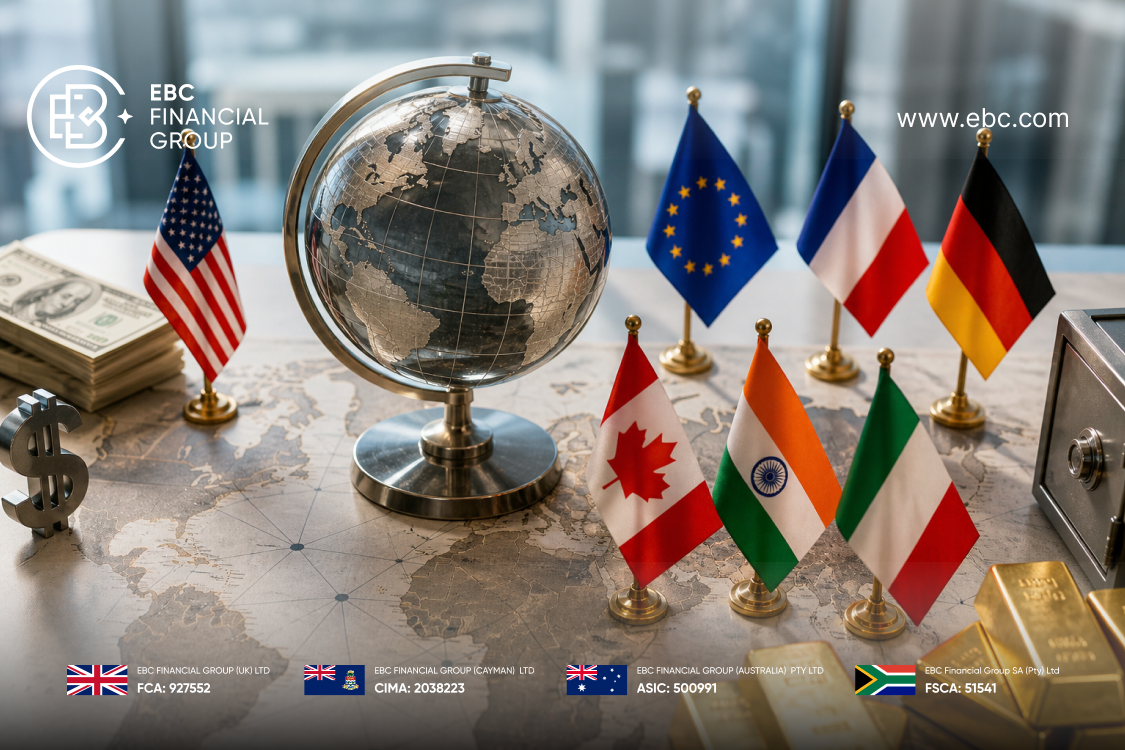
France completed the withdrawal of all 129 tonnes of gold from the Federal Reserve Bank of New York between July 2025 and January 2026, booking roughly $15 billion in capital gains. All 2,437 tonnes of France’s gold reserves are now stored in Paris. Germany (1,236 tonnes) and Italy (1,053 tonnes) still hold a combined $245 billion in American vaults. The repatriation debate in both countries is now mainstream.
Canada’s Prime Minister Mark Carney announced a $25 billion sovereign wealth fund on April 27, 2026, explicitly designed to diversify away from American economic dependence. When an ally creates a sovereign fund to hedge against you, the financial weapon has become a financial boomerang.
The dollar’s share of global reserves has fallen from 72% in 2001 to 56.92% in Q3 2025. Gold’s share of official reserve assets has more than doubled from below 10% in 2015 to over 23% today. Central banks have bought more than 1,000 tonnes of gold per year for three consecutive years.
The freezing of $300 billion in Russian central bank reserves in February 2022 demonstrated to every central bank on earth that reserves held in Western jurisdictions can be frozen. That single decision accelerated the diversification trend more than any other event in the past two decades.
In the past six months, France pulled every ounce of its gold out of the United States. Canada created a sovereign wealth fund to reduce its dependence on the American economy. Europe began borrowing independently to finance its own defense. India continued repatriating gold it had stored abroad for decades. And central banks worldwide bought gold at a pace not seen since the 1960s.
None of these countries are adversaries of the United States. France is a NATO ally. Canada is America’s closest trading partner. India is a strategic partner Washington has spent a decade courting. These are not the actions of enemies. They are the actions of allies and partners who have watched the United States weaponize the dollar-based financial system, and have quietly concluded they need to reduce their exposure to it.
That shift, driven by allies rather than adversaries, is what makes the current moment different from anything in the past 80 years of dollar dominance.
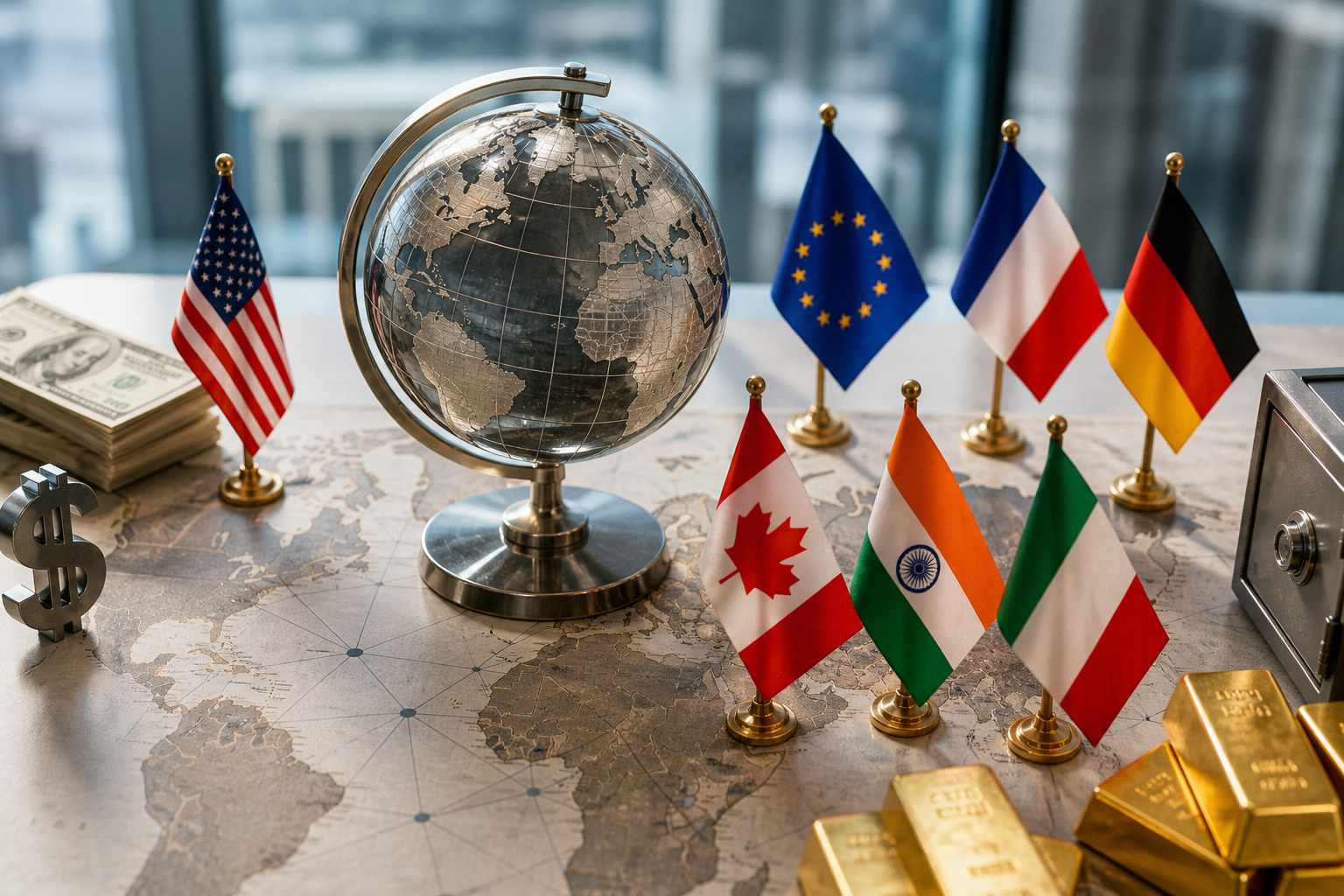
On April 27, 2026, Prime Minister Mark Carney announced the Canada Strong Fund, a $25 billion sovereign wealth fund designed to invest in energy, critical minerals, agriculture, and infrastructure. Carney described it as “a national savings and investment account” and confirmed that individual Canadians will be able to buy into the fund through a retail investment product.
Canada sends 75% of its exports to the United States. Carney has repeatedly stated that the era of sending Canadian wealth south is over. The fund’s mandate, to finance “nation-building projects” and diversify Canada’s economic relationships, is a direct response to U.S. tariff threats, trade instability, and what Ottawa now views as an unreliable partnership.
When the United States’ closest neighbor and largest trading partner creates a sovereign instrument specifically to reduce dependence on the American economy, the signal reaches every capital on earth. If Canada is hedging, the reasoning goes, perhaps everyone should be.
Between July 2025 and January 2026, the Banque de France sold all 129 tonnes of gold it held at the Federal Reserve Bank of New York across 26 separate transactions. It purchased an equivalent volume of higher-standard bullion in Europe. All 2,437 tonnes of France’s gold reserves are now stored in Paris, in the underground vault known as La Souterraine, for the first time since the 1960s. The operation generated roughly $15 billion in capital gains.
Governor François Villeroy de Galhau said the move was “not politically motivated.” Central banks do not announce geopolitical pivots in press releases. They act, and the actions speak for themselves.
The last time France repatriated gold at this scale was under President Charles de Gaulle between 1963 and 1966, when France moved over 3,300 tonnes from New York and London. That earlier move was a direct challenge to the Bretton Woods system and contributed to the pressure that led to the Nixon Shock of 1971, when the United States ended the dollar’s convertibility to gold.
The question now is who follows. Germany still holds 1,236 tonnes of gold in New York, 37% of its total reserves. Italy holds 1,053 tonnes, representing 43%. Together, roughly $245 billion in European gold sits in American vaults. Michael Jäger, president of the European Taxpayers Association, has publicly called for German repatriation, arguing that access to Germany’s gold “can no longer be taken for granted.” A year ago, this was a fringe position. It is now part of mainstream budget discussions ahead of the May 2026 federal debate.
India has repatriated 274 tonnes since 2023. The Netherlands moved 122.5 tonnes from New York back in 2014. Each withdrawal reduces the concentration of global gold reserves in American vaults and increases the proportion held under direct sovereign control.
The Hormuz war accelerated a separation that had been building for years. Washington’s public criticism of European defense spending, its unilateral approach to the Iran conflict, and its threats around trade policy pushed European governments past a threshold.
The EU agreed in December 2025 to borrow €90 billion independently to finance Ukraine’s defense over two years, bypassing the American-led framework that had coordinated Western support since 2022. Europe’s broader rearmament push could lift EU defense spending by 18 percentage points of GDP by 2035. European governments are not only spending more on defense. They are building the institutional capacity to spend it independently of the United States.
This is the context that makes France’s gold repatriation and Canada’s sovereign fund more than isolated events. They are part of a pattern where allied nations are constructing economic and financial infrastructure that reduces their dependence on American systems, not because they oppose the United States, but because they no longer assume the relationship will remain stable.
The IMF’s COFER data tracks how central banks hold their foreign exchange reserves. The trajectory is clear.
The dollar’s share peaked at roughly 72% in 2001. By Q3 2025, it had fallen to 56.92%. The Federal Reserve’s own 2025 report confirmed the dollar “comprised 58 percent of disclosed global official foreign reserves in 2024.” That is a 15-percentage-point decline over 24 years.
The lost share did not go to the euro, which sits around 20%. It did not go to the Chinese yuan, which remains below 2%. It went to a basket of nontraditional currencies: the Australian dollar, Canadian dollar, South Korean won, and a category the IMF labels “other.” Central banks are diversifying broadly, not replacing one dominant currency with another.
Gold tells a parallel story. The share of gold in official reserve assets has more than doubled from below 10% in 2015 to over 23% today, according to the Federal Reserve. The World Gold Council reports that central bank gold buying has exceeded 1,000 tonnes per year for three consecutive years. The Federal Reserve’s own analysis notes that “increases in gold holdings are generally not associated with a decline in U.S. dollar reserves except for China, Russia, and Turkey.” For most central banks, gold is an addition, not a replacement. But the direction is unambiguous.
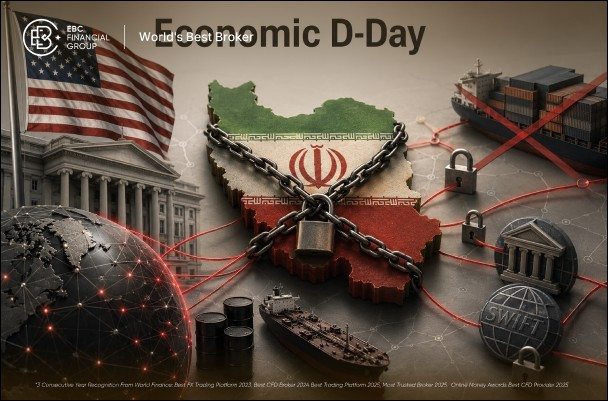
The acceleration of these trends traces back to a single decision: the freezing of roughly $300 billion in Russian central bank reserves in February 2022.
Within days of Russia’s invasion of Ukraine, the G7 and EU made it illegal to engage in any reserve management transactions with the Russian central bank. More than half of Russia’s foreign exchange reserves were locked overnight. The immediate effect was devastating for Moscow: the ruble collapsed, capital controls were imposed, and the central bank lost its primary stabilization tool.
The second-order effect extended far beyond Russia. Every central bank in the world watched a sovereign nation’s reserves get frozen in jurisdictions where they were held for safekeeping. The European Central Bank’s President Christine Lagarde expressed concern that seizing the assets could “tarnish the euro.” Belgium’s Prime Minister called outright confiscation “an act of war.” Chatham House warned that the precedent “would increase the risk perceived by several other countries.”
The message that landed in central bank boardrooms from Riyadh to Jakarta to Brasilia was clear: reserves held in Western financial systems are conditionally safe. The conditions are set by Washington. And they can change overnight.
This was not the first time the United States had frozen sovereign assets. Iran, Venezuela, Afghanistan, Libya, and Syria all experienced variations of asset freezing or seizure. But the Russian freeze was different in scale ($300 billion), in the target (a G20 economy), and in the scope of the coalition involved. It proved that the dollar system could be weaponized against a major economy, and that proof changed how every other major economy thinks about reserve management.
Sanctions work because the dollar is dominant. The dollar is dominant because countries trust the system enough to hold their reserves in it. Every time sanctions demonstrate that reserves can be frozen, a portion of that trust erodes.
The erosion is slow: percentage points per decade rather than per year. But it compounds. And the paradox is that Washington cannot both weaponize the dollar system and maintain universal trust in it. These two objectives are in direct conflict.
The alternatives being built are fragmented, inefficient, and years from matching the dollar’s depth and liquidity. India now pays for Russian oil in rupees, dirhams, and yuan, with Moscow demanding the Chinese currency directly and forcing New Delhi to become one of the largest open-market buyers of yuan in the world. Brazil has expanded local currency settlement with trading partners. The BRICS+ group is developing a payment infrastructure designed to operate independently of SWIFT. The Shanghai Cooperation Organisation conducts the vast majority of intra-member trade in local currencies. The most technically ambitious challenge is mBridge, a blockchain-based platform built by the central banks of China, Hong Kong, Thailand, the UAE, and Saudi Arabia to settle cross-border payments in real time, bypassing SWIFT entirely. (read: From Petrodollar to Petroyuan)
None of these systems rival the dollar today. But they do not need to replace the dollar to reduce its leverage. They only need to exist at sufficient scale that at-risk nations can route around the system. Each new sanctions regime adds urgency to building them. And the nations building them are no longer limited to adversaries.
Saudi Arabia, India, Brazil, Indonesia, and South Africa, the major neutral economies, are all constructing financial infrastructure that reduces their dollar exposure. Not because they oppose the United States, but because the precedents of the past four years have made the risk of concentrated dollar dependence measurable and real.
The dollar will remain the world’s dominant reserve currency for years, likely decades. No alternative has the depth, liquidity, or institutional infrastructure to replace it. The yuan’s capital controls prevent it from functioning as a true reserve currency. The euro lacks a unified fiscal authority. Gold pays no yield.
But dominance and monopoly are different things. The dollar held 72% of reserves in 2001 and holds 57% today. If the current pace continues, it could fall below 50% within the next decade. That would not end dollar dominance, but it would meaningfully reduce the leverage that sanctions provide. Every percentage point of reserve share lost represents central banks that have moved assets beyond Washington’s reach.
The practical implication is that every sanctions decision now carries a long-term cost to the dollar’s structural position. That cost may be worth paying when the target is a genuine security threat. But when sanctions are deployed broadly, frequently, and against nations that are not adversaries, the cumulative effect is to accelerate exactly the multipolar financial system that Washington says it wants to prevent.
France is a NATO ally. It pulled all its gold from New York. Canada is America’s closest trading partner. It just created a sovereign fund to diversify away from American dependence. India is a strategic partner Washington has spent a decade building ties with. It has been repatriating gold for three years. Germany, with 37% of its gold reserves still in New York, is publicly debating whether to bring them home.
The nations driving the structural shift away from dollar concentration are not adversaries. They are allies, partners, and neutral economies that have watched the United States deploy financial sanctions as a foreign policy tool and drawn a rational conclusion: reduce exposure. The dollar’s share of reserves has fallen 15 percentage points in 24 years. Gold’s share of reserve assets has more than doubled in a decade. The trend is structural, cumulative, and driven by exactly the countries Washington needs to keep inside the system. That is the paradox, and it does not have a solution that allows the United States to keep weaponizing the dollar while expecting the world to keep trusting it unconditionally.