Published on: 2026-03-26
A key question for European equity investors is which index, the CAC 40 (Cotation Assistée en Continu) or the DAX (Deutscher Aktienindex), currently demonstrates greater strength.
These indices reflect distinct market profiles. The DAX is more cyclical and industrial, making it sensitive to manufacturing recoveries.
The CAC 40 has greater exposure to luxury goods, global consumer demand, energy, and healthcare, which makes it respond differently when growth slows or commodity prices rise.
Currently, the DAX demonstrates stronger economic momentum. However, headline performance comparisons may overlook important differences in index composition and methodology.
Before comparing performance, it is essential to clarify what each index measures, as methodological differences can mislead direct comparisons.
The DAX tracks 40 of the largest companies listed on the Frankfurt Stock Exchange and is calculated as a total return index, meaning dividends are reinvested. This gives the DAX a built-in performance advantage when quoted against price-only indices.
The CAC 40, by contrast, tracks the 40 largest companies on Euronext Paris and is a price return index by default.
When analysts employ the CAC 40 Gross Return version, which reinvests dividends, the long-term performance gap between the indices narrows significantly. For a meaningful comparison, the CAC 40 GR should be used rather than the headline price index.
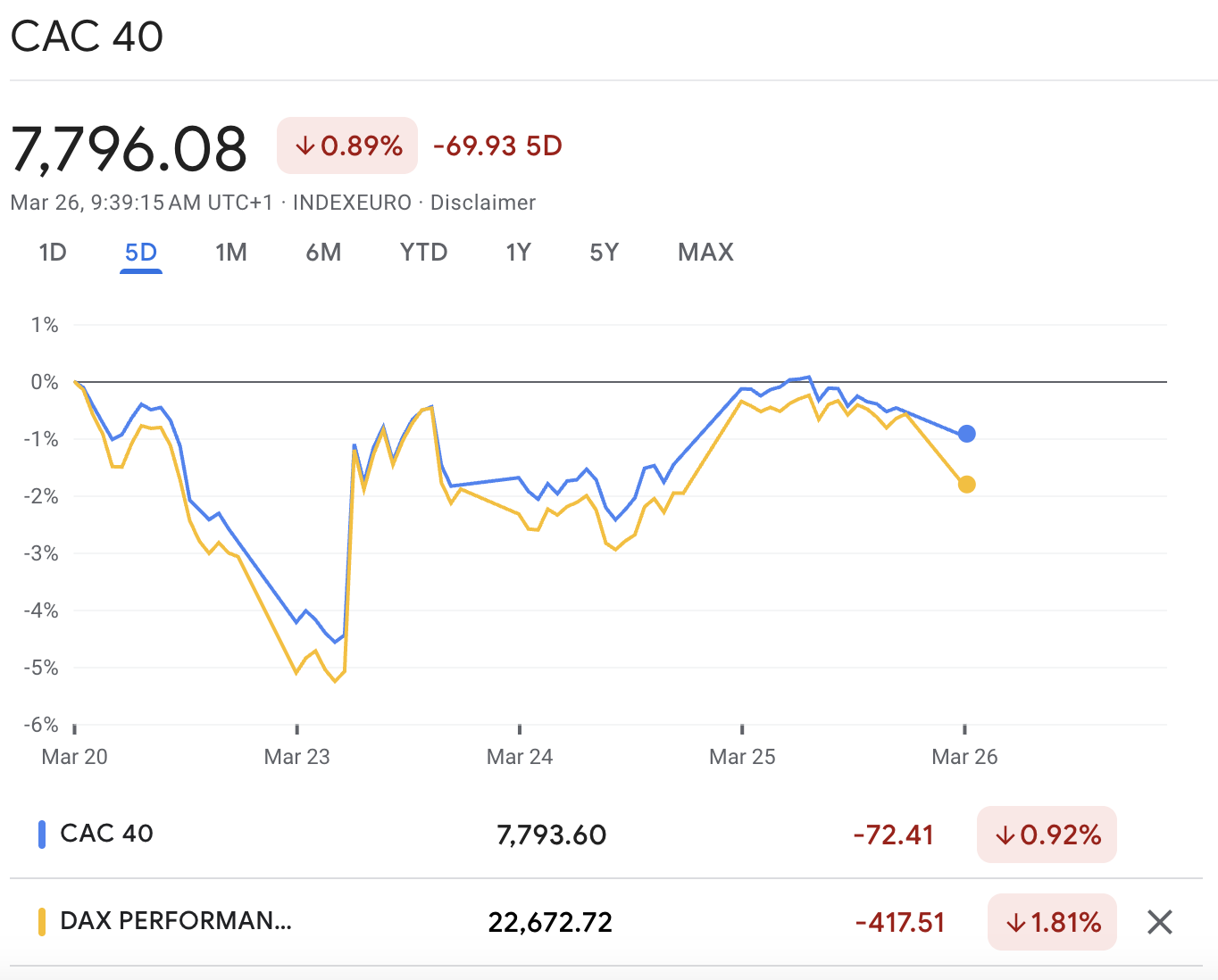
As of late March 2026, the CAC 40 stands at 7,726.20, with a 52-week range of 6,763.76 to 8,642.23.
On a 12-month basis, the index is down 1.26%, while its year-to-date return is -4.98%. Bloomberg’s latest market data also put the CAC 40 on a P/E ratio of 17.05 and a price-to-book ratio of 1.99.
The DAX stands at 22,653.86, with a 52-week range of 18,489.91 to 25,507.79. Its 1-year return is -0.94%, while the year-to-date move is -7.56%. On valuation, the DAX shows a P/E ratio of 16.29 and a price-to-book ratio of 1.87.
| Metric | CAC 40 | DAX |
|---|---|---|
| Latest cited level | 7,726.20 | 22,653.86 |
| YTD return | -4.98% | -7.56% |
| 1-year return | -1.26% | -0.94% |
| P/E ratio | 17.05 | 16.29 |
| Price/book | 1.99 | 1.87 |
| Constituents | 40 | 40 |
Based on these metrics, the CAC 40 has demonstrated marginally stronger recent performance, while the DAX is valued at slightly lower multiples.
The strongest argument for the DAX is the turn in Germany’s industrial cycle. Germany’s manufacturing PMI rose to 51.7 in March, up from 50.9 in February, marking the strongest expansion since June 2022.
Production growth has accelerated, and new orders are rising at the fastest pace in four years. This environment typically benefits indices with significant exposure to industrials, exporters, chemicals, engineering, and capital goods.
However, this does not indicate a full recovery for Germany. The German services PMI declined to 51.2 in March from 53.5 in February, and business sentiment has weakened.
For equity investors, the most relevant aspect is that the sectors most pertinent to the DAX, namely manufacturing and global trade sensitivity, are exhibiting clearer improvement compared to previous months.
Valuation also helps the DAX case. Market data show the DAX trading on a P/E of 16.29 and a price-to-book of 1.87, slightly below the CAC 40 on both measures.
BlackRock’s iShares DAX fund data show a similar valuation profile, with the benchmark trading at a P/E ratio of 17.06 and a P/B of 1.83 as of March 20.
Although Germany is not inexpensive in absolute terms, current valuations do not reflect a premium for its stronger cyclical leverage.
The CAC 40 remains relevant. It is one of Europe’s most globally diversified large-cap indices, with sector mix as its primary differentiator.
The index has greater exposure to luxury goods, consumer brands, energy, healthcare, and leading multinationals whose earnings depend as much on China, the United States, and the Middle East as on domestic French growth.
This sector composition may be advantageous during periods of slower European growth. TotalEnergies contributes an energy buffer, while Sanofi provides defensive healthcare exposure.
LVMH, Hermès, and Kering offer exposure to global premium consumption. However, this also increases the index's vulnerability if Chinese demand declines or global consumer spending decreases.
In summary, the CAC 40 may appear more defensive than the DAX under certain macroeconomic conditions, though it is not a pure safe-haven index. Recent data remain mixed: the latest manufacturing PMI was 50.2, marginally above the expansion threshold, while the services PMI was lower at 49.6.
Although these figures do not indicate a recession, they also do not demonstrate the broad-based growth required to assert that the CAC 40 possesses stronger cyclical momentum than the DAX.
The DAX is commonly quoted as a performance index, which means dividends are reinvested. The CAC 40 is a price return index that does not include dividend reinvestment in its headline level.
This methodological distinction makes the DAX appear stronger over extended periods than a simple price index, even before considering sector composition. This represents a significant difference in index construction.
Investors should consider two questions. First, which market currently has stronger earnings and a more favorable macroeconomic backdrop?
Second, are the two benchmarks being compared on the same return basis? Without this adjustment, long-term performance comparisons may be misleading.
At present, the DAX demonstrates stronger fundamentals. Germany’s manufacturing rebound is more robust, the DAX provides greater operating leverage for a cyclical recovery, and its valuation is not higher than that of the CAC 40.
If improvements in factory orders, output, and export-sensitive activity continue, the DAX has greater potential for further gains.
The CAC 40 currently demonstrates greater stability than strength. It may outperform if energy prices remain elevated, healthcare maintains its defensive characteristics, and global luxury demand persists.
The CAC 40 may also perform well if investor preference shifts toward global consumer franchises rather than European industrial cyclicals. However, current macroeconomic evidence indicates that the French index lacks the cyclical momentum exhibited by the DAX.
In short:
The DAX currently leads in terms of cyclical strength.
The CAC 40 continues to offer value for diversification and defensive positioning.
For long-term performance comparisons, it is essential to adjust for differences in index methodology before drawing definitive conclusions.
The CAC 40 comprises 40 major French companies listed on Euronext Paris, whereas the DAX includes 40 leading German companies listed on the Frankfurt Stock Exchange. The sector composition also differs: the DAX is more industrial, while the CAC 40 has greater exposure to consumer and luxury sectors.
Not in all circumstances. The DAX tends to outperform during periods of manufacturing and export growth, while the CAC 40 demonstrates greater resilience when energy, healthcare, and global consumer brands are leading.
One contributing factor is index construction. The DAX is typically tracked as a performance index with dividend reinvestment, whereas the CAC 40 is usually quoted as a price index. This distinction significantly affects long-term performance comparisons.
In some environments, yes. The CAC 40 has more exposure to healthcare, energy, and luxury brands, which can make it less purely tied to Europe’s industrial cycle.
According to the latest data, the DAX currently trades at slightly lower price-to-earnings and price-to-book ratios, although the difference is not substantial.
For investors comparing the CAC 40 and DAX, current evidence favors the DAX. Germany’s manufacturing momentum has improved more significantly; the index offers better cyclical leverage, and its valuations are not higher than those of France.
The CAC 40 remains a credible alternative, particularly for investors seeking exposure to global brands, energy, and healthcare sectors. However, current data indicate that it is more balanced than dominant in the present environment.
The key takeaway is that these benchmarks require careful comparison. Sector composition, economic sensitivity, and index methodology all influence performance outcomes.
Disclaimer: This material is for general information purposes only and is not intended as (and should not be considered to be) financial, investment or other advice on which reliance should be placed. No opinion given in the material constitutes a recommendation by EBC or the author that any particular investment, security, transaction or investment strategy is suitable for any specific person.