Published on: 2026-01-12
Updated on: 2026-07-14
Index CFDs and index futures both let you trade the direction of a stock index, such as the S&P 500 or the DAX, without buying every share in it. The main difference is structural. An index futures contract is a standardised contract traded on a regulated exchange, with a fixed expiry date and a central clearing house. An index CFD is a contract for difference traded over-the-counter, with no expiry, in which your broker is the counterparty, and you pay to hold the position overnight.
That single distinction drives everything else: what each one costs, how much leverage you can use, how much money you need to start, and who stands on the other side of your trade. This guide breaks down each difference with real contract specifications and current data from exchanges and regulators, so you can see how the two instruments actually work before deciding which fits your situation.

Index futures trade on exchanges (for example, CME Group or Eurex), expire quarterly, settle in cash, and are backed by a central clearing house.
Index CFDs trade over the counter, have no expiry, roll continuously, and are settled between you and your broker.
Futures charge commissions and exchange fees, but no daily financing fees. CFDs usually charge a spread and an overnight financing fee on positions held past a daily cut-off.
For very short holding periods, CFDs are often cheaper to run. For positions held over weeks or months, futures often cost less because they carry no daily financing charge.
Retail leverage on major stock index CFDs is capped at 20:1 in the EU, UK, and Australia. Futures margin is set by the exchange and changes with market volatility.
Regulators require CFD providers to disclose that a large share of retail accounts lose money. Neither instrument removes risk.
An index future is listed and traded on a regulated derivatives exchange. Every contract has the same size, tick, and expiry, and every trade is guaranteed by the exchange’s clearing house. When you buy or sell a future, the clearing house becomes the counterparty to each side of the trade, so you are not relying on the financial standing of the trader who took the other side.
An index CFD is an agreement between you and your broker to exchange the difference in an index’s price between the time you open and close the position. It is not listed on an exchange. The broker sets the quote, and the broker is your counterparty. This is what “over the counter” means: the contract exists bilaterally, between two parties, rather than on a central marketplace.
Here is how the two compare across the features that matter most.
| Feature | Index Futures | Index CFDs |
|---|---|---|
| Trading venue | Regulated exchange | Over the counter (OTC) with a broker |
| Counterparty | Central clearing house | Your broker or CFD provider |
| Contract size | Standardised by the exchange | Usually flexible and determined by the broker |
| Expiry | Fixed expiry dates, typically quarterly | Most cash index CFDs have no fixed expiry |
| Settlement | Cash-settled on the contract's settlement date | Cash-settled when the position is closed |
| Main costs | Commission, exchange fees, and potential rollover costs | Spread, possible commission, and overnight financing |
| Retail leverage | Determined by exchange margin requirements | Subject to local regulations (for example, up to 20:1 for major indices in the EU, UK, and Australia) |
| Typical starting capital | Generally higher, even for micro contracts | Generally lower, with more flexible position sizing |
An index future obligates the two parties to settle the difference between the contract price and the index level on a set future date. Because stock indices cannot be physically delivered, index futures settle in cash. Most major index futures expire on a quarterly cycle, in March, June, September, and December, on the third Friday of the month.
Each contract has a fixed multiplier that turns index points into money.
The E-mini S&P 500 future (ES) on CME Group has a multiplier of $50 per index point, so one contract controls $50 times the index level. Its minimum tick is 0.25 index points, worth $12.50 per contract.
The Micro E-mini S&P 500 futures contract (MES) is one-tenth the size, with a $ 5-per-point multiplier and a tick worth $1.25.
CME Group’s Micro E-mini equity index futures also cover the Nasdaq-100 (a $2 multiplier), the Dow Jones Industrial Average (a $0.50 multiplier), and the Russell 2000 (a $5 multiplier). These micro contracts launched in May 2019 and expire quarterly, settling in cash to the spot index.
In Europe, the DAX future (FDAX) on Eurex is worth EUR 25 per index point, with a Mini-DAX at EUR 5 and a Micro-DAX at EUR 1. The EURO STOXX 50 future (FESX) is worth EUR 10 per index point. Its minimum tick is 1.0 index point, or EUR 10, following a change confirmed by Eurex in March 2022.
You do not pay the full contract value when trading a futures contract. Instead, you deposit margin, which acts as collateral to cover potential losses on the position.
Futures brokers typically distinguish between two margin levels:
Initial margin is the amount required to open the position.
The maintenance margin is the minimum account balance required to keep the account open.
Futures positions are marked to market each trading day, meaning gains and losses are added to or deducted from the account balance. If losses push the balance below the maintenance margin, additional funds may be required. Otherwise, the position may be reduced or closed.
Margin requirements depend on the contract, position size and current market conditions. They often increase during periods of high volatility, so the amount needed to hold a futures position can change over time.
An index CFD mirrors the price of an underlying index, often tracking its futures or cash price. You never own anything. You open a position, and when you close it, you settle the difference in price with your broker in cash. There is no expiry date, so the position can stay open as long as you meet the margin requirement and pay any holding costs.
Position sizing is flexible. Instead of buying a whole standardised contract, you choose the size, often in small fractions of a standard lot. This is why a CFD account can open an index position with far less capital than a futures account needs.
Because a CFD position uses leverage, holding it past a daily cut-off usually triggers an overnight financing charge, sometimes called a swap. The broker calculates it on the full notional value of your position, not just the margin you posted.
The charge is built from a reference interest rate plus or minus a broker spread. For index CFDs priced in US dollars, that reference rate is typically the Secured Overnight Financing Rate (SOFR), which the Federal Reserve Bank of New York publishes every US business day. When interest rates are high, financing costs more, which matters a great deal for positions held over long periods.
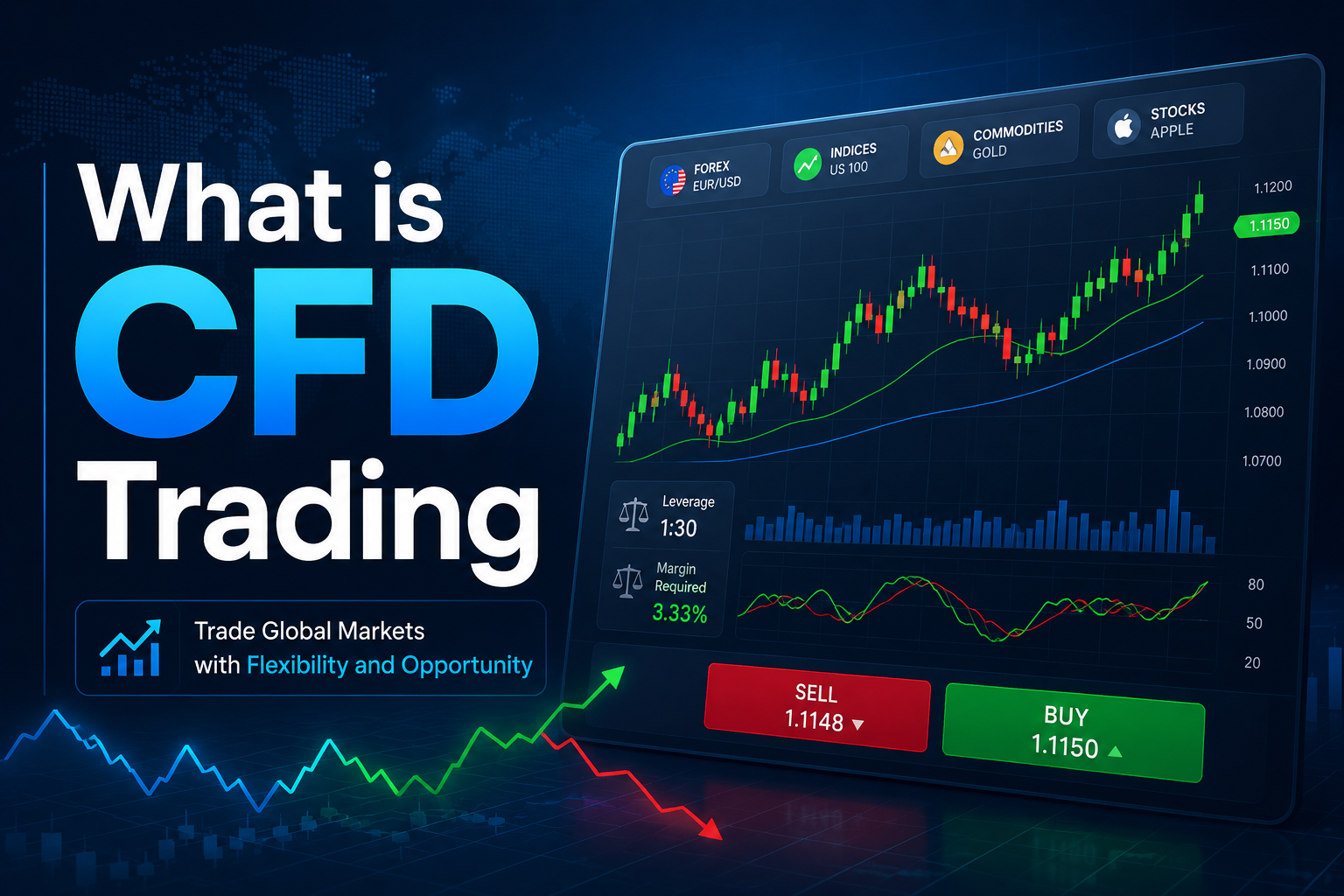
If you are new to how CFDs are structured, our explainer on what CFD trading is and how it works covers the mechanics in more depth.
The honest answer is that it depends on how long you hold the position. The two instruments load their costs differently.
Index futures charge a commission per contract and small exchange and regulatory fees. Once you are in, there is no daily financing charge. The cost is mostly fixed per trade.
Index CFDs usually fold the cost into the spread, the gap between the buy and sell price, and then add an overnight financing fee for each day you hold. There is often no separate commission on index CFDs, but the financing charge accumulates.
That leads to a clear pattern:
For very short holding periods, such as intraday trades, CFDs are often cheaper. There is little or no financing to pay, and you avoid the fixed commission structure of futures.
For longer holding periods, measured in weeks or months, futures often cost less, because they carry no daily financing charge. The CFD financing fee, charged every day on the full position value, adds up.
Neither structure is cheaper in every case. The deciding factor is your holding period and the size of your position. Working out the total cost before you trade, including spread, commission, and any financing, is part of sound risk and money management.
Leverage lets you control a large position with less capital. Both instruments use it, but the limits and the entry costs differ.
For retail CFD traders, regulators cap leverage on major stock indices at 20:1. This limit applies across the European Union under ESMA rules from 2018, in the United Kingdom under the FCA rules made permanent in 2019, in Australia under ASIC rules from 2021, and in Cyprus under CySEC measures that follow the ESMA framework. The same regimes cap major currency pairs at 30:1, not indices, so the correct figure for a major index is 20:1. These rules also require a margin close-out level and negative balance protection, which stops a retail account from falling below zero.
For futures, there is no single retail leverage cap in the same form. Your effective leverage comes from the exchange’s margin requirement relative to the contract value, and that requirement moves with volatility as described above.
On the capital side, futures set a higher floor. Even a micro contract represents a meaningful position, and you must post the exchange margin for it. A CFD account, by contrast, can open a much smaller position, which is one reason CFDs are the more accessible route for traders starting with limited capital. If you are learning how leverage and margin interact, our guides on how leverage works in trading and what a margin call is explain the mechanics.
This is one of the sharpest practical differences.
An index future expires. On the quarterly settlement date, the contract closes and settles in cash. A trader who wants to keep the exposure must “roll” the position, closing the expiring contract and opening the next one. Rolling has its own cost and timing, and forgetting to roll means your position closes whether you intended it to or not.
An index CFD does not expire. The position rolls automatically and stays open until you close it or your margin runs out. There is no settlement date to track. The trade-off is the daily financing charge, which is the price of that open-ended structure.
Major index futures are among the most heavily traded instruments in the world, and their prices come from a central, transparent exchange order book. Everyone sees the same market.
Index CFD prices are quoted by brokers and are usually derived from the underlying futures or cash market. Liquidity and spreads depend on the broker’s pricing and the market is open hours. Because the quote is not a central exchange price, execution quality varies more between providers than between exchange members trading the same futures contract.
With a future, the clearing house guarantees the trade. CME Clearing and Eurex Clearing stand between the buyer and the seller, reducing the risk that the other party fails to pay.
With a CFD, your counterparty is your broker. If the broker fails, your position and funds depend on how that broker holds client money and which regulator oversees it. This is a real difference in structure, not a comment on any specific firm. It is one reason regulators pay close attention to how CFD providers are run.
Taxation of trading gains varies by country, and the rules differ for futures and CFDs in many jurisdictions. For example, the US “60/40” tax treatment for certain futures is specific to the United States, where CFDs are not available to residents. Because the rules depend entirely on where you live, this guide does not give tax guidance. Check the rules that apply in your own jurisdiction, or speak with a qualified local tax professional.
EBC offers index CFDs on major benchmarks across several regions, including:
US indices: S&P 500 (SPXUSD), Nasdaq-100 (NASUSD), Dow Jones Industrial Average (U30USD), and Russell 2000 (RUTUSD)
European indices: DAX (D30EUR), EURO STOXX 50 (E50EUR), FTSE 100 (100GBP), and CAC 40 (F40EUR)
Asia-Pacific indices: Nikkei 225 (225JPY), ASX 200 (200AUD), China A50 (CNIUSD), and Hang Seng (HSIHKD)
These are traded as CFDs, with flexible lot sizes and a maximum leverage of 100:1, subject to the rules of your account’s jurisdiction.
Rather than name a winner, it helps to match the instrument to the situation.
| If you are... | The structure that may fit better |
|---|---|
| Trading intraday and closing positions the same day | Index CFDs, as overnight financing usually does not apply to intraday trades |
| Holding positions for weeks or months | Index futures, as they generally do not charge daily overnight financing, though rollover may be required at expiry |
| Starting with a smaller account | Index CFDs, because position sizing is usually more flexible |
| Wanting exchange trading with central clearing | Index futures, which trade on regulated exchanges with central clearing |
| Trading from a market without direct access to futures exchanges | Index CFDs, which may provide more accessible exposure in many jur |
For many traders in Asia, the Middle East, Africa, and Latin America, direct access to US futures exchanges is limited, and index CFDs are the practical way to take index exposure. US residents cannot trade CFDs at all, so the choice does not arise for them. Where you live shapes which instrument is even available to you.
No. Index CFDs have no expiry date. The position rolls continuously and stays open until you close it, or your account no longer meets the margin requirement. In exchange, you usually pay an overnight financing charge for each day the position is held.
Yes. Most major index futures expire on a quarterly cycle, in March, June, September, and December, and settle in cash. To keep the exposure past expiry, a trader rolls the position into the next contract.
It depends on how long you hold the position. CFDs are often cheaper for very short trades because there is little financing to pay. Futures are often cheaper for positions held over weeks or months because they carry no daily financing charge, only the upfront commission and fees.
Retail leverage on major stock index CFDs is capped at 20:1 in the European Union, the United Kingdom, and Australia. These rules also require negative-balance protection and a margin closeout level.
It varies by broker and instrument. Many index CFDs are priced from the underlying futures market, while some track the cash index. The broker’s product terms state which reference the CFD follows.
For a future, the exchange’s clearing house is the counterparty and guarantees the trade. For a CFD, your broker is the counterparty, and the contract exists between you and that broker.
Index futures set a higher floor, because you must post exchange margin even for a micro contract. Index CFDs allow smaller, flexible position sizes, so an account can open an index position with less capital. The exact amount depends on the index, the leverage, and the position size.
Index CFDs and index futures give you exposure to the same underlying indices, but through different machinery. Futures are standardised, exchange-traded, quarterly-expiring contracts backed by a clearing house, with costs concentrated in commissions. CFDs are flexible, over-the-counter, non-expiring contracts settled with your broker, with costs concentrated in the spread and daily financing.
The practical decision usually comes down to three things: how long you plan to hold, how much capital you have, and what your market allows you to access. Short holds and smaller accounts often point toward CFDs. Longer holds point toward the lower carrying cost of futures. And in much of the world, availability decides it before anything else does.
Whichever you use, the leverage that makes these instruments efficient also enlarges losses, and regulators require CFD providers to disclose that a large share of retail accounts lose money. Understanding the exact cost and risk of a position before you open it is something no instrument choice can replace.
Disclaimer: This material is for general information purposes only and is not intended as (and should not be considered to be) financial, investment, or other advice on which reliance should be placed. No opinion given in the material constitutes a recommendation by EBC or the author that any particular investment, security, transaction, or investment strategy is suitable for any specific person.