Published on: 2026-03-25
Updated on: 2026-03-25
If you have been watching the Australian dollar (AUD) lately, you already know it has had quite a ride.
After a period of decline followed by a sharp recovery, the AUD currently trades at a level that prompts analysts and market participants to question whether it is undervalued or accurately priced.
This issue is relevant not only to currency traders but also to importers, international travelers, investors with overseas exposure, and those seeking to understand the broader implications for the Australian economy in 2026.
The Australian dollar has recovered significantly from its multi-year lows and is trading near levels analysts consider close to fair value.
Multiple valuation frameworks suggest the Aussie is modestly undervalued against the US dollar at current market prices.
The Reserve Bank of Australia’s hawkish stance is providing underlying support for the currency.
Key risks to the upside and downside both remain live, making the AUD one of the most closely watched G10 currencies this year.
Global factors, particularly China’s economic health and commodity prices, continue to exert outsized influence on the AUD's trading range.
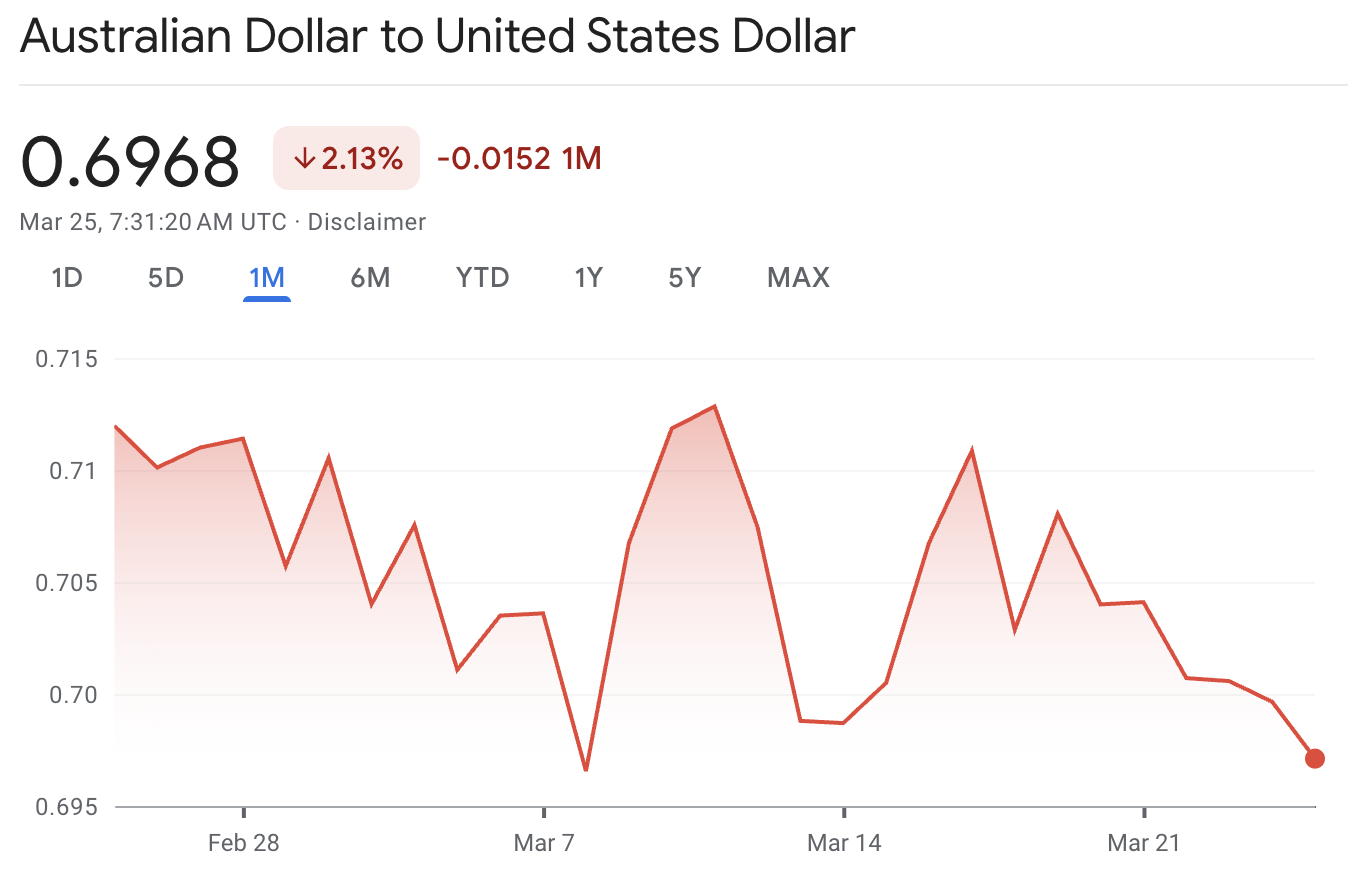
The Australian dollar climbed from 0.6415 in November 2025 to above 0.7200 in February 2026, its strongest level in three years, before reversing sharply below 0.70 as the Middle East conflict pushed traders into the safe-haven US dollar.
As of late March 2026, the Australian dollar edged down to around USD 0.70, approaching a two-week low amid caution over geopolitical developments and softer-than-expected domestic inflation figures.
Consumer prices were unchanged in February from the previous month, while annual inflation slowed to 3.7%, slightly below expectations, though inflation remains above the RBA’s 2-3% target range.
To assess whether the AUD is undervalued or fairly priced, it is necessary to consider the primary frameworks economists use to determine currency fair value. Three key approaches are commonly applied:
| Framework | What It Measures | AUD Implication (2026) |
|---|---|---|
| Purchasing Power Parity (PPP) | Relative price levels across countries | AUD modestly undervalued |
| Interest Rate Differentials | Yield attractiveness vs. other currencies | Supportive of AUD |
| Terms of Trade | Export vs. import price ratios | Positive due to iron ore and energy |
Purchasing power parity is a measure of the prices of specific goods across countries and is used to compare the absolute purchasing power of currencies, effectively calculating the ratio of a market basket’s price at one location to another.
Based on a PPP model that compares the prices of identical goods across countries and adjusts for inflation, the fair value of the Australian dollar is estimated at around USD 0.72, suggesting the currency has little further upside from a pure PPP standpoint.

However, the Australian dollar often exhibits momentum-driven overshooting, and a short-term appreciation toward USD 0.75 to 0.80 remains possible, although such elevated levels are unlikely to persist.
The CFR’s Mini Mac Index, which uses iPad mini prices rather than burgers for a more globally traded benchmark, paints a similar picture.
The Australian dollar has fallen from 1.6% undervalued to 5.2% undervalued against the US dollar, reflecting its sensitivity to China’s economic fortunes, given Australia’s high trade exposure to the region.
Thus, both major PPP-based frameworks indicate that the Australian dollar is modestly, but not significantly, undervalued.
The Reserve Bank of Australia is arguably the single biggest domestic driver of AUD strength in 2026.
The RBA raised its official cash rate twice in a row in February and March 2026, bringing it to 4.10%, the highest level since 2012, as inflation refuses to fall back within the 2% to 3% target band. Markets now fully price in a third consecutive hike in May 2026.
Australia is on track to have the highest central bank rate in the G10 by mid-2026, a rate differential that could encourage capital to flow out of the US, boosting demand for the AUD and putting downward pressure on the US dollar.
A higher Australian cash rate relative to the US makes the Aussie more attractive to yield-seeking investors, which is a structural tailwind for the currency throughout 2026.
Major institutional forecasts for AUD/USD through the rest of 2026 vary, but the direction is broadly upward from current levels:
Westpac: Sees AUD rising to USD 0.70 by September and USD 0.71 by December 2026.
NAB: Forecasts AUD/USD reaching USD 0.72 by Q3 2026, then easing slightly to USD 0.71 by year-end.
ING: Takes a more cautious view, projecting AUD/USD steady at USD 0.68 in Q3 and USD 0.69 by year-end.
The consensus outlook anticipates a higher AUD/USD exchange rate by year-end. However, ongoing uncertainty in the US economy, including tariff policy, potential Federal Reserve rate cuts, and rising de-dollarisation, poses notable downside risks to the US dollar.

When iron ore prices rise, export income increases, national income improves, and the Australian dollar tends to strengthen. When prices fall, the reverse occurs, and a weaker exchange rate helps cushion the economy by making other exports more competitive.
Australia earns substantial income annually from iron ore alone, and China remains its dominant buyer. Any shift in Chinese demand hits the AUD directly.
Chinese economic data remains a critical factor. Any decline in Chinese Purchasing Managers' Index (PMI) exerts significant downward pressure on the AUD, as market participants often treat the currency as a proxy for Chinese economic performance.
Goldman Sachs revised its forecast for China’s 2026 GDP growth upward, and a US-China tariff agreement that reduced potential tariff rates on Chinese goods supported this revision.
At the start of 2026, the AUD/USD exchange rate benefited from favorable macroeconomic conditions. Rising inflation risks in Australia and increasing pressure on the Federal Reserve to implement rate cuts have shifted the balance of risks against the US dollar.
A third factor driving currency moves is interest rate differentials. Sticky inflation halted the RBA’s cutting cycle just as the chance of US rate cuts increased, making Australian dollar assets relatively more attractive.
While the fundamental case for a modestly undervalued AUD is real, several risk factors could push it back down:
Middle East escalation: The same oil spike that hurts Japan and the eurozone adds to Australian export revenues as a net energy exporter, but fear-driven risk aversion sends traders into the US dollar, selling AUD first.
China slowdown: A sharp deterioration in Chinese economic data would undercut commodity demand and weigh heavily on the Aussie.
Global recession risk: Traders treat AUD as a risk-on currency, meaning confidence in global growth drives money into the Aussie, while fear drives money into the US dollar and away from AUD.
Domestic softness: Disappointing business activity data has added pressure on the Aussie, with Australia’s manufacturing PMI slipping to a five-month low and the services sector recording its first contraction since early 2024.
Based on multiple valuation measures, the Australian dollar appears modestly undervalued against the US dollar in March 2026. PPP models place a fair value around USD 0.72, while the currency trades closer to USD 0.70. That gap is real, but it is not extreme.
The structural case for a stronger AUD is supported by:
The RBA’s hawkish rate cycle
Australia’s status as a net energy exporter
Recovering Chinese demand for Australian commodities
A broadly weakening US dollar backdrop
Risks remain significant. Geopolitical shocks, weaker-than-expected Chinese growth, or a shift in global risk sentiment could rapidly eliminate the current valuation gap.
While the AUD is not substantially undervalued, current market pricing appears more pessimistic than recent economic data would suggest.
Yes. The RBA explicitly notes that the Aussie is often described as a commodity currency because export prices strongly influence demand for AUD.
Because exchange rates reflect relative growth, rates, capital flows, and global demand for each currency, not national income alone.
On fundamental valuation metrics, the AUD appears modestly undervalued, but significant risks, including geopolitical shocks and uncertainty around China, remain.
Yes. China is Australia’s largest trading partner, so shifts in Chinese demand can move Australian exports and the currency.
The Australian dollar in 2026 sits in a zone that most economists would describe as modestly undervalued rather than deeply cheap.
PPP models point to a fair value closer to USD 0.72, while the currency trades near USD 0.70 after retreating from a three-year high above USD 0.72 in February.
Although the AUD does not represent an exceptional value, fundamental analysis indicates that the market is applying a modest discount that may not be fully warranted by current economic conditions.
Disclaimer: This material is for general information purposes only and is not intended as (and should not be considered to be) financial, investment or other advice on which reliance should be placed. No opinion given in the material constitutes a recommendation by EBC or the author that any particular investment, security, transaction or investment strategy is suitable for any specific person.