Published on: 2026-05-08
Updated on: 2026-05-08
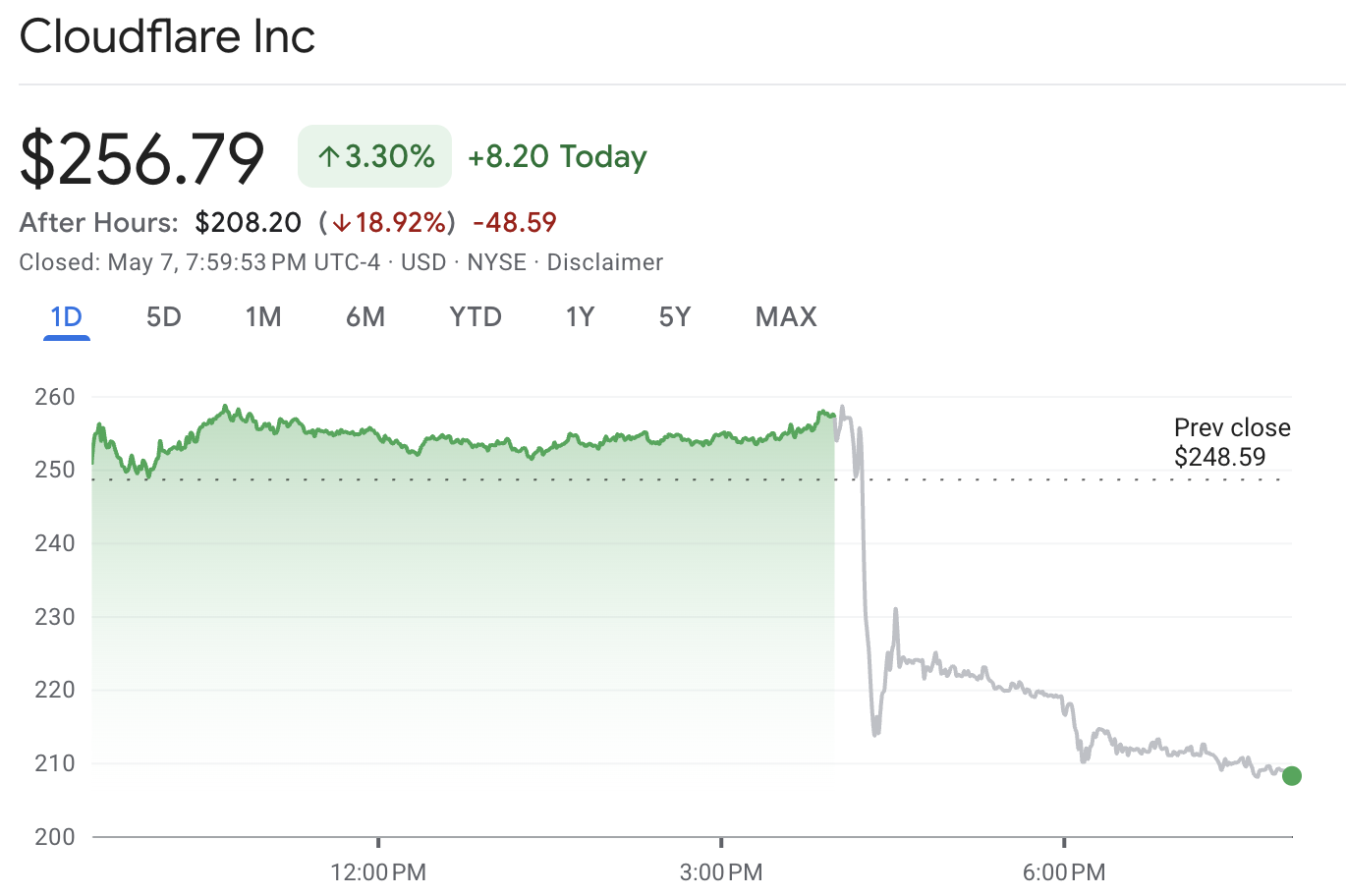
Cloudflare (NET) stock fell sharply in after-hours trading after the internet infrastructure company paired stronger-than-expected first-quarter results with a sweeping AI-driven restructuring plan. The reaction showed how little tolerance investors have for execution risk in richly valued software names, even when revenue growth remains strong and demand indicators look resilient.
The stock closed Thursday’s regular session at $256.79, up 3.36%, before market reports showed a double-digit decline in extended trading after the company announced plans to cut more than 1,100 jobs, or roughly 20% of its workforce.
Cloudflare said the restructuring is designed to shift the company toward an “agentic AI-first” operating model, but investors treated the move as a new risk factor rather than a straightforward productivity upgrade.
Cloudflare’s Q1 revenue rose 34% year over year to $639.8 million, confirming durable demand for its connectivity cloud platform.
The stock fell sharply after hours, despite stronger Q1 results, as investors focused on valuation, guidance quality and restructuring risk.
The company plans to cut approximately 1,100 roles, as management reorganizes around AI-driven workflows.
Restructuring charges are expected to total $140 million to $150 million, with most of the cost concentrated in Q2 and the plan substantially complete by the end of Q3.
Q2 revenue guidance of $664 million to $665 million implied continued growth, but failed to deliver the stronger upside investors appeared to expect after the stock’s rally.
Cloudflare’s first-quarter numbers were not the issue on the surface. Revenue reached $639.8 million, up 34% from a year earlier, while non-GAAP operating income came in at $73.1 million, equal to 11.4% of revenue. The company also delivered 34% current remaining performance obligation growth, a signal that contracted demand remains healthy.
The problem was the market’s starting point. Cloudflare had already been priced as one of the higher-quality growth names in cloud infrastructure, cybersecurity and edge computing. That left little room for ambiguity.
A clean beat would have needed to come with stronger guidance, visible margin leverage and limited operational disruption. Instead, investors received good results, measured guidance and a large workforce reduction.
For the second quarter, Cloudflare guided revenue to $664 million to $665 million. For the full year, it projected revenue of $2.805 billion to $2.813 billion, with full-year non-GAAP operating income guidance of $418 million to $421 million.
Those figures imply continued growth. Yet premium software stocks are often judged less by whether they beat estimates and more by whether they force investors to raise future assumptions. Cloudflare did not deliver the type of guidance reset that would justify further multiple expansion after a strong pre-earnings rally.
| Metric | Q1 2026 Result | Market Interpretation |
|---|---|---|
| Revenue | $639.8 million | Growth remained strong at 34% year over year |
| GAAP operating loss | $62.0 million | Losses persisted despite scale |
| Non-GAAP operating income | $73.1 million | Profitability remained positive on an adjusted basis |
| Non-GAAP operating margin | 11.4% | Margin profile remains under scrutiny |
| Current RPO growth | 34% YoY | Backlog demand remained resilient |
| Q2 revenue guidance | $664 million to $665 million | Solid growth, but not enough to reset expectations |
Cloudflare’s fundamentals still point to a business with scale, strong customer relevance and expanding platform breadth. The company operates across internet security, application performance, developer infrastructure and AI-related edge workloads. That mix gives it exposure to several long-term growth markets.
The equity market, however, looked past the headline growth rate. Investors focused on the interaction between valuation and uncertainty. A company growing above 30% can still sell off if the market begins to question whether future growth will arrive with enough operating leverage to support the multiple.
Cloudflare said the planned layoffs were not a conventional cost-cutting exercise. Management framed the move as a structural redesign around AI, arguing that software creation, internal workflows and customer delivery are entering a new phase.
The company’s internal AI usage has increased by more than 600% over the past three months, with employees across engineering, HR, finance and marketing running thousands of AI agent sessions each day.

That explanation may make strategic sense, but it introduced a difficult question for investors: can Cloudflare remove roughly one-fifth of its workforce while maintaining the sales execution, product velocity and customer support intensity required of a high-growth enterprise software company?
Cloudflare expects the restructuring to cost $140 million to $150 million, with most charges incurred in Q2 and the plan substantially complete by the end of Q3. The costs are mostly tied to severance, benefits and related expenses.
The size of the charge matters because it reduces near-term earnings clarity. The timing also matters. Cloudflare is making a major operating shift while trying to convince investors that AI will be a growth accelerator, not a margin drag or organizational distraction.
Cloudflare has leaned heavily into the AI infrastructure theme. In April, the company expanded its agent-focused platform strategy with tools designed to help developers build, deploy and scale AI agents across Cloudflare’s global network.
That positioning is strategically powerful. AI agents may increase demand for secure compute, low-latency routing, identity controls, browser automation, model access and traffic management. Cloudflare already has assets across many of those layers.
Still, the stock reaction shows that investors want measurable conversion. AI exposure alone is no longer enough. The market wants to see whether Agent Cloud, Workers and related products can drive incremental revenue growth, stronger retention and durable margin expansion.
Cloudflare’s market capitalization stood near $89.7 billion at Thursday’s close. Against the midpoint of the company’s full-year 2026 revenue guidance, that implied a revenue multiple above 30 times before the after-hours decline.
That valuation leaves little margin for mixed messaging. When a stock trades at a premium multiple, investors punish even small signs of uncertainty. In Cloudflare’s case, the uncertainty came from three places at once:
A Q2 revenue guide that did not decisively reset expectations
A large AI-led workforce reduction
A restructuring charge large enough to affect near-term profitability optics
Cloudflare’s selloff fits a wider market pattern. Investors remain willing to pay for AI-linked growth, but they are becoming more selective. Companies must now show how AI improves revenue quality, customer adoption and operating efficiency. Strategic language alone carries less weight.
That creates a tougher test for high-growth software firms. AI can be a catalyst, but it can also be read as a disruption risk if companies announce major workforce changes without clear near-term financial benefits. For Cloudflare, the market is effectively asking whether AI will expand the company’s addressable market or simply force a costly internal reset.
The next key event is Cloudflare’s investor communication around its post-restructuring model. Investors will look for clearer answers on revenue growth durability, AI product contribution, operating margin targets and the expected productivity gains from the workforce reduction.
The company needs to show that the restructuring strengthens execution rather than destabilizing it. That means sustaining large-customer growth, improving adjusted margins and demonstrating that AI-led workflows can accelerate product delivery without weakening enterprise sales coverage.
The after-hours move signals a sharp break in short-term sentiment. A large earnings-related gap often creates a new supply zone as investors who bought ahead of results reassess risk. For the stock to stabilize, Cloudflare likely needs stronger management commentary, analyst support or evidence that the restructuring does not impair growth.
Until then, Cloudflare stock may trade less on the Q1 beat and more on the credibility of management’s AI transition plan.
Cloudflare delivered a strong quarter by conventional standards, but the market response showed that conventional strength was not enough. Revenue growth remained robust, adjusted profitability was positive and contracted demand indicators held up.
Yet the combination of high valuation, measured guidance and a major AI-led restructuring shifted investor attention from growth to execution risk.
The selloff does not invalidate Cloudflare’s long-term position in internet infrastructure or AI-enabled edge computing. It does, however, reset the burden of proof. Investors now need evidence that the company can turn its AI strategy into measurable revenue growth and operating leverage while managing one of the most significant organizational changes in its public-company history.