Published on: 2026-03-23
Updated on: 2026-03-23
If you looked at a trading screen in London, Frankfurt, or Paris this morning, you'd be forgiven for thinking something had fundamentally broken. It has. The "Red Monday" we're witnessing isn't just a bad day at the office for fund managers; it's a violent repricing of reality.
For months, the narrative surrounding European stock markets was one of cautious recovery. We were told inflation was tamed and that interest rate cuts were just around the corner. That script was tossed into the shredder over the weekend. Between a looming 48-hour ultimatum in the Middle East and a spike in energy costs that feels like a flashback to 2022. the floor has effectively dropped out from under the continent's biggest indices.
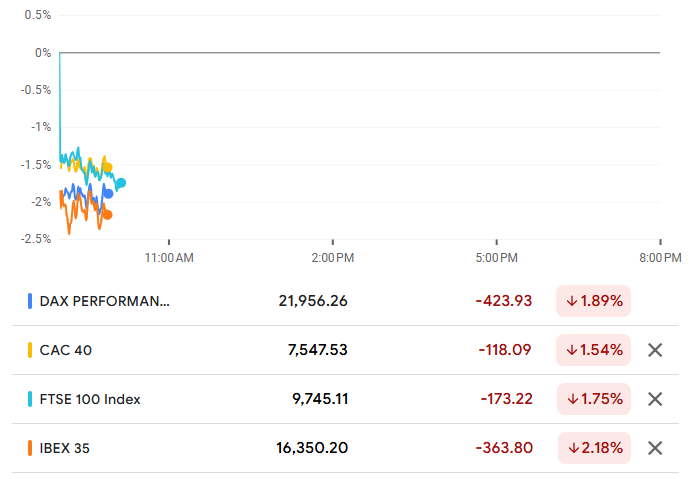
To understand the scale of the retreat, you only have to look at the benchmarks. By mid-afternoon, the damage across the Eurozone was widespread, with almost no sector left unscathed except for defense and heavy energy.
DAX (Germany): Currently sitting at 21,956.26, down a staggering 2.01%. For an index that represents the industrial backbone of Europe, this is a massive red flag.
CAC 40 (France): Losing 1.54% to land at 7,547.53. The luxury giants that usually prop up the French market are seeing investors run for the exits.
FTSE 100 (UK): Down 1.75%, barely holding the 9.745 line. Even the commodity-heavy London market isn't safe from the contagion.
IBEX 35 (Spain): Dropping 2.18%, as the prospect of higher fuel prices sends travel and tourism stocks into a tailspin.
The broader STOXX 600 has hit its lowest point in nearly four months. What's worrying traders isn't just the depth of the fall, but the speed of it. This isn't a slow drift; it's a liquidation.
The primary catalyst for today's chaos is the escalating tension in the Strait of Hormuz. With a 48-hour ultimatum set to expire at midnight, the risk of a full-scale maritime blockade is no longer a "tail risk"—it's the base case for many desks in London and New York.
Europe is uniquely vulnerable here. Unlike the U.S., which has its own shale reserves, Europe's industrial machine runs on imported energy. With Brent Crude flirting with $115 a barrel this morning, the math for European manufacturers simply doesn't add up anymore.
While the geopolitical news is grabbing the headlines, there are three deeper, more structural reasons why European stock markets are failing to find any support today:
The ECB's Nightmare Scenario: The European Central Bank is now caught in a classic trap. If they cut rates to save the economy, they risk letting energy-driven inflation run wild. If they keep rates high, they might push the continent into a deep recession. Investors hate uncertainty, and right now, the ECB looks like it's flying blind.
Manufacturing Margin Compression: This is a fancy way of saying that companies can't pass on costs anymore. In 2024 and 2025, firms raised prices to cover their bills. But the European consumer is tapped out. If energy costs go up another 20%, companies will have to eat those costs themselves, destroying their profit margins.
The Flight to the "Greenback": When the world gets scary, money flows to the U.S. Dollar. We are seeing a massive rotation out of European equities and into U.S. Treasuries and cash. This weakens the Euro, which in turn makes imported energy even more expensive. It's a vicious cycle that is playing out in real-time on today's charts.
Even in a bloodbath like this, money doesn't just disappear—it moves. The divergence between sectors today is telling a very specific story about what the "smart money" expects to happen next.
The Defense Hedge: Shares in companies like BAE Systems and Rheinmetall are actually trading up. In a world of ultimatums and regional conflicts, defense spending is the only "guaranteed" growth sector left.
The Energy Divergence: While BP and Shell are holding steady due to higher oil prices, the renewable sector is getting hammered. Higher interest rates make funding large-scale wind and solar projects much more expensive, and right now, the market is prioritising "old energy" that works today over "green energy" that works tomorrow.
Airlines are Crashing: This is the most visible victim of the current crisis. Between IAG (British Airways) and Lufthansa, we're seeing drops of 6% to 8%. Higher fuel costs plus a nervous consumer equals a disaster for airline earnings.
From a technical analysis perspective, today's move is significant because it broke through the 50-day moving average on several major indices. When these levels break, it triggers "stop-loss" orders from automated trading systems, which only accelerates the selling.
We are no longer looking for "bargains"; we are looking for where the bleeding stops. Many analysts are now pointing to the 200-day moving average as the next real level of support, which could mean another 3% to 5% downside from here if the news from the Middle East doesn't improve by tomorrow morning.
The takeaway from today's session is clear: the era of "easy gains" based on central bank promises is over. European stock markets are being forced to deal with a world where energy is expensive, geopolitics are volatile, and growth is anything but guaranteed.
We are currently in a "show me" market. Investors are no longer willing to buy the dip based on a headline; they want to see actual earnings resilience and a clear path to energy security. Until that happens, the bias for European stocks remains firmly to the downside.
The next 24 hours will be crucial. If the midnight deadline passes without a shot being fired, we could see a massive "relief rally." But if the situation escalates, today's 2% drop might look like a minor blip compared to what's coming.
Disclaimer: This material is for general information purposes only and is not intended as (and should not be considered to be) financial, investment or other advice on which reliance should be placed. No opinion given in the material constitutes a recommendation by EBC or the author that any particular investment, security, transaction or investment strategy is suitable for any specific person.