Published on: 2026-04-06
Updated on: 2026-07-01
Gearing ratio measures how much a company relies on debt financing. It helps investors judge whether a company’s returns are supported by a healthy balance sheet or by excessive borrowing.
Higher funding costs can turn manageable debt into a profit drag, especially for companies facing refinancing needs. For traders and investors, gearing ratio is not just an accounting measure. It is a practical signal of financial risk, return potential, and balance-sheet discipline.
Gearing ratio measures financial leverage by comparing debt with equity, capital, assets, or earnings.
Debt-to-equity is the most common gearing ratio, but interest coverage often provides a better view of whether debt is affordable.
A ratio below 25% is usually considered low, 25% to 50% moderate, and above 50% high, though sector context matters.
High gearing can boost shareholder returns when profits rise, but it can magnify losses when earnings fall.
Traders should compare gearing with peers, track changes over time, and evaluate whether earnings comfortably support debt obligations.
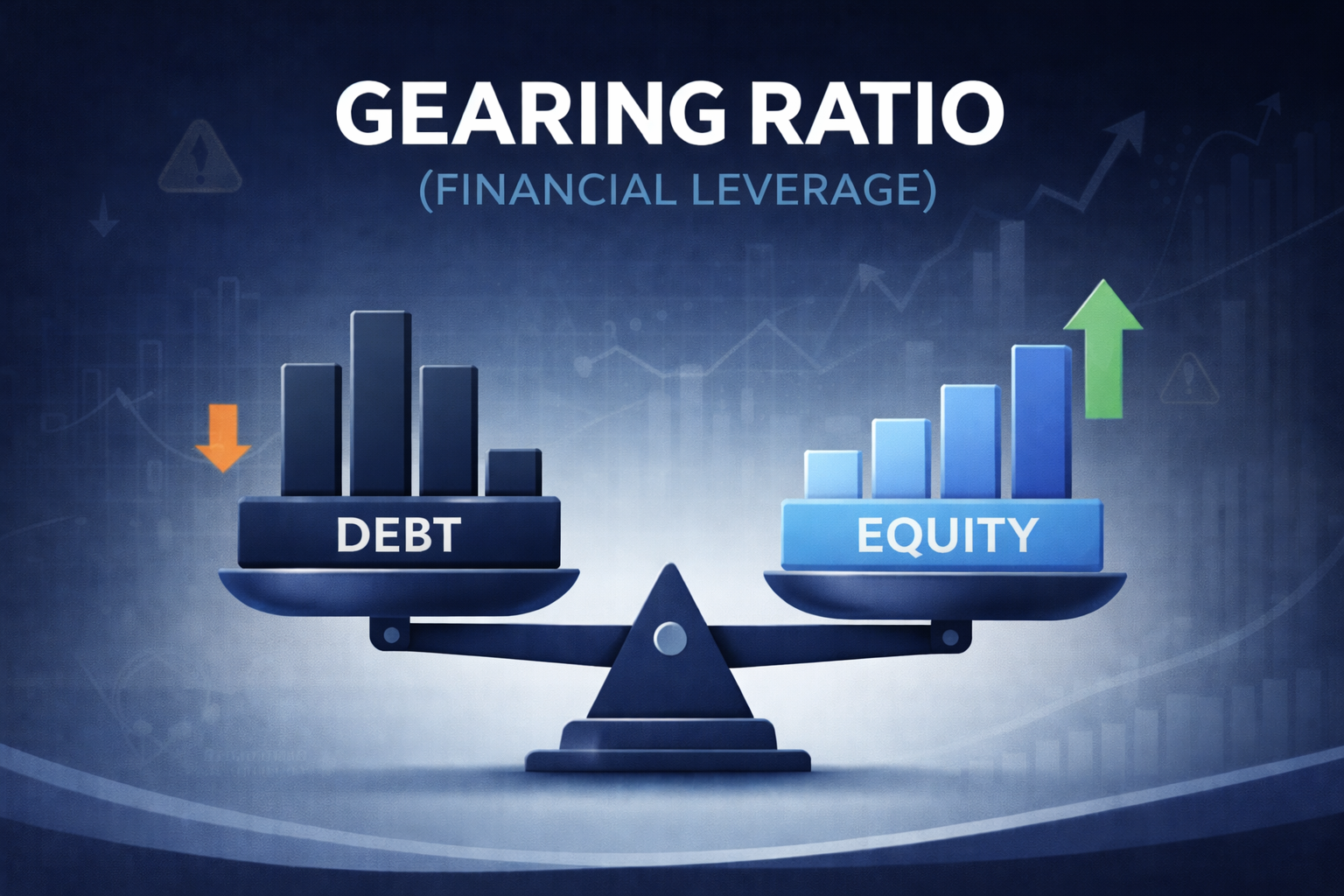
The gearing ratio is a financial metric that measures how much a company depends on borrowed money. It compares debt with shareholder equity, total capital, total assets, or earnings.
A company with high gearing relies more heavily on borrowing to fund operations, expansion, acquisitions, or long-term assets. This can increase shareholder returns when business conditions are favourable.
Debt becomes a problem when earnings weaken because interest and principal payments do not fall with revenue. Companies with low gearing usually have more resilient balance sheets, although they may sacrifice some growth opportunities.
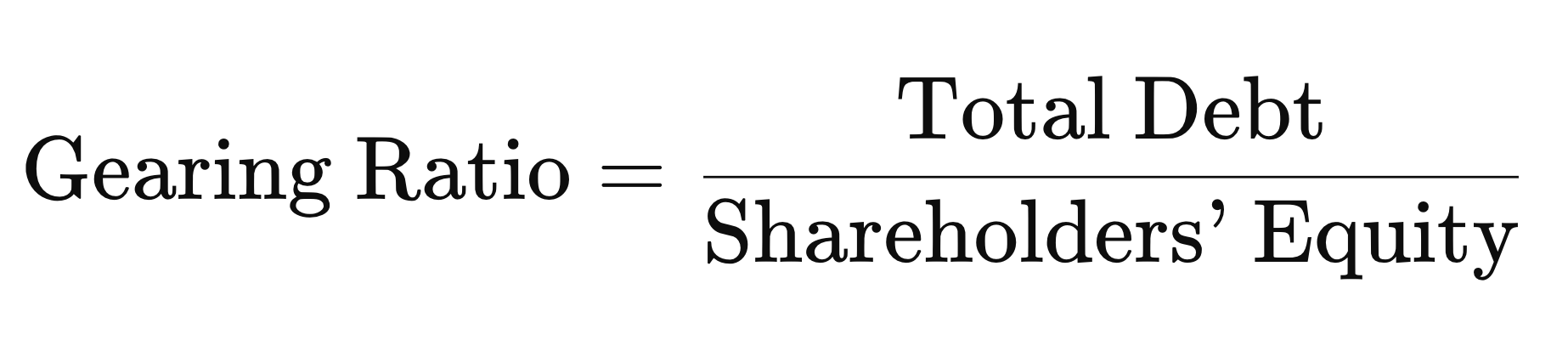
There is no single gearing ratio formula. Gearing is a family of leverage ratios, each answering a different question.
| Ratio | Formula | What It Tells You |
|---|---|---|
| Debt-to-Equity Ratio | Total Debt / Shareholders' Equity | How much debt supports each $1 of equity |
| Debt-to-Capital Ratio | Total Debt / (Total Debt + Equity) | The share of long-term capital funded by debt |
| Debt Ratio | Total Debt / Total Assets | How much of the asset base is financed by debt |
| Equity Ratio | Shareholders' Equity / Total Assets | How much of the asset base is funded by owners |
| Interest Coverage Ratio | EBIT / Interest Expense | Whether operating profit can cover interest costs |
Debt-to-equity: How leveraged are shareholders?
Debt-to-capital: How much funding comes from debt?
Debt ratio: How much of the asset base is financed by debt?
Equity ratio: How much of the business is funded by owners?
Interest coverage: Can the company actually afford its debt?
Debt-to-equity is the most widely used measure because it gives a direct view of the balance between creditors and shareholders. Interest coverage is equally important because it tests debt affordability, not just debt size.
Investors usually analyse gearing alongside interest coverage and cash flow. A company may have high gearing but stable cash generation. Another may have moderate gearing but weak earnings, making its debt burden more fragile.
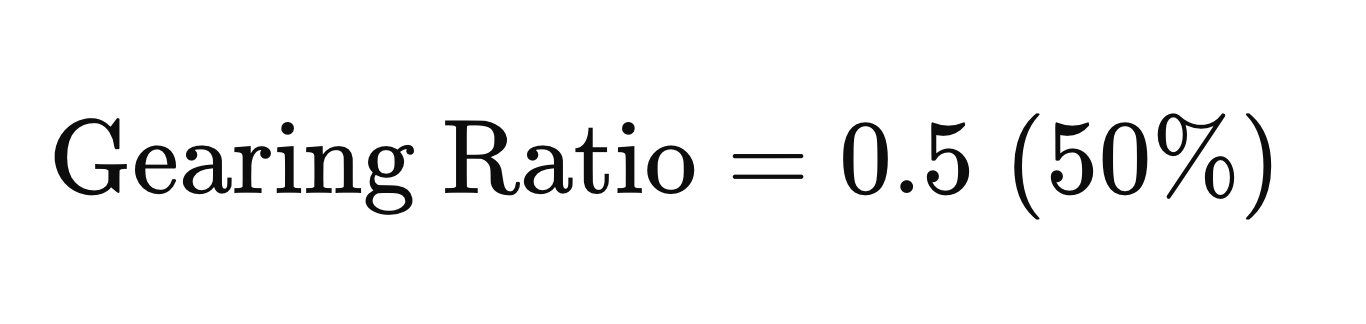
Assume a company has:
Total debt: $500 million
Shareholders’ equity: $1 billion
The debt-to-equity ratio is: $500 million / $1 billion = 0.5x, or 50%
This means the company uses $0.50 in debt for every $1 of equity. A 50% gearing ratio indicates meaningful leverage and should be compared with the company’s earnings quality, cash flow, and sector peers.
Assume another company has:
Total debt: $1.2 billion
Shareholders’ equity: $800 million
EBIT: $180 million
Interest expense: $90 million
Debt-to-equity ratio: $1.2 billion / $800 million = 1.5x, or 150%
Interest coverage ratio: $180 million / $90 million = 2.0x
This company is highly geared, with debt at 1.5 times equity. The 2.0x interest coverage ratio adds a second warning signal. Operating profit covers interest expense only twice, leaving limited room for weaker earnings, higher refinancing costs, or margin pressure.
Ask:
Is this company more leveraged than competitors?
Is high leverage normal for this industry?
Utilities, telecoms, infrastructure, and transportation companies often carry more debt because they own long-life assets and usually generate steadier cash flows. Software, internet, and semiconductor companies often operate with lower gearing because they are more asset-light or hold larger cash reserves.
Ask:
Is debt rising faster than revenue?
Is cash flow keeping pace?
Are margins strong enough to support higher borrowing?
Rising gearing is not always negative. Debt used to fund expansion or acquisitions may strengthen future earnings.
The warning sign is debt increasing while revenue, margins, and cash flow weaken.
Ask:
Can the company comfortably service its debt?
Would interest costs remain manageable if earnings fell?
Are large debt maturities approaching?
A company with high gearing and strong interest coverage may still have flexibility. A company with moderate gearing and weak coverage may face pressure sooner.
Gearing ratios change when debt, equity, assets, or earnings move. This makes the ratio useful not only as a snapshot, but also as a trend indicator.
| Event | Effect on Gearing |
|---|---|
| New Borrowing | Increases gearing |
| Debt Repayment | Reduces gearing |
| Equity Issuance | Reduces gearing |
| Share Buybacks | Increases gearing |
| Falling Profits | Often increases gearing pressure |
| Asset Write-Downs | Can increase gearing |
| Retained Earnings Growth | Can reduce gearing over time |
A company may look more leveraged after a major acquisition, even if the deal improves future earnings. Another company may see gearing rise because profits fall or assets are written down. The first case may signal investment. The second may signal stress.
A good gearing ratio depends on the industry, business model, cash flow stability, and interest rate environment. Broad benchmarks still help readers interpret the number.
Low gearing (below 25%): Indicates conservative debt use and lower financial risk.
Moderate gearing (25% to 50%): Reflects a balanced use of debt and equity.
High gearing (above 50%): Suggests greater reliance on debt and higher financial risk.
These figures provide a starting point, but industry context matters more than any universal threshold.
A 60% gearing ratio may be acceptable for a regulated utility with predictable earnings. The same ratio may look aggressive for a fast-changing technology company with volatile cash flow.
High gearing is easier to manage when earnings are growing, and credit conditions are supportive. It becomes more dangerous when demand slows, margins contract, or refinancing costs rise.
Sector comparison is one of the most important parts of gearing analysis because capital needs differ widely.
Current U.S. sector data show how large the gap can be. In January 2026, telecom services had market debt-to-equity of 95.40%, utilities stood at 75.88%, software was only 5.67%, and semiconductors were 2.58%. Interest coverage also varied sharply across sectors.
| Sector | Market Debt-to-Equity | Interest Coverage | Interpretation |
|---|---|---|---|
| Telecom Services | 95.40% | 3.61× | High debt reflects network investment and infrastructure costs |
| Utilities (General) | 75.88% | 2.57× | High leverage is common, but rate sensitivity matters |
| Software (System and Application) | 5.67% | 18.95× | Low gearing reflects asset-light business models |
| Semiconductor | 2.58% | 23.06× | Low debt and strong coverage indicate balance-sheet strength |
| Total Market Excluding Financials | 17.14% | 6.73× | Useful broad benchmark for non-financial companies |
A 60% gearing ratio may be conservative for a utility and aggressive for a software company.
Weak earnings can reduce dividends and capital investment.
Severe stress may force asset sales or equity issuance.
Credit rating pressure can raise future borrowing costs.
Floating-rate debt reprices quickly.
Refinancing becomes more expensive when rates rise.
Higher interest costs can reduce net profit even when revenue is stable.
Companies with near-term maturities face greater refinancing risk.
Debt only creates value when a business can earn more on borrowed capital than it pays in interest.
Debt can increase shareholder returns when investments succeed.
Debt can magnify losses when projects underperform.
Highly geared stocks often react more sharply to:
earnings releases
interest-rate decisions
credit downgrades
refinancing announcements
margin pressure
dividend cuts
For traders, gearing ratio can act as a volatility signal. A leveraged balance sheet can make equity prices more sensitive to small changes in earnings expectations.
Debt only creates value when a business can earn more on borrowed capital than it pays in interest.
| Type | Potential Strength | Main Risk |
|---|---|---|
| High Gearing | Can lift returns when growth is strong | Higher interest burden and refinancing risk |
| Low Gearing | More resilience in downturns | May limit expansion if debt is underused |
| Moderate Gearing | Balances growth and financial control | Still vulnerable if earnings weaken sharply |
High gearing is common in industries with predictable cash flows. Utilities, pipelines, telecom companies, and infrastructure businesses often operate with leverage levels that would appear dangerous in technology companies.
The problem is not debt by itself. The problem is debt that grows faster than earnings, cash flow, or asset productivity.
Low gearing reduces balance-sheet risk, but it does not remove business risk. A company with little debt can still lose market share, suffer falling margins, or face weak demand.
Low gearing may also suggest a company is being too cautious if it has strong cash flow and attractive investment opportunities.
A single gearing benchmark cannot apply to every sector. Utilities, telecoms, software, and semiconductors all have different asset needs, cash-flow profiles, and debt capacity.
Peer comparison is essential. A company should be judged against businesses with similar operating models, not against the market average alone.
Gearing ratio measures how much a company relies on debt compared with equity, capital, assets, or earnings. It helps investors understand whether returns are supported by a strong balance sheet or amplified by borrowing.
The most common formula is total debt divided by shareholders’ equity. This is also called the debt-to-equity ratio. A 50% result means the company has $0.50 in debt for every $1 of equity.
A gearing ratio above 50% is often considered high. However, this depends on the sector. Utilities and telecoms often have higher gearing than software or semiconductor companies because their asset bases and cash-flow profiles differ.
Debt-to-equity is one type of gearing ratio, but gearing can also include debt-to-capital, debt ratio, equity ratio, and interest coverage. Together, these ratios provide a fuller view of leverage and debt affordability.
A company can reduce gearing by repaying debt, raising equity, retaining profits, selling non-core assets, or improving earnings. Stronger equity and lower debt both reduce financial leverage.
Gearing ratio is a practical measure of financial leverage. It shows how much a company depends on debt and how that debt can affect risk, returns, and market sensitivity.
Traders and investors should compare companies with peers, track changes over time, and evaluate whether earnings comfortably support debt obligations.
When interest rates are elevated, gearing becomes even more important because refinancing risk and interest expense can quickly reshape profitability. Used properly, it helps identify companies that use debt productively and those that carry more risk than their returns justify.
Disclaimer: This material is for general information purposes only and is not intended as (and should not be considered to be) financial, investment or other advice on which reliance should be placed. No opinion given in the material constitutes a recommendation by EBC or the author that any particular investment, security, transaction or investment strategy is suitable for any specific person.