Published on: 2026-04-02
Updated on: 2026-04-02
Asia’s currencies are under pressure because the region is most exposed to any disruption in oil flows through the Strait of Hormuz.
On April 2, Brent crude climbed 4.9% to $106.16, and U.S. crude rose 4.0% to $104.15 after Washington signaled that military action against Iran would continue, pushing investors back into the dollar and away from Asia’s most oil-sensitive markets.
Several of Asia’s largest energy-importing economies have seen some of the sharpest currency declines against the dollar since late March. The Indian rupee and Japanese yen have lost more than 1.5% each, while the Korean won has shed around 3%.
Oil-importing economies must purchase more US dollars to pay for energy as crude prices rise. Increased dollar demand weakens domestic currencies in countries heavily reliant on imported oil.
At the same time, geopolitical stress drives investors toward the dollar as a safe-haven asset. The US, as a net energy exporter, actually benefits from higher crude prices. That means the dollar strengthens precisely when Asia’s import bills are at their most punishing.
Most of Asia’s major economies are net energy importers, which leaves them exposed when oil and gas prices rise sharply. Asia’s growth model is more vulnerable to higher imported energy costs than that of net energy exporters.
The damage is not distributed evenly. Each currency tells a different story. Here is where the major currencies stand:
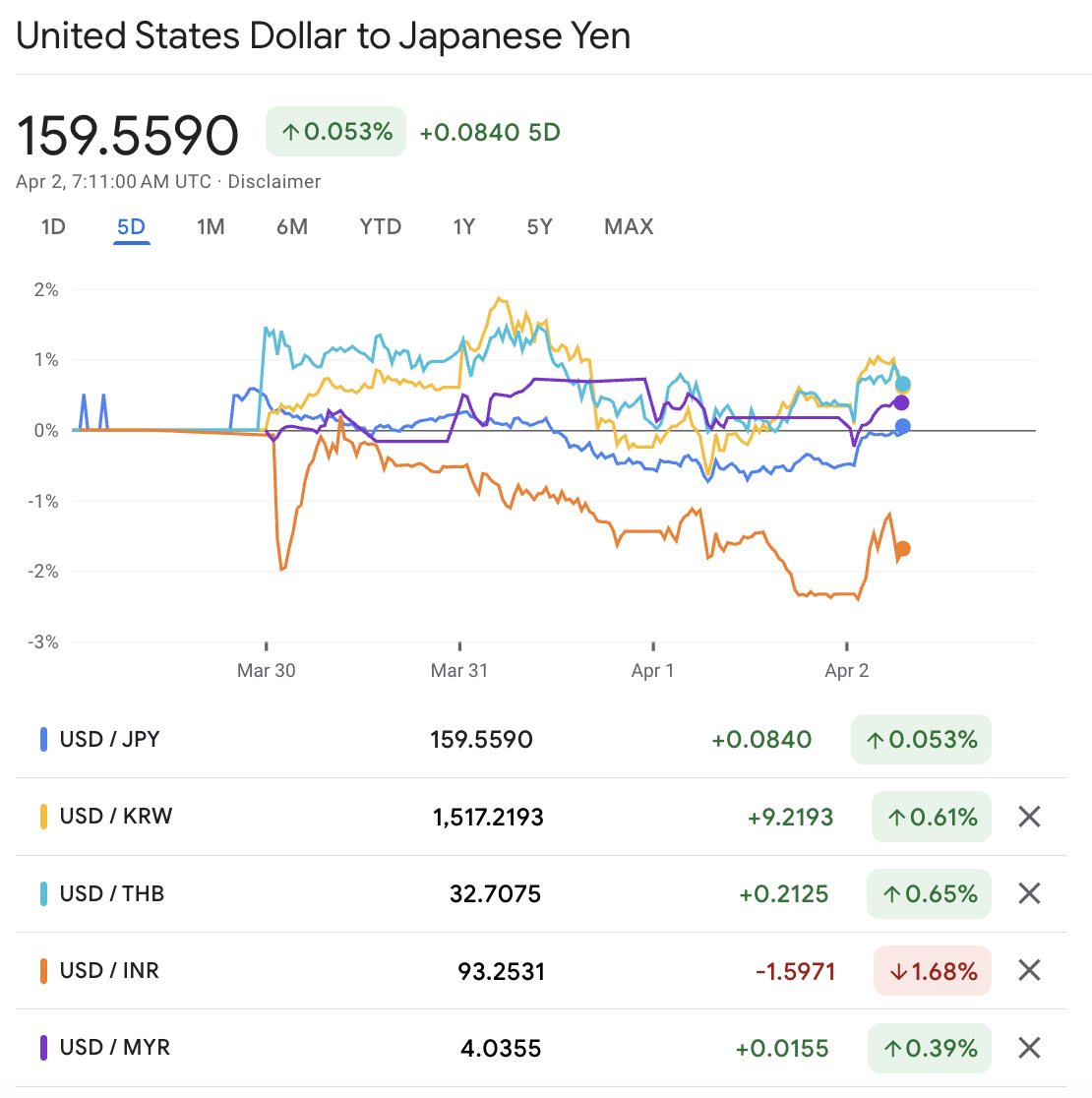
| Currency | Approximate Move (late Feb to late Mar 2026) | Primary Pressure |
|---|---|---|
| Thai Baht (THB) | -4.5% | Oil dependence, weaker trade balance |
| Korean Won (KRW) | -3.5% | Oil imports, weaker FX conversion support |
| Indian Rupee (INR) | -4.0% | Import bill, capital outflows |
| Japanese Yen (JPY) | -5.0% | Heavy energy import exposure, intervention risk |
| Malaysian Ringgit (MYR) | -2.2% | Net energy exporter, but still pressured by stronger USD |
The yen’s safe-haven reputation is being tested in the harshest possible way. Japan relies on the Middle East for 95% of its crude imports, around 70% of which pass through the Strait of Hormuz.
With logistics and insurance disrupted immediately after the outbreak of war, Japan’s refining and manufacturing sectors faced a double hit of procurement panic and surging costs.
In Japan, yields on two-year government bonds rose above 1.32% during intraday trading, hitting their highest level in 30 years since 1996, amid yen weakness. The Bank of Japan now faces a policy dilemma that has no clean exit.
The won remains under pressure because stronger exports are not fully offsetting higher energy costs and defensive dollar demand. Korea’s net oil and gas imports exceed 4% of GDP. At $100 Brent, Korea’s current account is expected to narrow sharply from 6.5% of GDP in 2025.
Despite export revenues, Korean companies are sitting on dollars rather than converting them. Exporters hold onto USD for FX risk mitigation and overseas cash payments, meaning dollar inflows are not increasing even as exports hold up.
Net foreign assets now largely determine FX movements, and that dynamic is continuing to pressure the won.
India’s currency tumbled to 94.19 rupees per dollar, hitting a record low, for a nation that imports more than 80% of its oil demand.
Geopolitical instability has also led foreign institutional investors to sell emerging-market assets, resulting in significant capital outflows.
Foreign portfolio outflows have compounded the rupee’s weakness by adding capital-account pressure to a worsening oil bill. That is a currency being hit on both the trade and capital account sides simultaneously.
Thailand’s baht fell 6.50% from late February to late March, marking the steepest drop among Asian currencies. Thailand has a limited fiscal cushion and a current account surplus too modest to absorb sustained energy costs.
Its heavy reliance on tourism, which is also being disrupted by the regional conflict, compounds the damage.
Once currencies start to weaken, the pressure compounds. Fuel is bought in dollars, so a softer rupee, won, baht, or yen raises the local-currency cost of the same barrel even if oil stops rising.

The market is pricing that pass-through aggressively because only 3.5 million to 5.5 million barrels a day of pipeline capacity can realistically bypass Hormuz, far below normal flows.
That leaves central banks facing an uncomfortable trade-off. Raise rates or defend the currency too aggressively, and growth takes the hit. Move too slowly, and imported inflation deepens while FX pressure intensifies.
Asian central banks collectively hold around $8 trillion in foreign exchange reserves, which gives them real capacity to smooth disorderly moves. Those reserves can smooth volatility, but they are less effective against a prolonged oil shock.
Asian governments are responding very differently to higher crude prices, reflecting differences in subsidy systems, fiscal buffers, and political willingness to pass costs through to consumers.
Several economies, including Indonesia, Japan, and India, are holding retail fuel prices unchanged despite rising global benchmarks, relying on state-owned oil companies or fiscal support to cushion consumers.
Indonesia’s officials have indicated a worst-case scenario of crude averaging $92 per barrel, well above the $70 per barrel assumption in the 2026 budget, highlighting limited room to manage sustained shocks without broader fiscal strain.
Because most of Asia imports energy in U.S. dollars. Higher crude prices raise dollar demand, increase import costs, and worsen trade balances, which puts local currencies under pressure.
The rupee, yen, won, baht, rupiah, and peso are under the most visible pressure, though the trigger differs by country. Oil dependence is the common denominator.
China’s yuan was limited to a modest decline thanks to capital controls and policy intervention, insulating it from the sharp moves seen in the yen and won. Its managed exchange rate system provides a buffer that most Asian peers do not have.
Oil above $100 is the key threshold. If Brent and WTI remain there, Asian FX is likely to stay under pressure because the import and inflation shock remains active.
Asian currencies are falling as oil prices rise because Asia is the most exposed end market for the energy passing through Hormuz.
With Brent at $106.16, WTI at $104.15, and only limited bypass capacity available, the shock is feeding directly into the rupee, yen, won, baht, rupiah, and peso through bigger import bills and a stronger dollar.
The next move will depend on whether oil remains elevated and whether policymakers respond more forcefully. If oil stays high and policy support remains hesitant, Asia FX stays vulnerable. If crude retreats and central banks offer a credible defense, the selloff can stabilize.
Disclaimer: This material is for general information purposes only and is not intended as (and should not be considered to be) financial, investment or other advice on which reliance should be placed. No opinion given in the material constitutes a recommendation by EBC or the author that any particular investment, security, transaction or investment strategy is suitable for any specific person.