Published on: 2026-05-14
EMS shares in India are facing a sharper test of earnings quality. The sector’s long-term growth story remains intact, but recent results from Kaynes Technology, Dixon Technologies and Syrma SGS show that revenue growth alone no longer protects valuations.
India’s electronics manufacturing service (EMS) base has moved beyond the early promise phase. Electronics production rose to ₹11.3 lakh crore in 2024-25, while electronics exports climbed to ₹3.27 lakh crore. Mobile phone exports alone reached ₹2 lakh crore.
The market is no longer asking whether India can assemble more electronics. It is asking which companies can convert scale into margins, cash flow and higher-value manufacturing.
Kaynes Technology reported 26.2% revenue growth in Q4 FY26, but net profit fell 21.5%, exposing weaker profit conversion.
Dixon Technologies delivered a much larger revenue base, but Q4 FY26 profit fell 36%, showing that scale does not remove earnings risk.
Syrma SGS stood out with 67% profit growth and 56% revenue growth, making it the cleaner example of execution-led expansion.
The next phase of India’s EMS cycle will reward product mix, component localisation and cash discipline, not only topline growth.
EMS valuations are becoming more selective as investors separate assembly-led revenue from durable earnings growth.
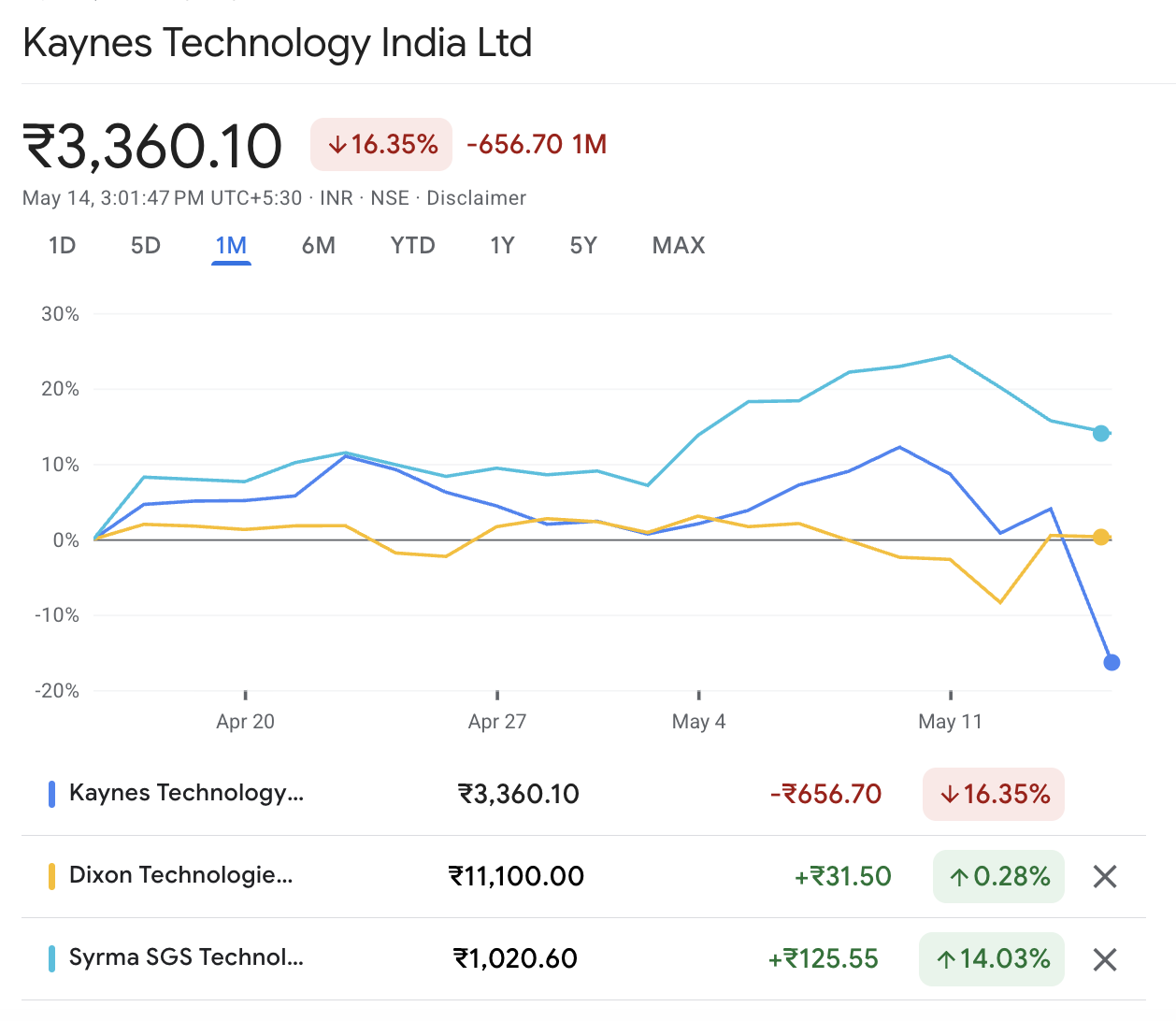
India’s EMS sector is not moving as one trade. Recent earnings show a clear divide between companies growing revenue and companies converting that revenue into profit.
| Company | Q4 FY26 Revenue | Q4 FY26 Profit Trend | Key Signal |
|---|---|---|---|
| Kaynes Technology | ₹1,242.6 crore, up 26.2% YoY | ₹91.2 crore, down 21.5% YoY | Revenue growth did not protect profit |
| Dixon Technologies | ₹10,511 crore, up 2% YoY | ₹256 crore, down 36% YoY | Scale stayed strong, but profit conversion weakened |
| Syrma SGS Technology | ₹1,476.8 crore, up 56% YoY | ₹119.2 crore, up 67% YoY | Profit grew faster than revenue |
Kaynes is the clearest warning. A 26.2% rise in quarterly revenue would normally support a growth narrative. Instead, the profit decline shifted attention to missed expectations, brokerage downgrades, balance-sheet quality and whether earlier growth assumptions had become too ambitious. The market message was direct: strong demand is not enough if earnings quality weakens.
Dixon shows a more complicated signal. It remains one of India’s largest EMS platforms, with scale across consumer electronics and mobile manufacturing. Yet its Q4 profit decline shows that size alone cannot prevent pressure at the bottom line. For a company already priced as a sector leader, even temporary profit weakness can reset expectations.
Syrma SGS delivered the stronger contrast. Its profit growth outpaced revenue growth, supported by better execution and a more diversified business mix. That makes Syrma important in this debate because it shows the EMS story is not broken. Investors are simply becoming more selective about which growth deserves a premium.
In EMS, revenue can rise quickly when a company wins large customer orders or expands assembly capacity. But large contracts often come with tighter pricing, imported component exposure and customer concentration.
That is why EBITDA margin, profit after tax and operating cash flow now matter more than headline sales. If revenue rises but profit falls, investors read it as a sign that scale is not yet translating into operating leverage.
This is the core reset for EMS shares in India. The market is not rejecting growth. It is rejecting growth without margin proof.
Not all EMS revenue deserves the same valuation multiple. High-volume mobile phone or consumer device assembly can generate impressive sales, but margins are often thin because large original equipment manufacturers hold significant pricing power.
Higher-quality revenue usually comes from more complex categories. These include industrial electronics, automotive systems, railway electronics, medical devices, defence electronics, printed circuit board assemblies and engineered components.
These areas require stronger technical capability, longer qualification cycles and deeper customer relationships. They are harder to scale quickly, but they can support better margins and stickier contracts.
For EMS shares, the key question is no longer only how fast revenue is growing. It is what kind of revenue is growing.
EMS growth can absorb cash before it creates returns. Companies must fund inventory, manage imported components, extend credit to customers and invest in capacity before revenue fully converts into cash.
That creates a clear risk. Reported sales can look strong while operating cash flow weakens.
This is why investors should track receivables, inventory days and operating cash flow alongside revenue. A large order book is positive only if it converts into profitable sales and cash generation. In a high-valuation sector, weak cash flow can trigger a faster derating than slower sales growth.
India has already made major progress in final assembly, especially in mobile phones. The next opportunity is deeper localisation across components, modules and sub-assemblies.
This includes printed circuit boards, camera modules, display parts, batteries, enclosures, connectors, sensors and semiconductor-linked packaging. These categories matter because they allow India to capture more value from the electronics supply chain instead of relying mainly on final assembly.
The Electronics Components Manufacturing Scheme now has 75 approved applications, including 29 additional proposals cleared in the latest tranche. Total approved investment under the scheme stands at ₹61,671 crore, after the latest ₹7,104 crore set of approvals.
The policy tailwind is meaningful, but it will not lift every EMS company equally. The winners will need engineering depth, customer commitments, disciplined capex and the ability to execute beyond basic assembly. Companies locked in low-margin assembly may still grow, but they may struggle to defend premium valuations.
India’s EMS outlook for 2026-2027 remains positive, but the easy growth trade is over. The market will no longer reward capacity expansion alone. It will look for margin stability, cash conversion and higher domestic value addition.
Localisation is the main test. Companies moving into components, printed circuit boards, modules and precision sub-assemblies should capture more value than firms focused mainly on final assembly.
Product mix will also matter. Industrial, automotive, medical, railway and defence electronics offer stronger margin potential than high-volume consumer assembly.
The key risk is cash absorption. Faster growth can still stretch inventories, receivables and operating cash flow. The strongest EMS shares will be those that turn scale into profit, not just revenue.
EMS shares in India remain tied to one of the country’s strongest manufacturing themes. Domestic demand, exports, policy support and global supply-chain diversification still provide a solid long-term base.
But the easy rerating phase is over. Kaynes, Dixon and Syrma show that the market is no longer treating all EMS growth equally. Revenue expansion can still disappoint when margins contract, profit conversion weakens or cash flow fails to keep pace.
The next leaders will not simply assemble more. They will keep more value from what they manufacture. In India’s EMS sector, revenue growth still matters, but it now needs proof from margins, cash conversion and localisation.