Published on: 2026-03-30
Updated on: 2026-03-30
India's stock market is under pressure today, driven by multiple factors.
Here are the main reasons behind why share market is falling:
Crude oil has jumped to around the $115 to $120 area, raising fears about inflation and the import bill.
Foreign investors have continued to be net sellers, with outflows in March totaling approximately ₹1.14 lakh crore.
The rupee has been under stress after touching a record low of 94.85 against the US dollar on Friday before rebounding today.
Global risk sentiment is weak, with other Asian markets also falling as oil prices rose.
The Nifty and Sensex were already technically weak before today's drop, which made the selling easier to extend.
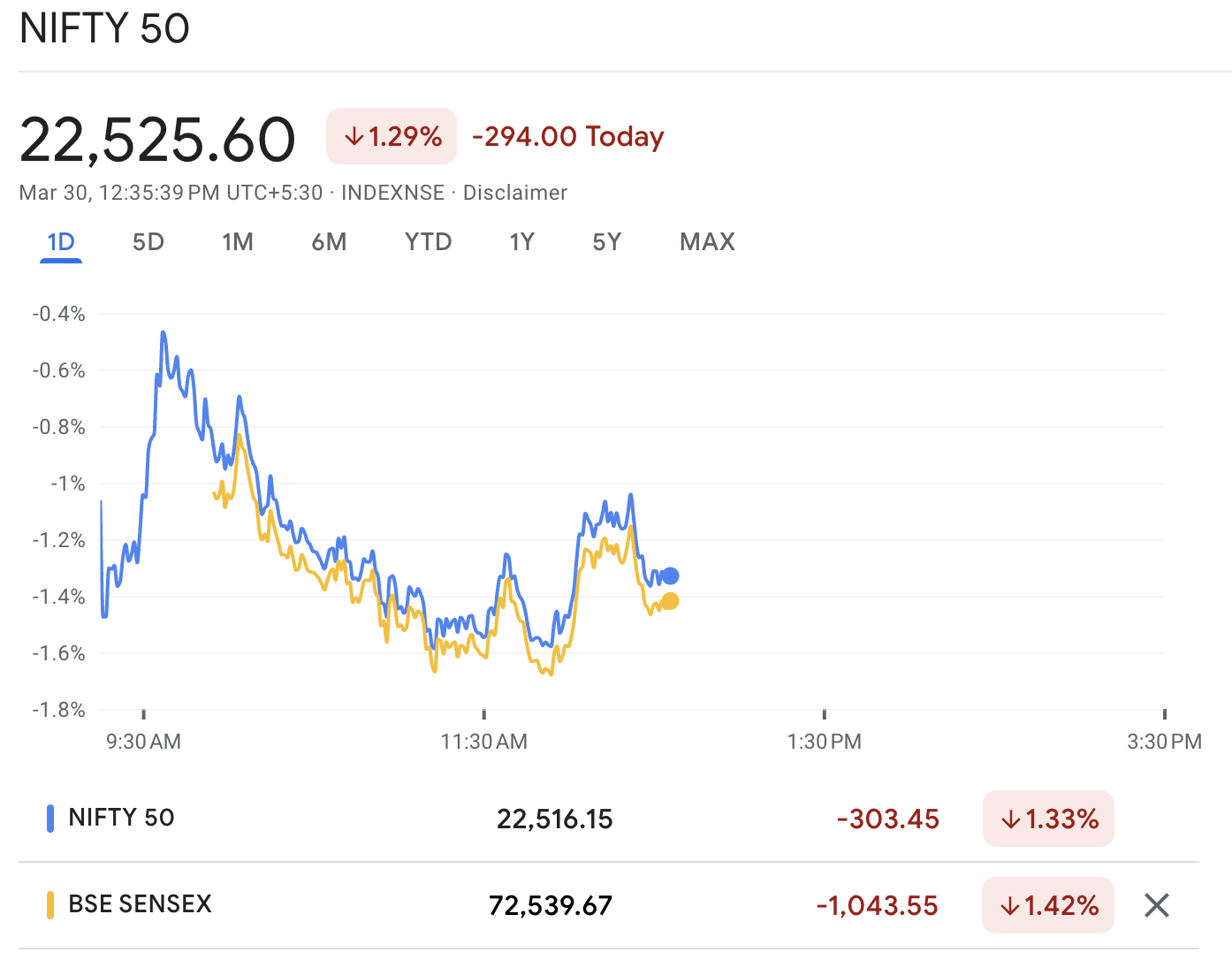
As of approximately 11:21 IST on March 30, 2026, the Nifty 50 index stood at 22,480.35, down 339.25 points, or 1.49%. The opening session also showed the Sensex down more than 1,100 points, with weakness spreading across major sectors.
Crude oil is the clearest pressure point. Reports today showed Brent crude near $120 a barrel, while other market coverage placed Brent around $115 to $116. Even the lower end of that range is a major jump from the levels seen before the recent Middle East shock. Brent had risen from $72.48 at the end of February to $112.57 by the end of March, a surge of about 65.6%.
For India, expensive oil hurts on several fronts simultaneously. It can widen the trade deficit, push up inflationary pressures, strain the rupee, and raise concerns about interest rates staying higher for longer.
That is why oil spikes usually hit market sentiment quickly, especially in sectors sensitive to fuel, borrowing, and consumer demand costs. Today's sell-off makes sense in that backdrop.
Foreign investor selling is the second big reason. According to The Times of India, foreign portfolio investors withdrew approximately ₹1.14 lakh crore from Indian equities in March, marking a record monthly withdrawal.
For the daily context, the NSDL report showed FIIs were net sellers of ₹4,367.3 crore in the cash segment on March 27, while DIIs bought ₹3,566.15 crore.
That daily sale is small compared with the full monthly outflow, but it clearly shows the trend. The monthly figure is more than 26 times the March 27 daily cash-market sell figure, suggesting that foreign selling pressure has been persistent rather than one-off.
When foreign institutional investors reduce their exposure, the market loses a crucial source of support, and domestic buying must work much harder to slow the decline.
The rupee is another important part of the story. It hit a record low of 94.85 against the US dollar on Friday, then rebounded by 128 paise to 93.57 on Monday morning.
That rebound is helpful, but it does not change the fact that currency volatility has risen sharply, and that usually makes equity investors more cautious.
A weak rupee matters because it raises the local cost of imports, including crude oil. It also hurts sentiment among overseas investors who consider both stock returns and currency losses.
The rupee's move from 94.85 to 93.57 is a bounce of about 1.35%. However, the market is still reacting to the bigger message: currency stability has become harder to maintain in the current environment.
Today's fall is not happening in isolation. Asian markets fell amid rising oil prices and heightened geopolitical tensions. The prevailing sentiment suggests a risk-off stance, prompting investors to shift away from equities and toward safer investments.
When that global backdrop is negative, Indian markets often struggle to resist, even if domestic long-term fundamentals have not changed much in a single day.
This is why the market reaction feels sharper than a normal headline-driven move. Oil, currencies, foreign flows, and global sentiment are all pointing in the same direction, creating a stronger wave of selling pressure.
The market now has three immediate triggers to watch. First is crude oil. If Brent stays near the current elevated zone or pushes higher, pressure on India's inflation, rupee, and market mood could continue.
Second is foreign flow data. If FII selling remains heavy, rebounds may stay weak. Third is whether Nifty can hold the 22,420 to 22,480 support band. If that area breaks, the market may quickly look for lower support.
At the same time, there is one point of caution for bears. Both Nifty and Sensex are close to oversold on the daily RSI, so short and sharp pullbacks upward can still happen even inside a weak market. A bounce, though, is not the same as a trend change.
For the chart to improve, the indices need to reclaim pivot and resistance levels, and the pressure from oil, the rupee, and foreign selling needs to cool down.
The main reasons are higher crude oil prices, sustained FII selling, rupee volatility, and weak global risk sentiment. These factors are hitting the market together, which is why the fall is broad.
Yes, oil is the main trigger today. Brent has risen sharply and was around $115.30 on March 30, nearing $120. For India, that immediately raises macro risk.
Yes. Official NSDL data indicate FPI equity outflows of ₹1,13,810 crore in March 2026 through March 27. That is an unusually heavy outflow and a major reason the market is struggling to hold rallies.
Yes. The rupee opened stronger at 93.59 after closing at 94.81 on Friday, but it is still trading near historically weak levels. That means the market still sees currency risk as part of the broader problem.
So, why is the share market falling in India today? Because the market is dealing with an oil shock, heavy FII selling, and rupee stress at the same time. Any one of those would be enough to make traders cautious. All three together are forcing a broader risk reset.
For now, this is a pressure market, not a comfort market. If oil prices remain high and foreign institutional investors continue to sell, the risk of a downturn will persist. However, if the rupee stabilizes and crude oil prices decrease, the market may receive some support.
In the meantime, the technical outlook for both Nifty and Sensex remains weak, so traders should proceed with caution.
Disclaimer: This material is for general information purposes only and is not intended as (and should not be considered to be) financial, investment or other advice on which reliance should be placed. No opinion given in the material constitutes a recommendation by EBC or the author that any particular investment, security, transaction or investment strategy is suitable for any specific person.