Published on: 2026-05-15
Updated on: 2026-05-15
Some recession-proof stocks are only defensive until the first weak earnings report proves otherwise. A company can sell groceries, medicine, burgers, or household products and still disappoint if sales slow, margins shrink, or cash flow no longer supports dividends and buybacks.
This list looks for stocks with current 2026 evidence of resilience: demand still holding, profit margins under control, cash generation intact, and one clear risk investors should monitor. The screen favors companies with proof in recent earnings, not names that only look safe because they belong to a defensive sector.
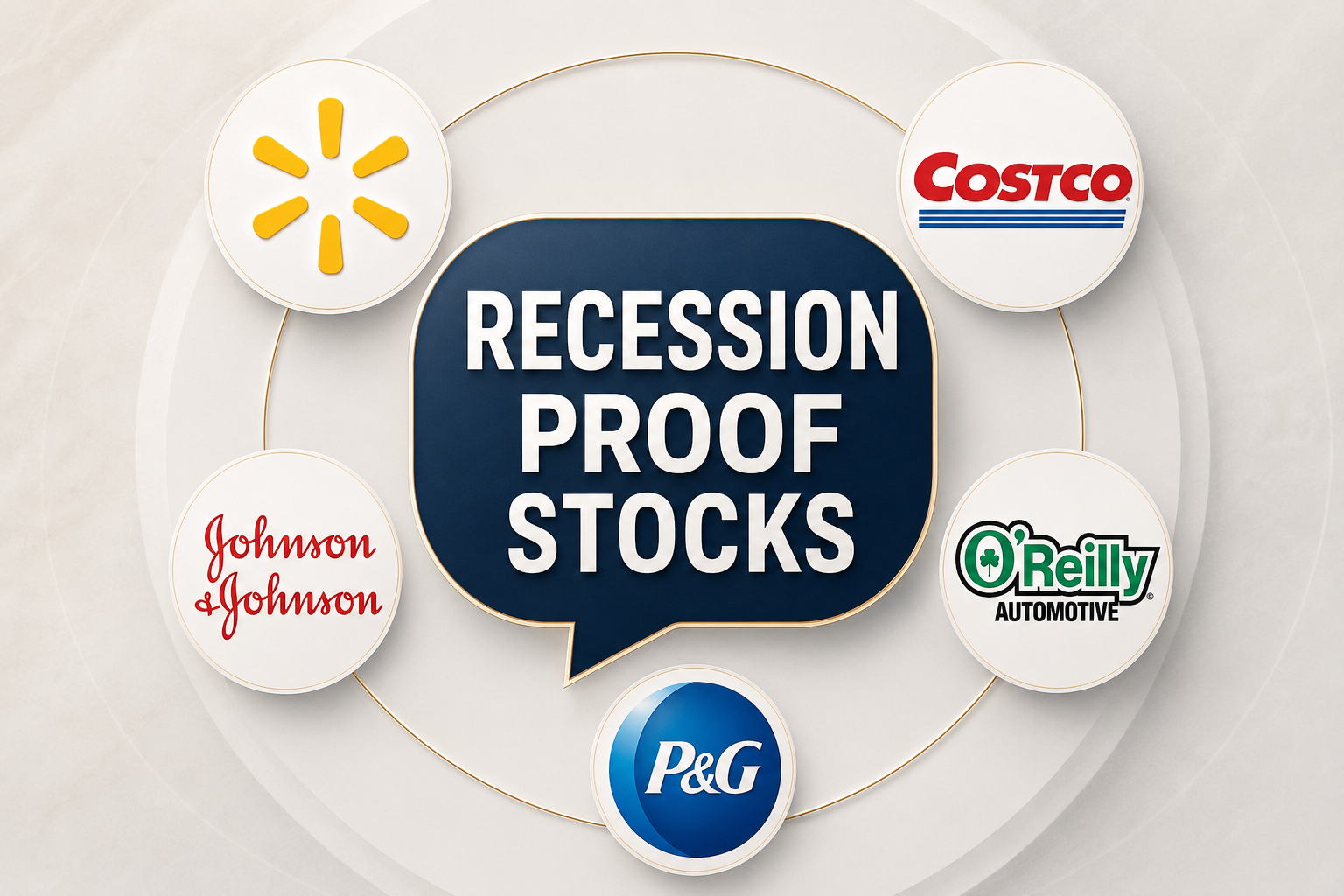
Walmart and Costco passed because value-seeking consumers are still showing up. Walmart’s operating income is growing faster than sales, while Costco’s membership-fee growth provides recurring income beyond merchandise margins.
P&G, Coca-Cola, and Colgate made the list because their 2026 results still show pricing power, volume support, or cash flow strength. Colgate is the least clean pass because North America's softness and margin pressure are already visible.
Johnson & Johnson and Abbott were included for current healthcare catalysts, not sector reputation. J&J raised 2026 guidance, while Abbott added Exact Sciences to strengthen its oncology diagnostics position.
McDonald’s, Republic Services, and O’Reilly show that recession resilience is not limited to consumer staples. Loyalty sales, waste collection, and auto-repair demand can hold up when households become more selective.
The biggest risk is buying “safe” stocks at prices that already assume perfection. Costco, O’Reilly, and McDonald’s may pass the business-quality test while still requiring valuation discipline.
| Stock | Why It Passed | 2026 Catalyst | Main Risk | Verdict |
|---|---|---|---|---|
| Walmart (WMT) | Value demand plus improving profit mix | Operating income grew faster than sales | Tariffs and weak discretionary demand | Clean pass |
| Costco (COST) | Membership fees support recurring income | Membership fees rose to $1.36 billion | Valuation risk | Clean pass |
| Procter & Gamble (PG) | Organic growth and cash discipline | Net sales rose 7%, organic sales rose 3% | Private-label trade-down | Clean pass |
| Coca-Cola (KO) | Pricing power without volume damage | Revenue rose 12%, organic revenue rose 10% | Affordability pressure | Clean pass |
| Colgate-Palmolive (CL) | Organic growth still positive | EPS rose 7%, sales rose 8.4% | Margin pressure and North America softness | Qualified pass |
| Johnson & Johnson (JNJ) | Guidance raised despite patent risk | 2026 sales and EPS outlook increased | Litigation and patent erosion | Clean pass |
| Abbott Laboratories (ABT) | Healthcare growth plus diagnostics catalyst | Exact Sciences acquisition completed | Integration and reimbursement risk | Qualified pass |
| McDonald’s (MCD) | Value, loyalty, and franchise scale | Comparable sales rose 3.8% | Value offers may pressure margins | Qualified pass |
| Republic Services (RSG) | Pricing and cash flow remain strong | EBITDA margin expanded 50 bps | Acquisition execution risk | Clean pass |
| O’Reilly Automotive (ORLY) | Repair demand remains resilient | Comparable sales rose 8.1% | Lower miles driven or consumer stress | Clean pass |
This list starts with earnings data, not sector labels. A grocery, healthcare, or consumer-staples stock does not qualify because it looks defensive. It qualifies only when current margins, cash flow, and demand signals support the recession-resilience thesis.
The Clean Pass and Qualified Pass labels separate stronger candidates from stocks that still belong on the list but require closer monitoring. A clean pass showed broad support across demand, profitability, and cash flow. A qualified pass showed enough resilience to qualify, but with a visible weakness, such as valuation risk, margin pressure, acquisition execution, or softer regional demand.
Walmart earns its place through operating leverage, not just grocery traffic. Q4 FY2026 revenue rose 5.6%, global eCommerce grew 24%, and operating income increased 10.8%, showing that value-seeking demand is converting into faster profit growth.
The stronger signal is Walmart’s changing profit mix. Advertising, marketplace, digital, and omnichannel businesses give the company more ways to protect earnings while consumers remain price-sensitive.
2026 catalyst: Operating income grew faster than sales.
Risk: Tariffs and weaker discretionary spending could pressure margins.
Signal to watch: Whether operating income keeps growing faster than revenue.
Verdict: Clean pass. Walmart has demand resilience plus improving profit quality.
Costco’s defensive strength lies in membership income, not merchandise margins. Q2 FY2026 net sales rose 9.1% to $68.24 billion, comparable sales increased 7.4%, and membership fees reached $1.36 billion, up from $1.19 billion a year earlier.
That recurring fee stream gives Costco more earnings stability than a traditional retailer. Shoppers may be trading down, but Costco is still turning value-seeking behavior into renewal income and store traffic.
2026 catalyst: Membership fees and comparable sales both increased.
Risk: Valuation remains demanding if earnings expectations reset.
Signal to watch: Membership renewal rates and comparable traffic.
Verdict: Clean pass. Costco has recurring income and durable value demand.
P&G remains a cleaner staples pass because growth still includes volume, not price alone. Fiscal Q3 2026 net sales rose 7% to $21.2 billion, organic sales increased 3%, core EPS rose 3%, and management maintained fiscal-year guidance.
The stock’s defensive case rests on branded demand holding without excessive discounting. Positive organic sales show households have not fully traded away from premium everyday products.
2026 catalyst: Organic sales remained positive, and guidance was maintained.
Risk: Faster private-label trade-down could weaken pricing power.
Signal to watch: Organic volume growth versus pricing contribution.
Verdict: Clean pass. P&G has demand stability and cash discipline.
Coca-Cola qualifies because pricing has not yet broken volume. Q1 2026 net revenue rose 12% to $12.5 billion, organic revenue increased 10%, and global unit case volume grew 3%.
That mix gives Coca-Cola a stronger defensive profile than a price-only revenue story. If volume stays positive while pricing holds, the company can protect earnings even as consumers become more selective.
2026 catalyst: Revenue growth came from both pricing and volume.
Risk: Lower-income consumer pressure could drive smaller pack sizes and promotions.
Signal to watch: Unit case volume, especially in price-sensitive markets.
Verdict: Clean pass. Coca-Cola still has demand resilience and pricing strength.
Colgate is a qualified pass, not a flawless one. Q1 2026 net sales rose 8.4%, organic sales increased 2.9%, and Base Business EPS grew 7% to $0.97, while gross profit margin declined 20 basis points to 60.6%.
The concern is already visible. North America softness and gross margin pressure reduce the cushion, making Colgate less clean than P&G or Coca-Cola despite positive headline growth.
2026 catalyst: Organic sales and Base Business EPS both increased.
Risk: Margin pressure and weaker organic sales in North America could persist.
Signal to watch: Gross margin recovery and North America organic sales.
Verdict: Qualified pass. Colgate belongs on the list, but needs to improve margins to stay there.
Johnson & Johnson earns inclusion through raised guidance, not healthcare reputation. Q1 sales rose 9.9% to $24.1 billion, operational growth reached 6.4%, adjusted EPS was $2.70, and management raised its 2026 sales and EPS outlook.
The stock still carries real pressure from patent erosion and litigation. Current product and MedTech momentum are strong enough to pass the screen, but the legal and drug-cycle risks remain central to the thesis.
2026 catalyst: Management raised full-year sales and adjusted EPS guidance.
Risk: Litigation exposure and patent erosion could pressure valuation.
Signal to watch: Whether newer medicines and MedTech sales offset patent pressure.
Verdict: Clean pass. J&J has current earnings resilience, though it faces legal and patent risks.
Abbott passes through healthcare growth, plus a fresh diagnostics catalyst. Q1 adjusted diluted EPS rose 6% to $1.15, and the Exact Sciences acquisition added a stronger oncology diagnostics angle to the portfolio.
That deal improves Abbott’s long-term growth profile, but it also raises the bar for execution. Cancer diagnostics can add recurring testing demand, yet the stock remains defensive only if the acquisition strengthens earnings quality rather than adding dilution and integration drag.
2026 catalyst: Exact Sciences expanded Abbott’s oncology diagnostics position.
Risk: Acquisition dilution, integration costs, and reimbursement pressure could weigh on earnings.
Signal to watch: Comparable sales growth and acquisition-related margin impact.
Verdict: Qualified pass. Abbott has a credible catalyst, but the acquisition must deliver.
McDonald’s emphasises value, scale, and loyalty rather than just cheap food. Q1 2026 global comparable sales rose 3.8%, systemwide sales increased 11% to more than $34 billion, and loyalty markets generated more than $9 billion in quarterly systemwide sales.
The trade-off is margin pressure. Value offers can protect traffic when households pull back, but they can also squeeze restaurant economics if wages, rent, and food costs remain elevated.
2026 catalyst: Comparable sales returned to growth with support from value and loyalty.
Risk: Promotions may defend traffic while pressuring margins.
Signal to watch: Comparable sales versus restaurant-level margin trends.
Verdict: Qualified pass. McDonald’s has demand support, but limited room for pricing mistakes.
Republic Services adds a non-consumer defensive angle through pricing and cash flow. Q1 2026 EPS reached $1.70, net income margin and adjusted EBITDA margin both expanded 50 basis points, cash flow from operations reached $1.23 billion, and adjusted free cash flow was $984 million.
Waste collection does not rely on a strong consumer cycle, but execution still matters. Heavy acquisition spending can improve scale if integration works, or weaken flexibility if costs rise.
2026 catalyst: Pricing and cost control expanded margins while cash flow stayed strong.
Risk: More than $700 million invested in acquisitions raises integration and balance-sheet risk.
Signal to watch: Adjusted EBITDA margin and acquisition-related debt pressure.
Verdict: Clean pass. Republic Services has recurring demand, pricing power, and strong cash flow.
O’Reilly qualifies because repair demand is still strong across professional and DIY customers. Q1 2026 comparable store sales rose 8.1%, diluted EPS increased 16% to $0.72, and operating cash flow reached about $1 billion year to date.
The recession logic is practical. When households delay vehicle replacement, repair demand can stay resilient. That thesis weakens if miles driven fall, lower-income consumers cut maintenance, or parts inflation pressures transactions.
2026 catalyst: Comparable sales exceeded expectations across professional and DIY channels.
Risk: Lower miles driven, consumer stress, or parts-cost inflation could reduce transaction volume.
Signal to watch: Comparable store sales and professional customer growth.
Verdict: Clean pass. O’Reilly has repair-demand resilience and earnings momentum.
The strongest names on this list are not automatically the highest-yielding stocks. The cleaner signal is operating flexibility: pricing power, recurring revenue, margin control, and cash flow that can survive slower growth.
Use the list as a filter, not a buy-all basket. A stock can pass the business-quality test and still disappoint if valuation already assumes perfection.
Review the same four signals each quarter: revenue trend, margin trend, free cash flow, and guidance. If one breaks, the stock moves from recession-resistant to watchlist only.
No listed stock is fully recession-proof. Share prices can fall even when earnings hold up. The better goal is to find companies with repeat demand, pricing power, cash flow, and balance sheets strong enough to absorb slower growth.
The biggest mistake is judging safety by sector alone. A grocery, healthcare, or consumer-staples stock can still disappoint if margins shrink, debt costs rise, or free cash flow weakens.
Only if the dividend is funded by free cash flow. A high yield can signal stress when earnings weaken or debt costs rise. A lower-yield stock with stronger cash conversion may carry less risk.
Review them quarterly after earnings. Check revenue trend, margin trend, free cash flow, and guidance. If one breaks, the stock belongs on a watchlist rather than a defensive shortlist.
This is a qualifying list, not a performance ranking. Each stock had to show current 2026 earnings or guidance evidence, a positive demand signal, stable or improving profitability, visible cash generation, and one clear risk.
Companies were excluded if the defensive case relied mainly on reputation, sector label, dividend history, or past recession performance without fresh 2026 validation. Valuation was treated as a risk, not an inclusion filter.
This screen should be reviewed quarterly after earnings, using four checks: revenue trend, margin trend, free cash flow, and guidance.
The next earnings slowdown will separate the Clean Passes from the Qualified Passes. The question is whether Colgate, Abbott, and McDonald’s can repair their weak spots before margins become the market’s first disappointment, or whether the recession-proof label starts coming off one company at a time.