Published on: 2026-03-27
Updated on: 2026-03-27
The Strait of Hormuz. A narrow stretch of water between Iran and the Arabian Peninsula, roughly 39 km wide at its tightest point. Those are not phrases typically found in the everyday financial lexicon. Yet the exact area described is one of the most economically significant places on Earth at this moment.
The Strait of Hormuz has been thrust into the centre of a global geopolitical storm that sent equity indices tumbling across Asia, from Mumbai to Tokyo. Brent Crude oil peaked at nearly $120 a barrel, while central banks worldwide have been swept up in the crisis, forced to reassess interest rate decisions. The crisis began on 28 February 2026, when the United States and Israel launched coordinated strikes on Iran. Tehran's response was swift: missile and drone barrages hit Gulf infrastructure, and Iran's Islamic Revolutionary Guard Corps declared the strait effectively closed to commercial shipping. Within days, tanker traffic through the world's most critical oil chokepoint dropped by 95% – triggering a sequence of events that has totally warped the short-term outlook for Asian economies.
The questions from every investor watching Asia’s markets bleed red is not just about how the markets are being impacted. In a geopolitical crisis of this level, the concerns run deeper. Why does this military conflict thousands of kilometres away cause stock markets across an entire region to fall? How can investors navigate and assess the markets? The answers to all these questions may lie within four transmission channels, interconnected and active across Asia.
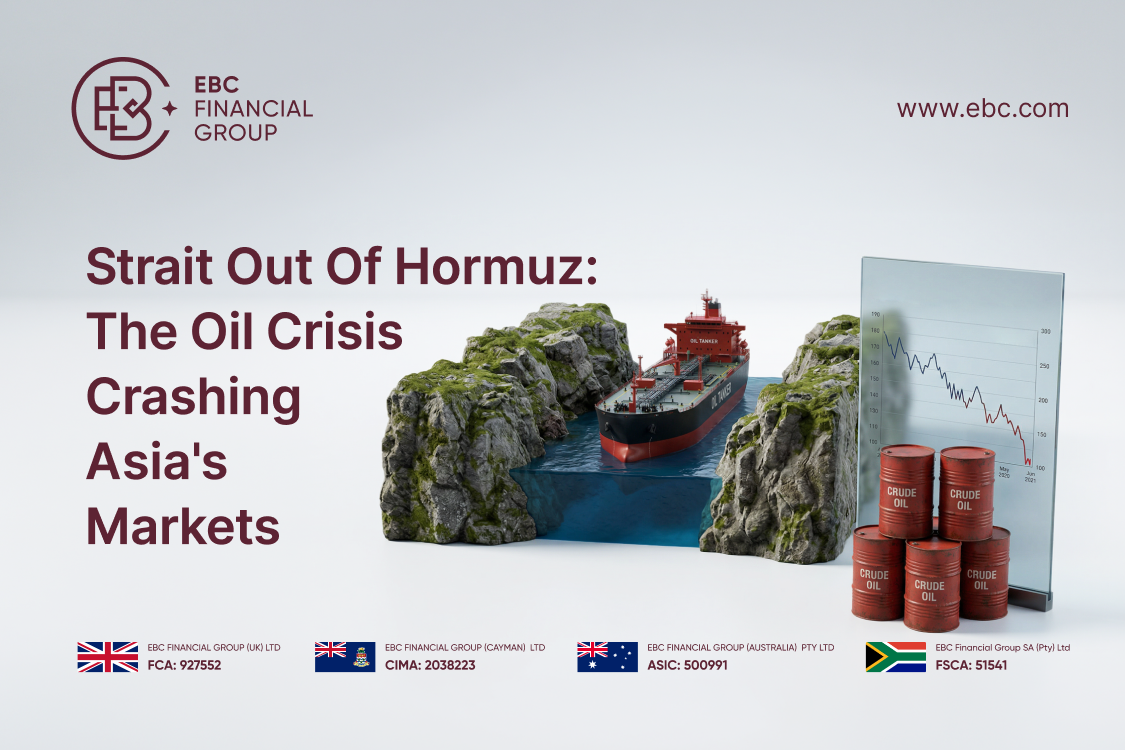
To understand the crash, we first need to understand the scale of what the Strait carries.
Roughly 20 million barrels of crude oil transit this waterway every single day: about one-fifth of all petroleum consumed worldwide. Beyond crude, the Strait carries around 20% of global LNG trade, primarily from Qatar's North Field, the world's single largest natural gas reservoir. Fertiliser shipments vital for food production across South and Southeast Asia also utilise the same lane.
According to US EIA, 84% of all crude flowing through Hormuz is destined for Asian markets. China accounts for 37.7% of total Hormuz flows, India at 14.7%, South Korea at 12.0%, and Japan at 10.9%. Together, these four major economies absorb nearly 75% of all crude oil and 59% of all LNG transiting the strait. To put the numbers into perspective: Japan imports approximately 95% of its crude from the Middle East; South Korea sources 70%; India approximately 60%.
This is a dependency borne of decades of industrial and manufacturing growth and demand. With the Strait closed, the Asian economies aren’t simply facing higher energy or productivity costs. The region is staring at a direct cut-off to the supplies that fuel its factories, power its grids, heat its homes, and grow its food. That is the foundation upon which the region’s market movements in the weeks since the 28th February strike should be understood.
Before the US-Israel strikes, Brent Crude was trading at approximately $71 per barrel as of 25 February. After a week, prices climbed past $90: a leap of over 25%. Come 9th March, Brent jumped again close to the $120 mark, breaching $100 for the first time since 2022.
Multiple fronts fed the oil price surge simultaneously. Israel struck Iranian oil depots in Tehran over the weekend of 7–8th March. Bahrain declared force majeure after drone attacks hit a critical desalination plant and its sole oil refinery. Collective oil output from Kuwait, Iraq, Saudi Arabia, and the UAE fell by an estimated 6.7 million barrels per day. Most dramatically, Qatar halted LNG production at Ras Laffan — one of the world's largest natural gas facilities — after Iranian drone strikes. Qatar alone supplies 20% of global LNG.
Even the IEA's announcement of a 400-million-barrel emergency reserve release — the largest coordinated release in its history — only offered brief relief from the surging prices.
The leap from an oil price surge to a crashing equity index happens through specific, traceable mechanisms. As it happens, four of these factors triggered simultaneously.
The first is import cost inflation. When oil prices rise, the costs of running factories, shipping goods, and generating electricity all increase. For economies like Japan’s and South Korea’s, where energy-intensive manufacturing of semiconductors, automobiles, steel, and petrochemicals form the backbone of corporate earnings, higher energy costs compress profit margins directly and immediately. The Korea Institute for Industrial Economics and Trade (KIET) warns that total domestic manufacturing production costs could see rises of over 11%, if a prolonged disruption happens. The earnings outlook for Asia's industrial and manufacturing companies have also deteriorated, and this is reflected in equity markets, whichprice-in that deterioration, in real-time.
The second is currency depreciation. With oil prices surging and energy import bills widening, the current account deficits of oil-dependent nations grow, which leads their currencies weaken against the US Dollar. A weaker currency then makes Dollar-denominated oil even more expensive — compounding the original shock. The South Korean Won has breached 1,500 per Dollar for the first time since the 2009 financial crisis. The Indian Rupee, Thai Baht, Philippine Peso, Indonesian Rupiah, and Malaysian Ringgit all fell. For foreign investors holding Asian equities, currency depreciation further stacks the losses: the index falls and the currency in which it is denominated also weakens.
The third is risk-off capital flight. When geopolitical uncertainty spikes, global investors tend to move capital from higher-risk emerging market equities into safe-haven assets — the US Dollar, gold, and US Treasury bonds. This capital outflow causes stock indices to fall even beyond what the direct economic damage would justify. One can think of it as a resentment-driven amplifier, acting on top of the fundamental damage. In this crisis, the primary beneficiaries of that flight seem to be the US Dollar and US Treasuries, as investors liquidate positions across Asian equities and rotate into the safety of American assets. That surge in Dollar demand loops directly back into the currency depreciation channel: a stronger Dollar drives a weaker Won, Rupee, Baht, and Ringgit — making Dollar-denominated oil more expensive still, and compounding further the pressure upon those very markets that investors are fleeing.
The fourth is interest rate recalibration. Before the conflict, most Asian central banks, and the U.S. Fed, were seemingly expected to announce rate cuts. After the 28 February strikes, rate cut expectations have withered away, which leads to the discount rate applied to future earnings rising, and further pushing equity valuations lower, even for companies without direct energy exposure.
The Fed held rates at 3.50%–3.75% on 18 March for the second consecutive meeting. Its dot plot still projects one cut in 2026, but 7 out of 19 FOMC members also expect no cuts at all this year. The uncertainty has been made crystal clear by Fed Chair Powell: "Nobody knows." The Fed on hold, keeps the dollar supported, which loops directly back onto the currency depreciation channel and creates unrelenting pressure on the markets in Asia.
Across Asia, the different countries’ economic vulnerabilities reflect their specific energy dependencies. The four channels hit differently for each.
Japan, with 95% crude dependency on the Middle East, has been among the most structurally exposed major economies. The Nikkei 225 plunged more than 7% intraday on 9 March before closing 5.2% lower at 52,728.72. Japan holds strategic emergency petroleum reserves of around roughly 200+ days of supply comprising government, private-sector, and jointly held stocks: a meaningful buffer for sure, but not a long-term solution by any stretch, in the event of drawn-out disruptions. An extended closure risks widening its trade deficit sharply and tipping the economy into stagflation.
South Korea's KOSPI fell 6% on 9 March to 5,251.87, with a circuit breaker triggered after a 10% weekly decline — its worst since March 2020. The Won's breach of 1,500 per Dollar reflects the market pricing in the full weight of all four transmission channels simultaneously: margins under pressure, currency falling, capital fleeing, and rates on hold. President Lee Jae Myung activated a 100 trillion won ($68 billion) market-stabilisation programme in response.
On 5 March, Washington, having spent months pressuring New Delhi to reduce Russian crude dependency as a condition of their trade deal, reversed course by issuing a 30-day waiver permitting Indian purchases of Russian crude: a clear acknowledgement that the Hormuz crisis had made the prior position untenable. Indian oil ministry officials pushed for US waivers to resume imports of Russian crude idled in floating storage near Asian hubs.
China holds estimated onshore crude stockpiles of approximately 1.2 billion barrels. This is about 108 days of import cover and buffers that its regional neighbours lack. But Beijing has already ordered domestic refiners to cease fuel exports to retain internal stockpiles, and higher energy costs feed directly into production costs for steel, chemicals, and electronics. With China's 2026 growth outlook already modest, this is unwelcome pressure.
Southeast Asia is absorbing the shock primarily through cost inflation and fuel-conservation measures. Since the conflict began, Vietnam has implemented eleven fuel price adjustments. By March 19, gasoline prices had risen approximately 30%, while diesel had climbed nearly 50% from pre-conflict levels, according to Vietnam's Ministry of Industry and Trade. Kerosene, used heavily in rural and agricultural communities, rose approximately 35% over the same period. Pakistan officially announced a four-day government workweek to reduce fuel consumption; while Thailand and the Philippines encouraged flexible and remote working arrangements across their public sectors.
Beyond the direct energy price transmission, several secondary shocks are deepening the damage and widening the circle of industries affected.
Aviation has been among the fastest-hit sectors. Jet fuel prices soared from $85–$90 per barrel before the strikes, up to $150–$200 per barrel. Korean Air fell 17% in just over a week, and IndiGo dropped nearly 8% in a single session on March 9, as oil prices crossed $100 per barrel for the first time since 2022, accumulating losses of over 18% since the February 28 strikes. Korean Air estimates that every $1 per barrel move in oil affects its operating profit by approximately $30.5 million. Vietnam Airlines faces estimated operating cost increases of 60 to 70% on current fuel prices. Middle East airspace closures have added two to three hours per long-haul flight, pushing per-flight costs higher still.
Petrochemical supply chains across Asia have also consequently been thrown into chaos. Singapore's Aster Chemicals, Indonesia's PT Chandra Asri Pacific, Thailand's Rayong Olefins, and China's Wanhua Chemical have all declared force majeure. Industries reliant on naphtha, propane, ethylene oxide, and styrene monomer — the inputs into packaging, automotive parts, electronics casings, and synthetic textiles — are facing a chain reaction. The longer physical supply remains disrupted, the longer and more expensive the restart processes become.
Fertiliser industries are a possibly underrated dimension of the crude oil crisis. Around one-third of global seaborne fertiliser trade transits the Strait of Hormuz, and Qatar's QAFCO — the world's largest single-site urea exporter — was forced to halt production after drone strikes cut off its gas feedstock at Ras Laffan. Since the February strikes, urea prices have risen approximately 30% on international benchmark spot markets, with some global spot transactions reported as high as $680 per metric tonne. For India, which produces 87% of its urea domestically but relies on natural gas for 70–80% of production costs, the timing is absolutely crushing: the fertiliser demand period peaks during the months before the June monsoon, which leaves almost no margin for supply recovery. Meanwhile in the immediate aftermath of the strikes, soybean oil surged to a two-year high, driven by its close correlation with crude prices.
Remittances represent a macro-economic tripwire that will not blatantly appear on an equity screen, but instead directly affects household consumption and currency stability across the region. India has over 9 million citizens working in GCC countries who remit approximately $50 billion annually — the equivalent of nearly 38% of India's total remittance inflows. In the Philippines, total personal remittances reached $39.62 billion in 2025, or over 7.3% of GDP. Over in Nepal, remittances alone account for approximately 25% of GDP. As things stand, escalations that disrupt employment in the Gulf, through evacuation or job losses, would look to inflict devastating effects, ripping away critical pillars of consumption across multiple Asian economies, simultaneously.
The Hormuz Strait conflict has caused a perfect storm of four simultaneous crises cascading across the Asian regional markets, across profit margins, currencies, capital flows, and interest rate expectations: creating what has been dubbed the “largest supply disruption in the history of the global oil market”. Currency weakness makes energy more expensive. Higher energy costs compress earnings. Compressed earnings expectations push investors toward safe havens. Finally, safe-haven flows strengthen the Dollar further, which feeds back into currency weakness.
Layered over this are secondary shocks in aviation, petrochemicals, semiconductors, fertilisers, and remittances: significant industries that connect the energy price spike to the real economies in which Asia's listed companies operate.
Asia's industrial base was built upon affordable and more importantly, always accessible Middle Eastern crude oil. The Hormuz Strait crisis has been a brutal economic wake-up call, echoing across the entire continent.
Though some markets staged a partial recovery, with the KOSPI, Hang Seng and Nikkei 225 rebounding over 24 – 25 March: do not mistake relief for resolution, for the damage has been done. Analysts caution that any gains realised may be short-lived, so long as the Strait remains effectively closed to most commercial traffic. Oil remains at historically elevated levels, and the Strait remains firmly under Iranian control, with no clear end to the conflict in sight. The IEA also warned that even an immediate end to hostilities could not produce an immediate return of shipping traffic or a calming of energy markets.
With each passing day, investors across Asia scramble to navigate the Hormuz Strait crisis and its expanding impact on the many economies that depend so heavily upon Middle Eastern crude. Did the Asian market crashes mark a violent near-term dislocation, or was it the moment that the region’s exposed energy vulnerability was finally and permanently priced in? The right investor or trader, who can successfully deduce the right answers to these questions, may well be able to come out on top of this crisis.
Interested in trading Asia’s top indices, like the Nikkei 225 or Hong Kong Hap Seng?
Trade your biggest opportunities today, on our platform. Trade with EBC, the World’s Best* Broker.
*3 Consecutive Years of Recognition from World Finance: Best FX Trading Platform 2023, Best CFD Broker 2024, Best Trading Platform 2025, Most Trusted Broker 2025. Online Money Awards Best CFD Provider 2025.
Disclaimer & Citation
This material is for information only and does not constitute a recommendation or advice from EBC Financial Group and all its entities (“EBC”). Trading Forex and Contracts for Difference (CFDs) on margin carries a high level of risk and may not be suitable for all investors. Losses can exceed your deposits. Before trading, you should carefully consider your trading objectives, level of experience, and risk appetite, and consult an independent financial advisor if necessary. Statistics or past investment performance are not a guarantee of future performance. EBC is not liable for any damages arising from reliance on this information.