Published on: 2026-04-07
Updated on: 2026-04-07
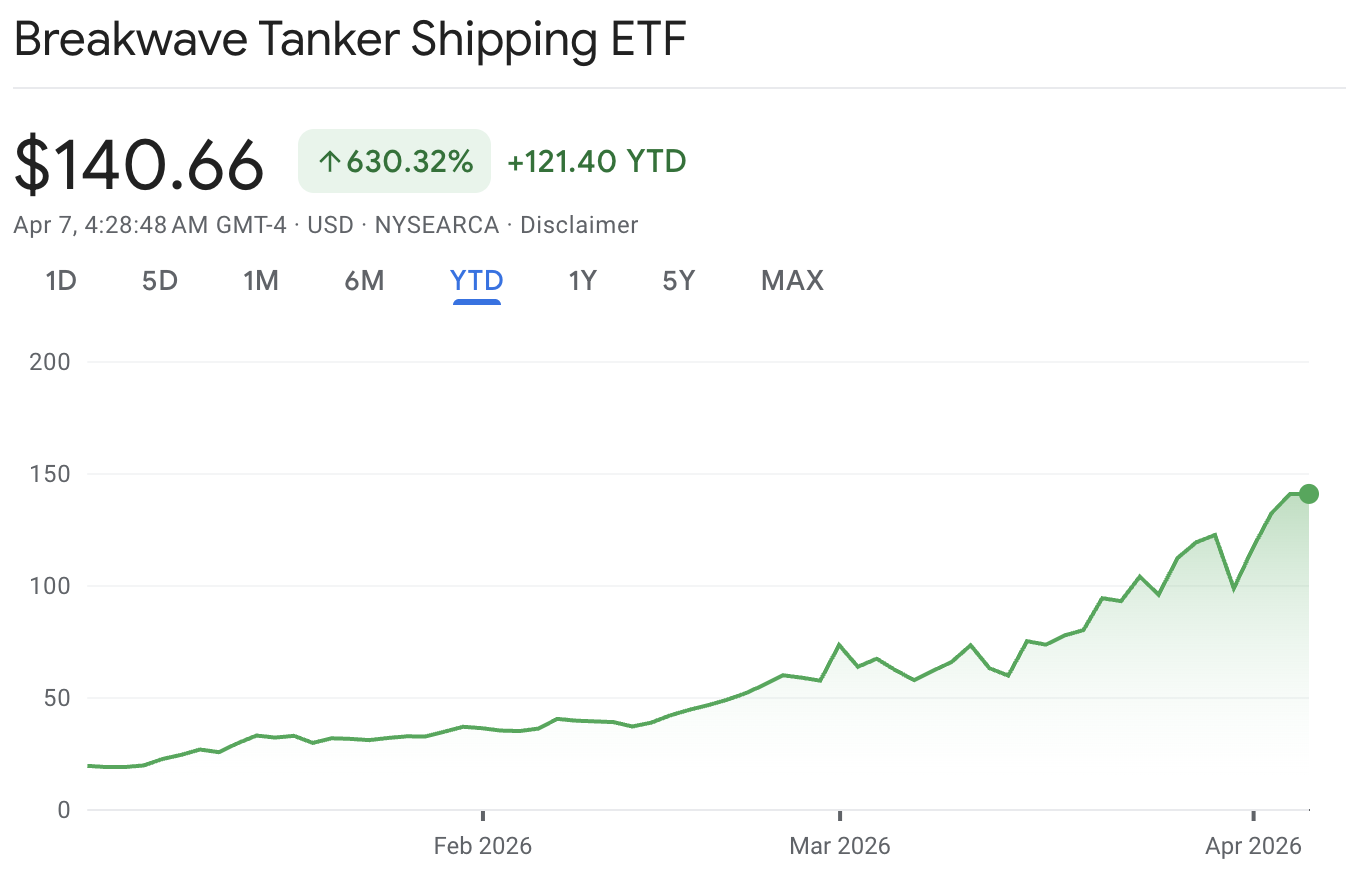
BWET ETF is crushing 2026 because it is a tanker freight product, not a standard oil-price ETF, and it is designed to track daily changes in crude tanker freight futures.
The fund increased approximately 630.3% from its year-start price of $19.26 to $140.66 by the close on April 6, 2026, making it one of the strongest-performing ETFs of 2026 so far.
BWET's April 1 holdings were concentrated in front-month TD3C tanker contracts, with May 2026 at 29.72%, April 2026 at 29.50%, and June 2026 at 14.70%, showing a strong front-end freight bias.
The technical setup remains bullish, but it is stretched, with price far above its 20-day, 50-day, and 200-day moving averages and momentum in overbought territory.
Risk is not theoretical. As of April 2, 2026, BWET displayed a 1.26% median bid-ask spread over 30 days and a -0.33% premium or discount reading. Total annual expenses are capped at 3.50% through December 31, 2026, excluding brokerage, interest, and extraordinary expenses.
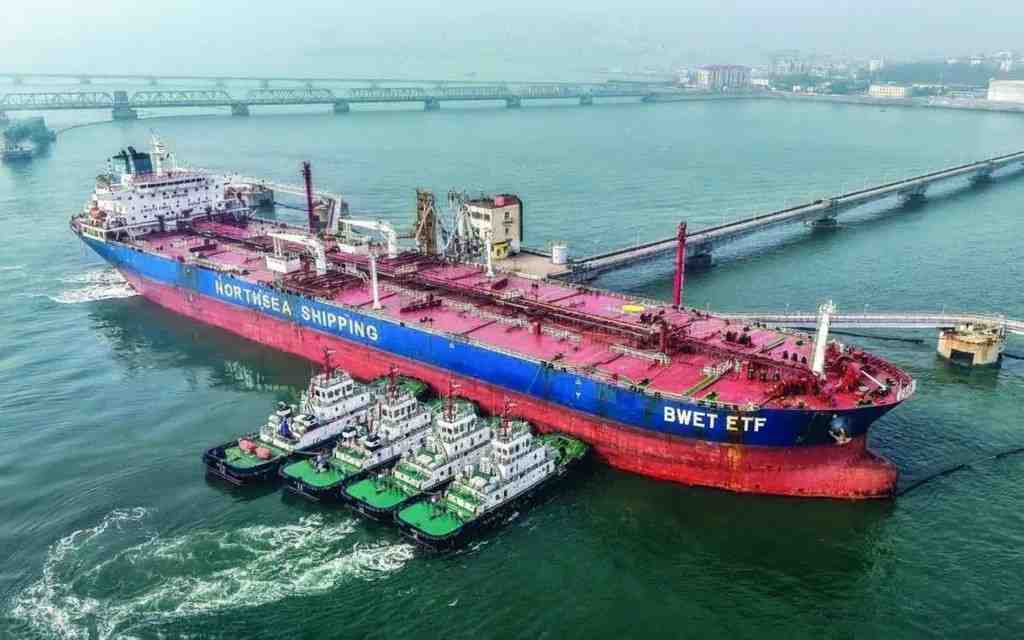
BWET does not own oil producers, refiners, pipelines, or physical crude. It owns exchange-cleared freight futures linked to the cost of shipping crude. The prospectus is unusually clear on this point.
The fund seeks daily exposure to near-dated freight futures, mainly the nearest calendar-quarter strip, and it is not intended to track spot freight or spot oil prices.
That matters because freight can break away from crude. If oil prices remain stable but shipping capacity tightens, freight futures can still increase. Conversely, if oil prices rise while traders anticipate a reduction in freight costs, BWET may underperform.
The fund's own prospectus warns that freight futures can diverge from spot charter rates and that the share price can vary substantially from spot-related freight measures.
The core driver is route stress. Flows through the Strait of Hormuz in 2024 and early 2025 accounted for more than one-quarter of global seaborne oil trade and about one-fifth of global oil and petroleum product consumption. When that corridor is disrupted, freight rates do not just rise a little. The whole shipping chain reprices.
That repricing is visible in tanker benchmarks. The Baltic Dirty Tanker Index reached a record high of 3,737 on March 27, 2026, and remained at 3,639 on April 2, 2026, significantly higher than the approximately 1,100 level observed in late March 2025. BWET was built for exactly this kind of move because it is long the freight futures most exposed to crude tanker routes.
The holdings make the point even clearer. As of April 1, the fund's largest listed positions were in the May, April, and June 2026 TD3C contracts, while cash collateral and a government agency portfolio backed the futures book. This is not broad energy exposure. It is a concentrated bet on front-quarter freight staying elevated.
| Metric | Latest reading | Why it matters |
|---|---|---|
| BWET market price (Apr. 6 close) | $140.66 | Shows how hard freight expectations have repriced |
| 2026 move from year-start price | +630.3% | Confirms BWET is behaving like a high-beta freight vehicle |
| Total annual expenses cap* | 3.50% | High holding cost, and some trading-related expenses can sit on top |
| Apr. 2 NAV / market price | $132.45 / $132.01 | Shares can trade away from NAV |
| 30-day median bid-ask spread | 1.26% | Execution risk is real |
| Apr. 2 premium / discount | -0.33% | Secondary-market frictions still matter |
| Core route mix | 90% TD3C, 10% TD20 | BWET is mainly a VLCC route trade |
The table above shows why BWET has a strategic advantage only in a stressed freight market. It is concentrated, expensive, and structurally different from plain oil exposure. That structure can create outsized upside, but it can also magnify reversals once the front strip cools.
| Scenario | Market condition | BWET implication |
|---|---|---|
| Tight market | Route disruption persists and front-month freight stays scarce | Break above $144.50 can extend toward the $150 to $180 zone |
| Base case | Partial normalization, but freight risk premium stays elevated | Choppy trade in a broad $110 to $145 range |
| Fast normalization | Transit improves and 2026 deliveries pressure rates | Mean reversion toward the $75 to $100 zone becomes plausible |
*These are scenario ranges, not price targets. The point is probabilistic. BWET still has risk-adjusted potential, but this potential now depends less on the direction of oil prices and more on whether freight stress continues longer than supply normalization.
The market still has a clear bullish catalyst: freight stress has only marginally eased. Ship traffic through the Strait of Hormuz has picked up from late-March extremes, but recent reports still describe volumes as well below pre-conflict levels. Even if crude oil prices stop rising, a risk premium remains in tanker routes.
The bear case also has real support. Kpler expects 419 tanker deliveries in 2026, up from 247 in 2025, while BIMCO expects crude-tanker supply to grow 1.5% in 2026. If route risk fades while new tonnage arrives on schedule, freight rates can cool faster than many momentum traders expect.
| Indicator | Latest reading | Signal |
|---|---|---|
| Apr. 6 close | $140.66 | Trend remains intact |
| 20-day moving average | $92.79 | Price is far above the short-term trend |
| 50-day moving average | $64.32 | Medium-term momentum remains strong |
| 200-day moving average | $28.72 | Long-term trend is still sharply positive |
| RSI (14) | 72.14 | Overbought |
| ATR (14) | $12.69 | High volatility |
| ADX (14) | 37.88 | Strong trend strength |
| 52-week high | $147.40 | Nearby breakout area |
The chart still points higher, but this is now an extended move, not easy momentum. As of the April 6 close, BWET was $140.66 versus a 20-day moving average of $92.79, a 50-day moving average of $64.32, and a 200-day moving average of $28.72.
Barchart's 14-day RSI was 72.14, its 14-day ATR was $12.69, and its 14-day ADX was 37.88. That combination fits a strong uptrend, but also an overbought and high-volatility setup where pullbacks can be violent.
Not in the usual sense. BWET is a freight-futures fund linked to the cost of transporting crude oil, rather than to spot crude prices or a selection of energy stocks.
Because shipping stress has repriced faster than oil itself.
Normalization. If traffic through key routes improves and tanker deliveries rise as expected, freight can cool quickly.
BWET ETF has a strategic advantage in 2026 because it sits at the intersection of energy, shipping, and geopolitics. That is also why it is easy to misread. This is a freight instrument wearing an oil label.
As long as route stress, elevated tanker benchmarks, and front-month futures strength remain in place, the upside case survives. If those supports fade, BWET can correct far faster than a standard oil trade.
Disclaimer: This material is for general information purposes only and is not intended as (and should not be considered to be) financial, investment or other advice on which reliance should be placed. No opinion given in the material constitutes a recommendation by EBC or the author that any particular investment, security, transaction or investment strategy is suitable for any specific person.