Published on: 2026-04-02
Updated on: 2026-04-02
As of early April 2026, USD/TRY is trading in the 44.2 to 44.5 zone and remains close to record highs.
The dominant driver remains inflation carry erosion: Turkey's policy rate is 37%, while the CPI is at 31.53%. Market participants expect an inflation rate of 25.38% by the end of 2026.
External balances remain a drag. In January 2026, the current-account deficit was $6.807 billion, and the March survey respondents expected the full-year 2026 deficit to reach $31.6 billion.
The Central Bank of the Republic of Türkiye (CBRT) is smoothing volatility, not fixing the exchange rate. On March 1, it started Turkish lira-settled foreign exchange forward selling transactions and suspended one-week repo auctions for a period.
Our base case is that the lira may stabilize in bursts, but a durable nominal recovery is not the high-probability outcome for 2026. The base case remains a managed climb toward the 50.97 area implied by the March CBRT market survey.
Scenario probabilities are ranked as follows:
| Scenario | 90-day USD/TRY target | Probability | Primary driver |
|---|---|---|---|
| Base: Continued controlled depreciation | 45.50-46.50 | 55% | Positive but narrowing real-rate cushion, external deficit, and volatility smoothing rather than reversal |
| Bear: Disorderly break higher | 47.00-50.00 | 30% | Reserve pressure plus heavier domestic dollarisation |
| Bull: Temporary recovery window | 41.50-42.50 | 15% | Lower energy pressure, steadier reserves, and renewed confidence in disinflation |
*Methodology: These probabilities are editorial scenario weights, not outputs from a published econometric model. They are based on the direction of official reserve data, inflation, and policy expectations from the March CBRT Survey of Market Participants, the current-account trend, and the bank's recent liquidity actions.
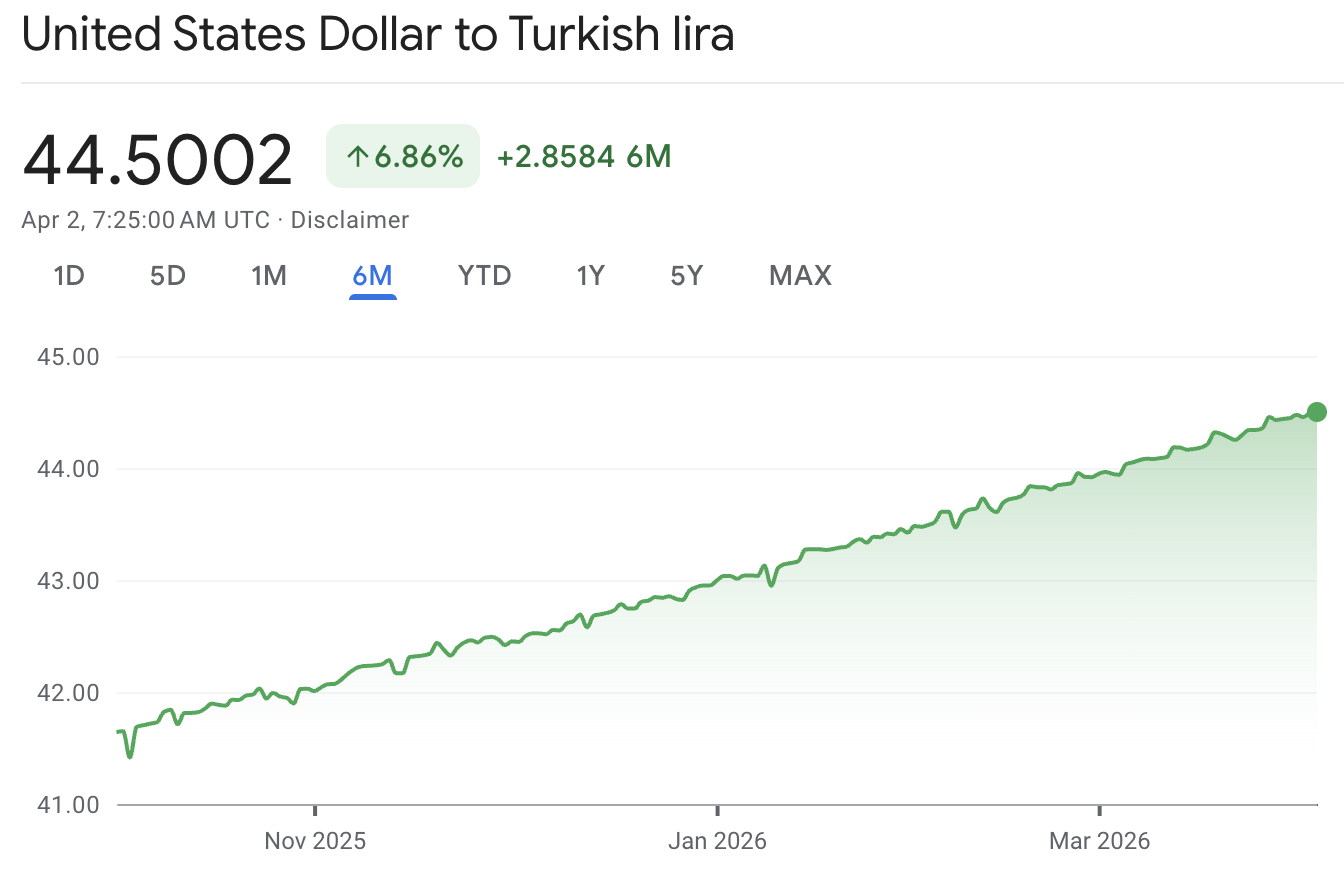
The Turkish lira entered April 2026 under multi-directional pressure. USD/TRY remained in the mid-44s into early April, keeping the pair close to record highs.
What makes this episode difficult for the lira is that the combined pressure from geopolitical developments has lifted energy prices, global risk appetite has weakened, and the market is less willing to fund a high-yield carry trade when inflation remains elevated. This combination increases Turkey's import costs and weakens the demand for the lira.
The CBRT responded by suspending one-week repo auctions for a period and leaning on liquidity management tools.
In its March 18 meeting summary, the bank stated this approach raised the average funding cost to 40%, in line with the overnight lending rate.
This was not a standard change in the policy rate. It was a liquidity-tightening step designed to buy time, support transmission, and slow the pace of depreciation rather than reverse it immediately.
| Metric | Latest reading | Market meaning |
|---|---|---|
| USD/TRY | 44.2435 / 44.3232 CBRT indicative | Spot remains near record highs and supports the managed-depreciation framing. |
| CBRT policy rate | 37% | Tight in nominal terms, but the market still expects easing later in 2026. |
| Turkey CPI | 31.53% y/y, 2.96% m/m in February | Inflation is lower than 2024 extremes, but still too high for stable nominal FX appreciation. |
| End-2026 CPI expectation | 25.38% | Disinflation is expected to continue, but slowly. |
| January current account | -$6.807bn | Structural hard-currency demand remains a constraint. |
| Official reserve assets | $177.5bn on March 19 | Intervention capacity still exists, but the buffer is being used. |
| End-2026 USD/TRY expectation | 50.9685 | Market-participant pricing still points to a weaker lira by year-end. |
The prevailing retail belief is that high nominal rates should lead to a rally in the lira. Institutional reality is harsher. A currency strengthens when real returns are durable, reserve buffers are rebuilding, and external funding needs are manageable. Turkey has made progress on the first leg, but not enough on the second and third.
With a policy rate at 37%, inflation expectations for end-2026 are at 25.38%, and year-end policy rate expectations have already decreased to 30.63%. The market perceives a positive, yet diminishing, real-rate cushion. That is enough to slow depreciation. It is not enough to reverse it.
This is why USD/TRY behaves more like a managed crawl than a classic crisis spike. On March 1, the CBRT announced it would start selling foreign exchange forward contracts settled in Turkish lira to enhance foreign exchange liquidity and mitigate potential market volatility.
On the same date, it also said one-week repo auctions would be suspended for a period. When a central bank leans on liquidity tools and forward-market operations, it is trying to smooth conditions, not promise a hard ceiling for the exchange rate.
Reserve behaviour tells the same story. In the governor's February inflation briefing, the CBRT stated it had increased to $208 billion as of February 6, up from $184 billion on October 31, while net reserves excluding swaps had risen to $78 billion. By March 19, official reserve assets had eased to $177.5 billion.
That does not by itself imply a reserve crisis. It suggests that exchange-rate stability is using up balance-sheet capacity faster than policymakers would prefer.
Our base case is sustained lira weakness at a pace that accelerates if the reserve burn rate in March proves to be a new steady state rather than a spike. The 44.50–45.00 zone is the immediate resistance/breakout level to monitor.
This is not automatically a 2018-style disorder scenario. In the February Inflation Report briefing, the CBRT stated the share of Turkish lira deposits had stabilised around 60%, while the March Monetary Policy Committee summary showed gross international reserves at USD 197.5 billion as of March 6, despite a massive decline from late January.
That mix argues for controlled depreciation as the base case, not an immediate breakdown in market functioning.
The managed-depreciation assumption also ignores the domestic dollarization risk. If Turkish households, who historically rush into USD and gold deposits when confidence falters, begin converting lira savings at scale, the TCMB faces a completely different magnitude of intervention demand.
This scenario requires several conditions to improve simultaneously: energy prices need to ease, reserve pressure needs to stabilise, and the market needs renewed confidence that disinflation will continue.
Under that mix, USD/TRY could retrace part of the first-quarter rise and move back toward the 41.50 to 42.50 area within 60 to 90 days. The key signal would be steadier reserves and calmer FX volatility rather than one strong equity session.
If domestic savers shift more aggressively into FX and gold while reserve pressure stays high, the market could move from controlled depreciation to a faster break higher. That would materially increase intervention demand and reduce the room for gradual management.
In that case, policymakers could be forced into tighter liquidity or additional rate action, which would raise domestic funding costs and likely widen sovereign risk premia. The result would be greater pressure on credit growth and a higher probability of a move into the upper 40s in USD/TRY.
That is why the bear case keeps a 47.00 to 50.00 90-day range.
A wider trade or energy shock would increase that risk by reducing external receipts or further increasing import costs.
Not primarily. The current move resulted from a managed repricing of inflation, easing expectations and external funding needs, rather than a one-session funding shock.
Yes, but only as a brake. High nominal rates can slow depreciation when real rates stay positive, and reserves improve. They do not guarantee appreciation when inflation remains above 31%, and the current account remains in deficit.
The next CBRT policy decision is due on April 22, 2026, according to the bank's official calendar. That meeting matters because traders will test whether the bank continues to prioritise disinflation or resumes a faster easing pace.
Our base case is that USD/TRY remains biased higher through 2026, but in a controlled rather than disorderly path.
The bottom line is that the lira does not need a new panic to make new nominal lows. It only needs inflation, easing expectations, and external deficits to remain more persistent than the policy response. Right now, that remains the most credible market path.
Disclaimer: This material is for general information purposes only and is not intended as (and should not be considered to be) financial, investment, or other advice on which reliance should be placed. No opinion given in the material constitutes a recommendation by EBC or the author that any particular investment, security, transaction, or investment strategy is suitable for any specific person.