Published on: 2025-12-05
Updated on: 2025-12-05
Silver ETFs have gone from niche diversifier to front-page story. With spot silver doubling in 2025 and several silver ETFs delivering 100%+ returns, investors who were early are sitting on outsized gains, while latecomers wonder whether they are already too late to the party.
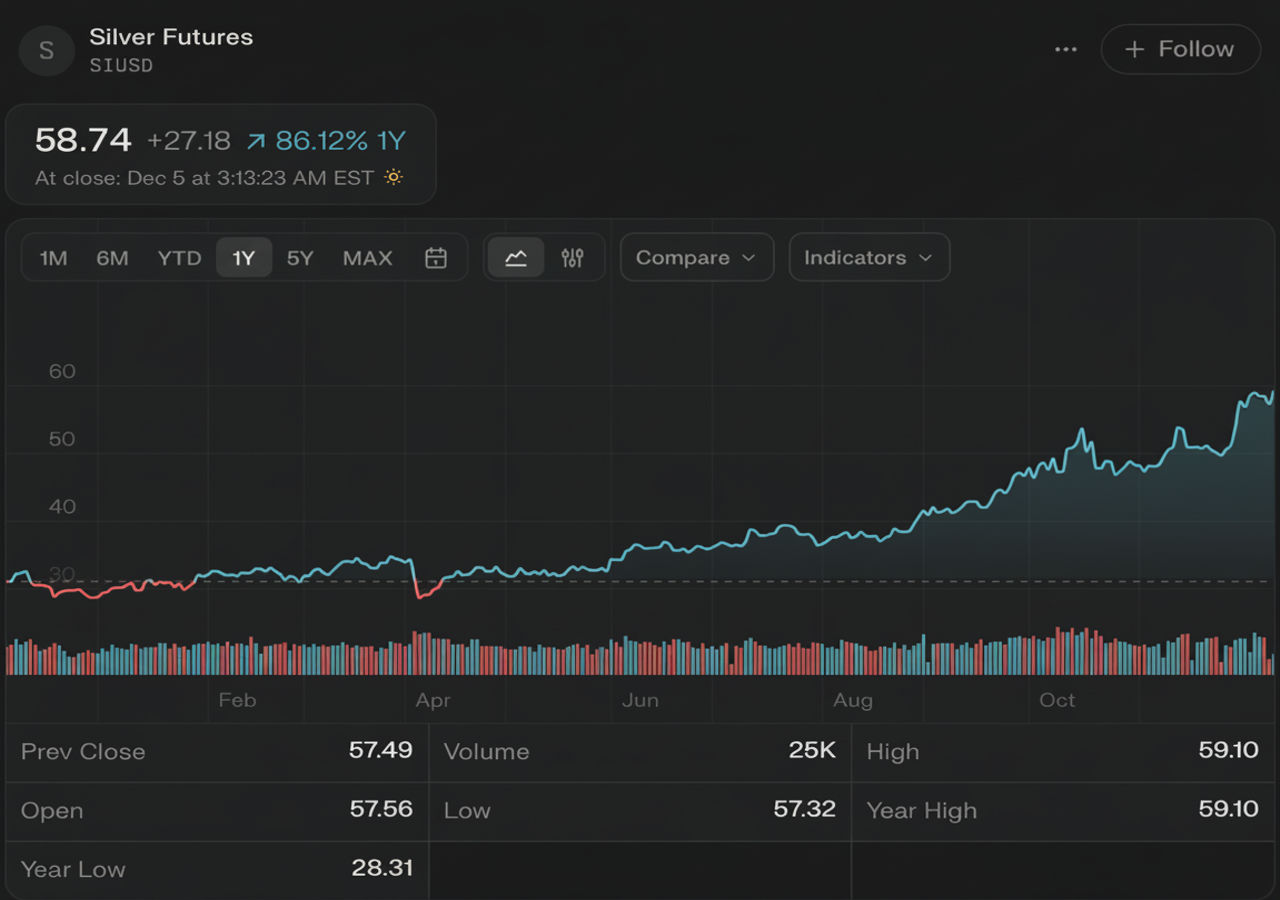
The numbers are big enough that you can't ignore them. Indian silver ETFs like UTI Silver ETF and ICICI Prudential Silver ETF have crossed the 100% mark this year, while global funds such as Global X Silver Miners ETF are up well into triple digits as silver futures trade near record highs around $58–59/oz.
In this article, we will unpack what's really behind those triple-digit returns, what the charts are saying now, and how thoughtful investors are positioning rather than just reacting.
| ETF / Fund | Type | Region | 2025 YTD return | Why it matters |
|---|---|---|---|---|
| UTI Silver ETF | Physical silver ETF | India | ~100.9% | Top-performing Indian silver ETF this year; pure play on silver price in rupee terms. |
| ICICI Prudential Silver ETF | Physical silver ETF | India | ~100.7% | Another India-listed product clearing 100% YTD, showing how local investors have ridden the rally. |
| Average of 21 India silver ETFs/FoFs | Mixed | India | ~98.5% | Data shows the 100% story isn’t just one lucky fund. |
| iShares Silver Trust (SLV) | Physical silver ETP | US/global | ~98% YTD NAV, ~65–95% over last 12 months | Flagship global silver ETF; trades near $52 with a 52-week range of about $26–53, effectively doubling from the lows. |
| ProShares Ultra Silver (AGQ) | 2× leveraged silver ETF | US | ~170–200% 1-year return; among top ETFs by YTD performance | High-octane product delivering roughly twice the daily move in silver; great in uptrends, brutal in reversals. |
| SLVP (iShares MSCI Global Silver & Metals Miners) | Silver miners ETF | US | ~170%+ YTD | Miner equities have leveraged the move in the metal, but add company- and country-specific risk. |
*Silver ETFs sit near the top of global ETF performance tables in 2025, beating broad equity benchmarks like the S&P 500.
For an investor looking at that table, the temptation is obvious: "If it just did 100%, maybe it can do 100% again." That's rarely how this game works.
Silver futures have climbed to around $58–59/oz, posting about a 100% gain in 2025 and hitting all-time highs.
TradingEconomics data shows silver near $57/oz, up roughly 85–100% year-to-date depending on the base date used.
Indian MCX silver has surged to a record ₹1.84 lakh per kg as of 4 December 2025, reflecting both global prices and local tightness.
In short, the metal itself has either doubled or come very close, which is exactly what's feeding through into ETF returns.
Indian silver ETFs have led the headlines:
Reports indicates that 21 silver ETFs/FoFs in India have delivered an average return of 98.51% in 2025, with 10 funds crossing 100%.
UTI Silver ETF tops the list with 100.89% YTD, followed by ICICI Prudential Silver ETF at 100.72%, HDFC Silver ETF at 100.29% and SBI Silver ETF at 100.04%.
Globally, the largest bullion-backed ETF and the main miners' fund have also exploded higher:
iShares Silver Trust (SLV): BlackRock shows YTD NAV total return of 98.01% as of 1 December 2025, with a NAV around $52.20 and a 52-week range of $26.23–$52.93.
Global X Silver Miners ETF (SIL): Yahoo Finance data shows a YTD return of 137.74% and a 1-year return of 96.6%.
The UCITS version of Global X Silver Miners (LON: 0IYF) shows a 1-year return of just over 103%, confirming triple-digit gains in Europe as well.
The Silver Institute has been warning about deficits for years:
Its January 2025 outlook projects the silver market will remain in a "sizeable deficit" for the fifth year running, with a shortfall of around 149 million ounces this year.
A mid-year analysis using World Silver Survey 2025 data estimates the cumulative supply deficit from 2021–2025 at roughly 796–820 million ounces, nearly a full year of mine output.
That kind of sustained deficit is rare for a major industrial metal, giving investors confidence that strong fundamentals, not just hype, are supporting high prices.
Silver is not just a safe haven; it is a workhorse metal:
Reports indicate that industrial demand hit 689.1 million ounces in 2024, with solar panel usage alone at 243.7 million ounces, a record share.
The Silver Institute expects industrial demand to remain near record levels in 2025, even with some "thrifting" by manufacturers to reduce the amount of metal used per product.
Separate research suggests solar PV already consumes about 15% of yearly silver supply, with demand set to grow as the energy transition accelerates.
When combined with rising usage across EVs, electronics, medical equipment, and 5G infrastructure, this creates a durable industrial base of demand supporting silver prices.
This year's move isn't only about factories:
Analysts note silver has outpaced gold, doubling in 2025 while gold is up around 60%, helped by expectations of future Fed rate cuts and tight supply.
Deutsche Bank highlights the tightest industrial silver availability on record, with lease rates at their highest since 2002.
The Silver Institute and several strategists expect silver ETF holdings to reach a record 1.1 billion ounces, indicating heavy investment flows into silver-linked products.
In other words, macro + structural deficit + industrial demand all lined up at once. Silver finally had the perfect storm, and ETFs magnified it.
From a chart-based view, both spot silver and key ETFs are stretched but still constructive.
| Asset | Recent Price / Range | Key Technicals | Read-through |
|---|---|---|---|
| COMEX Silver Futures | ~$58, 52-week: $27.52–59.66 | Trading at top of range; overall rating “buy” on major TA dashboards | Trend up, but any break below high-$40s would mark a cooling. |
| SLV (Silver Trust) | ~$51.76, 52-week: $26.19–53.39 | RSI 14 ≈ 49.6 (neutral), MACD buy, price above 50- and 200-day MAs | Medium-term bullish, short-term no longer extreme; room for both pullbacks and extensions. |
Data for the continuous COMEX silver contract shows:
Price: Around $58/oz, after a 20–21% move over the past month and nearly 99% YTD performance.
52-week range: $27.52–59.66, so the price is trading at the very top of the yearly range.
Technical summaries rate silver futures as an overall "buy" based on oscillators and moving averages.
Other insights point to support near $47.60, with upside targets around $52–53 initially, followed by the $58–62 zone, which has now largely been tested.
Technical summary for SLV (iShares Silver Trust) on 4 December 2025 shows:
Price: About $51.76, with a 52-week range of $26.19–53.39.
14-day RSI: 49.6, which is neutral – the ETF is no longer overbought despite big gains.
MACD (12,26): 0.32, still on a buy signal.
Moving averages: Price sits above its 50-day simple MA (50.56) and well above the 200-day MA (~46.35), a classic bullish structure, even if short-term indicators are mixed.
For Global X Silver Miners ETF (SIL):
Price trades around $76, not far from its 52-week high near $80.
YTD returns above 135% show how leveraged miners' earnings are to silver's move.
European UCITS sister funds show similar 100%+ 1-year returns.
The consistent message from wealth managers:
It would be wise to reduce your exposure if silver occupies most of your portfolio.
If you bought with a 5-year-plus horizon and your allocation is still within your target range, staying invested makes sense, as the structural story (deficits + green demand) is intact.
In practice, smart investors are:
Booking partial profits: For example, trimming 20–40% of their ETF holdings, rather than exiting fully.
Recycling gains into underweight assets (quality equities, short-duration bonds, or even gold) to bring risk back in line.
This is classic rebalancing, not a call on whether silver tops out at $59 or $65.
Advisers in India and globally warn against piling in with a single big ticket right after a 100% year:
Silver is twice as volatile as gold in many periods; buying after a vertical move can lock you into painful drawdowns if there's a 20–30% correction.
Instead, staggered approaches such as SIPs (Systematic Investment Plans) or regular small buys spread over several months are being recommended for fresh money.
The idea is simple: if the long-term thesis is correct, you don't need to win every short-term timing battle.
Different investor types are gravitating to other instruments:
1. Core Exposure: Bullion ETFs
SLV, SIVR and Indian silver ETFs give direct exposure to the metal without mining-stock risk.
2. High-Beta Exposure: Silver Miners ETFs
SIL and similar UCITS products have delivered 130%+ returns but swing more violently with earnings and operating risk.
3. Tactical and Income: Covered-Call or Leveraged Products
Some investors are using call strategies on SLV or specialised ETNs to generate income or add leverage, but these are better suited to traders who can watch positions closely.
Smart investors are matching the product to their temperament: steady bullion for core exposure, miners for torque, options or leverage only for capital they can afford to trade aggressively.
Recent history is a reminder:
Recent reports highlighted how silver hit a record $54.5/oz on October 17, 2025, before dropping 13.5% over the next ten day, yet it remained up over 60% year-to-date.
That kind of whiplash is normal for silver. A 100%+ year makes the next 20–30% swing more, not less, likely.
The current silver rally relies heavily on expectations of Fed easing and declining real yields.
If rate cuts are delayed or the dollar re-strengthens, precious metals can correct even if the supply deficit story hasn't changed.
Silver often overshoots in both directions; what fundamentals justify and what the price prints can diverge for months at a time.
High prices are already causing behavioural change:
The Silver Institute expects industrial demand to dip slightly in 2025, partly because manufacturers are cutting silver content ("thrifting") where they can.
Forecasts suggest production could trend lower into 2030, but if a global slowdown hits, factories can still pull back faster than mines.
Long term, the energy transition still favours silver. In the short term, a cyclical industrial slowdown can easily knock 20–30% off prices.
No. Many of the best-known funds are closed, but not all are above 100%. SLV's NAV return is about 98% YTD, while miners' ETFs like SIL and several Indian silver ETFs have cleared the 100% mark.
Consider partial profit-taking if silver has grown beyond your intended allocation, while maintaining a core position for those with a multi-year investment horizon.
Yes, they could. Many analysts see scope for silver to average around the mid-$50s in 2026, and some research houses sketch upside scenarios toward $65–95/oz if deficits persist and monetary policy turns more supportive.
In conclusion, Silver ETFs delivering 100%+ in a single year is not an occasional event. It reflects a genuine shift in the metal's balance: five straight years of deficits, a powerful industrial story and a macro environment that suddenly favours real assets again. The miners have amplified that story, turning a strong silver rally into triple-digit ETF charts.
For investors, the smart play now isn't guessing whether the next $5 move is up or down. It's about position sizing and discipline. If silver has ballooned beyond what you ever intended to hold, trimming back and rebalancing is simply risk control.
If you still believe in the multi-year case, keeping a core exposure via bullion ETFs while treating miners and leveraged products as tactical tools keeps you in the game without betting the farm.
Disclaimer: This material is for general information purposes only and is not intended as (and should not be considered to be) financial, investment or other advice on which reliance should be placed. No opinion given in the material constitutes a recommendation by EBC or the author that any particular investment, security, transaction or investment strategy is suitable for any specific person.