Published on: 2026-03-05
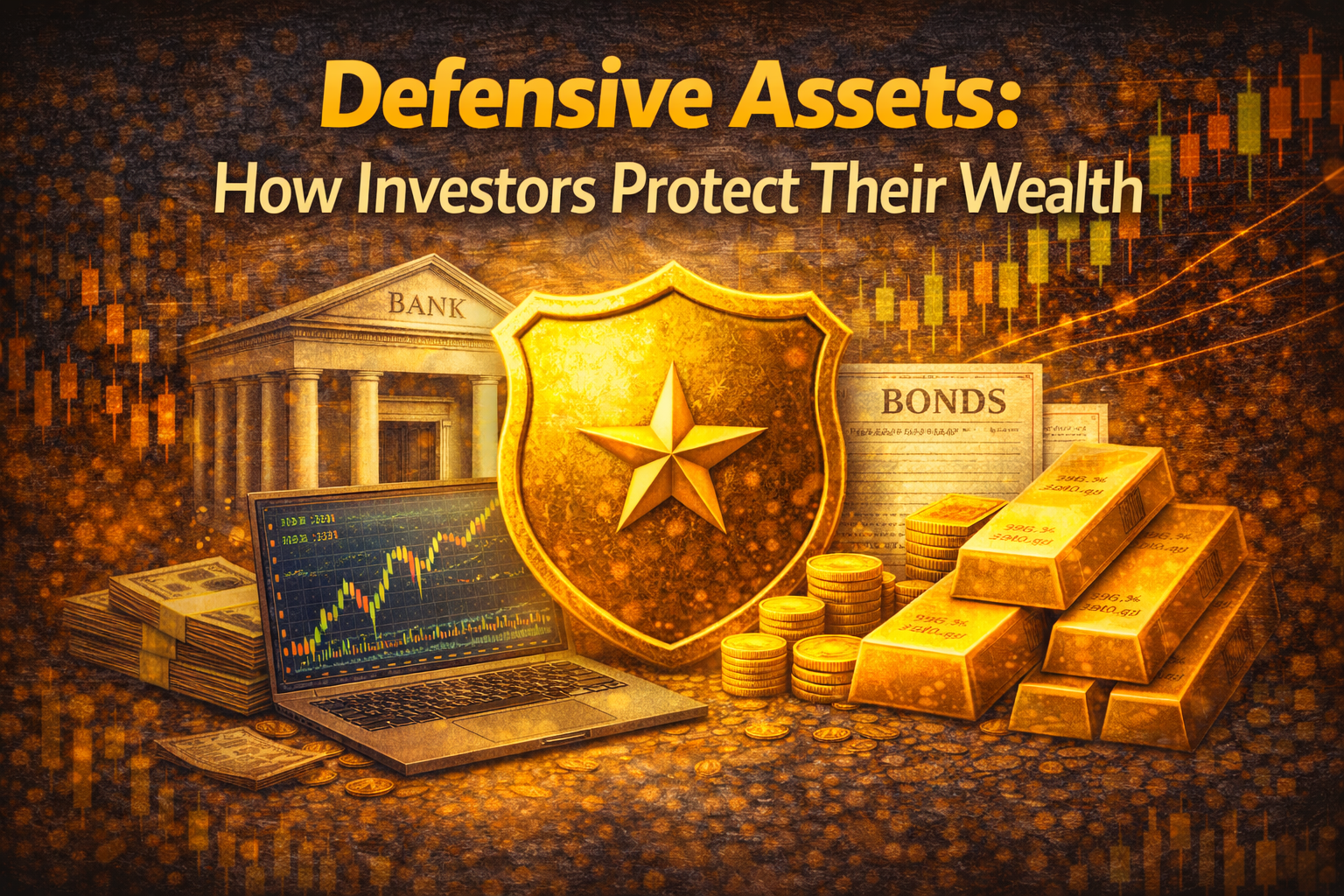
Defensive assets are investments that tend to maintain their value relatively well during periods of economic uncertainty, market volatility, or financial downturns. They are typically associated with stability, lower risk, and consistent demand regardless of economic conditions.
In simple terms, defensive assets are investments investors often turn to when their priority shifts from pursuing high returns to protecting capital and reducing volatility.
While they may not deliver the strongest growth during economic expansions, defensive assets often provide greater resilience during market stress, making them an important component of diversified portfolios.
Financial markets move through cycles of expansion and contraction. During strong economic conditions, investors often favour higher-risk assets that offer greater return potential. However, when uncertainty rises, risk tolerance usually declines.
Defensive assets become particularly attractive during situations such as:
Economic recessions
Financial crises
High inflation environments
Geopolitical tensions
Stock market corrections or crashes
During these periods, investors often prioritise capital preservation and stability over aggressive growth strategies. Defensive assets can help reduce portfolio losses and provide a stabilising effect when riskier assets decline.
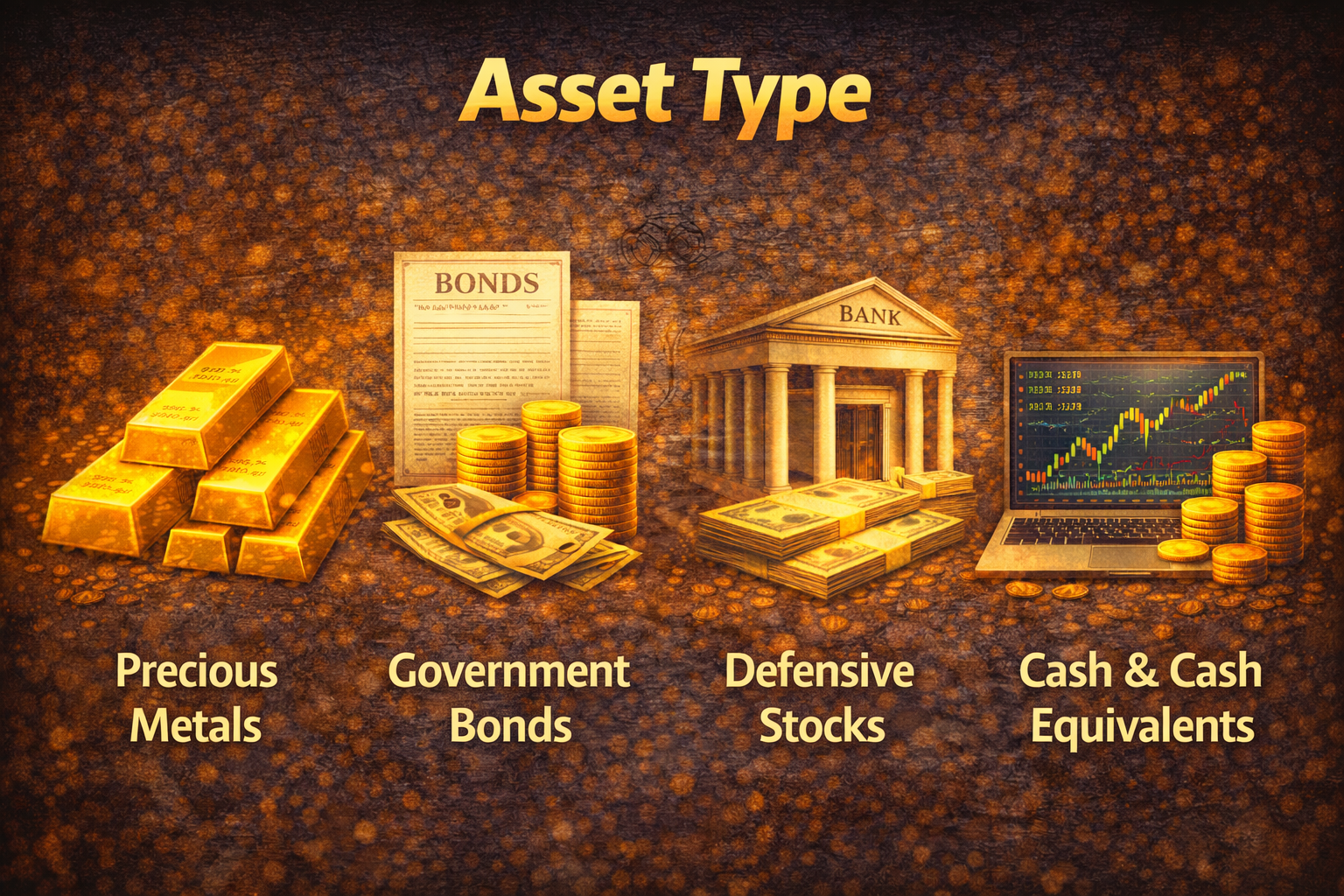
Several types of investments are widely regarded as defensive because they have historically demonstrated lower volatility or maintained demand regardless of economic conditions.
Each of these assets plays a slightly different role in portfolio protection, but they all share the common goal of reducing exposure to severe market fluctuations.
Defensive assets are often contrasted with growth assets, which aim to generate higher long-term returns but usually involve greater risk.
Examples of growth assets may include technology stocks, emerging markets, or high-growth companies. These investments may generate strong returns during favourable economic conditions but can also experience larger losses during market declines.
Defensive assets generally deliver more modest long-term returns compared to riskier investments. This happens because investors effectively exchange higher growth potential for greater stability.
By investing in defensive assets, investors typically accept:
Lower average returns
Slower capital appreciation
In return, they may benefit from:
Reduced volatility
More predictable income streams
Smaller drawdowns during market stress
This trade-off between risk and stability is a fundamental principle in portfolio management.
Defensive assets often outperform riskier investments during periods of declining market confidence.
They are commonly favoured during:
Stock market downturns
Global financial crises
Economic recessions
Periods of elevated uncertainty
During major market sell-offs, investors frequently reallocate capital from equities into government bonds, precious metals, or other defensive assets to reduce risk exposure.
This shift in capital flows can support the performance of defensive assets when other markets struggle.
Most investors do not allocate their entire portfolio to defensive assets. Instead, they typically combine them with higher-growth investments as part of a broader asset allocation strategy.
A balanced portfolio might include:
Growth assets for long-term capital appreciation
Defensive assets to reduce volatility and protect capital
This diversification helps smooth portfolio performance across different market environments.
For example, during strong economic periods, growth investments may drive returns. During downturns, defensive assets may help limit losses and maintain portfolio stability.
Understanding these advantages and limitations helps investors determine how defensive assets fit within their overall financial strategy.
Safe-Haven Asset:An investment expected to maintain or increase value during periods of market turbulence.
Asset Allocation: A strategy that divides investments across asset classes to balance risk and return.
Market Volatility: The degree of price fluctuations experienced in financial markets over time.
Bear Market: A prolonged period of declining asset prices accompanied by negative investor sentiment.
Capital Preservation: An investment strategy focused on protecting existing wealth rather than maximising returns.
Defensive assets are investments designed to maintain stability during economic downturns or periods of market volatility. They focus on capital preservation rather than rapid growth and may include government bonds, gold, cash equivalents, and stocks from essential industries.
Investors often purchase defensive assets to reduce portfolio risk during uncertain economic conditions. These investments generally experience lower volatility and may provide stability when financial markets decline.
No investment is entirely risk-free. Although defensive assets are typically more stable than growth investments, they can still lose value due to factors such as interest rate changes, inflation, or broader financial market stress.
Common examples include gold, government bonds, cash equivalents, and stocks in sectors like utilities, healthcare, and consumer staples. These assets are considered defensive because demand for their underlying services tends to remain relatively stable during economic downturns.
Defensive assets may underperform during strong bull markets because investors often shift toward higher-growth investments during economic expansions. However, they remain important for maintaining balance and reducing overall portfolio risk.
Defensive assets are investments designed to provide stability and capital protection during uncertain economic conditions. Although they may not generate the highest returns during strong market expansions, they can help reduce volatility and limit losses during downturns.
Common defensive assets include gold, government bonds, defensive sector stocks, and cash equivalents. By incorporating these investments into a diversified portfolio, investors can balance risk while preparing for changing market environments.
Disclaimer: This material is for general information purposes only and is not intended as (and should not be considered to be) financial, investment or other advice on which reliance should be placed. No opinion given in the material constitutes a recommendation by EBC or the author that any particular investment, security, transaction or investment strategy is suitable for any specific person.