Published on: 2026-03-05
Updated on: 2026-03-05
Oil is dominating global market talk because Middle
East conflict escalation has lifted perceived supply and transit risk, forcing a
renewed risk premium into crude benchmarks and feeding a broader risk-off tone.
EBC Financial Group ("EBC") notes, however, that for Kenya the underplayed macro
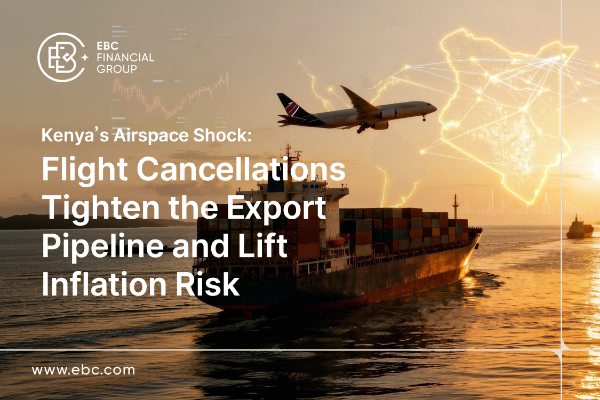
channel is increasingly in the air: regional airspace restrictions and flight
cancellations are compressing lift and extending routings just as supply chains
are already stressed.
"Oil is the headline, but airspace is the plumbing," said David Barrett, Chief Executive Officer, EBC Financial Group (UK) Ltd. "When corridors narrow, cargo capacity vanishes quietly, schedules become unreliable, and the cost of time rises sharply. For Kenya's perishables, time is the product."
EBC highlights that air disruptions are not limited to passenger travel. When carriers suspend services and reroute around closed airspace, the system loses belly capacity and network efficiency at once, tightening the market for uplift and cold-chain slots. That matters because the resulting squeeze can be felt even by exporters far from the conflict zone, as hubs that connect Africa to Europe and Asia operate with fewer flights, longer routings, and higher insurance and handling frictions.
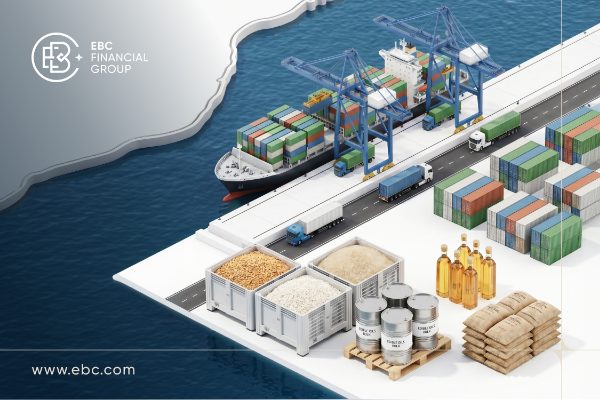
Kenya's competitive edge in horticulture is built on reliable uplift and speed, particularly for floriculture and other high-value perishables where freshness and delivery windows determine realised pricing. EBC notes that a capacity squeeze can therefore behave like a macro shock: delays translate into quality risk, discounting, and working-capital strain, while unpredictable schedules can force costly rebookings and last-minute reroutes. The same mechanism can also raise the landed cost of time-critical imports, with airfreight scarcity and insurance uncertainty showing up as higher logistics charges rather than visible tariff changes. In EBC's view, this is why "airspace risk" deserves to sit alongside oil in boardroom risk registers: it can hit FX receipts and near-term inflation dynamics through the same supply-chain bottleneck.
EBC considers that Kenya's currency and inflation sensitivities can be amplified when a logistics shock coincides with risk-off pricing. A stronger US dollar during heightened geopolitical uncertainty can tighten financial conditions via imported costs and funding preferences, even before any domestic policy response. Against that backdrop, the disinflation path can become less linear if freight and insurance charges rise and then stick, particularly for goods where substitution away from air is limited.
EBC expects the "duration question" to hinge on whether airspace restrictions ease quickly and whether airlines can restore network efficiency without prolonged rerouting. The broader macro backdrop also matters: scheduled updates that shape fuel-cost expectations and the US dollar tone can influence freight pricing and hedging behaviour across supply chains.
Analysts at EBC caution that the core risk is not simply higher logistics costs, but timing uncertainty. When uplift becomes unreliable, exporters face a more adverse distribution of outcomes: missed delivery windows, heavier discounting, and longer cash cycles that can ripple through employment and investment decisions in export-heavy regions.
"Markets can price a barrel in real time, but they often underprice the corridor until it breaks," Barrett added. "For Kenya, airspace restrictions are not background noise. They can turn into a trade and inflation shock long before the data catches up."
Brent and other commodities benchmarks often serve as practical reference points for fuel and freight sensitivity. EBC's Commodities offering is designed for traders seeking market access, complemented by the EBC Trading Academy for wider risk-context and learning.
Disclaimer: This material is for information only and does not constitute a recommendation or advice from EBC Financial Group and all its entities ("EBC"). Trading Forex and Contracts for Difference (CFDs) on margin carries a high level of risk and may not be suitable for all investors. Losses can exceed your deposits. Before trading, you should carefully consider your trading objectives, level of experience, and risk appetite, and consult an independent financial advisor if necessary. Statistics or past investment performance are not a guarantee of future performance. EBC is not liable for any damages arising from reliance on this information.