Published on: 2026-03-04
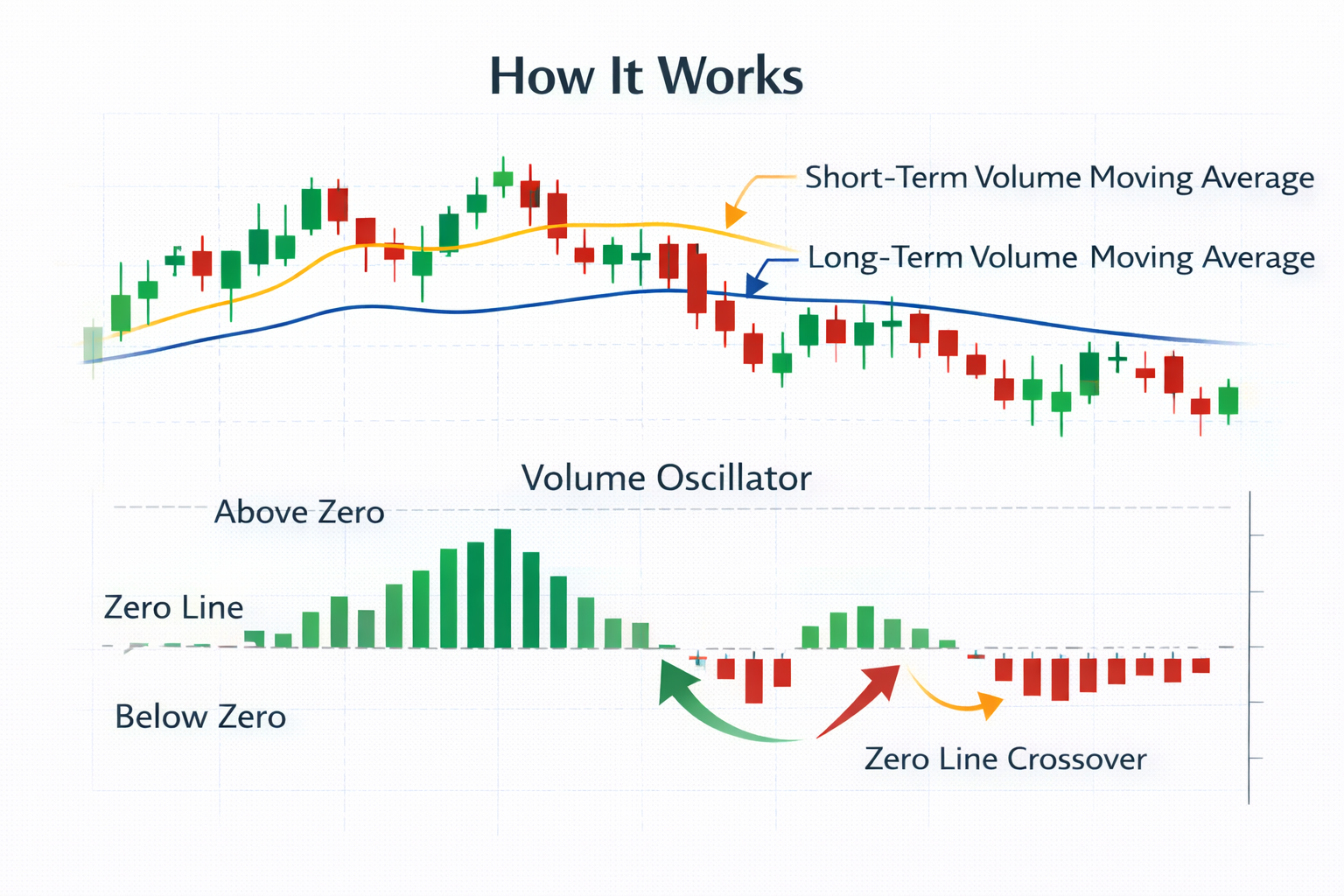
The Volume Oscillator is a technical analysis indicator that measures the difference between two moving averages of trading volume. Its purpose is to determine whether short-term trading activity is stronger or weaker than the longer-term average.
Unlike price-based indicators, the Volume Oscillator focuses entirely on market participation. It fluctuates above and below a zero line, reflecting shifts in buying and selling intensity.
Importantly, the indicator does not forecast price direction. Instead, it evaluates the strength or conviction behind a price movement.
The Volume Oscillator compares two moving averages of volume:
A short-term moving average (e.g., 5 periods)
A long-term moving average (e.g., 20 periods)
The formula is conceptually expressed as:
Volume Oscillator = Short-Term Volume MA − Long-Term Volume MA
Some platforms display the result as a raw numerical difference, while others express it as a percentage.
When short-term volume exceeds the long-term average, the oscillator moves above zero.
When short-term volume falls below the longer-term average, the oscillator turns negative.
This comparison highlights shifts in participation strength rather than absolute volume levels.
The oscillator should always be interpreted alongside price structure, support and resistance levels, and broader trend context. On its own, it does not provide trade entries or exits.
Practical Trading Uses
The Volume Oscillator is typically used as a confirmation tool rather than a standalone signal generator.
When price breaks above resistance or below support and the oscillator turns positive or rises sharply, it suggests stronger participation behind the move. This may increase the likelihood that the breakout is genuine rather than temporary.
If price makes higher highs but the oscillator fails to rise or begins to decline, it may signal weakening participation. This divergence can suggest that buying pressure is fading even as the price continues upward.
Sudden spikes in the oscillator often occur during major news releases or economic events. A sharp increase reflects expanding activity and heightened trader interest.
During sustained uptrends, consistently positive readings indicate continued participation. If the oscillator gradually declines while price remains elevated, it may signal a weakening trend.
Scenario A:
Price breaks above resistance.
The Volume Oscillator turns strongly positive.
Short-term volume surges above its long-term average.
This combination suggests broad participation supporting the breakout.
Scenario B:
Price breaks resistance.
The oscillator remains flat or negative.
Volume does not expand meaningfully.
In this case, the breakout may lack conviction, increasing the risk of a false move.
The Volume Oscillator is an oscillator because it compares short-term and long-term volume averages and fluctuates dynamically around a zero line. It emphasises relative shifts in participation rather than cumulative totals.
The Volume Oscillator works best when combined with trend analysis, chart patterns, and other technical indicators.
Trading Volume: The total number of shares or contracts traded during a specific period.
Moving Average: A smoothing calculation applied to price or volume data to identify trends over time.
Momentum Indicator: A tool that measures the speed or strength of price movement.
Divergence: A condition where the price and an indicator move in opposite directions.
Breakout: When price moves beyond a defined support or resistance level with increased trading activity.
The Volume Oscillator measures the difference between a short-term and a long-term moving average of trading volume. It shows whether recent market participation is increasing or decreasing compared to historical activity. The indicator helps traders assess whether price movements are supported by expanding or weakening trading interest.
No, the Volume Oscillator is generally considered a confirming or lagging indicator because it is based on moving averages of past volume data. It reacts to changes that have already occurred rather than predicting future price direction. Traders typically use it to validate price movements rather than anticipate them.
No, it does not predict whether the price will rise or fall. The indicator measures participation strength, not direction. A positive reading only shows that short-term volume exceeds the long-term average. Traders must combine it with price analysis to determine market bias.
Common settings include 5- and 20-period volume moving averages, though traders may adjust them based on the timeframe and strategy. Shorter settings make the oscillator more sensitive, while longer settings smooth out fluctuations and reduce noise.
Yes, it can be applied to stocks, commodities, indices, and other markets where reliable volume data is available. However, in decentralised markets such as forex, where volume data may represent tick volume rather than actual traded contracts, interpretation should be approached with additional caution.
The Volume Oscillator is a volume-based technical tool that compares short-term and long-term trading activity to assess participation strength. Fluctuating above and below a zero line, it helps traders determine whether momentum is expanding or fading.
Although it does not forecast price direction, it provides valuable confirmation for breakouts, divergence analysis, and trend strength evaluation. When used alongside price action and broader technical analysis, the Volume Oscillator enhances a trader’s understanding of market conviction and participation dynamics.
Disclaimer: This material is for general information purposes only and is not intended as (and should not be considered to be) financial, investment or other advice on which reliance should be placed. No opinion given in the material constitutes a recommendation by EBC or the author that any particular investment, security, transaction or investment strategy is suitable for any specific person.