Published on: 2026-03-09
Updated on: 2026-03-09
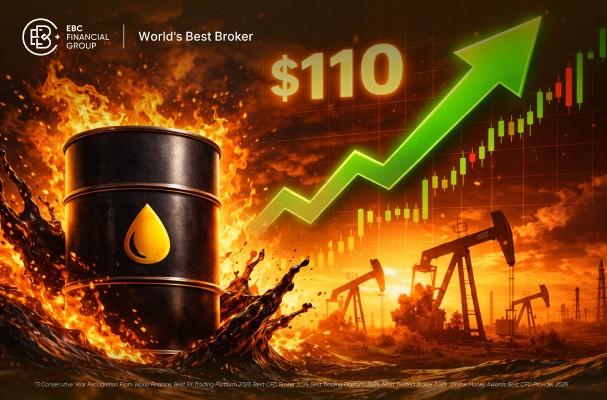
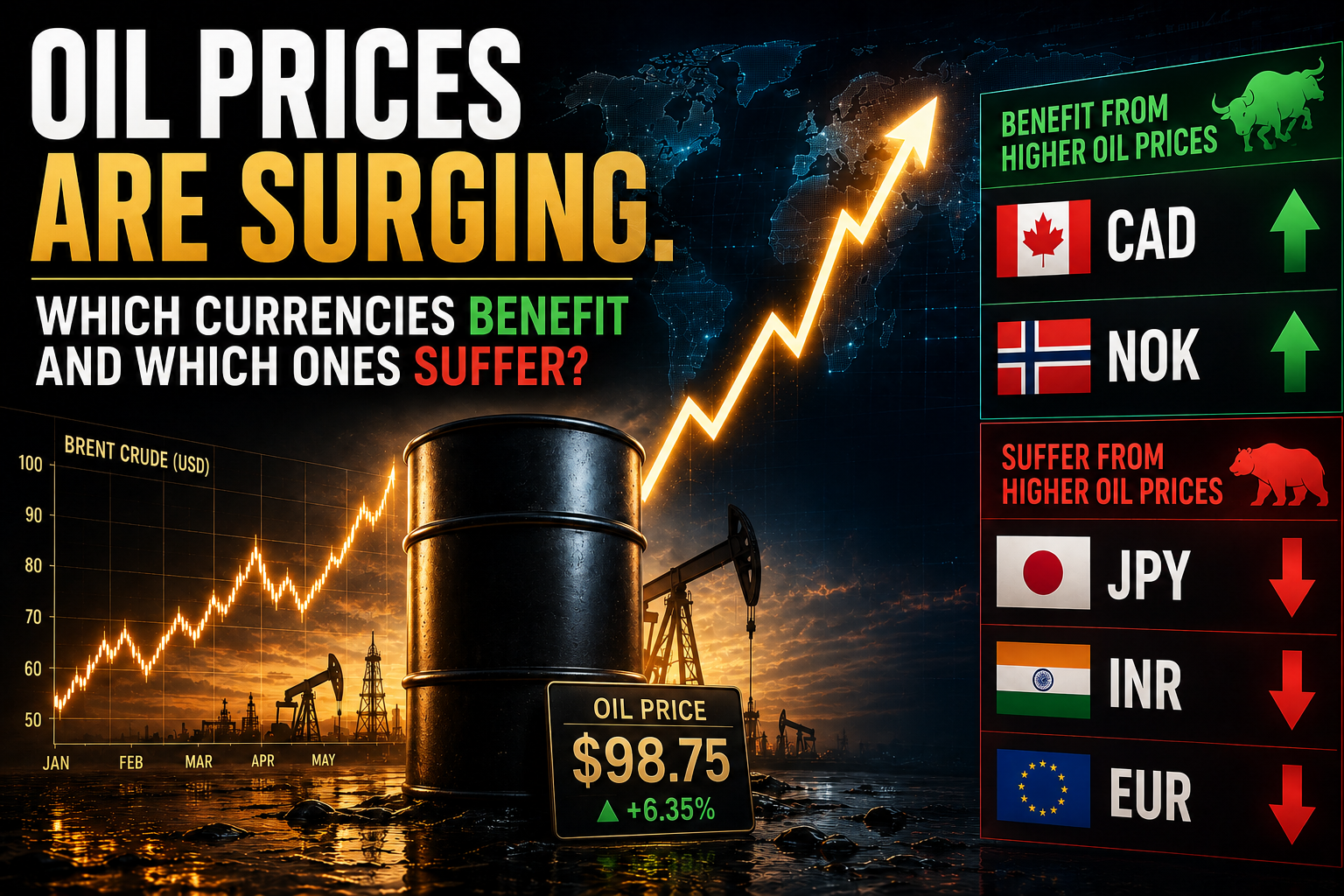
Oil prices have entered a state of "shock mode," and the market is responding as it typically does when supply risks become tangible. Brent crude futures settled at above $114 on March 9, 2026, after trading as high as $119, and they had already pushed above $110 on March 8.
That is a major change from just two weeks ago. Oil prices were still in the low $70s on February 27, and it only started to accelerate when geopolitical risk around Middle East shipping routes turned into an active disruption.
The question now is simple and urgent: is $150 possible, or does the market run out of fuel before it gets there?
Oil prices jumped because the market is pricing in a disruption around the Strait of Hormuz, one of the world's most crucial energy chokepoints. In 2024, oil flows through the Strait averaged about 20 million barrels per day, which is roughly 20% of global petroleum liquids consumption, according to the U.S. Energy Information Administration (EIA).
Meanwhile, the recent increase is related to the escalating Iran conflict and growing threats to shipping. There are concerns that tanker traffic and regional output may be restricted for a longer period than traders anticipated.
Thus, Is $150 possible? Yes, but it would usually require harsher conditions than the market has fully confirmed today, such as a prolonged, effective blockage of Hormuz flows and meaningful production outages across multiple Gulf producers.
For historical context, oil prices surged above $110 and even reached $120 at times in 2022, during the post-pandemic demand rebound and the shock of Russia's invasion of Ukraine. Therefore, Goldman Sachs predicts that oil prices could reach $150 if disruptions persist and supply flows remain significantly restricted.
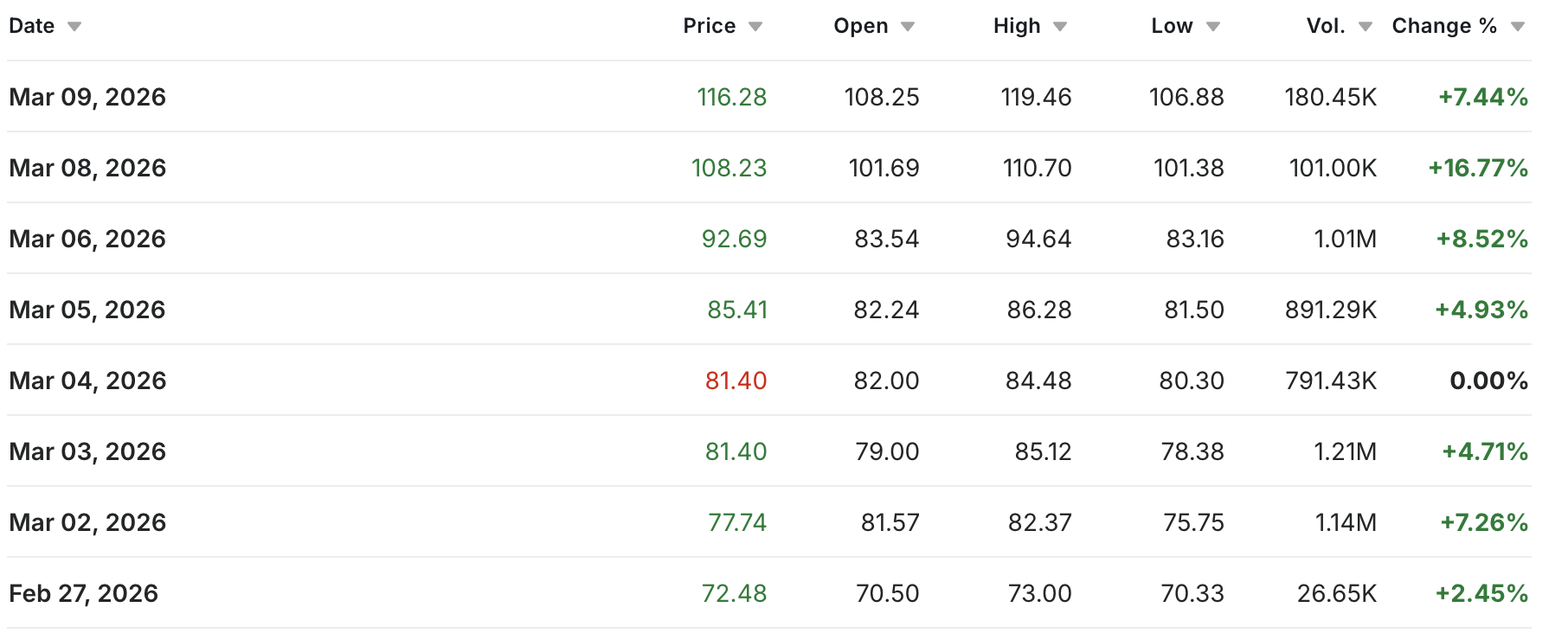
Before we break down the reasons, it helps to see how extreme the move has been across both major benchmarks.
*Data is derived from Investing.
Brent rose from $72.48 on February 27 to above $114 on March 9, a gain of about 58.2% in less than two weeks of trading days.
The jump was not smooth. The most significant changes occurred in two sessions, with Brent increasing from $92.69 on March 6 to $108.23 on March 8, and then exceeding $114 on March 9.
Over approximately one month, Brent rose from $69.04 on February 9 to over $114, an increase of around 66.0%.
The scale indicates that the market is not operating at the typical balance of supply and demand. It is trading fear, logistics, and worst-case planning.
Official EIA monthly data indicate that Brent averaged $67.99 in September 2025 and $70.89 in February 2026, reflecting an increase of only about 4.3% over that period.
In other words, the "normal" oil market remained in the $60–$70 range until the current shock took hold.
WTI has mirrored the same pattern, with even larger percentage swings from a slightly lower base.
| Benchmark | Feb 27 close | Mar 9 | Move |
|---|---|---|---|
| Brent (futures) | $72.48 | $114+ | +57% |
| WTI (futures) | $67.02 | $114+ | +70% |
Oil is a global commodity, but it still moves through narrow physical routes. The Strait of Hormuz is the biggest of them all. The EIA estimates oil flows through the Strait averaged about 20 million barrels per day in 2024, which is around 20% of global petroleum liquids consumption.
Additionally, the EIA states that the Strait of Hormuz is a crucial chokepoint with very few alternative routes available if it were to be blocked.
When a route like that is questioned, traders do not wait for perfect confirmation. They bid up crude because the cost of being wrong is huge for refiners, airlines, and nations that rely on imports.
Even if oil exists on paper, it is of no use if it cannot move freely. The significant drop in traffic occurred as insurers reduced war-risk coverage, leading to higher freight costs as vessels slowed or diverted.
Such disruption can lead to a "phantom shortage," where supply is available but delayed in practice. In the short term, delays behave like lost barrels.
Oil prices often include a "risk premium," which is an extra price added for uncertainty. In calm times, that premium is small. In war-driven times, it can expand fast.
Once the market starts to believe disruption may last weeks instead of days, the premium can jump again.
When a market moves 15% to 25% in a day, mechanics matter. Traders who were short crude often rush to cover. Risk models force funds to cut exposure or hedge. Options dealers adjust. All of that can add fuel to price action even if the underlying news has not changed hour to hour.
You can see the speed of repricing in the settlements. Brent moved from around $77.74 (March 2) to over $114 (March 9) over the five trading sessions shown in the historical table.
To note, $150 is not a base case. It is a stress case. That said, history shows it is not impossible. Brent reached an all-time high near $147.50 in 2008, and Brent also averaged well above $110 during parts of 2022.
Here is a practical way to frame the road from $110 to $150.
| Scenario | What needs to happen | What prices often do | What to watch |
|---|---|---|---|
| De-escalation | Shipping risk fades and flows normalize quickly. | Oil can retrace sharply because the risk premium collapses. | Evidence of safer passage and lower freight and insurance stress. |
| Partial disruption (weeks) | Some flows resume, but security and insurance remain tight. | Oil can stay elevated, often in the $100–$120 zone. | Government messaging, tanker traffic, and emergency stock policy signals. |
| Prolonged disruption (multi-week, severe) | Large Hormuz flow loss persists and regional output is curtailed. | $150 becomes plausible in a panic phase. | Any sign that the disruption is lasting and broadening, not narrowing. |
To reiterate, Goldman Sachs described a path to $150 if the disruption becomes severe and sustained.
That is not a guarantee, but it tells you credible market participants are modeling it.
Even during significant disruptions, oil markets have mechanisms in place to relieve pressure. They are not perfect, but they are equally important.
When fuel becomes too expensive, households drive less, businesses cut travel, and manufacturers slow orders. Demand destruction does not happen overnight, but it can occur quickly once prices stay high.
The IEA has shown in past crises that coordinated releases can be large. In 2022, IEA member countries agreed on an initial release of 60 million barrels, equivalent to 2 million barrels per day for 30 days.
A release does not "solve" a chokepoint closure. It can help alleviate panic while diplomatic efforts and logistics are being adjusted.
Before this conflict intensified, the EIA expected oil prices to decline in 2026 because global production was projected to exceed demand, and inventories were expected to build.
That matters because it suggests the underlying market had a buffer, even if that buffer can vanish in a shipping crisis.
The EIA estimates that in 2024, the United States imported approximately 0.5 million barrels per day of crude oil and condensate from Persian Gulf countries via the Strait of Hormuz. This accounted for about 7% of total U.S. crude imports and around 2% of the country's petroleum liquids consumption.
Asia, by contrast, takes the majority of Hormuz crude flows, which is why Asian risk assets often react first and hardest.
The next 72 hours will be about logistics, not speeches. Oil can stay high if the physical system remains clogged, even if diplomatic language sounds calmer.
You should watch:
Tanker movement and insurance coverage are the real gates of supply.
Evidence of production cuts due to full storage, because that turns a shipping crisis into a production crisis.
Whether bypass pipelines ramp further, as the EIA estimates, only a limited share of Hormuz flows can be diverted.
Oil surged because the Iran conflict has disrupted production and shipping, and markets are pricing a serious risk to the Strait of Hormuz.
Yes, by widely reported intraday levels. Oil traded consistently in this region and above it in 2022.
It is possible under a severe scenario. Goldman Sachs has warned oil could reach $150 if Hormuz flows stay heavily disrupted through March, and Gulf exporters face pressure to shut production due to storage limits.
In conclusion, oil prices above $110 signals the market is treating the Iran conflict as a supply shock risk, not a normal geopolitical headline.
The critical issue lies at Hormuz, where approximately 20 million barrels per day typically flow through the Strait. Alternative routes are limited and cannot fully replace this volume.
$150 is possible, but it likely requires sustained disruption that forces real production shutdowns and keeps shipping unsafe for weeks, which is why the next signals to watch are tanker movement, insurance, and storage pressure, not only political messaging
Disclaimer: This material is for general information purposes only and is not intended as (and should not be considered to be) financial, investment or other advice on which reliance should be placed. No opinion given in the material constitutes a recommendation by EBC or the author that any particular investment, security, transaction or investment strategy is suitable for any specific person.