Published on: 2026-04-23
Updated on: 2026-04-23
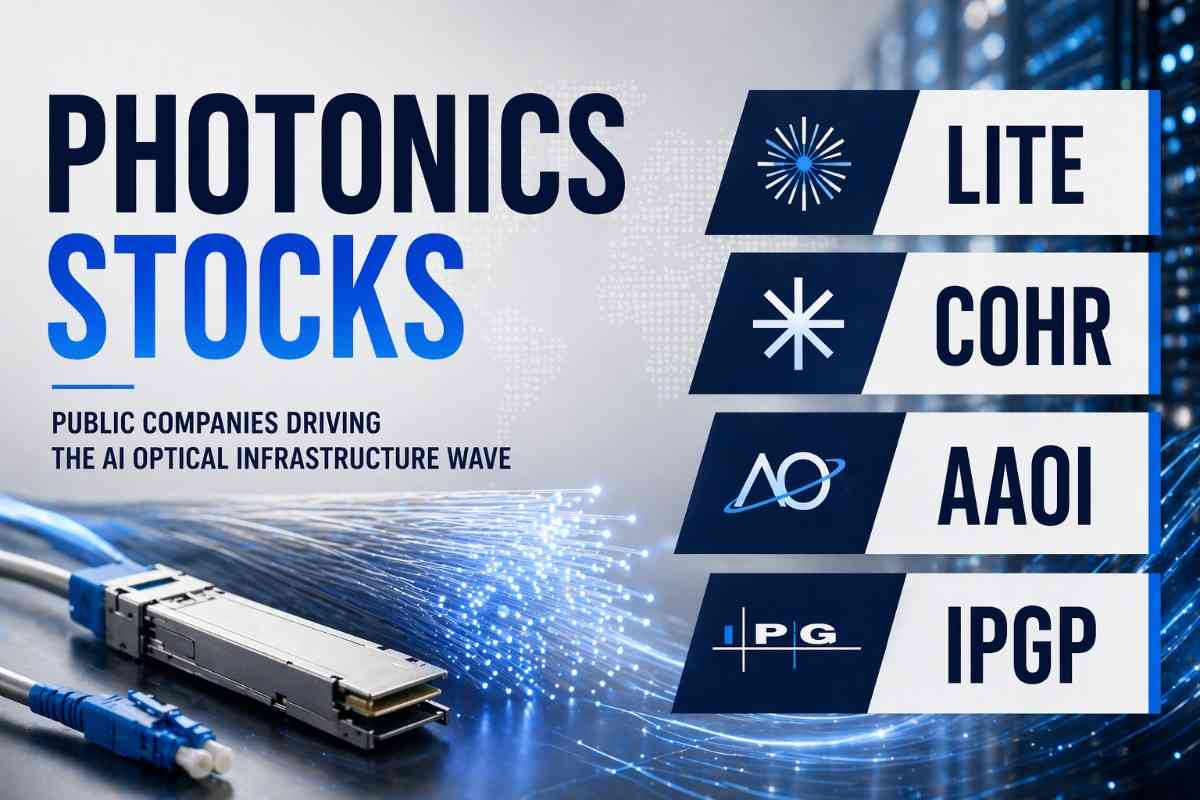
Photonics stocks are no longer a niche corner of the market. AI infrastructure is forcing the network layer to solve for bandwidth density, latency, power efficiency, and physical scale all at once, pushing the optical stack toward the center of the next data-center buildout.
Vendors across the chain are now racing to commercialize 1.6T and 3.2T transceivers, co-packaged optics, optical circuit switching, silicon photonics, and denser fiber systems because electrical links alone are becoming less efficient as AI clusters grow larger.
This list takes a stricter route: public stocks only, no ETFs in the ranking, and no private-company noise. The list is built around four tests: exposure purity, financial proof, relevance to the current AI optical cycle, and how useful each stock is for an actual investor.
The best photonics stocks are not simply optics-adjacent names. They are public companies with real revenue exposure to optical modules, transceivers, lasers, silicon photonics, optical packaging, or fiber connectivity.
The near-term driver is AI optical infrastructure, not quantum optionality.
Lumentum ranks ahead of Coherent because its current AI-optics proof is more concentrated, while Coherent offers a broader platform.
Marvell and MACOM are stronger choices for readers who want optical exposure without tying the thesis to a single product line or hyperscale customer.
AAOI and Credo offer more torque, but the market is already demanding fast execution. That makes them opportunities, not easy buys.
A photonics stock is a public company whose business is materially tied to the generation, transmission, detection, or application of light-based technologies.
| Exposure label | What it means |
|---|---|
| Pure-play photonics | Photonics sits at the center of the business and the stock thesis |
| Core optical enabler | Optical products are a major growth engine, but not the whole company |
| Diversified meaningful exposure | Photonics matters, but sits inside a broader business |
| Thematic adjacency | Theme-linked, but with weaker direct revenue linkage |
In practical terms, that means lasers, optical components, transceivers, photonic chips, optical packaging, and fiber connectivity. It does not mean every semiconductor or networking stock can be pulled into a broad keyword basket.
Photonics matters now not because the technology is new, but because AI is finally forcing adoption at a commercial scale. The timing case is strongest at the network bottleneck.
| Horizon | Main driver | What investors should watch |
|---|---|---|
| Now | AI optical interconnects | Orders, backlog, customer commitments |
| Next | Packaging, dense fiber, scale-out infrastructure | Margin leverage and manufacturing position |
| Later | Frontier photonics applications | Commercialization discipline |
Lumentum is scaling optical circuit switching and advanced laser capacity for AI data centers.
Coherent is pushing a full roadmap across pluggables, co-packaged optics, and silicon photonics.
Marvell is broadening its optical DSP and silicon-photonics engine portfolio.
MACOM is building around higher-speed optical ecosystems.
Corning is benefiting from the fiber and connectivity side of the same capex cycle.
Exposure: Pure-play photonics.
Lumentum takes the top spot because it offers the clearest blend of direct exposure and current proof. Fiscal Q2 2026 revenue reached $665.5 million, non-GAAP operating margin rose to 25.2%, optical circuit switch backlog moved above $400 million, and NVIDIA announced a $2 billion investment alongside multiyear commercial agreements.
This is not just thematic relevance. It is concentrated optical demand with visible operating leverage.
Lumentum edges out Coherent because more of its current equity story is driven by AI optics rather than a broader platform narrative.
Priced in: The premium is defendable only if backlog converts cleanly and the NVIDIA relationship expands into durable revenue.
Best fit: Research now.
Exposure: Pure-play photonics.
Coherent is the deepest optical platform on the list and arguably the most strategically complete. Fiscal Q2 2026 revenue came in at $1.69 billion, non-GAAP EPS reached $1.29, and the company continues to ramp capacity against strong demand.
Its roadmap spans 1.6T and 3.2T transceivers, co-packaged optics, silicon photonics, and 400G-per-lane links, while NVIDIA’s strategic partnership includes multiyear purchase commitments and capacity rights.
Coherent sits just behind Lumentum because its exposure is broader and its stock already reflects more of that platform value.
Priced in: The rerating is warranted, but future upside now depends more on execution at scale than on discovery.
Best fit: Core direct exposure.
Exposure: Core optical enabler.
Marvell is the strongest large-cap bridge between AI compute and AI optics. Fiscal Q2 2026 revenue hit a record $2.006 billion, up 58% year over year, and management tied that growth to custom silicon and electro-optics.
Its optical stack now includes 1.6T DSPs, light engines, TIAs, and laser drivers, making Marvell more than an indirect beneficiary.
It earns its place ahead of Credo because the commercial engine is broader, customer breadth is better, and the optical thesis is less fragile.
Priced in: The premium can hold if Marvell keeps converting AI design momentum into durable revenue, but not if investors begin treating every AI connectivity claim as interchangeable.
Best fit: Diversified AI-optics exposure.
Exposure: Core optical enabler.
Credo offers the sharpest growth torque in the group. Fiscal Q3 2026 revenue reached $407.0 million, up 201.5% year over year, with non-GAAP gross margin of 68.6%.
The DustPhotonics acquisition deepens its position in higher-speed optical connectivity and silicon photonics, and management has pointed to optical revenue that could exceed $500 million in fiscal 2027.
Credo ranks below Marvell because scale, diversification, and customer durability still matter, especially after a sharp rerating.
Priced in: The stock now demands near-flawless execution. Any slip in customer ramps or margin progression would be punished quickly.
Best fit: aggressive growth.
Exposure: Core optical enabler.
MACOM is the cleaner mid-cap choice for readers who want real optical leverage without pure-play fragility.
Fiscal Q1 2026 revenue was $271.6 million, up 24.5% year over year, with a gross margin of 55.9% and forward guidance that still points higher. Its roadmap spans 1.6T and 3.2T ecosystems, coherent-lite, and optical PCIe connectivity.
It stands above AAOI because the thesis is less beholden to a single customer or a single order cycle.
Priced in: Still demanding, but far less stretched than the hotter AI-optics trades.
Best fit: Balanced exposure.
Exposure: Pure-play photonics.
AAOI is the highest-beta direct trade on the list. The company disclosed a new $71 million 800G order from a major hyperscale customer, bringing orders from that customer to $124 million since mid-March and more than doubling the existing backlog from that account.
That is real demand. It is also a concentration risk in plain sight.
AAOI sits below MACOM because the upside is obvious, but its dependence is narrower, and the stock can outrun the business very quickly.
Priced in: This is a tactical name. The market is already paying for continued order acceleration.
Best fit: High-beta exposure, not core positioning.
Exposure: Diversified meaningful exposure.
Fabrinet is one of the most investable secondary names in the theme because it monetizes optical complexity rather than one headline product.
Fiscal Q1 2026 revenue was $978.1 million, up from $804.2 million a year earlier, and the company guided the next quarter to $1.05 billion to $1.10 billion.
It ranks ahead of Corning because the optical linkage is tighter, and earnings sensitivity to optical communications is more direct.
Priced in: It carries less narrative premium than the pure-play names, which is part of the appeal.
Best fit: Lower-risk exposure to optical infrastructure.
Exposure: Diversified meaningful exposure.
Corning belongs because the AI optical buildout is also a fiber-and-connectivity story. Its multiyear agreement with Meta is worth up to $6 billion and directly covers optical fiber, cable, and connectivity solutions for advanced U.S. data centers.
Corning sits below Fabrinet because the photonics thesis is less concentrated, and the stock still trades primarily as a broader industrial technology company. That also makes it steadier.
Priced in: The market is not valuing Corning as a pure AI optics play, which limits upside torque but also reduces thematic fragility.
Best fit: Conservative exposure.
Exposure: Pure-play photonics.
IPG remains one of the cleanest listed photonics businesses investors can own, but it ranks last because the immediate AI-optics catalyst is weaker. Q4 2025 revenue rose 17% to $274.5 million, and management reported both revenue and bookings growth.
That is enough to keep IPG relevant, especially for readers who want broader exposure to industrial photonics, but not enough to outrank names with more direct leverage into AI network spending.
Priced in: Far less crowded than the AI-optics leaders.
Best fit: Broader photonics exposure beyond the current data-center cycle.
The risk is not that photonics is irrelevant. The risk is that investors assume adoption will be cleaner, faster, and more evenly monetized than it will be. Electrical and copper alternatives can remain good enough longer than bulls expect in parts of the network.
Smaller names can become hostages to a single hyperscale customer. Diversified names may struggle to translate optical wins into group-level earnings fast enough. In frontier segments such as photonic quantum computing, technical progress still does not guarantee commercial scale.
| Company | Exposure | Why It Ranks Here | Best Use |
|---|---|---|---|
| Lumentum | Pure-play | Strongest mix of direct exposure, backlog, and customer-backed proof | Research now |
| Coherent | Pure-play | Deepest platform, larger rerating already reflected | Core direct exposure |
| Marvell | Core optical enabler | Broadest large-cap optical relevance | Diversified AI-optics |
| Credo | Core optical enabler | Fastest growth, highest expectations | Aggressive growth |
| MACOM | Core optical enabler | Cleaner balance of relevance and risk | Balanced exposure |
| AAOI | Pure-play | Strong demand, concentrated risk | Tactical/high beta |
| Fabrinet | Diversified | Tight optical linkage through manufacturing leverage | Lower-risk enabler |
| Corning | Diversified | Fiber and connectivity buildout exposure | Conservative exposure |
| IPG Photonics | Pure-play | Broad photonics exposure, weaker near-term AI catalyst | Broader theme exposure |
Readers who want the cleanest direct exposure should start with Lumentum and Coherent. Those who want exposure to AI infrastructure with lower single-product risk should focus on Marvell and MACOM.
Readers looking for more torque can study Credo and AAOI, but those are names to size carefully because the market is already paying up for execution. Fabrinet and Corning are steadier ways into the optical buildout, while IPG Photonics is the name for readers who want photonics as a broader industrial technology category rather than as a narrow AI network trade.
Photonics is becoming part of the real infrastructure stack behind AI, cloud connectivity, and advanced manufacturing. That does not make every optics-adjacent stock worth owning. It means the market is finally distinguishing between companies that talk about light-based technology and companies that can turn it into scaled revenue, expanding margins, and durable relevance.
In this niche, the edge no longer comes from spotting the theme. It comes from knowing which public names can still justify the price of admission.