Published on: 2026-04-23
Updated on: 2026-04-23
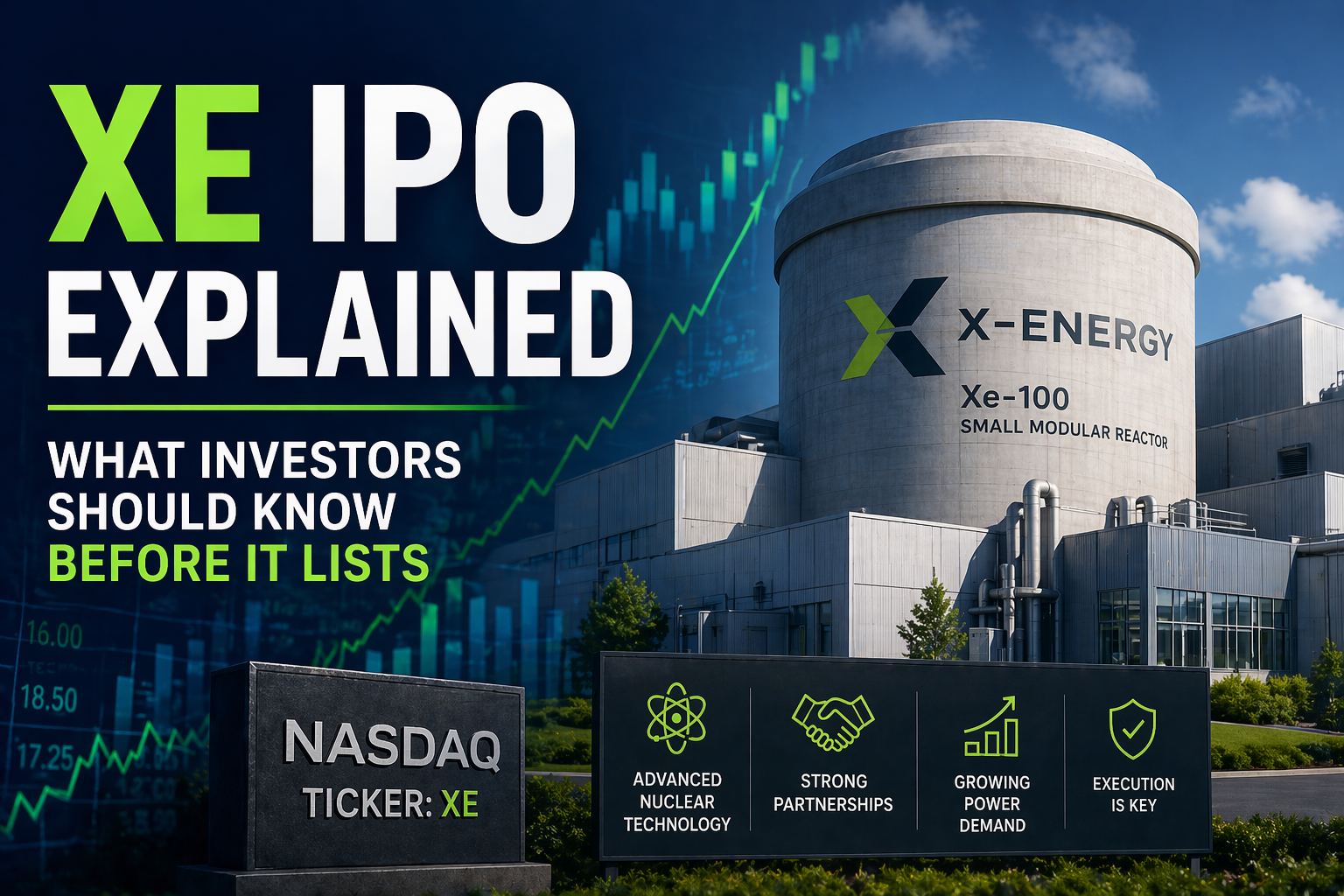
The XE IPO is drawing attention because X-energy is trying to enter public markets before it has delivered its first reactor, but after it has built enough commercial and regulatory momentum to argue that advanced nuclear is moving closer to execution.
On April 15, 2026, X-energy launched a roadshow for 42,857,143 Class A shares at an expected price range of $16 to $19 and said the stock had been approved for listing on the Nasdaq Global Select Market under the ticker XE, subject to final pricing and official notice of issuance.
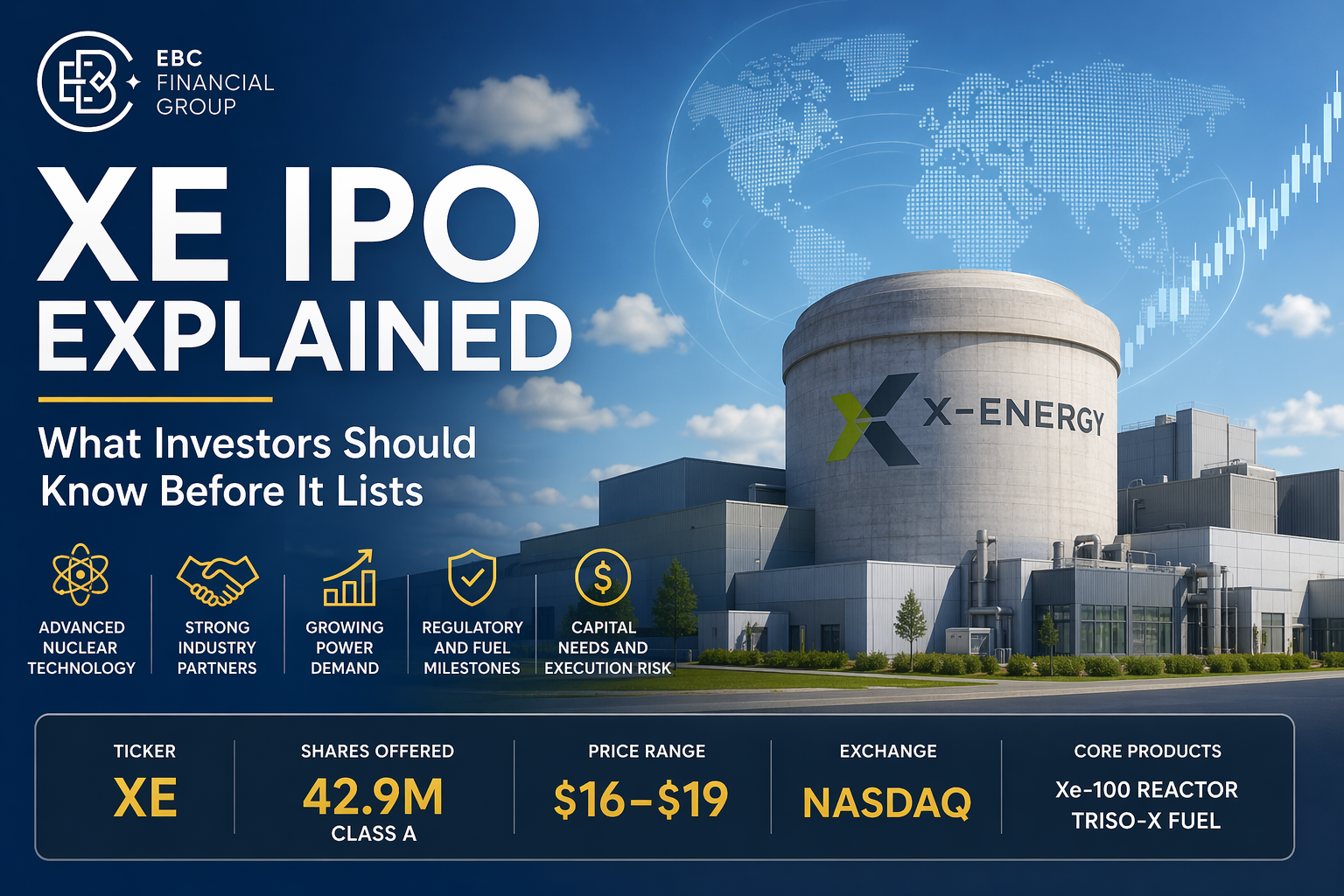
X-energy develops both the Xe-100 reactor and TRISO-X fuel, which gives it a more integrated model than many advanced nuclear developers.
The company is still pre-commercial. It says it has not yet delivered a reactor and has not achieved final investment decisions for any deployment.
X-energy already has credible counterparties, including the U.S. Department of Energy, Dow, Amazon, and Energy Northwest, but current revenue still comes mainly from government and development-stage work.
Capital needs remain central to the story. X-energy ended 2025 with $458.9 million in cash and cash equivalents, but it also says it expects an ongoing need to raise additional capital.
For IPO investors, this is mainly an execution story. Licensing progress, fuel manufacturing, project timing, and future financing matter more than near-term earnings.
X-energy is an advanced nuclear company built around two linked products. The first is the Xe-100, an advanced small modular reactor based on high-temperature gas-cooled reactor technology.
X-energy says each reactor is designed to produce 80 megawatts of electric power or 200 megawatts of thermal output, and that the design is usually deployed as a four-reactor plant producing about 320 MWe. The second product is TRISO-X fuel, which uses high-assay, low-enriched uranium (HALEU) enriched to 15.5%.
X-energy’s model also differs from that of a traditional utility. The company says it does not plan to construct, own, or operate the plants once built. Instead, it expects to earn technology fees, project support fees, long-term service revenue, and fuel revenue.
That matters, but investors should keep one limitation in mind: the filing also states that X-energy has not yet entered into technology or intellectual property agreements with customers, nor has it entered into definitive fuel supply agreements.
The timing reflects stronger demand for firm, carbon-free power, especially from industrial users and large data-center operators. Amazon backed X-energy in a roughly $500 million financing round in October 2024 and said the two companies aim to bring more than 5 GWe online in the United States by 2039.
The first Amazon-backed project with Energy Northwest is planned as a four-reactor, 320 MWe facility in central Washington, with the option to expand to 960 MWe.
The company also has real regulatory and project milestones to point to. The NRC license for the Tennessee fuel facility was issued on February 13, 2026. Dow and X-energy submitted a construction permit application for the Seadrift, Texas project on March 31, 2025.
X-energy also continues to benefit from the U.S. Department of Energy’s Advanced Reactor Demonstration Program, which the filing describes as providing up to $1.2 billion of reimbursement through 2027 on a 50/50 cost-share basis.
The deal is less about monetising a mature operating business and more about funding the next phase of licensing, fuel manufacturing, supply-chain development, and project execution.
The most useful way to read the XE IPO is to separate credibility from completion. X-energy has credible partners, meaningful government support, and a licensed fuel-fabrication path. It also remains a company with no delivered commercial reactor, no final investment decision for any deployment, and significant financing needs ahead.
Source: X-energy launch materials and SEC filing.
Three points stand out from these figures. First, revenue exists, but it is still tied mainly to cost-share agreements, government contracts, and development milestones rather than reactor deployment at scale.
Second, losses and cash burn are substantial, which is normal for a capital-intensive industrial technology business at this stage, but still critical for investors to track. Third, customer concentration is high, so progress or delays with a small number of counterparties can move the story quickly.
Investors should pay particular attention to capital needs. X-energy says it expects continued operating losses, higher capital expenditure needs, and an ongoing need to raise additional capital.
The upside case is that licensing milestones stay on track, the Dow project advances cleanly, the Amazon and Energy Northwest relationship leads to repeatable deployments, and TRISO-X becomes a real fuel advantage. In that outcome, X-energy could start to look less like a development-stage company and more like a long-duration platform business.
The base case is slower. Revenue grows in steps, capital needs remain high, and the market values XE as a long-horizon energy-transition name rather than a near-term earnings story. That still leaves room for upside, but only if execution remains steady and financing stays available on reasonable terms.
The risk case is straightforward. Permitting slips, project costs rise, fuel manufacturing takes longer than planned, or new capital is raised on weak terms. If that happens, the market could stop valuing X-energy as a future platform and start treating it mainly as a cash-hungry promise.
Not really. X-energy has revenue, but it is still a development-stage business. The case depends much more on licensing progress, project execution, and fuel commercialisation than on near-term profitability.
The fuel business matters because X-energy is trying to sell both the reactor and the recurring fuel supply. That can improve customer lock-in and long-term revenue visibility, but investors should keep in mind that definitive fuel supply agreements are not yet in place.
Execution risk is the main issue. X-energy still needs to move from development to delivery while managing licensing, cost control, supply-chain expansion, and future financing.
The most important signals are regulatory milestones, progress at the Dow and Washington projects, development of the Tennessee fuel facility, and whether future capital can be raised without excessive dilution.
The XE IPO gives public-market investors exposure to advanced nuclear, but it is still an early-stage industrial investment. X-energy has a differentiated reactor-plus-fuel model, credible partners, and real regulatory progress. It also has no delivered commercial reactor, no final investment decision for any deployment, and ongoing funding needs.
For readers comparing nuclear energy stocks, X-energy falls at the high-risk end of the sector. This IPO is best viewed as a long-duration execution story, not a conventional growth-stock listing.