Published on: 2026-03-25
Updated on: 2026-03-25
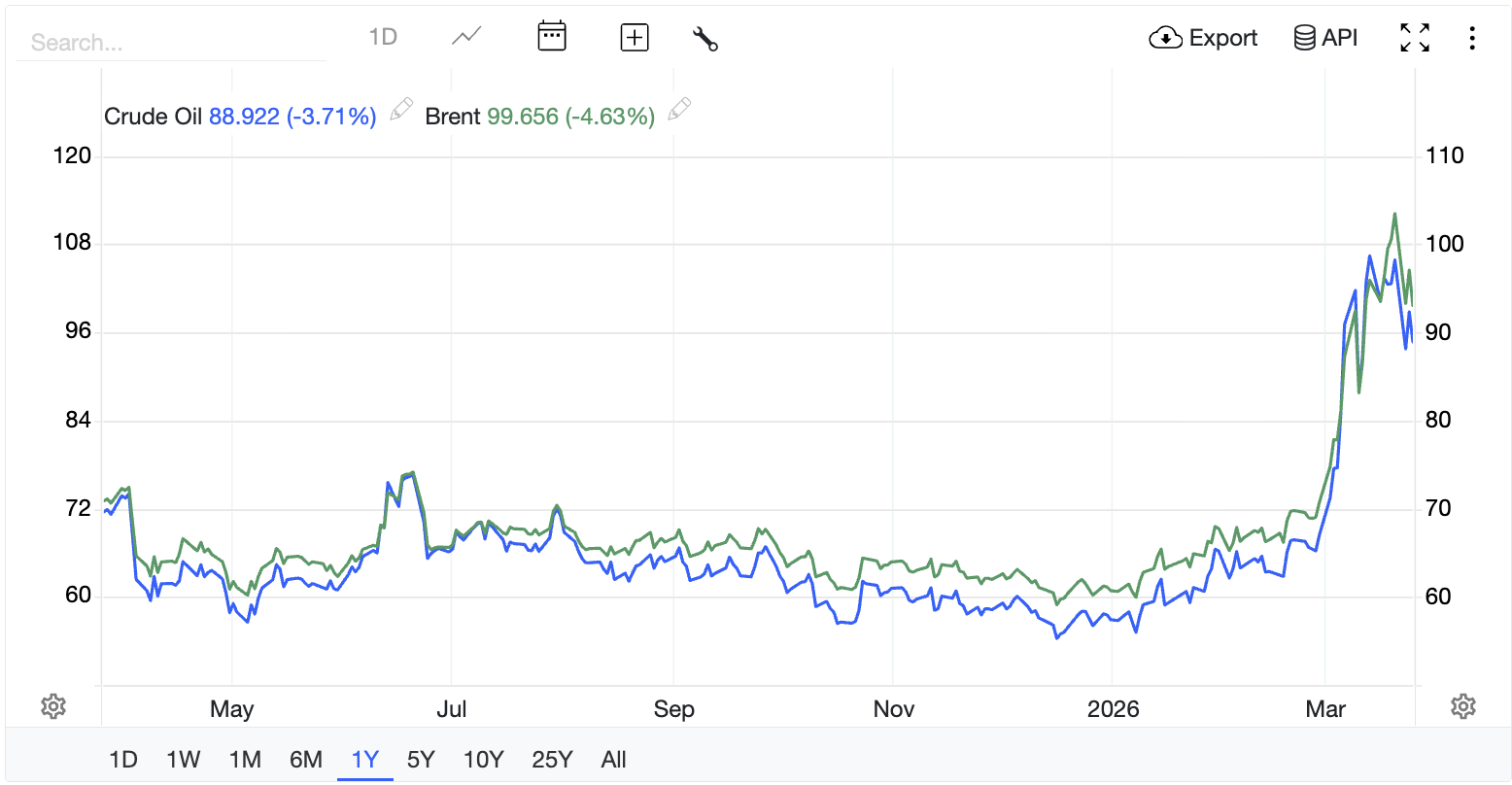
Brent crude fell about 6% to $98.28 a barrel, and WTI dropped roughly 5% to $87.61 after reports that the US had sent Iran a ceasefire proposal through Pakistan, cutting some of the war premium tied to the Strait of Hormuz.

As such, geopolitical factors, rather than inventory levels, mainly drove today's decrease in oil prices. The market reacted to a lower perceived risk of a prolonged shipping disruption through the world's most important oil chokepoint.
The next things to watch are whether diplomacy leads to genuine de-escalation, improves tanker traffic and insurance conditions, and whether the EIA inventory report confirms any near-term changes in the balance.
| Snapshot | Detail |
|---|---|
| Oil price move | Brent fell 6% to $98.28; WTI fell 5% to $87.61. |
| Catalyst |
Reports of a US ceasefire proposal to Iran, which eased fears of a prolonged Hormuz disruption. |
| Supply or demand signal |
Supply-risk easing. The market marked down the probability of a sustained interruption in Gulf exports and shipping. |
| One-line takeaway | Oil fell because traders priced out part of the Hormuz risk premium, not because they suddenly saw stronger supply or weaker demand in |
Oil prices fell because the market saw a lower chance of a drawn-out supply shock through the Strait of Hormuz after the ceasefire headline.
That matters because Hormuz carries more than one-quarter of global seaborne oil trade and about one-fifth of global oil and petroleum product consumption, so even a small improvement in perceived transit risk can knock a large geopolitical premium out of Brent.
The reaction also aligns with how crude had been trading earlier in the month. Prices had surged toward $120 amid fears of a lasting disruption to Gulf exports. Still, they had already shown a tendency to reverse sharply whenever traders believed the conflict might not damage physical oil flows for long. That is exactly what happened again here.
The best read on this move is that traders were not pricing in peace; they were pricing in a shorter disruption window. Oil does not need a full ceasefire to fall. It only needs the market to believe that the probability of a prolonged shipping freeze, broader infrastructure damage, or deeper producer shut-ins has decreased.
That is why the headline mattered less than the transmission path behind it. The EIA says the Strait is not physically blocked. Still, threats and insurance problems have kept most tankers away, and it warns that if reduced vessel traffic persists, storage behind the chokepoint will fill, and producers will have to shut in even more oil.
In other words, the key variable is duration. The ceasefire story lowered the perceived duration of the disruption, so Brent lost its premium quickly.
For now, this looks more like a repricing of excess geopolitical premium than a full bearish reset in oil. Brent crude oil prices, currently near $98, remain significantly higher than the approximately $92 level mentioned in the IEA's March market report and above the EIA's forecast of a $91 average for the second quarter of 2026.
It suggests that although some market concerns have lessened, not all issues have been resolved.
The near-term path depends on proof, not headlines. If traders see better tanker movement, lower insurance friction, or a durable diplomatic channel, the selloff can extend. If talks stall or new attacks revive concern about Gulf exports, the war premium can rebuild quickly.
The next scheduled checkpoint is the EIA Weekly Petroleum Status Report, due today, March 25, but for crude, shipping, and diplomacy still matter more than US stock changes.
On one side, yes: the earlier rally was built on a very real supply threat. The IEA reported that oil flows through Hormuz had decreased from approximately 20 million barrels per day (mb/d) before the war to nearly nothing.
Gulf countries reduced total oil production by at least 10 million barrels per day, leading to Brent crude prices surging to nearly $120 before returning to lower levels. That means the market had plenty of premium to remove once a credible de-escalation path appeared.
On the other side, the risk is not gone. The EIA states that nearly 20% of the global oil supply usually passes through the Strait of Hormuz and anticipates near-term production shut-ins, along with a lasting risk premium, until transit operations are fully restored.
| Instrument | Level / Zone | What it means |
|---|---|---|
| Brent | $97–$98 | First support zone; aligns with today’s selloff area and latest quoted level near $97.85 |
| Brent | Low-$90s (~$92) | Next downside area if Brent breaks below $97–$98 |
| Brent | $100 | First psychological resistance |
| Brent | $103–$105 | Next resistance zone above $100 |
| Brent | Above $110 | Would suggest the market is rebuilding a larger disruption premium |
| Brent-WTI spread | More than $11 | Shows Brent has been carrying more of the geopolitical risk premium |
For Brent, the key near-term support is $97 to $98. If that zone fails, the next likely downside area is the low $90s, with around $92 serving as a reference point.
On the upside, $100 is the first resistance level, followed by $103 to $105. A move back above $110 would indicate the market is pricing in a more serious disruption premium again.
For WTI, the expectation is that it will remain less sensitive to Brent as long as the market narrative remains centered on seaborne trade and the Strait of Hormuz. The fact that the Brent-WTI spread widened to more than $11 suggests Brent has been absorbing more of the geopolitical stress.
No. The market has priced out some risk, not all of it. The EIA still states that threats and insurance issues have reduced tanker traffic, and it expects a persistent risk premium until flows normalize more clearly.
Brent is the more globally exposed, seaborne benchmark, so it is more sensitive to shipping risk in the Gulf. That helps explain why the Brent-WTI spread widened sharply during the height of the Hormuz scare.
Due to geopolitical supply risks, the market reacted to lower chances of a prolonged disruption in the Hormuz Strait, which is currently more significant for crude oil than the usual weekly inventory fluctuations.
In conclusion, Oil prices today fell because traders cut the geopolitical premium tied to Hormuz after ceasefire reports lowered the perceived risk of a prolonged supply disruption. The real driver was not inventories or demand data, but a reassessment of how long Gulf shipping stress might last.
What matters now is whether diplomacy leads to actual normalization of flow; if it does not, crude oil prices may increase again.
Disclaimer: This material is for general information purposes only and is not intended as (and should not be considered to be) financial, investment or other advice on which reliance should be placed. No opinion given in the material constitutes a recommendation by EBC or the author that any particular investment, security, transaction or investment strategy is suitable for any specific person.