Published on: 2026-04-22
Updated on: 2026-04-22
A stock trades freely all week, then spends the last hour on Friday circling one number as if the tape has stopped moving. Breakouts fail, dips reverse, and the close lands almost exactly at a round strike. That pattern is known as option pinning, and it tends to show up when expiration turns one price level into the most important battleground on the chart.
The effect is more visible now because the U.S. options market has become faster, denser, and far more concentrated in short-dated contracts. More positions are being opened close to expiration, more hedging is taking place late in the session, and more contracts are being settled with little time left to adjust.
That does not mean every Friday close is pinned. It means the mechanics that produce pinning now have more room to show up in plain sight.
Option pinning describes a stock or ETF settling near a strike price as options expire.
The pattern is strongest when open interest is crowded around one strike.
Fridays attract the most attention because weekly expiries and standard monthly cycles still cluster there.
The more important issue is pin risk, which is the uncertainty around whether a near-the-money option will be assigned.
The growth of 0DTE options has made expiration-driven price behavior easier to notice.
Option pinning happens when the strike price begins to matter more than the stock’s broader trend. As expiration approaches, time value fades quickly and the market becomes less focused on where the stock traded earlier in the week.
The question narrows to something much more immediate: will the contract finish in the money, out of the money, or right on the edge?
Once price hovers near a heavily traded strike, multiple decisions start clustering around the same level. Some positions are being closed. Some are being rolled. Some are being hedged. Some are facing exercise or assignment. The stock can then start orbiting the strike instead of moving cleanly away from it.
That is what makes the chart look strange. The market is not dead. It is crowded.
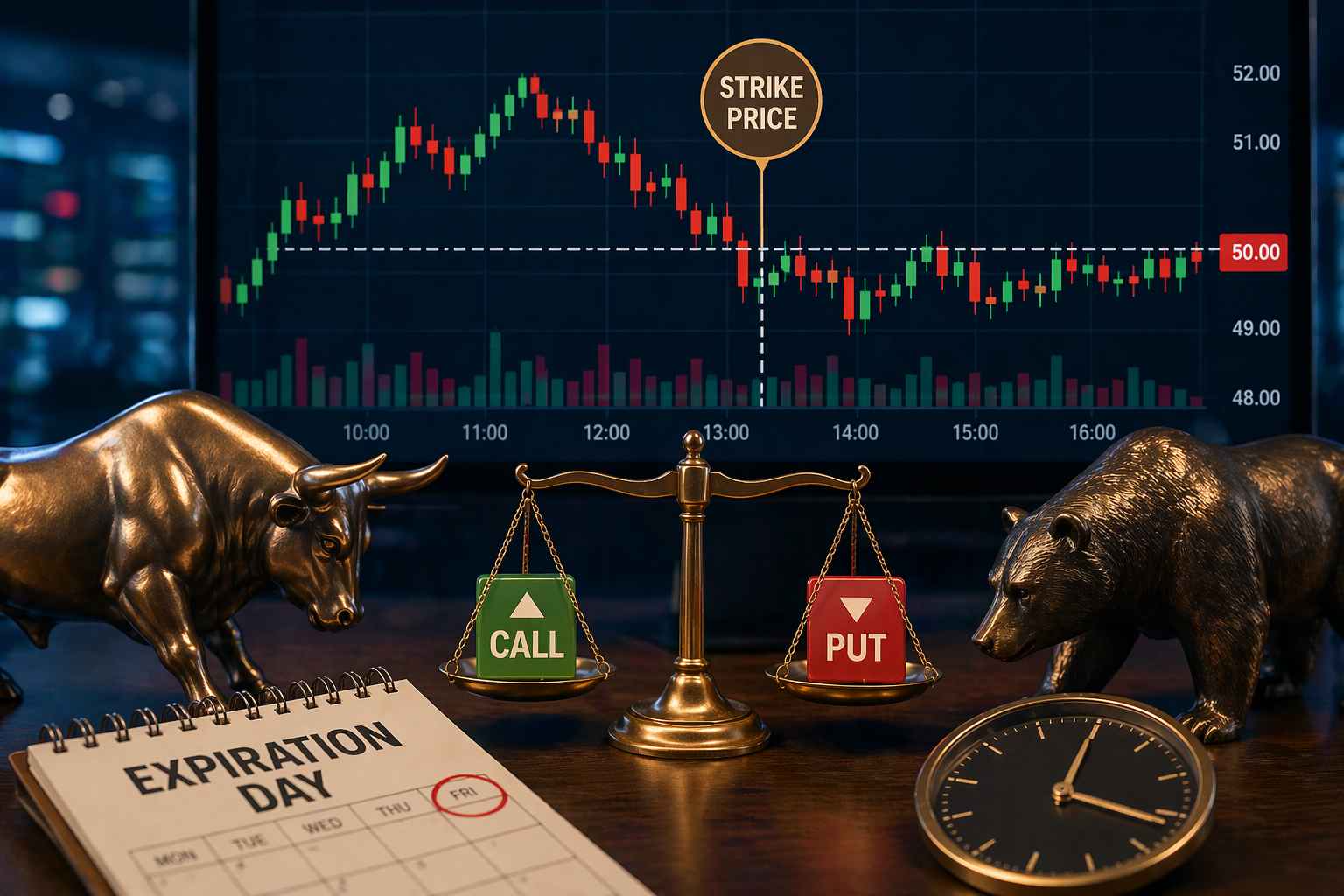
Near expiration, a move of a few cents can have outsized consequences. A close at $50.01 can produce a very different outcome from a close at $49.99. Shares may be delivered, short contracts may be assigned, and the next session may begin with exposure that did not exist before the bell.
That is why a stock pinned near a major strike can feel unusually sticky in the final hour. Price is no longer responding only to directional opinion. It is also responding to settlement mechanics.
Fridays remain the classic setting for option pinning because so much expiration activity still gathers there. Weekly options are commonly listed with Friday expiries, and standard monthly equity options still revolve around the third Friday of the month. That calendar structure gives late-Friday trading a different character from the rest of the week.

By the final stretch of the session, a stock near a popular strike may stop trading like a clean expression of fresh conviction. It starts trading like a line that cannot be crossed easily without changing who gets exercised, who gets assigned, and who must hedge again.
The short-dated options boom has made pinning more visible. A much larger share of trading now sits in contracts with very little time left. That compresses more activity into the last few hours of the session and makes strike-level behavior stand out more clearly on intraday charts.
In practical terms, the market now has more situations where price is pulled toward a settlement zone instead of pushed by a broad directional theme. The phenomenon is not new. The conditions that make it easy to observe are stronger than they used to be.
A useful way to frame option pinning is to imagine a stock trading near a major $50 strike into expiration.
If the stock rises:
some short calls move closer to assignment
hedges may need to be adjusted
traders closing positions can add friction to further upside
If the stock falls:
the same process can develop on the other side
put exposure becomes more relevant
near-the-money contracts become harder to classify cleanly
Instead of a smooth move away from the strike, price keeps snapping back toward the same level. That is the “freeze” many charts show late on Fridays. It is not always dramatic. Sometimes it appears as a slow orbit rather than a violent rejection. The effect is still the same. The strike becomes the center of gravity.
The chart pattern gets attention, but pin risk is what gives the subject real importance. Pin risk refers to the uncertainty that exists when price closes near the strike and it is not clear whether a short option will finish in the money and be assigned.
That uncertainty matters because a few cents can change the entire outcome of the position. A calm-looking close can still produce a materially different account after expiration processing is complete.
whether shares are delivered or called away
whether a short put becomes long stock
whether margin requirements shift overnight
whether the next session opens with exposure that was not planned
That is why option pinning belongs in risk management, not just chart commentary.
Option pinning usually appears through a cluster of signs rather than one clear signal.
repeated reversals around the same round-number strike
breakouts that fail quickly late in the session
price hovering near at-the-money contracts instead of trending decisively
a final print that lands very close to a heavily watched strike
weekly or monthly expiration in the background
None of these signs proves pinning by itself. Together, they describe a market being shaped by expiration mechanics rather than by a straightforward directional move.
Option pinning is not a guarantee that price will close at the strike with the largest open interest. It is not proof of manipulation. It is not a rule that overrides news, flow, or fundamentals.
A strong catalyst can break the effect quickly. A stock can gap away from a popular strike and never look back. Some expiries pass with little visible pinning at all. The pattern appears when expiration, positioning, and hedging pressure all converge around the same level at the same time. When that convergence fades, so does the pin.
Option pinning happens when a stock or ETF closes near a popular strike price as options expire, often because hedging and assignment decisions cluster around that level.
Fridays matter because many weekly options expire then, while standard monthly equity options also center on Friday expiration cycles.
Pin risk is the uncertainty over whether a near-the-money option will be exercised or assigned when the stock closes very close to the strike price.
Option pinning sits at the intersection of price, time, and settlement. A stock that looks frozen near a strike price is often reflecting expiration mechanics rather than a lack of activity. The market has not stopped moving. It has narrowed its focus to one level that suddenly matters more than all the others.
In a market where 0DTE and other short-dated options now carry far more weight, that behavior has become easier to see and more relevant to how late-session price action is interpreted. The odd Friday close is no longer just a quirk of the tape. It is a visible sign of how modern options markets resolve risk.